

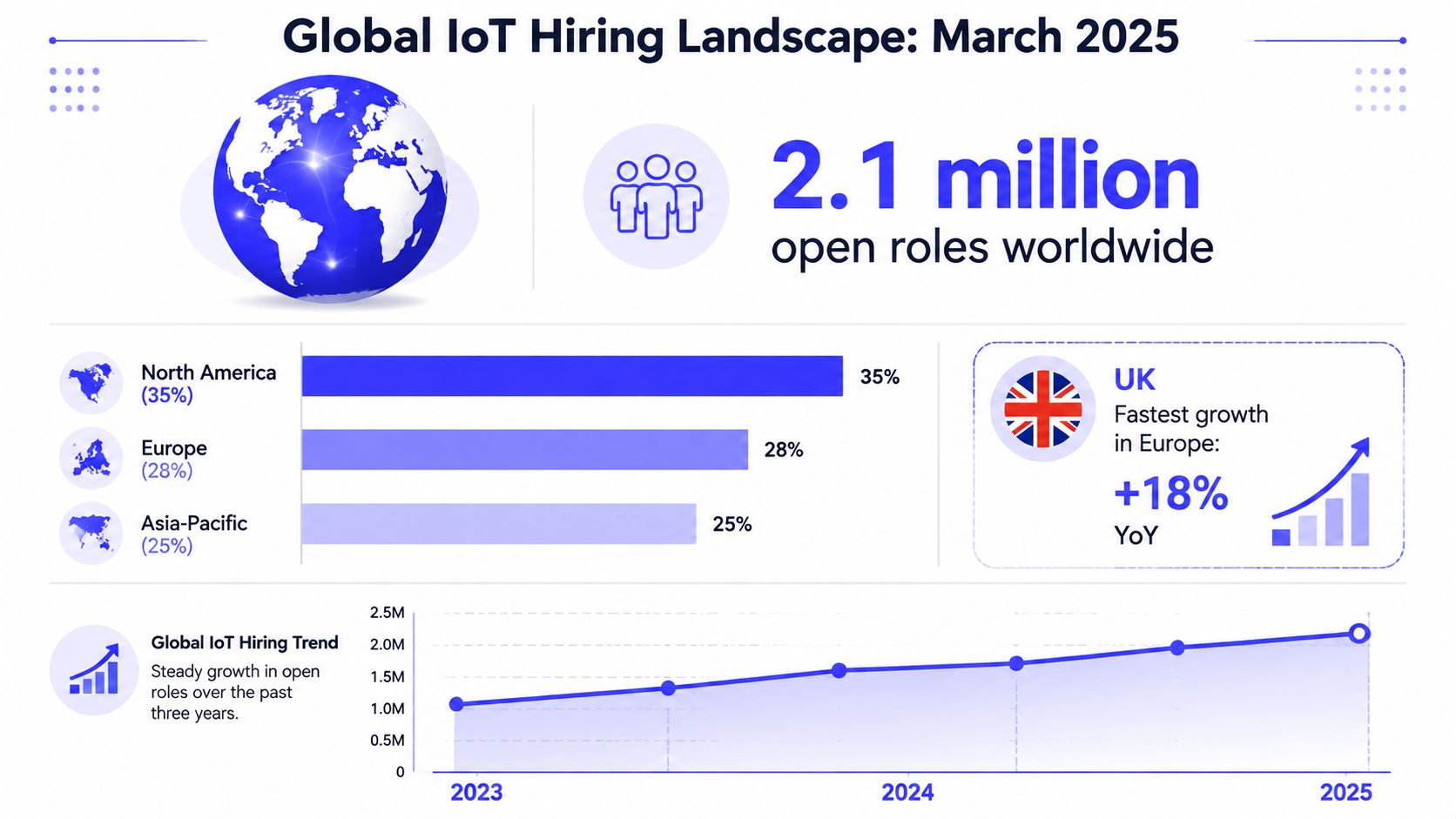
Nearly 23,000 new IoT jobs were posted worldwide in March 2025, and 53,181 openings were still active. That's not a niche hiring blip, it's a market where strong candidates are getting pulled across device, cloud, security, and data work at the same time.
Why Internet of Things Jobs Are a Distinct Hiring Market
Internet of things job hiring does not behave like generic software hiring. The market is narrower, more technical, and more cross-functional, because the work starts with a physical device and ends with a software system that has to stay reliable in the physical world.
The hiring volume backs that up. In March 2025, nearly 23,000 new IoT jobs were posted, 19,224 roles closed, and 53,181 listings stayed active, which points to sustained demand rather than a short-lived posting spike global IoT hiring data, March 2025 job volume. By May 2025, 20,436 IoT roles were filled in a single month, the highest closure level in that series, so employers were absorbing talent quickly instead of leaving roles open.
The UK shows the same pattern in a smaller but still meaningful specialist market. Over the 6 months to 7 August 2026, there were 417 permanent IoT jobs, equal to 0.40% of all permanent jobs, down from 719 roles and 0.86% a year earlier, yet the median annual salary was £55,000 and the 75th percentile was £75,000 UK IoT job market data. That combination tells you two things. IoT is no longer a novelty category, and employers still pay for people who can bridge embedded systems, connectivity, deployment, and operations.
Practical rule: If a candidate only describes themselves as “embedded” or “Python,” they're underselling what IoT teams need. The stronger story is translation across the device, cloud, security, and reliability layers.
That is why an internet of things job is best understood as a translation problem. You are turning a physical-world outcome into a measurable system, then making the device, network, backend, and support workflow all line up. Faberwork's note on reducing risk with IoT fits that reality, because risk rises fast when teams build hardware first and only later think about failure modes, observability, and scale.
The Five Core IoT Role Families Explained
The cleanest way to read IoT hiring is to stop treating job titles as one flat pile. In real teams, five role families show up again and again, and each one owns a different part of the stack.
Embedded and firmware engineer
This person owns the code that runs on the device. They work close to hardware, usually in C/C++, and they care about memory, power, timing, boot behavior, and device reliability. Common adjacent titles include firmware engineer, embedded software engineer, and device software engineer.
Edge ML engineer
This role sits between the device and the cloud. The engineer pushes lightweight inference or signal processing onto gateways or local hardware, often to reduce latency or bandwidth use. You'll see titles like edge AI engineer, embedded ML engineer, and gateway software engineer.
IoT cloud and platform engineer
This is the fleet and backend owner. They build device management, APIs, telemetry ingestion, provisioning, and operational tooling. Job boards often label this as IoT platform engineer, cloud IoT engineer, backend IoT engineer, or platform software engineer.
IoT security specialist
This role protects the fleet, the network, and the device lifecycle. It's not just app security. It includes identity, patching, secure boot, access control, and policy enforcement across connected devices. The job titles often include IoT security engineer, product security engineer, or security architect.
IoT data engineer
This person makes device data usable. They build pipelines, normalize telemetry, manage event streams, and feed analytics or operational dashboards. Common titles include data engineer, analytics engineer, and telemetry engineer.
| Role Family | Primary Stack | Owns |
|---|---|---|
| Embedded and firmware engineer | Device software, hardware interfaces | Device behavior, stability, and power efficiency |
| Edge ML engineer | Local inference, gateways, edge runtime | On-device or near-device intelligence |
| IoT cloud and platform engineer | Backend services, APIs, fleet tooling | Device onboarding, telemetry, and operations |
| IoT security specialist | Identity, policy, device hardening | Fleet protection and secure lifecycle management |
| IoT data engineer | Pipelines, event streams, dashboards | Usable telemetry and operational data flow |
Senior candidates stand out when they can explain handoffs. If they can't tell you who owns provisioning, OTA updates, or telemetry cleanup, they probably haven't worked on a real connected product yet.
A practical filter helps. If the job is about one device line, start with embedded. If the job is about a fleet, start with platform and security. If the job is about turning raw device signals into decisions, start with data. That's the split that matters on day one.
Skills, Languages, and Protocols That Matter
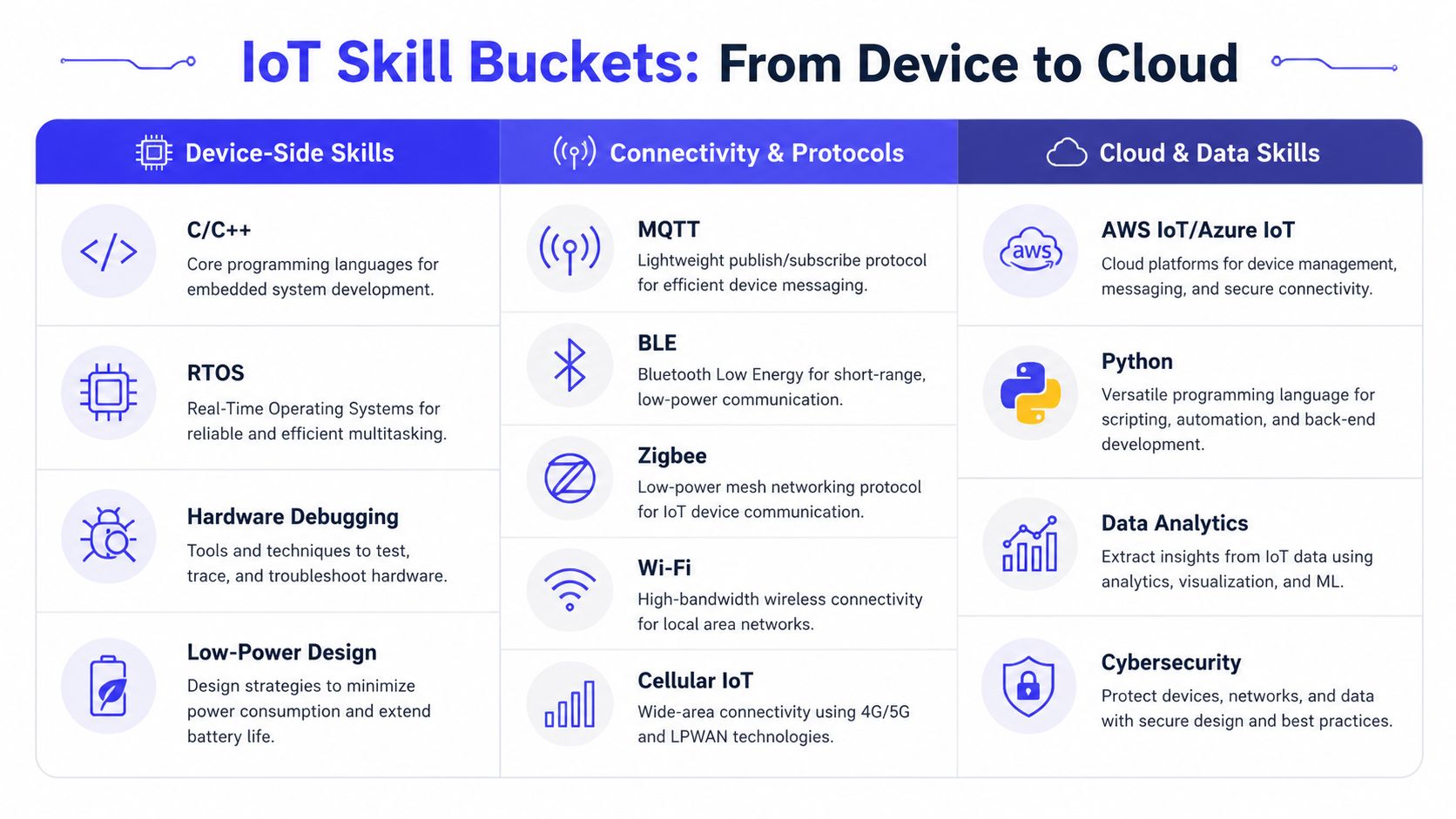
IoT hiring splits cleanly into three buckets, and teams make bad hires when they pretend one bucket covers the others. A firmware engineer and a cloud engineer may both say they “work in IoT,” but their day-to-day work is not the same.
Device side
On the device side, C/C++ is the language family that comes up again and again, because firmware needs tight control over memory and timing IoT systems careers guide. RTOS, hardware debugging, and low-power design matter because the device lives under battery, compute, and physical limits. If a candidate cannot talk about serial logs, firmware build flow, or power trade-offs, they are not ready to own the device layer.
Connectivity and protocols
Protocol choice is not decoration, it shapes the product. MQTT, HTTP, BLE, Zigbee, Wi-Fi, and cellular IoT all fit different latency, bandwidth, and power profiles IoT systems careers guide. Many candidates oversell their range. They have used one protocol in one project, then act like that proves platform breadth.
Cloud and data
Cloud-side IoT work usually adds Python, Java, or JavaScript for APIs, pipelines, and device services IoT systems careers guide. It also pulls in device management, telemetry, and over-the-air, or OTA, update pipelines. If a team expects the engineer to own the fleet, cloud skills are not optional.
The cleanest example is an OTA firmware update. The device engineer has to make the firmware accept a signed package safely. The platform engineer has to stage, target, and monitor the rollout. The security specialist has to make sure the update path is trusted. One feature, three layers.
In a telematics-heavy setup, Fleetalyse's telematics workflow for haulage is a good reminder that protocols and data handling are business choices, not just technical ones. The right choice depends on how often you need to move data, what failures you can tolerate, and how much power the device can spare.
Priority checklist for candidates
- Must have: one device language, one protocol family, and one cloud stack.
- Nice to have: experience with OTA, fleet monitoring, or edge inference.
- Red flag: only app-layer skills, no view of device constraints.
- Hiring signal: can explain how the same feature changes across device, network, and backend.
IoT Salary Ranges and What Drives the Numbers
IoT pay is set by stack ownership, production risk, and how narrow the role is. If an engineer only touches one layer, the market pays for that layer. If the role spans device, cloud, security, and fleet reliability, the number moves up fast. For UK roles, UK salary data for IoT jobs points in the same direction as the broader market: salaries rise as the work gets closer to live systems and harder to replace.
That gap matters for hiring and for candidates. Junior embedded hires usually land lower because they contribute to one subsystem. Senior platform, security, and fleet engineers command more because they carry more production risk and need to coordinate across teams. The strongest premium shows up in security, edge systems, and large-scale device operations, where mistakes are expensive and hard to unwind.
What the market is really paying for
Job-board medians mostly reflect permanent roles in larger markets. They do not capture equity, bonuses, or contract premiums, so hiring managers should not treat them as a ceiling. Candidates should not treat them as a promise either. Real compensation moves with device complexity, domain risk, and whether the product sits in regulated or safety-sensitive environments.
For budget planning, use a simple rule. If the role is mainly implementation on one layer, pay for that layer. If the role owns the device-to-cloud handoff, budget like a senior generalist. If the role spans security and fleet reliability, the premium is justified.
The cleanest way to judge value is by evidence from the work itself. A candidate who has handled firmware, telemetry, and rollout logic has a wider field of impact than someone who has only built an app interface. That is why IoT application development often sits at the center of salary discussions, it ties together device behavior, backend handling, and the failure modes that shape real production risk.
How IoT Teams Are Structured Inside Startups and Enterprises
A 10-person connected-product startup and a 200-person enterprise IoT group don't hire the same way. The startup needs breadth. The enterprise needs ownership boundaries, on-call discipline, and stronger controls around fleet behavior.
Startup team
A small team usually starts with one strong generalist, one embedded-focused engineer, and one cloud or platform engineer. The founder or product lead often drives scope, while the engineers handle device decisions, provisioning, and the first telemetry path. That works until the product grows enough that support tickets, rollout failures, and backend issues start competing with feature work.
Enterprise team
A larger enterprise group usually splits into device, platform, security, and data responsibilities. Reporting lines get clearer, and on-call becomes a real expectation. At that point, hiring a specialist too early is fine, but hiring only specialists before the platform exists is wasted money.
One rule I use with clients is blunt.
Don't overbuild firmware before your cloud pipeline is ready. If you can't observe the fleet, you can't safely scale the device layer.
That's why role order matters. For a new connected product, hire for end-to-end flow first, then add depth. For an enterprise fleet, hire for observability and security before the next device launch. If you get the sequence wrong, you create rework that eats both time and trust.
For product teams trying to map that structure into application work, IoT application development is the adjacent discipline to watch, because the application layer is where device data turns into business value.
Where IoT Demand Is Growing Right Now
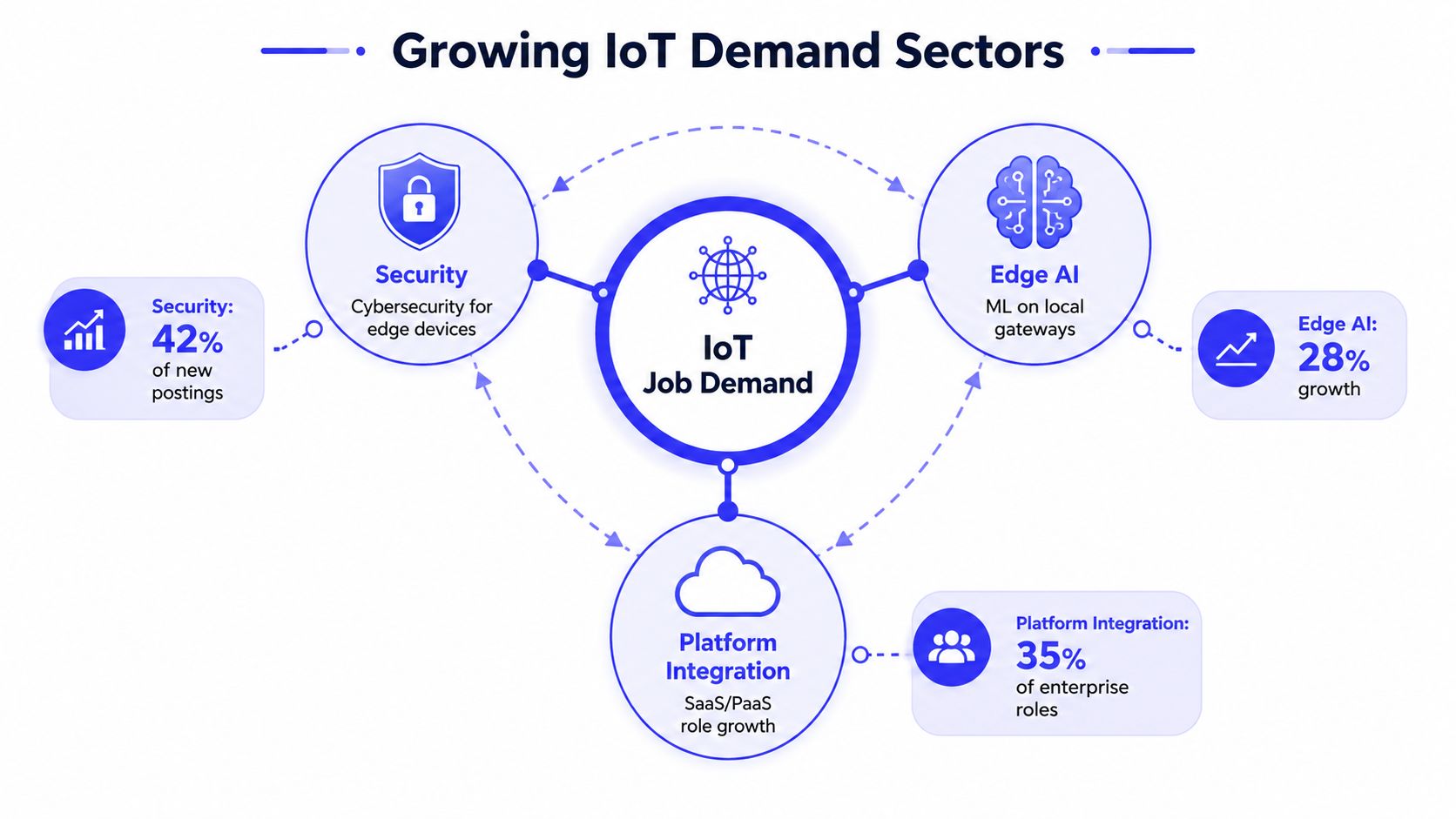
The easiest hiring mistake is treating IoT like an embedded-only market. The strongest demand sits where device work meets security, healthcare, industrial systems, and fleet operations, because the hard part is not shipping a device. It is managing, securing, and supporting thousands of them after launch.
That demand shows up in job boards and in the kinds of teams posting openly. Active openings cluster around medical-device work, governance, risk, and compliance security, along with platform roles that can handle device fleets at scale, as seen in Indeed IoT jobs. The pressure is also visible in security specialist roles, network and cloud architect positions, and data-heavy jobs tied to device telemetry and operational monitoring.
Healthcare deserves special attention. Medical IoT pulls in teams that can translate between device behavior, compliance, clinical workflows, and cloud systems, which is why Internet of Things in medical keeps showing up as a separate hiring lane rather than a side project. Candidates who understand device reliability, data handling, and security controls have a clearer path here than candidates who only know firmware syntax.
The hiring takeaway is blunt. If you want to get hired, focus on security, fleet observability, or platform integration. If you are hiring, fund those lanes first, because they decide uptime, trust, and scale. Teams that cannot secure the fleet end up delaying every feature that depends on it.
Interview Questions, Sample JDs, and How to Transition In
A good IoT interview tests systems thinking, not trivia. If the panel only asks protocol definitions, they'll miss whether the candidate can ship and support a connected product.
Sample IoT platform engineer JD
Owns: device onboarding, telemetry ingestion, fleet tooling, and rollout support.
Must be able to: design for device-to-cloud reliability, debug failures across layers, and work with firmware and security partners.
Should know: APIs, event pipelines, device management, and production observability.
Nice to have: OTA rollout experience, regulated-device familiarity, and incident response exposure.
Interview questions that matter
- What breaks first when a fleet hits scale, and how would you detect it?
- How would you design OTA updates so a failed rollout doesn't brick devices?
- What telemetry would you log to separate device failure from network failure?
- How would you secure provisioning for a device that ships in bulk?
Transition paths that actually work
Backend engineers usually transition fastest into platform work if they can show API design, event processing, and operational ownership. Mobile engineers often fit device-facing UX or companion-app roles if they understand intermittent connectivity. Embedded engineers can move into broader IoT roles when they show they can reason about cloud hooks, rollout safety, and supportability.
For a broader interview framework, the question set at interview questions asked by hiring manager is a useful reference point for structuring follow-up rounds. I'd still keep the IoT-specific questions above, because they surface a missing skill that many organizations don't test well, which is cross-layer debugging.
Your 30-60-90 Plan for Hiring or Landing an IoT Role
For hiring managers, spend days 1 to 30 scoping the role around one ownership boundary, then use days 31 to 60 to source and screen for device-cloud fluency. By days 61 to 90, run a pilot and make sure onboarding covers failure recovery, OTA, and observability.
For job seekers, use the same clock. Days 1 to 30 should map your background to one IoT lane, days 31 to 60 should fill the gap in your portfolio, and days 61 to 90 should focus on applications and technical conversations. If you need vetted specialists, ThirstySprout can help teams assemble senior remote talent across software, cloud, and data-heavy technical work.
The macro picture supports moving now. The global IoT market is projected to reach USD 865.20 billion by 2030 at a 9.6% CAGR, after being valued at USD 490.55 billion in 2024 and projected at USD 547.06 billion in 2025 IoT market projection. Don't wait for the next hiring cycle. Scope the role, pressure-test the handoffs, and start the pilot.
If you're hiring for an internet of things job or trying to break into one, ThirstySprout can help you move faster with vetted remote engineers who understand device, cloud, and data work. Visit ThirstySprout to scope a pilot, review sample profiles, and build the team you need without waiting months for the right specialist to surface.
Hire from the Top 1% Talent Network
Ready to accelerate your hiring or scale your company with our top-tier technical talent? Let's chat.