

TL;DR: Your IoMT Action Plan
- Focus on a High-Impact Pilot: Don't try to boil the ocean. Start with a 10-day remote patient monitoring (RPM) pilot for a specific condition like hypertension. This forces focus and delivers fast, measurable results.
- Prioritize a Scalable, Secure Architecture: Use a layered approach (Device, Ingestion, Platform, Application). For most teams, a hybrid model using managed services like AWS IoT Core for ingestion and a custom platform for core logic offers the best balance of speed and control.
- Build a Specialized Team: You need more than generalist software engineers. Hire dedicated Data Engineers for pipelines, ML Engineers for algorithms, and MLOps Engineers to productionize models. These roles are not interchangeable.
- Measure Business Impact: Define clear success metrics from day one. Target both clinical outcomes (e.g., reduce readmissions by 10%) and operational wins (e.g., 95% data transmission reliability) to prove ROI.
- Embed Security from Day One: Compliance isn't an add-on. Implement end-to-end encryption, secure device authentication (mTLS), and a plan for over-the-air (OTA) updates before writing a single line of application code.
Who This Guide Is For
This guide is for the technical and product leaders on the front lines, tasked with bringing a medical IoT solution from concept to a market-ready reality.
This is for you if you're:
- A CTO or Head of Engineering designing a scalable and secure IoMT architecture that can handle real-time patient data.
- A Startup Founder balancing ambitious AI-powered features with the budget and timeline to hire a dedicated development team without costly missteps.
- A Head of AI or Product Lead responsible for transforming noisy sensor data into reliable clinical insights and demonstrating business impact within weeks, not months.
We skip the high-level fluff and focus on the practical frameworks, trade-offs, and team composition you need to make decisions and act quickly.
A 4-Layer Framework for IoMT Architecture
The Internet of Medical Things (IoMT) is a system of connected medical devices, sensors, and software platforms that gather, transmit, and analyze health data in real time. A successful platform isn't just about hardware; it's about the intelligent flow of data through a structured architecture.
A robust IoMT system organizes this flow into four distinct layers. This framework helps you make clear technology choices and ensure data integrity from patient to clinician.
- Device Layer: Where data originates. This includes clinical-grade wearables (CGMs, ECG patches), in-hospital equipment (smart beds, infusion pumps), and remote monitoring devices (blood pressure cuffs, smart scales).
- Ingestion Layer: The secure front door for all incoming data. Its job is to reliably collect massive streams of information from thousands of devices, authenticate them, and funnel data using lightweight protocols like MQTT.
- Platform Layer: The brains of the operation. Here, data is processed, stored, and integrated. It includes data lakes (for raw storage), stream processing engines (for real-time analysis), and connectors to Electronic Health Record (EHR) systems using standards like FHIR.
- Application Layer: Where data becomes useful to a human. This layer powers clinician dashboards, triggers critical alerts, and runs the AI/ML models that predict adverse events. It is the user-facing part of the system where value is delivered.

alt text: Illustration showing various medical data sources, including wearables, sensors, and smartphones, connecting to a cloud-based platform layer for processing and analysis.
The IoMT market is projected to grow from USD 103.66 billion in 2025 to USD 367.33 billion by 2031, driven by a powerful 23.4% CAGR (IoT in healthcare market forecast). This growth is fueled by the clear business value these platforms provide.
Practical Examples of IoMT in Action
The business value of IoMT comes from improving patient outcomes, reducing costs, and increasing operational efficiency. Here are two real-world examples demonstrating how this works.
Example 1: Remote Patient Monitoring (RPM) for Chronic Disease
RPM is the flagship IoMT application, using connected devices to monitor patients outside the hospital. It's a proven method for managing chronic conditions like hypertension and diabetes.
- Scenario: A clinic launches an RPM program for 500 patients with congestive heart failure. Patients are sent home with a Bluetooth-enabled weight scale and blood pressure cuff that syncs to a cellular gateway.
- Devices: FDA-cleared scale and BP cuff. Cellular gateway transmits data via MQTT.
- Ingestion: Data is sent to AWS IoT Core, which authenticates the gateway and routes messages.
- Platform: An AWS Lambda function is triggered by new messages, checks for alert conditions (e.g., weight gain > 3 lbs in 24 hours), and fires an alert via Amazon SNS to the care team's dashboard. Data is stored in an S3 data lake and a FHIR-compliant database.
- Application: A React-based web app provides a dashboard for nurses to review trends and manage alerts.
Example 2: Smart Asset Tracking in a Hospital
Hospitals lose significant time and money searching for mobile equipment like IV pumps and ventilators. IoMT offers a direct solution with a clear ROI.
- Scenario: A 300-bed hospital needs to reduce time spent locating critical equipment and prevent asset loss.
- Devices: Low-power Bluetooth Low Energy (BLE) tags are attached to 1,000 mobile assets (pumps, wheelchairs, etc.).
- Ingestion/Platform: BLE gateways installed throughout the hospital receive beacon signals and forward location data to a central server (on-prem or cloud). The platform uses an indoor positioning system (IPS) algorithm to triangulate the real-time location of each tag.
- Application: A simple web or mobile app displays a floor plan map showing the live location of any tagged asset, searchable by type or ID.
Deep Dive: Trade-Offs, Pitfalls, and Tech Choices
Building an IoMT platform requires making critical decisions about your technology stack and security posture. Understanding the trade-offs is key to avoiding costly mistakes.
Managed Services vs. Custom Stack
When architecting your platform, you face a core choice: use managed cloud services or build a custom stack with open-source tools.
- Use when: Speed to market is critical, and you have a smaller in-house infrastructure team.
- Pros: Faster to implement, built-in security, automatic scaling. Reduces engineering overhead for device management and ingestion.
- Cons: Potential for vendor lock-in, can be more expensive at massive scale, less architectural flexibility.
- Use when: You need maximum control over cost and performance, and you have deep in-house expertise in distributed systems.
- Pros: Complete flexibility, avoids vendor lock-in, can be more cost-effective at extreme scale.
- Cons: Significantly higher upfront development time and cost. Requires a skilled team to manage security, scaling, and reliability.
For most startups, a hybrid approach offers the best of both worlds: use a managed service for the undifferentiated heavy lifting of the ingestion layer but build a custom platform and application layer where your core IP resides. This balances speed with long-term control. A core part of this is ensuring robust data integration in healthcare.

alt text: A diagram showing the business value of IoMT, with improved outcomes at the top, supported by cost reduction and efficiency gains at the base.
The Biggest Pitfall: Neglecting Security and Compliance
In IoMT, security isn't a feature; it's the foundation. A breach doesn't just leak data; it can compromise patient safety and destroy trust.
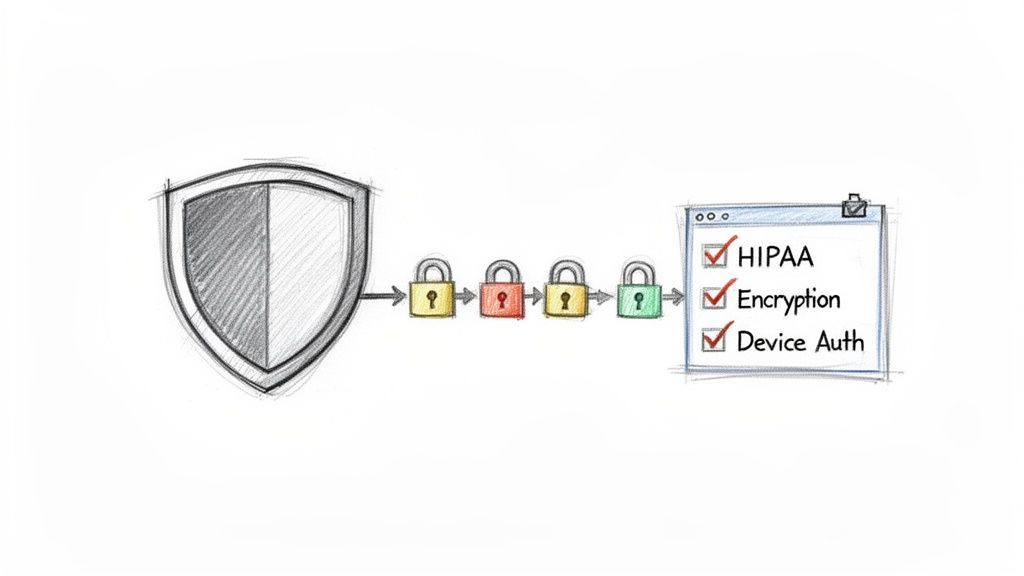
alt text: Illustration of a shield and locks representing the critical need for security and compliance in medical IoT platforms.
A common failure is neglecting firmware security. Your architecture must include a secure and reliable over-the-air (OTA) update mechanism. A device that is secure at launch can become a major liability within months if you cannot patch vulnerabilities in the field. This is non-negotiable.
Checklist: IoMT Security and Compliance
Use this checklist as a starting point to audit your development process and ensure you are building a secure, HIPAA compliance platform. For a deeper dive, see our guide on big data and security.
| Domain | Action Item | Primary Risk Mitigated |
|---|---|---|
| Device Hardware | Implement secure boot to ensure only signed firmware can run. | Unauthorized firmware or malware running on the device. |
| Data Transmission | Use TLS 1.3 and mutual TLS (mTLS) for all device-to-cloud communication. | Eavesdropping and man-in-the-middle attacks. |
| Cloud Platform | Enforce the principle of least privilege with strict IAM roles for all services. | A compromised service gaining access to unrelated data. |
| Application Layer | Implement role-based access control (RBAC) for all clinical and admin users. | Unauthorized access to sensitive patient data. |
| Operations | Establish a formal incident response plan and conduct regular drills. | Delays and confusion during an active security breach. |
| Firmware | Implement a secure over-the-air (OTA) update mechanism for all devices. | Inability to patch critical vulnerabilities in the field. |
What to Do Next: Your 3-Step Action Plan
Translate this guide into action. The path from idea to a working prototype is shorter than you think if you focus on proving value quickly.
1. Scope a 10-Day Pilot
Pick one specific, high-value problem. A tightly scoped pilot, like monitoring post-operative cardiac patients, forces focus and makes it easier to define device needs, data points, and workflows.
2. Define Success Metrics
Before writing any code, agree on what a "win" looks like. For an RPM pilot, this could be a clinical goal ("reduce manual nurse data entry by 15%") and an operational one ("achieve 95% data transmission reliability").
3. Assemble a "Been There, Done That" Team
You don't need a huge team for a pilot, but you need the right experts. The fastest way to validate your concept is to bring in engineers who have deep experience in building IoMT solutions. You will need a mix of Data, ML, and MLOps engineering expertise. You can accelerate this process when you hire a dedicated development team.
Ready to launch your pilot in weeks, not months? Schedule a discovery call with ThirstySprout to connect with a network of vetted AI and IoMT specialists.
References & Further Reading
For building out your team, we've developed a skill matrix and sample interview questions to help you hire the right talent.
IoMT Data Engineer Skill Matrix
An elite IoMT data engineer has experience with high-volume, real-time systems and understands the nuances of Protected Health Information (PHI).
| Core Competency | Desired Experience | Sample Interview Question |
|---|---|---|
| Stream Processing | Apache Kafka, Kinesis, or Flink | "A patient's device sends a heartbeat every second. Describe the architecture you would build to calculate a 5-minute rolling average heart rate for 100,000 active users, ensuring low latency." |
| Data Warehousing | Snowflake, BigQuery, or Redshift | "How would you design a data model in a warehouse to store both raw sensor data and structured EHR data to support clinical research queries?" |
| Healthcare Data | FHIR, HL7v2, and DICOM standards | "We receive patient data in HL7v2 format. What are the key steps and challenges in transforming this data into a FHIR-compliant resource for our API?" |
Related ThirstySprout Resources:
- IoT Development: A Guide to IoT Application Development
- Consumer Wearables: Apple Watch, Fitbit
Ready to build your IoMT pilot with a team that has done it before? ThirstySprout connects you with vetted AI, MLOps, and data engineers who can get your project from concept to a secure, scalable prototype. Start a pilot with us today!
Hire from the Top 1% Talent Network
Ready to accelerate your hiring or scale your company with our top-tier technical talent? Let's chat.