

Nearly 23,000 new IoT jobs were listed globally in March 2025, with 53,181 active openings still on the market and 19,224 roles closing in the same month. That hiring volume matters because connected products now require full delivery teams, not a single generalist with “IoT” in the title.
Good hiring plans start with system boundaries. In production, connected products fail at handoffs: device hardware that is hard to manufacture, firmware that drops connections in the field, cloud pipelines that buckle under noisy telemetry, or apps that expose weak operational tooling. Strong teams assign ownership around those pressure points and hire people who can work across interfaces without creating ambiguity.
Many guides reduce jobs in IoT to a flat list of titles. Real teams are built more deliberately. The useful view is functional: hardware, firmware, cloud, and application. CTOs need that structure to write cleaner job descriptions, build better interview loops, and avoid hiring two partial fits for one real problem. Engineers need it for the same reason. Career progress usually comes from owning one layer well, then learning the adjacent one.
If you are building a connected product, start by identifying where delivery is blocked, then hire for that layer first. If you are trying to break into the field, map your current skills to a specific part of the stack and build proof there, whether that means embedded C, MQTT infrastructure, fleet operations, or IoT application development for user-facing products.
The Modern IoT Team Structure Explained
Engineers make up a large share of IoT hiring, and entry-level openings remain scarce. There are over 7,000 total IoT roles in the US but only 107 listed as entry-level on major platforms (Indeed entry-level IoT job listings). That mismatch matters because connected products do not ship well with vague hiring plans or generalist job titles that try to cover the whole stack.
The teams that perform well in production are usually organized by function, not by a catch-all "IoT engineer" label. In practice, the cleanest model splits ownership across four layers: hardware, firmware, cloud, and application. That structure helps CTOs write tighter job descriptions and build interview loops that test the right work. It also helps engineers pick an entry point based on real skills instead of applying to broad jobs in IoT that ask for everything from PCB bring-up to Kubernetes.
If a company hires without that map, overlap shows up fast. Two people both assume they own provisioning. Nobody owns OTA rollback safety. The mobile team builds customer workflows before the telemetry pipeline is reliable. I have seen all three failure modes in production.
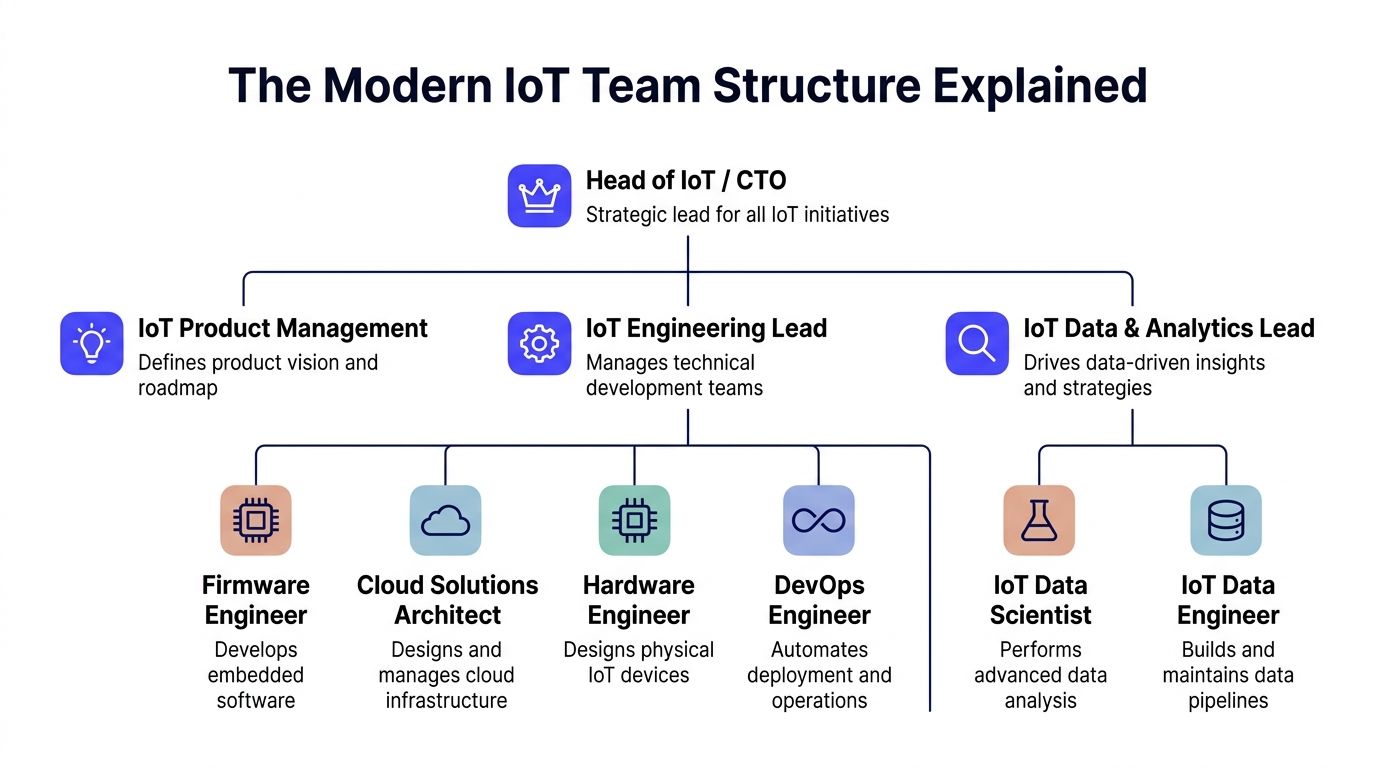
The four layers that matter
Hardware and edge. This layer owns the physical device and its behavior in the field. Work here includes sensor selection, radio choices, power draw, enclosure constraints, manufacturability, and test fixtures. Common roles include Hardware Engineer, Electrical Test Engineer, and Field Systems Engineer. Good hardware hires understand that a part that works on the bench can still fail your product if lead times, thermal behavior, or certification work are wrong.
Firmware and embedded software. This layer makes the device dependable. Engineers here write C, C++, or RTOS-based code, handle provisioning, state management, local fault recovery, connectivity logic, and OTA updates. The hiring trade-off is straightforward. A strong application engineer can often learn device APIs, but very few can quickly learn low-level debugging, watchdog behavior, and memory-constrained recovery paths under field conditions.
Cloud and platform. This layer handles fleet identity, message ingestion, device authentication, storage, workflow execution, and operational tooling. Titles vary by company, but the work usually lands with Cloud Platform Engineers, DevOps Engineers, SREs, or Solutions Architects. This is also where many teams under-hire. They treat cloud as a simple pipe for telemetry, then discover later that retries, duplicates, out-of-order events, and certificate rotation are the actual work.
Application and data. This layer turns raw device behavior into something operators and customers can use. That includes dashboards, mobile apps, alerts, reporting, analytics pipelines, and selective ML work when the data quality supports it. Teams building customer-facing workflows often need close coordination with IoT application development for user-facing products, because the app layer only works well when device states and backend workflows are explicit.
Practical rule: hire the bottleneck, not the broadest title. If devices are failing after deployment, hire firmware or fleet operations. If telemetry arrives but nobody trusts the alerts, fix cloud ingestion or application logic before adding more frontend capacity.
How the layers interact in real delivery
A temperature-monitoring product shows the dependency chain clearly. Hardware selects the sensor, radio, and battery profile. Firmware controls sampling cadence, sleep behavior, buffering, and retries. Cloud handles identity, provisioning, telemetry routing, storage, and control messages. Application teams turn that data into alerts, dashboards, and operator actions.
Each layer has a different failure mode. Hardware mistakes raise unit cost or reduce field life. Firmware mistakes drain batteries or brick devices during updates. Cloud mistakes create noisy data, broken provisioning, or weak fleet visibility. Application mistakes confuse users and hide operational problems that should have been visible on day one.
That is why a functional taxonomy is more useful than a flat list of job titles. It gives hiring teams a way to assign ownership cleanly, and it gives engineers a clearer route into the field by tying skills to one layer first, then to the interfaces around it.
In-Demand IoT Roles and Responsibilities
A large share of IoT hiring still clusters around engineering and automation work. That tracks with what teams struggle to ship. The hard part is rarely coming up with a title. It is assigning clear ownership across device behavior, fleet operations, cloud reliability, and the application logic people use every day.
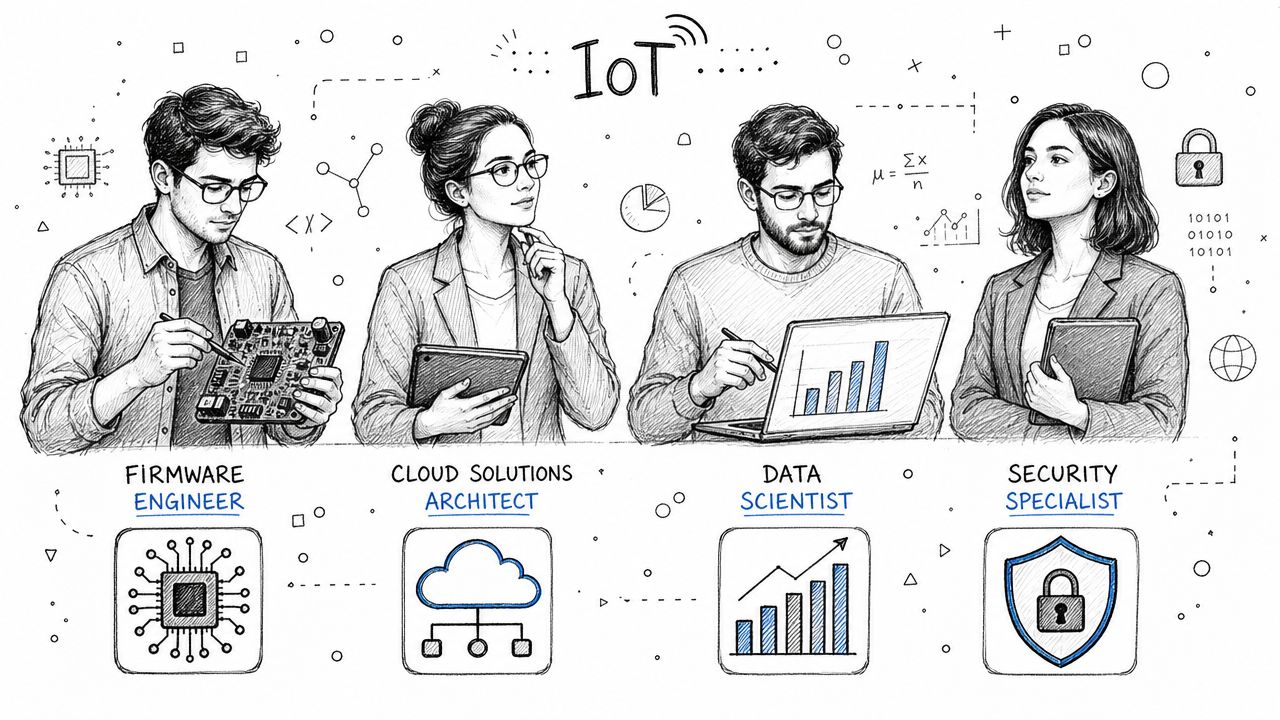
For CTOs, a functional taxonomy helps. For engineers, it gives a cleaner entry path. A candidate with strong RTOS and power-management experience is not competing for the same job as someone who has spent five years building ingestion pipelines and device identity systems. Both are in IoT. They solve different failure modes.
IoT firmware engineer
Firmware is still the hire that saves products from expensive field mistakes. These engineers work under hard constraints. Battery life, flash wear, intermittent connectivity, sensor timing, and bad recovery logic all show up here first.
Typical responsibilities include:
- Device lifecycle ownership including boot flow, local state, watchdog behavior, brownout recovery, and OTA update safety
- Protocol implementation for MQTT, CoAP, Bluetooth, Zigbee, or proprietary transports used on constrained devices
- Field diagnostics through logs, metrics, retry counters, crash traces, and fallback states that survive real deployment conditions
- Hardware coordination when board revisions, RF behavior, power rails, or sensor quirks force firmware changes
The hiring mistake I see often is treating firmware as embedded app development. It is systems work. A solid firmware engineer can explain why a retry loop drains a battery, why an ISR design causes missed samples, and why update rollback logic matters more than feature velocity once a fleet is live.
Mini-case: a battery-powered environmental sensor can pass bench tests and still fail in the field because the radio wakes too often, reconnect logic is noisy, or flash writes happen in the wrong pattern. Good firmware engineers catch those trade-offs before rollout. Great ones also expose enough device telemetry for cloud and support teams to diagnose failures later.
IoT cloud solutions architect
This role determines whether the fleet stays operable after the first serious scale-up. The architect owns the control plane, the telemetry path, and the operational rules that keep devices manageable when networks are unstable and customers need updates now, not next quarter.
A strong architect usually owns:
| Responsibility | What good looks like | Business impact |
|---|---|---|
| Device onboarding | Secure, repeatable provisioning with clear revocation and rotation paths | Faster rollout, lower support cost |
| Message routing | Topic and event design that supports retries, replay, and downstream isolation | Fewer lost events, cleaner integrations |
| Fleet operations | OTA rollout controls, state sync, failure segmentation, and rollback paths | Lower field risk |
| Data path design | Storage, retention, and processing chosen for actual product use cases | Lower waste, clearer analytics |
The best architects demonstrate their value by knowing what to keep off the network, what to process at the edge, and which failure modes operators will face at 2 a.m. They also understand system boundaries. For example, if a product needs controlled physical entry, a cloud workflow may need to call a gate access API as part of device-triggered actions or operator approvals. That is an application and integration decision as much as an infrastructure one.
Mini-case: if every raw sensor event goes straight into expensive downstream processing, cloud cost rises and alert quality drops. If the architect sets up edge filtering, sane retention rules, and separate paths for operational versus analytical data, teams get signals they can act on.
IoT data engineer or data scientist
This role starts paying off once telemetry supports a business decision, not just a connectivity status page. Industrial teams use it for anomaly detection, maintenance planning, throughput analysis, and quality control. Consumer teams use it for product health, support diagnostics, and behavior patterns that inform feature work.
Useful data work in IoT has a narrow definition:
- Pipelines produce trustworthy event streams with versioned schemas and clear handling for duplicates, delays, and null values
- Analysis reflects field reality including packet loss, device resets, clock drift, and inconsistent sampling windows
- Models fit deployment constraints such as limited labels, weak edge hardware, and operators who need explanations, not just scores
A data scientist who ignores device behavior usually produces models that look good in notebooks and disappoint in production. A practical one works backward from decisions in the field. What should trigger a truck roll? What should open a ticket? What should stay as a dashboard trend and never become an alert?
Automation and systems roles
This category gets less attention in generic IoT career guides, but it is where many deployments succeed or stall. Integration engineers, control systems specialists, technical automation consultants, and industrial platform engineers connect the digital stack to real equipment, real facilities, and real maintenance workflows.
Their responsibilities often include:
- PLC, SCADA, or industrial protocol integration
- Site commissioning and device acceptance testing
- Edge gateway setup and local failover behavior
- Cross-system workflows between sensors, alarms, maintenance tools, and business systems
These roles matter because a working demo is not the same as a reliable deployment. In industrial and building systems, the strongest hire is often the person who can trace a fault from sensor wiring to gateway config to message broker behavior without guessing.
For hiring teams, the takeaway is simple. Stop treating "IoT engineer" as one job description. Split the need by function: hardware-adjacent firmware, fleet and cloud architecture, telemetry and analytics, or automation and systems integration. That produces better job specs, better interview loops, and better hires.
Essential Skills and Certifications for IoT Talent
About 70 percent of IoT projects stall before they reach scale, and the pattern is familiar. Teams hire for a single specialty, then run into failures at the handoff between device, network, cloud, and application layers. In practice, the strongest IoT talent is usually mapped to a clear function first, then evaluated on how well they work across neighboring layers.
For CTOs, that means writing role-specific scorecards instead of searching for a mythical engineer who does everything. For engineers trying to enter the field, it means choosing a lane, then building enough adjacent knowledge to ship real systems without creating problems for the next team in the chain.
The skill matrix that actually matters
I use a simple hiring test. Can this person explain their own layer in detail, and can they predict what breaks at the boundary with the next one?
That is the difference between someone who can contribute to a prototype and someone you can trust with a production fleet.
Here's the matrix I'd use for hiring and career planning:
| Layer | Core skills | What to verify in interviews |
|---|---|---|
| Embedded | C/C++, RTOS, interrupts, memory limits, power management, OTA safety | Can they explain boot flow, failure recovery, watchdog use, and battery trade-offs? |
| Connectivity | MQTT, CoAP, AMQP, BLE, Zigbee, LTE-M, NB-IoT | Do they know how protocol choice changes latency, payload size, retry behavior, and cost? |
| Cloud | Python, APIs, queues, device registries, Kubernetes, AWS IoT or Azure IoT services | Can they design idempotent ingestion, provisioning flows, and safe rollout controls? |
| Data | SQL, time-series modeling, schema evolution, observability, stream processing | Can they handle duplicates, missing telemetry, bad clocks, and noisy devices? |
| Security | Device identity, key storage, certificate rotation, authz, secure boot, patching | Do they reason clearly about blast radius, field recovery, and compromised devices? |
The matrix is functional by design. A firmware engineer does not need to become a cloud architect. A cloud engineer does need to understand what an unstable radio link, limited flash, or a failed certificate rotation looks like on the device side.
What senior teams look for
Senior IoT engineers usually have depth in one layer and working competence across the seams between layers.
A concrete example helps. Protocol choice affects more than code style. MQTT can make sense for constrained devices and intermittent connectivity because it reduces overhead and gives teams better control over session behavior, retries, and delivery patterns. HTTP may still be the right call for simpler integrations, but candidates should be able to explain the trade-off instead of repeating a default preference.
The same goes for testing. Plenty of candidates can talk through clean device code or a tidy cloud diagram. Fewer can explain what happens when provisioning succeeds in the registry but fails on the device, when a broker floods downstream consumers with duplicates, or when an OTA update leaves part of the fleet on mixed firmware versions.
Those are the questions that reveal production judgment.
Hiring signal: Ask candidates to walk through one field failure, the root cause, and the design change they would make now. You will learn more from that answer than from a tool checklist.
If you are building interview loops for adjacent technical roles, this same approach works well in AI engineering hiring frameworks, where system boundaries and production trade-offs matter as much as raw implementation skill.
Certifications that help, and what they do not prove
Certifications help with screening. They are useful for engineers moving into IoT from embedded, backend, networking, or platform roles, and they can help recruiters sort inbound resumes faster.
They do not prove that someone has operated devices in the field.
The certifications with the most practical value are usually cloud credentials tied to AWS or Azure, security credentials that cover identity and access patterns, and industrial certifications when the role touches PLCs, SCADA, or facility systems. Vendor-neutral IoT certificates can still help early-career candidates, but they carry less weight than a working build with clear design choices.
For engineers, the fastest way to strengthen a resume is to pair a certification with a small end-to-end project. Connect an ESP32 or similar board to a cloud endpoint. Store telemetry. Expose a basic dashboard. Show device onboarding, key rotation, and failure handling. If you want a realistic API-shaped project, a gate access API is a useful prompt because it forces you to deal with event flows, permissions, device actions, and application behavior in one system.
That combination matters in hiring. Certs may get someone into the interview. A complete build, clear trade-offs, and a credible failure story are what usually get them the offer.
A Practical Guide to Hiring IoT Engineers
Most companies miss on IoT hiring for one of two reasons. They write a job description so broad that only consultants apply, or they interview like they're hiring a generic backend engineer and never test for edge-to-cloud judgment.
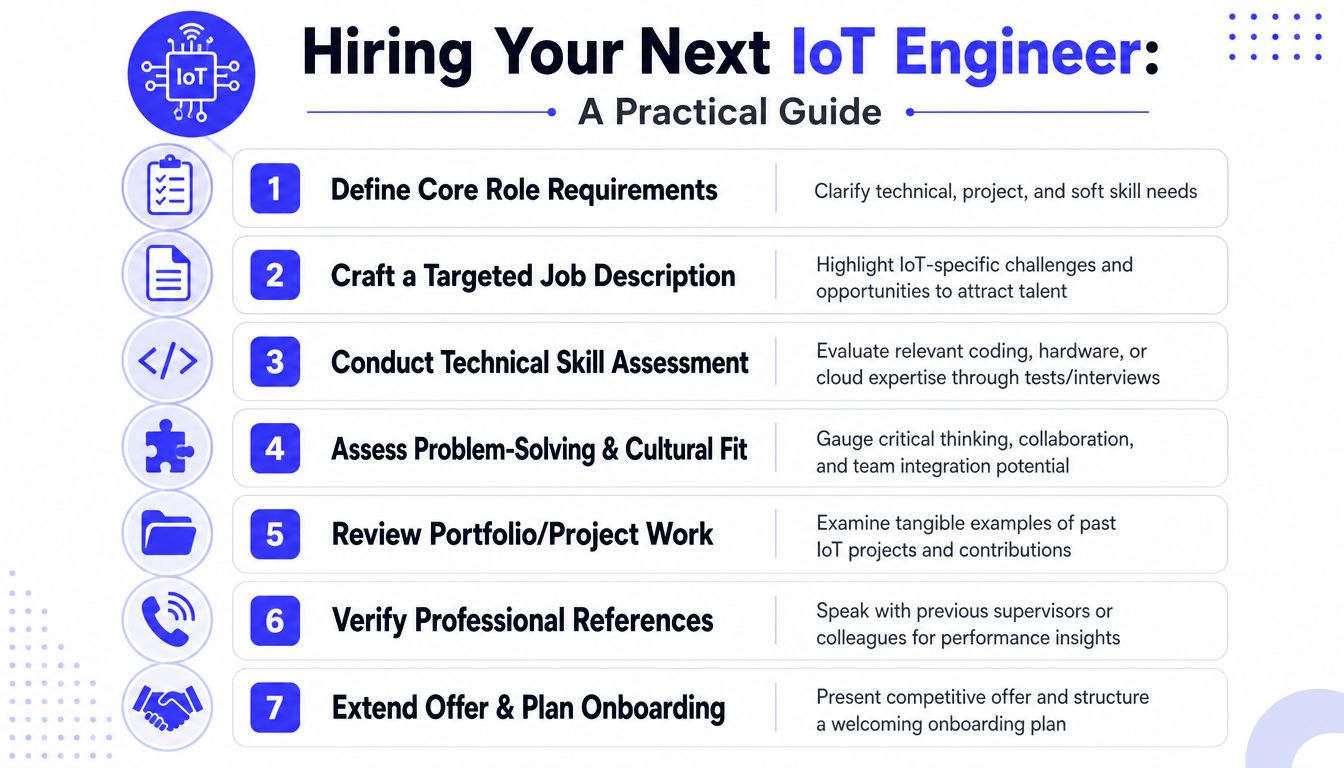
A job description template you can actually use
Role title
Senior IoT Engineer
What this role owns
You'll design and operate edge-to-cloud systems for connected devices. You'll work across firmware-adjacent workflows, cloud ingestion, fleet provisioning, over-the-air updates, and production observability.
What success looks like
- Reliable device onboarding with a repeatable provisioning flow and clear failure handling
- Stable telemetry pipelines that tolerate duplicates, retries, and intermittent connectivity
- Safe fleet operations including OTA rollout controls and rollback planning
- Cross-team execution with hardware, product, and data stakeholders
Required experience
- Production IoT systems with ownership of at least one full device-to-cloud workflow
- Hands-on cloud engineering in AWS, Azure, or Google Cloud Platform
- Protocol fluency in MQTT, CoAP, AMQP, or equivalent messaging patterns
- Operational judgment around observability, security, and rollout safety
Nice to have
- Embedded debugging experience
- Industrial telemetry or fleet operations background
- Edge ML deployment exposure
A better JD focuses on failure modes and interfaces. That's also why why skills-based hiring matters is especially relevant in IoT. Credentials help. Proven capability across provisioning, messaging, fleet ops, and incident response helps more.
Interview kit for real signal
Use structured questions that test reasoning, not keyword recall.
Provisioning question
A device is manufactured offline and first connects weeks later in the field. Walk through your provisioning and trust model.OTA question
How would you roll out a firmware update to a mixed fleet with unreliable connectivity and a non-trivial chance of mid-update failure?Data path question
A sensor reports duplicate messages during reconnect storms. How would you design ingestion so downstream systems remain trustworthy?Edge-cloud trade-off question
What logic should stay on-device, and what should move to the cloud, for a system that generates frequent anomalies?Debugging question
A fleet works in staging but drops messages in production. What are the first things you'd inspect?
Here's a practical hiring discussion to share with the team before interviews:
Take-home brief and scorecard
Take-home prompt
Design an edge-to-cloud flow for a temperature sensor. Include device provisioning, message transport, cloud ingestion, storage, alerting, OTA update strategy, and basic security controls. Keep it brief. Architecture diagram plus a short rationale is enough.
Scorecard
| Area | What to look for |
|---|---|
| System design | Clear boundaries between device, broker, cloud services, and apps |
| Reliability thinking | Duplicate handling, retries, offline behavior, rollback |
| Security thinking | Identity, secret handling, authorization boundaries |
| Communication | Can they explain trade-offs clearly to non-specialists? |
If you're hiring adjacent roles for data-heavy connected products, it's useful to compare this process with how teams hire AI engineers. The overlap in systems thinking is real, but the device and fleet constraints are where IoT interviews need to get sharper.
IoT Salary Benchmarks and Market Trends for 2026
A single salary number obscures the full picture in IoT. Teams are hiring across four different layers, hardware, firmware, cloud, and application, and pay shifts hard based on which layer owns production risk.
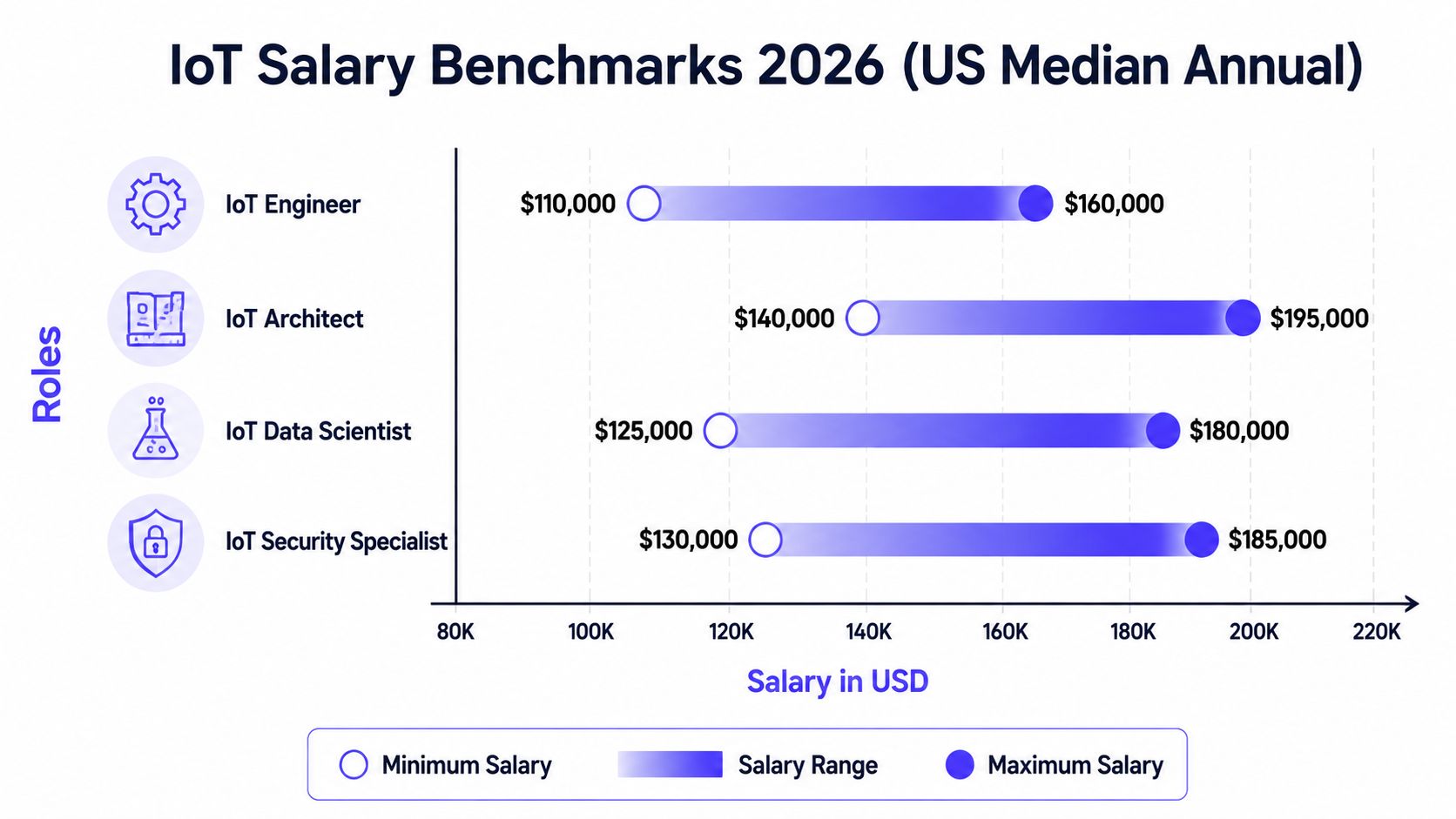
What the salary floor and ceiling look like
As of June 2026, the average annual salary for IoT professionals in the US is $129,899, with many roles landing between $101,000 and $157,000. Senior roles such as IoT Solutions Architect can go far higher when the job combines cloud architecture, device security, and data platform ownership, as outlined in this IoT careers and salary guide.
That top-line average is too blunt for headcount planning. A firmware engineer working close to RTOS constraints is not priced like a cloud engineer building ingestion pipelines, and neither is priced like a product manager carrying commercial responsibility for an industrial rollout.
Role-level benchmarks are more useful:
- IoT engineers average $113,261 per year in the U.S., according to the Indeed IoT jobs guide
- Industrial IoT roles average $83,498 annually, with a common range of $70,000 to $94,500, based on Industrial IoT salary data from ZipRecruiter
- Entry-level IoT Product Managers often land in the $70,000 to $90,000 range, with mid-level and senior compensation rising from there, according to this IoT product manager salary guide
The practical hiring point is simple. Budget by function, not by buzzword.
In my experience, the market pays a premium for engineers who can cross boundaries cleanly. A firmware developer who understands secure provisioning and can explain failure modes to the cloud team is harder to replace than someone who only writes device code. The same applies on the platform side. Cloud engineers who have handled flaky connectivity, duplicate events, and OTA rollback logic are closer to full-stack IoT engineers than their title suggests.
Why the market keeps paying up
Compensation is staying high because IoT work sits at the intersection of several growing markets. The broader IT labor market is still expanding, with salaries rising and long-term demand for technical roles remaining strong, according to this IT job market and salary outlook.
The harder problem is supply quality, not just supply volume. Plenty of candidates can build one layer. Fewer can reason across device constraints, network behavior, cloud reliability, and field operations. That gap is what pushes senior compensation up, especially for companies shipping connected products at scale.
CTOs should read these numbers as staffing signals. If the role touches production devices, regulated environments, or expensive downtime, the salary band needs room for systems judgment. Engineers should read them differently. The fastest path to higher pay is usually not “more IoT” in the abstract. It is depth in one functional layer plus enough adjacent knowledge to work well with the others.
If you're comparing adjacent data roles, use a narrower benchmark such as this analytics engineer salary breakdown. Analytics engineers often inherit cleaner upstream systems and fewer field constraints, which changes both compensation logic and interview expectations.
Where to Find and Attract Top IoT Engineers
The fastest way to fail in IoT recruiting is to search only for people with “IoT” in their title. Many of the strongest candidates come from embedded systems, platform engineering, industrial automation, networking, robotics, or device security. They've done the work. They just didn't use the buzzword.
Where hiring teams should actually look
Start with broad platforms, but don't stop there. Better candidates often show up in narrower, practice-based communities.
Use this sourcing checklist:
- Open-source contributors who work on embedded tooling, device SDKs, observability libraries, or edge runtime projects
- Firmware and device communities where engineers discuss field failures, OTA strategy, memory limits, and debugging techniques
- Industrial and automation circles where systems engineers and controls-minded talent already operate close to hardware
- Cloud platform communities where engineers have built reliable event pipelines and can learn device-side constraints faster than expected
- Adjacent operators such as network technicians, field systems engineers, and embedded QA specialists who have practical deployment instincts
The seniority mismatch matters here. Earlier, I cited that there are over 7,000 total IoT roles in the U.S. but only 107 entry-level listings on major platforms. That means many companies are fishing in the same narrow senior pool. If you don't create a path for adjacent talent, your search gets slower and more expensive.
What attracts strong candidates
Good IoT engineers don't move for vague innovation language. They respond to concrete scope.
Here's what usually works:
- End-to-end ownership over a meaningful slice of the stack
- Interesting constraints such as low power, edge intelligence, difficult field environments, or security-heavy deployments
- Clear product stakes so they know why the system matters
- Real partnership with hardware, product, and data teams instead of siloed ticket work
“We'll give you ownership of provisioning, OTA, and fleet reliability” is a stronger pitch than “Join our exciting IoT transformation.”
For candidates, the same logic applies in reverse. Search by function. Look for firmware, edge systems, cloud platform, device security, or telemetry data roles. Many of the best jobs in IoT won't advertise themselves with the clean label you expect.
Your Next Steps to Hire or Get Hired in IoT
The field gets simpler once you stop treating it like one role category. Jobs in IoT are a stack. Hiring gets easier when you define the layer. Career moves get easier when you pick the layer you can own next.
If you're hiring
Start with role definition, not headcount.
Map your bottleneck to the stack
If your issue is device behavior, hire near firmware or hardware. If the issue is fleet operations, hire cloud or platform. If the issue is turning telemetry into customer value, hire in application or data.Use a narrow hiring asset
Adapt the job description, interview kit, and take-home brief above for the exact slice of work you need. Strong candidates usually opt into specificity.Build for adjacent talent where possible
If you can't find the “perfect” IoT title match, hire from embedded, network, industrial, or platform backgrounds and onboard intentionally.
A lightweight checklist helps:
- Define ownership clearly so hardware, firmware, and cloud teams don't overlap badly
- Assess production judgment with outage, rollout, and failure-recovery questions
- Plan onboarding around the stack so new hires understand the interfaces, not just their module
If you're trying to get hired
Don't start with “I want an IoT job.” Start with the role you can prove.
Use this sequence:
- Pick one target lane such as firmware engineer, cloud platform engineer, IoT data engineer, or field systems engineer
- Build one complete artifact that shows device-to-cloud thinking, not just code in isolation
- Translate adjacent experience from embedded, backend, DevOps, networking, automation, or mobile into fleet, telemetry, and reliability language
A practical portfolio project beats broad self-labeling. An ESP32 sensor, a cloud ingestion path, a tiny dashboard, and a written explanation of provisioning and OTA trade-offs will do more for your candidacy than another generic certificate list.
What matters most next quarter
For teams, the next move is sharper scoping. For engineers, it's sharper positioning.
Bottom line: The market rewards people who can reduce risk across boundaries. In IoT, boundaries are where most systems fail and where the best careers are built.
If you need senior engineers who can operate across applied AI, data systems, and production-grade platforms, ThirstySprout can help you move quickly. You can Start a Pilot or See Sample Profiles to meet vetted remote talent who've shipped real systems and can plug into your roadmap without a long hiring cycle.
Hire from the Top 1% Talent Network
Ready to accelerate your hiring or scale your company with our top-tier technical talent? Let's chat.