

TL;DR
- Define the role first: Stop using the generic "AI Engineer" title. Map your specific business goal (e.g., build a support chatbot) to a specialist profile (e.g., NLP Engineer with RAG experience) and required skills (e.g., vector databases, prompt engineering).
- Source where they live: The best AI talent isn't on mainstream job boards. Find them in niche communities like Kaggle, contributing to open-source projects on GitHub, or through specialized talent networks.
- Vet with real-world problems: Use a multi-stage process: a short coding challenge (60-90 mins), a system design interview based on your actual business problems, and a small take-home project (4-6 hours) evaluated with a structured scorecard.
- Act fast: A well-run hiring process for a specialized AI engineer should take 4–8 weeks. Anything longer and you risk losing top candidates to competitors.
Who this guide is for
- CTOs & Heads of Engineering: Responsible for building AI teams and defining technical roles.
- Founders & Product Leads: Scoping new AI features and need to understand the required talent and budget.
- Hiring Managers & Talent Ops: Tasked with sourcing, vetting, and hiring specialized technical talent efficiently.
Framework: The 4-Step AI Hiring Process
Hiring elite AI talent comes down to a disciplined, four-step process. Skipping a step or getting one wrong leads to wasted time, mismatched hires, and delayed roadmaps.
- Define the Mission: Connect your business goal to a specific engineer profile and skill matrix.
- Source Intelligently: Go to niche communities where top engineers are already solving problems.
- Vet Pragmatically: Test candidates with challenges that mirror the actual job.
- Close & Retain: Make a compelling offer and have a structured 90-day onboarding plan.
Step 1: Define the Mission (Not the Title)
Before you write a job description, get crystal clear on the mission. The title “AI Engineer” is too broad to be useful. Throwing it out there is like fishing with a giant net—you’ll get a ton of applicants, but most won't be the right fit. This ambiguity chews up valuable engineering time in interviews that go nowhere.
Work backward from the business problem you're trying to solve. What, specifically, is this person going to build or fix? The answer dictates the exact specialist you need. An engineer who excels at building Retrieval-Augmented Generation (RAG) systems has a completely different skillset than someone designing computer vision models for a factory floor.
Our First-Party Insight: We've seen it repeatedly. Teams that spend one extra week meticulously defining the role cut their time-to-hire by 2–4 weeks. Precision upfront saves months of pain later.
The reference table below maps common business goals to the right AI engineering profile. Use it to ensure your search starts with a solid, strategic foundation.
alt text: A table mapping business goals like 'Automate support' to an engineer profile like 'NLP/RAG Engineer' and key skills like 'Vector DBs, Prompting'.
Practical Example 1: The SaaS RAG Chatbot
A B2B SaaS company wants to build a chatbot using a RAG architecture. The goal is to answer customer questions from a 50,000-document knowledge base.
- Wrong Approach: Post a job for a generic "AI Engineer." Their inbox would be flooded with résumés from CV experts and researchers with zero production experience.
- Right Approach: Define the role as a "Machine Learning Engineer, NLP & RAG."
This leads to a specific skill matrix:
- Vector Databases: Hands-on experience with Pinecone or Weaviate.
- Embedding Models: Deep understanding of choosing and implementing models like
text-embedding-ada-002. - Prompt Engineering: Proven ability to craft context-aware prompts that minimize hallucinations.
- APIs & Integration: Solid backend skills (Python, FastAPI) to build and integrate the service.
That level of detail instantly filters the applicant pool to engineers who have actually built these systems.
Practical Example 2: Manufacturing Quality Assurance
A manufacturing company needs to automate defect detection on its assembly line using cameras to spot microscopic cracks in metal parts.
- Their Role Definition: "Computer Vision Engineer."
- Image Processing: Deep expertise in libraries like OpenCV for image filtering and edge detection.
- Deep Learning for CV: Experience training and deploying object detection models like YOLOv8.
- ML Frameworks: Fluency in PyTorch or TensorFlow.
- Hardware Integration: Experience deploying models on edge devices like an NVIDIA Jetson for real-time performance.
- Technical Forums and Competitions: Platforms like Kaggle and Hugging Face are goldmines. Engineers here are actively solving problems and sharing code. It's a live portfolio.
- Open-Source Contributions: Search GitHub for contributors to libraries your team already uses. You’ll find engineers with proven, public-facing skills relevant to your stack.
- Specialized Talent Networks: If you need to move faster, partnering with specialist firms like ours can be a game-changer. It's worth understanding how data science recruiting firms operate to see if their targeted approach fits your needs.
Subject: Your work on [Project/Paper] & our fraud detection puzzle
Hi [Candidate Name],
My name is [Your Name], and I lead engineering at [Company]. I was impressed with your approach to [mention something specific, e.g., "your feature engineering in the XYZ Kaggle competition"].
We're building a real-time fraud detection system and are wrestling with a similar problem around [mention a specific challenge, e.g., "handling class imbalance in our transaction data"]. Given your work, I thought you might have an interesting take.
Would you be open to a 20-minute chat next week to trade notes? No resume or prep needed, just a candid technical talk.
- Data Ingestion: Are they thinking about Kafka streams or simple API endpoints? Why?
- Model Selection: Can they articulate the pros and cons of logistic regression versus an XGBoost model for this specific problem?
- MLOps: How are they thinking about deployment, monitoring for model drift with tools like Prometheus, and retraining?
- Objective: Build a simple API that classifies customer support tickets into five categories.
- Dataset: Provide a CSV file with 1,000 labeled examples.
- Deliverables: A Git repo link with the code, a short
README.md, and a Dockerfile for easy execution. - The Mission: Remind them of the difficult, fascinating problem they’ll solve.
- Their Ownership: Be specific about what project will be theirs from day one.
- The Team: Reiterate the caliber of the engineers they’ll collaborate with.
- Days 1–10 (Get Grounded): Pair them with an onboarding buddy. Goal: set up their dev environment, meet the team, and absorb context. No coding tasks yet.
- Days 11–30 (The First Win): Give them a well-defined, low-risk starter project, like fixing a known bug or improving a model's accuracy.
- Days 31–90 (Take the Reins): Hand over their first major project. By now, they should have the context and confidence to take full ownership.
- Full-Time: Best for core, long-term projects where you need deep institutional knowledge.
- Contract: Perfect for specific, time-boxed projects (3–12 months) like building a proof-of-concept.
- Fractional: A great way to get senior-level strategic guidance without the full-time salary, ideal for early-stage companies needing architectural direction.
- Pinpoint the Business Problem: What are you trying to solve? (e.g., reduce customer support tickets).
- Map Problem to AI Specialization: Is this NLP, computer vision, or classical ML?
- Create a Skill Matrix: List must-have technical skills (PyTorch, vector DBs) and soft skills.
- Write a Mission-Driven Job Description: Lead with the problem they will solve.
- Identify Niche Sourcing Channels: Target communities like Kaggle, Hugging Face, or GitHub.
- Craft Personalized Outreach: Reference a candidate’s specific project to show you’ve done your homework.
- Build an Internal Referral Program: Your current team’s network is your most powerful recruiting tool.
- Practical Coding Challenge (60-90 min): Screen for fundamental, hands-on skills.
- System Design Interview: Have the candidate architect a solution to a real business problem.
- Take-Home Project (4-6 hours): Assign a small project and use a standardized scorecard to evaluate it.
- Behavioral and Culture Fit Interview: Assess their collaboration and problem-solving approach.
- Scope Your First Role: Use the checklist above to define the technical requirements for your most critical AI hire.
- See Sample Profiles: Benchmark against pre-vetted AI engineer profiles to understand the market.
- Start a Pilot: The best way to know if someone is a fit is to work with them. Start a Pilot with a senior AI engineer and see their impact in as little as two weeks.
- Go In-House for your core, strategic AI initiatives where you need deep institutional knowledge.
- Outsource or Contract for well-defined, time-sensitive projects like building a proof-of-concept or bringing in niche expertise you don't need permanently.
These two examples couldn't be more different. A one-size-fits-all approach to hiring AI engineers is destined to fail. For more guidance on managing the process, see our guide to recruitment project management.
Step 2: Source and Attract Top AI Talent
Once you know exactly who you’re looking for, the hunt begins. The best AI engineers aren't scrolling through mainstream job boards. They're deep in technical communities, contributing to open-source projects, or sharing their work.
The global demand for AI engineers has exploded. An estimated 500,000 open AI-related positions are projected worldwide by the end of 2025. This talent crunch means your old playbook won't work.
Go Beyond LinkedIn and Into Niche Communities
To find specialized AI engineers, you need to explore the top niche candidate sourcing channels. Meet talent in their natural habitat, where they’re already solving technical problems.
 alt text: A diagram showing a three-step sourcing process: start with Niche Communities, move to Technical Forums, and supplement with a Referral Program.
Sourcing top AI talent is an active process. You have to meet engineers where they are.
Practical Example 3: Outreach That Gets a Response
Senior AI engineers get dozens of generic recruiting messages a week. To cut through the noise, your outreach needs to be personalized, concise, and focused on the technical challenge.
Sample Cold Outreach Template (Email)
This works because it shows you've done your homework, presents an interesting puzzle, and lowers the barrier to entry. It’s an invitation to a peer conversation, not an interview.
Step 3: A Rigorous Vetting Process for AI Engineers
A mismatched AI hire can derail your roadmap for months. A robust, multi-stage vetting process isn’t just nice-to-have; it's your most important risk-mitigation strategy. The goal is to find engineers who can build, deploy, and maintain resilient AI systems.
 alt text: A multi-stage hiring funnel showing the progression from resume screen to coding challenge, system design, take-home project, and final interviews.
The Foundational Coding Challenge
The first technical hurdle should be a practical coding challenge, not an abstract brain teaser. Give them a task that mirrors a small piece of the job.
For a generalist AI engineer, a data manipulation task using a library like Pandas is effective. Hand them a messy dataset and ask them to clean it, transform it, and extract a few specific insights.
Keep it short: This initial challenge should take 60–90 minutes. It’s a filter for clean code, logical thinking, and basic familiarity with the tools.
The Real-World System Design Interview
This is your best window into a candidate’s ability to think about trade-offs, scalability, and production readiness. Frame the question around a problem your business is genuinely facing.
Sample System Design Prompt"We need to design a real-time fraud detection system for our e-commerce checkout. Walk me through your high-level architecture. What data would you use, what models would you consider, and how would you tackle latency and monitoring?"
This opens a conversation about:
This is where you separate true builders from theorists. You can find more examples in our list of machine learning engineer interview questions.
The Take-Home Project and Scorecard
For the final technical stage, a small, well-defined take-home project is ideal. It gives candidates space to do their best work on a self-contained task that takes 4–6 hours.
Sample Take-Home Project Brief
You must evaluate this project with a structured scorecard. This removes "gut feel" bias and forces you to assess every candidate against the same standards.
AI Engineer Take-Home Project Scorecard
Using this scorecard makes your final hiring decision much more data-driven and fair.
Step 4: Closing the Deal and Onboarding
You’ve found a great candidate. Now for the hard part: getting them to sign and ensuring they succeed. This final stage is about more than just salary. You need an offer that speaks to their ambitions and an onboarding plan that gets them contributing fast.
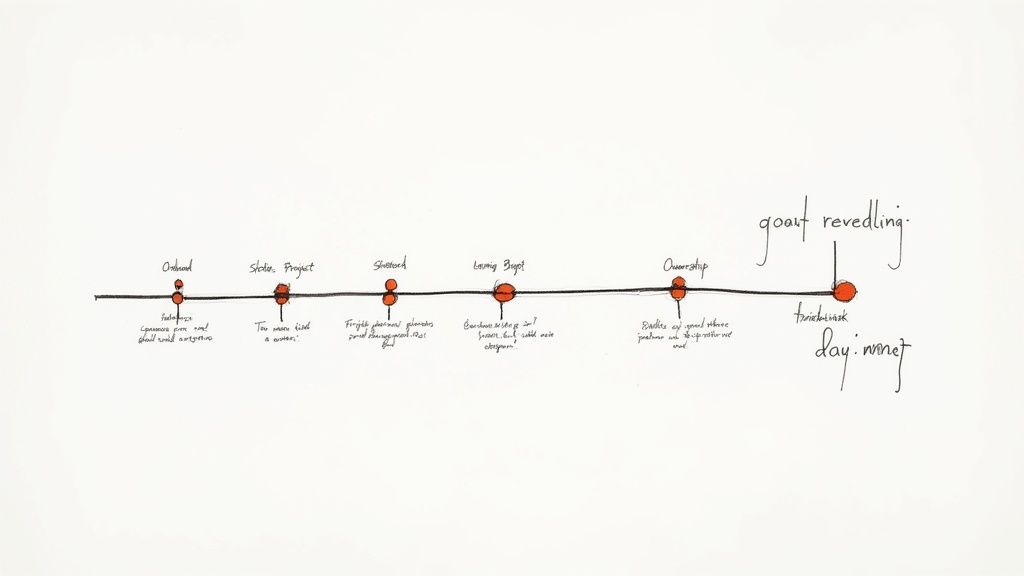 alt text: A timeline showing a 90-day onboarding plan for an AI engineer, with milestones for the first week, first month, and first quarter.
Crafting a Compelling Offer
In this market, a competitive salary is table stakes. Your offer needs to be strong, including meaningful equity if you're an early-stage company.
But money alone won't seal the deal. The best engineers are driven by the work.
Our advice: A dedicated learning budget of $2,000–$5,000 per year for conferences and courses shows you're serious about their growth. It's a small perk that sends a huge message.
A 90-Day Onboarding Plan for Impact
A structured onboarding plan gets new hires integrated, productive, and delivering a tangible win within their first quarter.
Full-Time, Contract, or Fractional?
Finally, decide on the right engagement model for your budget and timeline.
Your AI Hiring Checklist (Template)
This checklist boils down the entire playbook into a practical framework for building a repeatable hiring engine.
Phase 1: Define the Mission
Phase 2: Source and Engage Talent
Phase 3: Vet for Real-World Skills
Get the Full Version: Download our Comprehensive AI Hiring Checklist to keep your team aligned and your hiring process sharp.
What to Do Next
Deep Dive: Trade-offs and Common Questions
What’s the real cost to hire an AI Engineer?
For a full-time, mid-level AI engineer in the U.S., expect an annual salary between $120,000 and $180,000. Senior talent with expertise in hot areas like Large Language Models (LLMs) can easily exceed $200,000. Contract rates typically range from $100 to $250 per hour. The key is to benchmark against specific skills, not a generic title.
How long should the hiring process take?
A well-run process for a specialized AI engineer should take four to eight weeks. Any longer, and you risk losing top candidates who see a slow process as a red flag about your company's efficiency. Pre-vetted talent networks can cut sourcing time from weeks to days.
AI Engineer vs. Machine Learning Engineer: What's the difference?
A Machine Learning (ML) Engineer is laser-focused on building and training predictive models—algorithms, feature engineering, and statistical soundness.
An AI Engineer has a wider scope. They do what ML engineers do but are also responsible for weaving those models into software products. This includes building data pipelines, integrating with APIs (like those from OpenAI), and ensuring the entire system is production-ready.
Our Take: A great AI engineer is often 80% a strong backend or data engineer and 20% an AI specialist. Solid software fundamentals are non-negotiable.
Should I hire in-house or outsource?
References
Hire from the Top 1% Talent Network
Ready to accelerate your hiring or scale your company with our top-tier technical talent? Let's chat.