

TL;DR
- Treat Hiring Like a Project: Shift from a slow, administrative process to an agile project management framework. This cuts time-to-hire for competitive AI roles from months to just 2–4 weeks.
- Focus on Four Pillars: Implement (1) a role scoping sprint for total clarity, (2) data-driven pipeline management, (3) structured interviews with scorecards, and (4) a seamless closing process.
- Measure What Matters: Track Quality-of-Hire (QoH) and Offer Acceptance Rate (OAR), not just time-to-fill. A good target is an OAR >85% and QoH >8.5/10.
- Actionable First Step: Use our downloadable checklist to run your next AI hire as a structured, two-week sprint. Define your RACI chart and track candidate velocity to eliminate bottlenecks immediately.
Who this guide is for
This guide is for CTOs, Heads of Engineering, and Founders who need to hire specialized AI talent (like MLOps Engineers or AI PMs) and can't afford a slow, broken recruiting process that loses top candidates. It's for operators who need to build a high-performing team now.
Quick Answer: A 4-Pillar Framework for Hiring AI Talent
When you're after a senior MLOps engineer or a sharp AI product manager, the old, plodding recruitment process is your biggest liability. The best candidates are off the market in days, not weeks. Every bottleneck is a lost opportunity.
Adopting a project management framework for your hiring process gives you a critical edge. It treats hiring like an agile project with defined sprints, clear ownership, and measurable milestones.

Alt text: A diagram showing the four key stages of recruitment project management: Role Scoping Sprint, Data-Driven Sourcing, Structured Evaluation, and Closing & Onboarding.
This framework is built to solve the three most common failure points in technical hiring: fuzzy role definitions, a glacial pipeline, and inconsistent candidate evaluations.
- Role Scoping Sprint: A mandatory kickoff meeting to define the role, the evaluation scorecard, and the interview panel before any sourcing begins. This ensures everyone is calibrated from day one.
- Data-Driven Pipeline Management: Track metrics like candidate velocity (time-in-stage) and pass-through rates to instantly identify and fix bottlenecks in your process.
- Structured Interviewing: Use a pre-defined scorecard for all interviews. Assign specific competencies to each interviewer to ensure a consistent, data-driven evaluation process.
- Closing & Onboarding: Manage the offer process with the same project discipline, ensuring a verbal offer is followed by a written one within hours and that onboarding logistics kick off immediately upon signing.
The single biggest lever for accelerating hiring is achieving absolute role clarity before you start sourcing. A well-defined problem statement (the job description) and success criteria (the scorecard) prevent wasted cycles on mismatched candidates.
Practical Examples: How to Apply Recruitment Project Management Today
Theory is useful, but execution is what matters. Here are two practical tools you can build this week to bring this framework to life for your next critical AI hire.
Example 1: The Hiring Sprint RACI Chart
A RACI chart is a lifesaver. It’s a straightforward matrix that spells out who is Responsible, Accountable, Consulted, and Informed for every task. When you're in a high-stakes, fast-paced hiring sprint, it's the single best tool for eliminating ambiguity.
Here’s a sample RACI for a 4-week hiring sprint for a Senior MLOps Engineer. The mission: get from kickoff to a signed offer in under 20 business days.
Sample 4-Week Hiring Sprint RACI Chart for a Senior AI Engineer
This table defines roles and responsibilities for each key activity in a condensed hiring sprint, ensuring clarity and accountability to accelerate the process.
This simple grid makes it crystal clear that while the Recruiter is responsible for sourcing, the Hiring Manager is ultimately accountable for the quality of the candidates coming through.
Example 2: The Candidate Pipeline Velocity Dashboard
You can't manage what you don't measure. A velocity dashboard helps you track two make-or-break metrics: Time-in-Stage and Pass-Through Rate. This doesn't need to be a complex business intelligence project; a report in your Applicant Tracking System (ATS) or even a shared Google Sheet works.
Key Metrics to Track:
- Time-in-Stage: How many days does a candidate sit in each step? A number like 7+ days stuck in the Tech Screen stage is a massive red flag signaling a bottleneck.
- Pass-Through Rate: What percentage of candidates advance from one stage to the next? If you see a 90% rejection rate after the final panel, it could mean your interviewers aren't calibrated or your initial screen is letting the wrong profiles through.
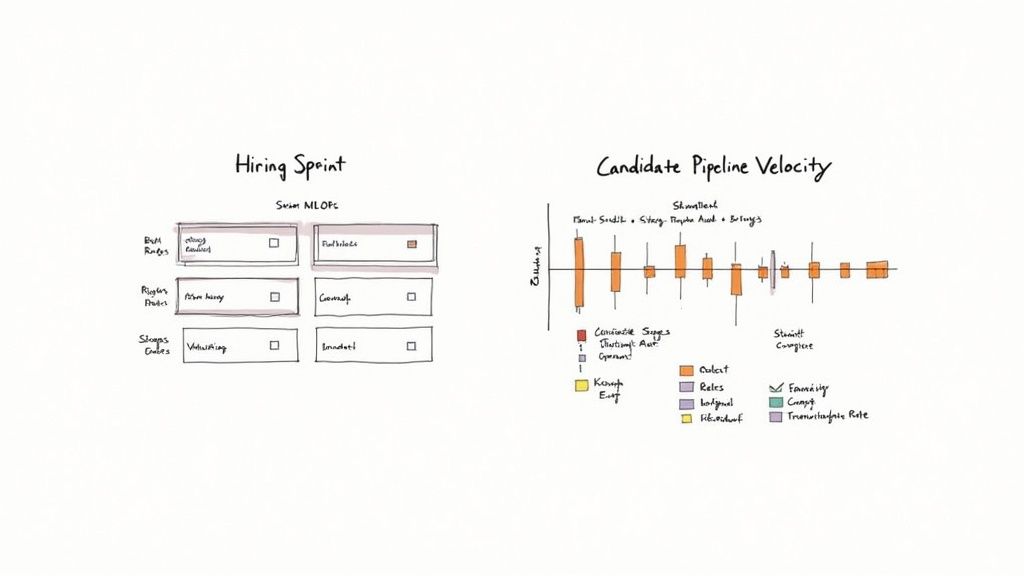
Alt text: A dashboard showing a Kanban-style hiring board and a chart tracking candidate pipeline velocity, with annotations on bottlenecks and pass-through rates.
By keeping an eye on these numbers weekly, you can diagnose problems before they derail the entire search.
Deep Dive: Why Your Old Recruiting Playbook Fails on AI Roles
Trying to hire a generalist software engineer with a standard process is slow but often works. Applying that same linear model to hyper-specialized roles like MLOps engineers or AI researchers is a recipe for failure. The speed and complexity of the AI talent market are on another level.
The problem is that traditional hiring treats recruiting like an administrative to-do list: post job, sift resumes, schedule calls, make offer. This ignores the insane specificity of AI skills and the white-hot demand for them. You're stuck in reactive mode in a market that rewards aggressive, project-driven execution.
The Domino Effect of a Vague Job Description
The first domino to fall is almost always a poorly defined role. A hiring manager says they need a "Senior AI Engineer," but what does that mean? Fine-tuning large language models (LLMs)? Building data pipelines with Spark? Deploying inference APIs on Kubernetes? Each is a different universe of skills.
This lack of clarity causes chaos:
- Interviewers go rogue, asking inconsistent questions based on their own idea of a "perfect" candidate.
- Sourcing becomes a shot in the dark, wasting weeks on candidates who are a terrible fit.
- Top candidates get spooked. The best talent can sniff out a disorganized hiring process and will quickly withdraw.
The Black Hole of Slow Feedback
In the AI talent market, speed is everything. A top-tier machine learning engineer often has multiple offers within days of starting their search. If your process takes weeks to provide feedback, it’s designed to fail.
It’s a painful but common story: we consistently see companies lose their top candidate because it took more than 48 hours to get feedback together and schedule the next interview. To A-plus talent, slowness looks like indecision. Or worse, a total lack of interest.
This issue is amplified by a global shortage of skilled project managers who know how to fix these broken processes. This scarcity bleeds directly into technical hiring, where a lack of project discipline means lost candidates. You can read more about these global talent gap challenges.
The Real-World Cost of a Broken Process
These recruiting failures aren't just an "HR problem." They hit the business with direct, measurable consequences.
- Your roadmap grinds to a halt. That new AI feature you promised gets pushed back, giving competitors an open lane.
- The opportunity cost is staggering. You burn countless engineering hours on a hiring process that produces nothing.
- You risk a catastrophic bad hire. Desperation leads to compromises, resulting in a hire that can poison team morale for months.
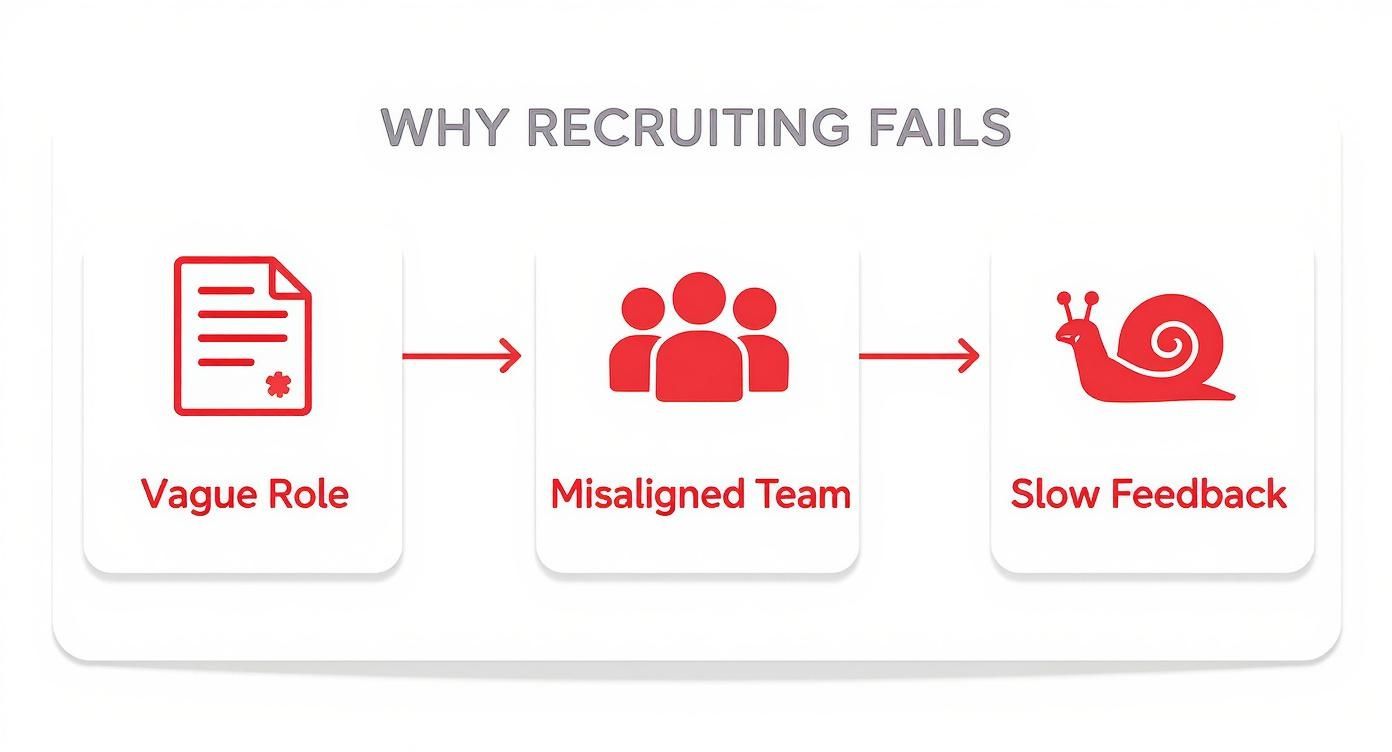
Alt text: A diagram showing a domino effect where a vague role definition leads to a misaligned team, which causes slow feedback and results in losing the best candidates.
A slow, disorganized hiring process sends a powerful signal to the market that your company probably isn't the agile, high-impact place they're looking for. To learn more about applying agile principles, explore various agile project management methodologies.
The Unavoidable Trade-Offs in Recruitment Project Management
Managing a recruitment project is a constant balancing act. You simply can't maximize every metric at once; you must make conscious, strategic trade-offs. The most common tug-of-war is Speed vs. Quality.
Pushing to slash your Time-to-Fill from 45 days down to 20 feels like a victory. But if your Offer Acceptance Rate plummets and your 90-day Quality-of-Hire scores tank, you haven't won. You've just hired the wrong people faster.
Think of it as the classic project management triangle. You're juggling three constraints: speed, quality, and cost. You can pick two to optimize for, but the third will feel the impact.
- Want to maximize speed? You might have to skip an interview stage or settle for a smaller candidate pool. That’s a direct risk to quality.
- Want to maximize quality? You might add a technical take-home project. That will almost certainly slow you down.
- Want to minimize cost? You could avoid specialized recruiting agencies, but this often means a weaker pipeline and a much longer search.
There's no magic formula. The key is to decide, intentionally, which metric matters most for a particular role. For a foundational hire like your first MLOps Engineer, quality is everything. For a more standard software engineering role to scale a team quickly, speed might be the priority. Our deep-dive on how to hire machine learning engineers talks more about striking this balance.
The demand for project leaders is skyrocketing, with projections showing the world will need nearly 88 million people in project management roles by 2027. With that competition, your hiring process must be sharp enough to secure the best talent. You can dig into some of these project management job trends to see the full picture.
We rely on data to sharpen our client strategies, which is a core tenet of our AI-powered recruiting and sourcing services.
Checklist: Your Downloadable Recruitment Sprint Template
This hands-on checklist—available as a Notion template or PDF—turns this playbook into a practical tool for your next hiring sprint. It breaks down the entire project into clear, binary tasks for each phase.
What's Inside the Checklist
- Phase 1 Kickoff: Is the job description finalized? Is the scorecard signed off on by everyone involved?
- Phase 2 Sourcing: Have we identified our primary sourcing channels? Are they running?
- Phase 3 Evaluation: Is the full interview panel trained on the scorecard? Are the interview loops scheduled?
- Phase 4 Closing: Are the offer details—salary, equity, start date—pre-approved by finance?
Think of this checklist as your project plan in a box. It forces discipline into the process, creating a repeatable, high-quality system that you can use for every single technical hire. The goal is to eliminate the guesswork and prevent those costly delays that lose you the best candidates.
You can pair this checklist with our candidate vetting engine. The checklist keeps your process consistent, while a solid vetting engine confirms the candidates you're spending time with are genuinely qualified. Download the checklist below to start running faster, more effective hiring sprints this week.
What to do next: 3 Steps to Faster AI Hiring
Reading is one thing—doing is what creates change. You don't need to overhaul everything overnight. A few deliberate actions this week can build serious momentum.
- Run a 30-Minute Process Audit: Get the recruiter and hiring manager in a room. Ask yourselves: Do we have a real role-scoping sprint? Can we track pipeline velocity? Does everyone use the same scorecard? This will instantly highlight your weakest link.
- Apply the Framework to a Real Hire: Take the downloadable checklist and run a post-mortem on a recent AI role you filled (or failed to fill). Go through each item and ask: Did we do this? This shifts the conversation from "hiring feels slow" to "we lost that candidate because it took nine days to schedule the final panel"—a specific problem you can solve.
- Build Your AI Team with Vetted Experts: When you’re ready to stop wrestling with a broken process and start shipping product with world-class AI talent, that's where we come in. This playbook gives you the framework, but executing it while building a company is a monumental task. We can help you shrink that timeline from months to weeks.
When you need to hire elite AI and ML engineers without the friction, ThirstySprout provides vetted, senior talent ready to start on a pilot.
Book a no-obligation scope call to start building your AI team.
References
Hire from the Top 1% Talent Network
Ready to accelerate your hiring or scale your company with our top-tier technical talent? Let's chat.