

The number that matters is $153,000 in median total pay for an analytics engineer in the U.S., not the headline base salary. If you're hiring your first one, budget against total compensation because equity, bonus, and company level can change the offer enough to win or lose the candidate.
That's the mistake most founders make. They benchmark the role like an analyst, price it like a back-office hire, and then wonder why the strongest candidates take a different offer. Analytics engineers sit in the middle of your data platform, reporting layer, and business logic. If you're building on dbt, Snowflake, BigQuery, Looker, or a modern warehouse-first stack, this hire shapes decision quality across the company.
Your Analytics Engineer Salary Guide for 2026
If you want a practical benchmark, start with median total pay of $153,000/year and a reported range of $126,000 to $188,000/year in the U.S., based on Coursera's summary of Glassdoor data in its analytics engineer salary overview. That's the cleanest anchor for hiring teams because it reflects total pay, not just base salary.
This guide is for founders, CTOs, Heads of Data, and talent leaders who need to answer one business question fast. How do I make a competitive offer without overpaying?
Here's the direct advice:
- Benchmark total comp first. Base-only comparisons will mislead you.
- Define the role before you price it. A BI-adjacent analytics engineer and a platform-oriented dbt/Snowflake specialist are not the same hire.
- Match your pay mix to your company stage. Startups usually compete with upside. Larger companies usually compete with cash predictability.
- Don't let title inflation set your budget. Price for scope, tooling, and decision ownership.
Practical rule: If the person will own core transformation logic, semantic modeling, testing, and stakeholder-facing data products, treat this as a high-leverage technical hire, not a reporting hire.
Who should use this guide
You'll get the most value from this if you're in one of these situations:
- Founders making a first data-platform hire and deciding whether to budget for an analytics engineer or a data engineer.
- CTOs replacing contractor-driven reporting work with a full-time owner for dbt models, warehouse structure, and analytics quality.
- Talent teams building salary bands that won't collapse during offer stage.
- Heads of Data cleaning up role confusion between analytics engineer, BI analyst, and data engineer.
The operating mindset
Don't ask, “What's the market salary?” Ask, “What kind of analytics engineer am I hiring?” That question gives you a real band. Everything else is noise.
The Analytics Engineer Salary Framework
Most salary guides blur together base pay, bonus, and equity. That's why they're hard to use in hiring meetings. A founder needs a simple model.
Think in three parts
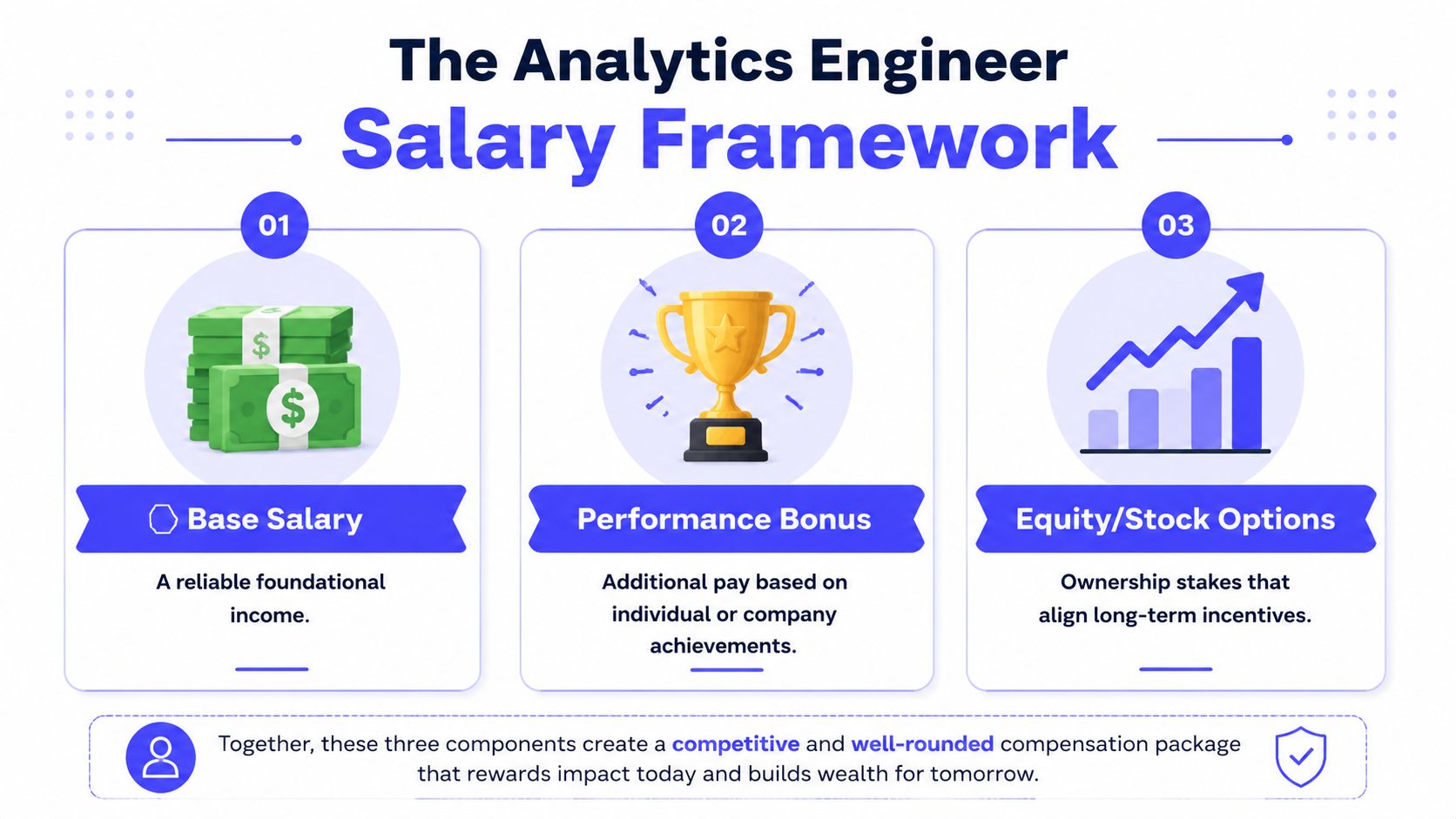
An analytics engineer offer has three moving pieces:
| Compensation component | What it does | Hiring implication |
|---|---|---|
| Base salary | Covers fixed cash compensation | Best for stability and easier candidate comparison |
| Performance bonus | Adds variable cash tied to company or individual outcomes | More common when you want predictable upside without changing base |
| Equity or stock options | Adds long-term upside | Critical for startups competing against bigger cash offers |
Coursera's summary of Glassdoor data reports median total pay of $153,000/year with a range of $126,000 to $188,000/year, while ZipRecruiter lists an average base-equivalent of $129,716/year in its market salary snapshot for data analytics engineers. That gap is the point. Total pay and base salary are not interchangeable.
If you ignore that, you'll under-budget for strong candidates.
Why founders get this wrong
A lot of teams pull a base figure from one salary site, add a little buffer, and call it market. That works for commodity hiring. It doesn't work for analytics engineering.
This role often pulls value from software-style practices like version control, CI/CD, test coverage, warehouse design, and reusable transformation layers. Candidates who've worked in dbt-centered teams know that. They compare total offers, growth path, and technical scope together.
If your offer is “fine on salary” but weak on total package and role design, candidates will still reject it.
A simple offer lens for hiring managers
Use this framework during comp planning:
- Set a target total compensation range first
- Decide how much of that should be fixed cash
- Use bonus or equity to close the gap based on company stage
- Check whether the scope matches the level you're pricing
That order matters. If you start with base alone, you'll end up negotiating reactively.
Key Factors That Drive Salary Ranges
Salary spread for analytics engineers is wide because companies use the same title for very different jobs. Some hires are closer to BI production. Others own the modeling layer, testing standards, metric definitions, and warehouse quality. If you price both roles the same, you either miss strong candidates or overpay for narrower scope.
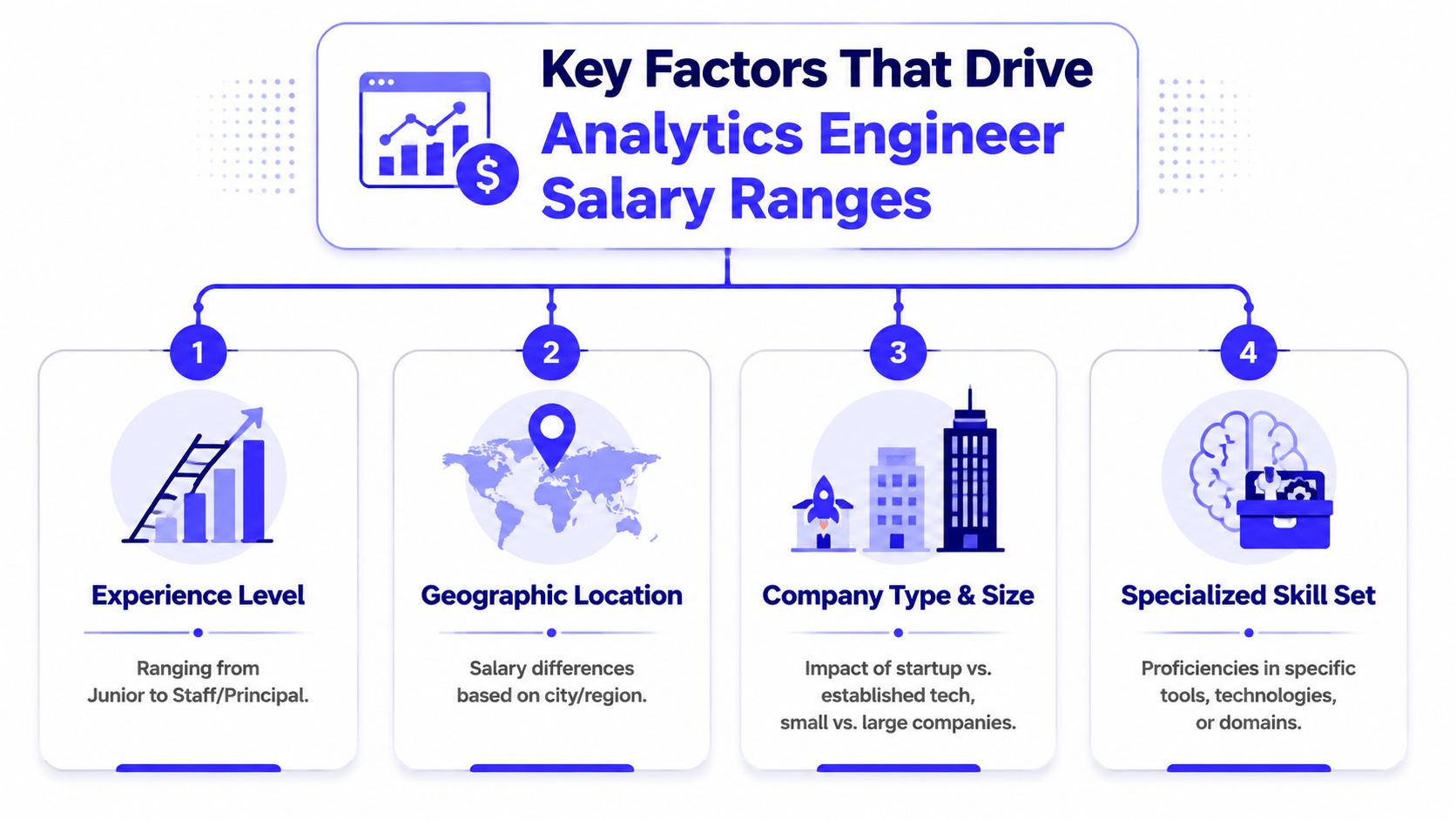
Public compensation benchmarks reflect that variance. Glassdoor's analytics engineer listings, as summarized by Built In's salary guide for analytics engineers, show a meaningfully higher pay band than lighter reporting-focused roles. Use that as a warning sign. Benchmarking by title alone is sloppy. Benchmark by actual ownership.
1. Scope matters more than years of experience
A candidate with four years in the right environment can justify a stronger offer than someone with eight years of dashboard work.
Here's the cutoff I use. Pay above the middle of your band when the person will:
- Own dbt modeling standards across domains, not just ship tickets
- Set testing and documentation expectations for the analytics layer
- Define business metrics with leaders in finance, product, or operations
- Review data quality issues at the root cause level instead of patching broken reports
- Create reusable datasets that reduce analyst rework across teams
If the hire will spend most of their time building one-off dashboards or cleaning CSVs, keep the role and salary band lower. If they will become the owner of trusted business logic, budget higher.
2. Location still changes the clearing price
Remote hiring widened your candidate pool. It did not flatten the market.
Candidates in New York, San Francisco, Seattle, and other high-cost markets still compare your offer against employers that pay at national top bands. You do not need to match the highest market in every case, but you do need a compensation policy you can defend. Founders get into trouble when they make one exception hire at a premium and then discover they have created internal tension across analytics, data engineering, and finance.
HR guidance on pay compression is useful here because it forces you to check the offer against adjacent roles, not just against the candidate in front of you.
3. Company stage changes what candidates will accept
Early-stage startups can win with scope, ownership, and equity. Mature companies usually win with cash, level clarity, and predictable bonuses.
Be honest about which one you are.
If your startup has weak equity upside, no data leadership, and a vague mandate, you cannot discount cash and expect top candidates to fill in the gaps. On the other hand, a candidate joining to build the company's analytics foundation from scratch may accept a lower base if the role has real authority and the equity is meaningful.
Tie compensation to the operating reality of the job, not to a story you hope the candidate believes.
4. Technical environment changes market value
Strong analytics engineers price the role based on how serious your data stack is.
A warehouse-first team with dbt, version control, tests, CI, and clear ownership attracts candidates who think like builders. Those candidates expect compensation closer to engineering-shaped offers because they are reducing long-term reporting cost, metric churn, and decision risk. Teams with immature tooling usually attract more reporting-heavy profiles, and those salary expectations are different.
If you want the stronger profile, the role has to look credible. These data engineering best practices for warehouse modeling, orchestration, and quality are a good reference point for what strong candidates expect to see.
5. Cross-functional exposure raises the price
The fastest way to under-budget is to ignore stakeholder complexity.
An analytics engineer who only supports marketing analytics is cheaper than one who has to align finance, product, operations, and leadership around shared metric definitions. Cross-functional trust work takes judgment. It also creates outsized business value because one good hire can prevent weeks of reporting disputes and bad planning decisions.
That is why the same title can sit in very different salary bands.
Use this rule when setting your offer:
- BI execution role: stay near the lower end of your range
- dbt and warehouse modeling owner: target the middle to upper-middle
- Metric system owner across functions: price at the top of band, or expect to lose the best candidates
Analytics Engineer Salary vs Related Roles
A lot of salary mistakes start with role confusion. Founders post for an analytics engineer when they need a BI analyst. Or they price an analytics engineer like a data engineer and then pack the role with stakeholder-facing reporting work.
That's how bad hires happen.
The role comparison that matters
| Role | Core responsibility | Best fit when you need | Compensation note |
|---|---|---|---|
| Analytics engineer | Transform raw warehouse data into trusted business-ready models and metrics | Clean reporting foundations, dbt ownership, semantic consistency, stakeholder-ready datasets | Market pay often reflects a hybrid of analytics and engineering responsibilities |
| Data engineer | Build and maintain ingestion, orchestration, infrastructure, and platform reliability | Pipeline scale, warehouse plumbing, source integration, platform resilience | Often priced more like backend or platform engineering |
| Data scientist | Build experiments, models, forecasting, or advanced statistical analysis | Prediction, optimization, experimentation, decision science | Usually justified only when the business problem needs modeling, not just data trust |
| BI analyst | Build dashboards, reporting views, and stakeholder analyses | Reporting consumption, KPI tracking, business reviews | Usually lower-cost than analytics engineering because the platform ownership is narrower |
How to choose without wasting budget
Hire an analytics engineer when your pain is data trust and reusable business logic.
Hire a data engineer when your pain is ingestion and infrastructure.
Hire a data scientist when your pain is prediction or experimentation.
If your need is still mostly dashboard creation and recurring reporting, you may want to explore BI analyst salaries before locking in a higher-cost technical role.
“The expensive mistake isn't overpaying a good analytics engineer. It's hiring the wrong role and then asking them to fix a problem they weren't hired for.”
A founder test for role clarity
Ask these four interview-prep questions before opening the role:
- Will this person own dbt models and tests?
- Will they define shared metrics across teams?
- Will they need to work with data platform tooling, not just dashboards?
- Will success depend on code quality as much as business context?
If you answered yes to most of those, you're in analytics engineer territory.
If you're comparing broader compensation across adjacent technical roles, this computer vision engineer salary guide is a useful reminder that specialized technical roles often look similar in title but very different in market logic.
Real-World Compensation Package Examples
The biggest mistake in analytics engineer salary planning is assuming salary sites disagree because one of them is wrong. Usually, they disagree because they're measuring different things.
PayScale reports an average base pay of $112,881, while 6figr reports $203k average total compensation, according to PayScale's analytics engineer salary page. That spread is exactly what hiring managers need to understand. The package changes based on company stage and how much value sits in bonus or equity.

Example one, Series B startup offer
A Series B SaaS company is replacing a messy stack of analyst-owned SQL, ad hoc Looker views, and fragile metric definitions. The candidate will own dbt modeling, tests, warehouse conventions, and stakeholder-facing metric governance.
A smart package here often looks like this structurally:
- Base salary below big-tech cash levels
- Meaningful equity upside
- Clear ownership of the analytics layer
- Direct access to product, finance, and leadership decisions
This works when the company can offer two things. Real ownership and believable upside.
If you're the founder, don't oversell equity and under-design the role. Good candidates will ask who owns source modeling, who reviews dbt pull requests, what warehouse you run, and whether business metrics are already contested. If your answers are weak, equity won't rescue the offer.
Example two, larger company offer
A later-stage or public tech company hiring a mid-level analytics engineer usually wins differently. The role is narrower, the systems are more established, and compensation tends to be easier to compare.
That package usually leans on:
| Package element | Startup-heavy offer | Larger company offer |
|---|---|---|
| Cash mix | Lower fixed cash, more upside narrative | Higher fixed cash, more predictable |
| Variable pay | Equity-centered | Bonus plus stock-based compensation |
| Role scope | Broad ownership | Defined lane inside a larger team |
| Candidate appeal | Autonomy and impact | Stability and compensation clarity |
Candidates weighing these offers are really comparing risk and control. Founders should respond accordingly.
Offer design rule: Don't compete on the part of compensation you're weakest at. If you can't beat large-company cash, win on scope, decision ownership, and upside.
A useful HR-side refresher on how employers frame package value beyond salary is this guide to total job benefits vs total employee compensation. It's helpful when you're writing the actual offer narrative, not just the spreadsheet.
Mini scorecard for package strength
Use this before you send the offer:
- Role clarity: Can the candidate explain what they'll own in one sentence?
- Comp logic: Does the cash-equity mix match your company stage?
- Technical credibility: Can your team explain the stack without hand-waving?
- Growth story: Is there a believable next step after this role?
If any of those are weak, the issue usually isn't salary alone.
How to Build a Competitive Offer Checklist
You don't need a perfect comp model. You need a repeatable one. Use this checklist to build an analytics engineer offer that's competitive and defensible.
Step one, define the actual job
Write the role in operational terms, not title terms.
Use a scorecard like this:
| Question | If yes | If no |
|---|---|---|
| Will this person own dbt models, tests, and documentation? | Price as an analytics engineering hire | You may be hiring a BI analyst |
| Will they work across product, finance, and GTM metrics? | Expect stronger stakeholder and systems skills | Keep scope narrower |
| Will they shape warehouse modeling conventions? | Budget for higher leverage | Keep level moderate |
| Will they review code and improve data quality practices? | Treat as an engineering-shaped role | Don't over-title the role |
Step two, benchmark total compensation
Don't start with a base number from a salary site and improvise from there. Start with your target total package, then decide how much should be base, variable cash, and long-term upside.
Many teams need recruiting support, especially if they're comparing candidates across startup, scale-up, and enterprise backgrounds. A specialized partner that understands modern data hiring, such as these data analytics recruiters, can help pressure-test your range before you go to market.
Step three, match the mix to your company stage
- Early-stage company: Lean harder on ownership, equity, and breadth.
- Growth-stage company: Balance solid cash with upside.
- Larger company: Emphasize clarity, level, and predictable compensation.
Don't copy another company's package formula. Copying a public-company plan into a startup usually creates disappointment on both sides.
Step four, sell the non-cash reasons to join
Strong analytics engineers care about more than pay. They care whether the job is worth doing.
Your offer should answer:
- What business problems will they fix first?
- What tools will they use?
- Who will trust their work?
- How much autonomy will they have?
A vague role needs a higher offer because the candidate is pricing in risk.
Fast checklist for founders
- Define the scope before opening the req
- Set a total comp target, not just base
- Choose a comp mix that fits your stage
- Check internal fairness before offer stage
- Write a concrete role narrative
- Prepare for negotiation before the candidate asks
What to Do Next
If you are hiring your first analytics engineer, your next mistake will usually be one of two things. You either overpay for a vague role, or you underprice a high-impact one and lose the candidate.
Treat this hire like a business design decision. Salary follows scope, level, and risk. If those are fuzzy, your offer will be weak even if the number looks competitive.
Start by writing down what success looks like in the first 12 months. Be specific. Do you need someone to clean up a messy dbt project, define trusted business metrics, improve warehouse performance, or build a modeling layer that product and finance can both rely on? That answer should determine the level and pay band before you talk to candidates.
Then pressure-test your range against the actual market you compete in. Your market is not "analytics engineers." It is analytics engineers with your stack, your stage, your location strategy, and your level of ambiguity. A startup hiring one person to own modeling, testing, BI support, and stakeholder translation should expect to pay for breadth. A larger company hiring into a mature platform can offer narrower scope and more predictable progression.
Negotiation is part of the process. Good candidates will ask why the role sits at this level, what changes compensation after year one, and whether they are joining a real data function or being asked to patch organizational confusion. Have those answers ready.
Ignore base salary in isolation. Build and sell the full package clearly.
Your next three actions:
- Write the role scorecard with first-year outcomes, core ownership areas, and the limits of the job.
- Set a compensation range and walk-away point before interviews start, including base, equity, and any bonus.
- Test the offer story out loud so every interviewer can explain why this package is fair, competitive, and aligned to the business need.
If you need help calibrating role scope, compensation, and candidate quality, ThirstySprout can help you find vetted data and AI talent without dragging the search out for months. Start a pilot, review sample profiles, and get clear on what a strong first data hire should look like before you make an expensive mistake.
Hire from the Top 1% Talent Network
Ready to accelerate your hiring or scale your company with our top-tier technical talent? Let's chat.