

TL;DR:
- Partner with a specialist, not a generalist. Data analytics recruiters have vetted networks, understand the tech stack (SQL, Python, dbt, Tableau), and cut time-to-hire from 90+ days to under 45.
- Vet recruiters with targeted questions. Ask them to explain the difference between a BI Analyst and a Data Scientist or how they source passive candidates beyond LinkedIn. Use our scorecard below to grade them.
- Leverage AI for speed, but rely on human judgment for quality. The best recruiters use AI to source candidates quickly, then spend their time on deep technical vetting and culture fit assessment.
- Choose agencies for speed (1-4 hires), in-house for scale (5+ hires/year). Agencies provide immediate access to talent for urgent roles. In-house is a long-term play for building a consistent talent pipeline.
- Action: Use our downloadable checklist to vet your next recruiting partner and our job brief template to define your next data analytics role with precision.
Who this is for:
This guide is for technical leaders (CTOs, Heads of Engineering) and hiring managers who need to hire data analysts, analytics engineers, or BI specialists. It's for you if you're tired of sifting through irrelevant resumes and need to build a high-impact data team within the next quarter.
A Quick Framework for Vetting Data Analytics Recruiters
Picking the right recruiting partner directly impacts your team's quality and your product's velocity. A surface-level chat won't cut it. Use this three-step process to separate the true specialists from generalists who just know the right buzzwords.
- Assess Technical Depth: Can they speak your language? A great partner must understand the nuances between roles and tools. Vague, hand-wavy answers are a massive red flag.
- Evaluate Sourcing Strategy: Where do they find candidates you can't? The best talent is passive. Their strategy must go beyond posting on job boards.
- Define Success Metrics: How will you measure performance? Agree on KPIs like Time to Fill, Submission-to-Interview Ratio, and Quality of Hire before starting the search.
This framework ensures you find a partner who acts as an extension of your team, not just a resume forwarding service.
Practical Examples: Vetting in the Real World
Theory is one thing; practical application is another. Here are two examples of how to apply this framework.
Example 1: Differentiating a BI Analyst from a Product Analyst
This scenario tests a recruiter's understanding of role-specific business context.
Your Question: "Walk me through how you'd differentiate a BI Analyst for a marketing team versus a Product Analyst for a SaaS product team. What specific skills would you screen for in each?"
- Weak Answer: "They both use SQL and Tableau to make dashboards. I'd look for someone with experience in those tools."
- Strong Answer: "A Marketing BI Analyst needs deep experience with attribution models and tools like Google Analytics or Mixpanel to measure campaign ROI. I'd ask for examples of dashboards they've built to track CAC and LTV. For a Product Analyst, I'd focus on their ability to analyze user behavior—A/B test results, feature adoption funnels, and churn analysis. I'd probe their experience with product analytics platforms like Amplitude and ask how they've used data to influence a product roadmap."
The strong answer demonstrates a clear understanding of how the same core skills are applied differently to solve distinct business problems.
Example 2: The Recruiter Evaluation Scorecard
Use a simple scorecard during your vetting calls to make an objective, data-driven decision. It forces you to compare recruiters on the criteria that matter.
Recruiter Evaluation Scorecard
This scorecard prevents you from being swayed by a slick presentation and grounds your decision in concrete evidence of capability.
Deep Dive: Trade-Offs, Pitfalls, and Alternatives
Choosing a recruiting partner involves navigating several trade-offs. Here’s a look at the key decisions and potential pitfalls.
Specialized Agency vs. In-House Recruiter
This is the most common crossroads. The right choice depends entirely on your hiring velocity and long-term strategy.
Choose a Specialized Agency If:
- Speed is critical: You need to fill 1-4 roles in the next 3 months to hit a product deadline.
- The role is niche: You're hunting for a "unicorn" with a rare combination of skills (e.g., an Analytics Engineer who knows both Looker and a specific e-commerce data model).
- Your team is overloaded: Your internal TA team lacks the bandwidth or deep technical expertise to vet data professionals effectively.
The primary trade-off is cost. Agency fees, typically 20-30% of the first-year salary, are higher per hire but offer immediate ROI and zero fixed overhead.
Build an In-House Team If:
- Hiring is continuous: You plan to hire 5+ data professionals annually. At this scale, a salaried recruiter is more cost-effective.
- Employer branding is a priority: You want to build a reputation as the place for data talent to work through content, meetups, and community engagement.
- Culture is paramount: You believe only a full-time employee can authentically screen for and sell your company's unique culture.
The pitfall here is ramp-up time. Expect it to take 3–6 months for a new in-house recruiter to become fully productive. For a deeper dive, check out our guide on finding data scientist recruiters.
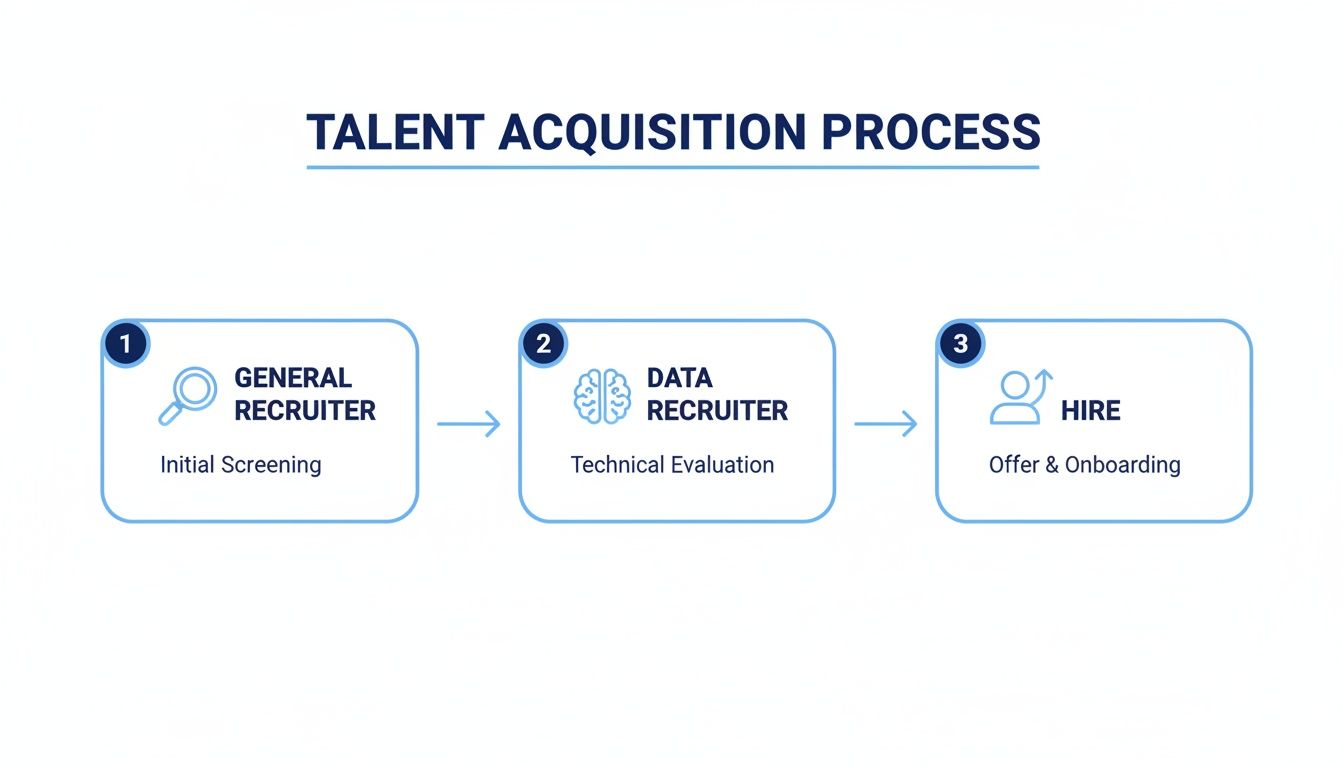
Alt text: A flowchart showing a three-step talent acquisition process: Step 1 is Sourcing & Screening, Step 2 is Technical & Cultural Interviews, and Step 3 is Offer & Hire. This illustrates a recruiter's streamlined workflow.
The Role of AI in Modern Recruiting
AI is no longer a buzzword; it's a standard tool for top recruiters. It excels at high-volume sourcing and initial screening, freeing up human experts for high-value work.
- AI-Powered Sourcing: Tools can scan platforms like GitHub, Kaggle, and LinkedIn to identify candidates with the right mix of skills in hours, not days.
- Predictive Matching: More advanced systems analyze data from past successful hires to score new candidates on their likelihood of success, reducing bias and improving match quality.
The Pitfall: Over-reliance on AI can lead to missing high-potential candidates who have non-traditional backgrounds. A great recruiter uses AI as a scalpel, not a sledgehammer. They leverage it for speed at the top of the funnel, then apply their deep human judgment to assess problem-solving skills and business acumen. When used correctly, the best AI recruiting software complements, not replaces, expertise.
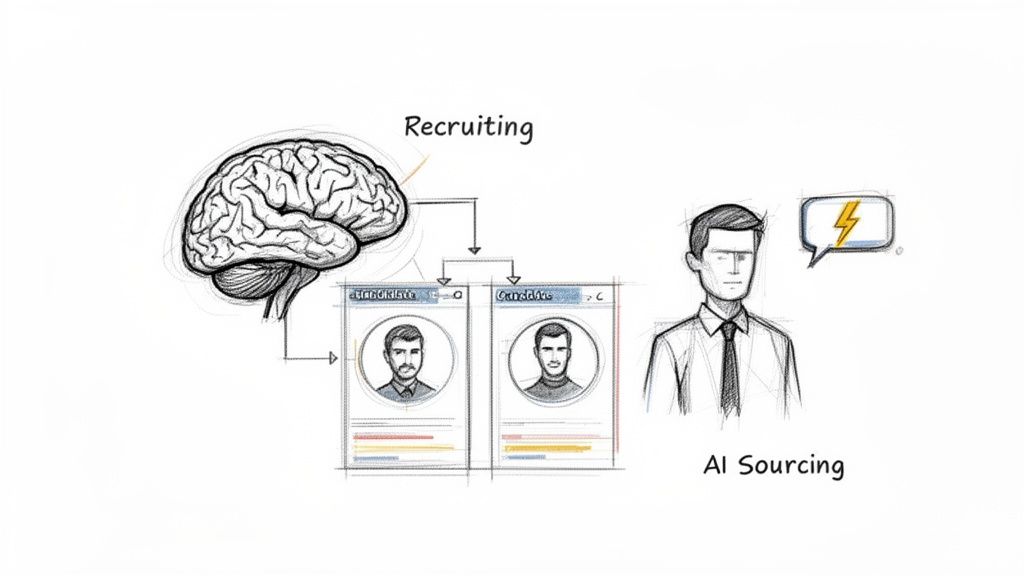
Alt text: An image contrasting a complex, winding path labeled "Manual Sourcing" originating from a human brain with a direct, straight arrow labeled "AI-Powered Sourcing" pointing from a computer to a target candidate profile.
Measuring What Matters: Recruiter KPIs
To ensure you're getting value, you must track performance. Move beyond gut feelings and focus on the metrics that directly impact your business.
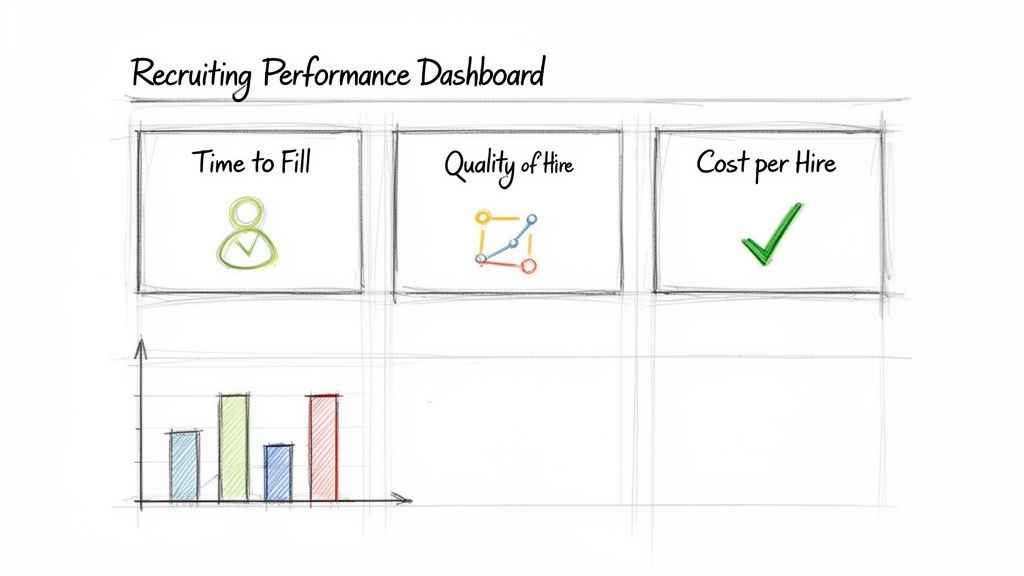
Alt text: A sketch of a recruiting performance dashboard showing four key metrics: Time to Fill (42 days), Quality of Hire (85%), Cost per Hire ($12k), and a bar chart showing hires over time.
- Time to Fill: Aim for 30–45 days for specialized data roles. Longer times often indicate a mismatch in role definition, compensation, or sourcing strategy.
- Submission-to-Interview Ratio: A healthy ratio is 3:1. A 10:1 ratio is a red flag that the recruiter’s initial screening is weak.
- Quality of Hire: This is your north star metric. Track it via 90-day retention rates, hiring manager satisfaction scores, and performance against first-quarter goals. A strong recruiter delivers hires who ramp up quickly and contribute meaningfully. Learn more about defining Quality of Hire metrics.
Checklist: Your Data Hiring Toolkit
To make this actionable, here is a checklist and a link to our templates. Use these to structure your process and hire with more confidence.
[ ] 1. Define the Role with a Structured Job Brief
- Clearly state the business problem this role will solve in the first 90 days.
- Specify must-have technical skills (e.g., SQL, Python, Tableau, dbt) vs. nice-to-haves.
- Define success metrics for the 3, 6, and 12-month marks.
[ ] 2. Vet Recruiting Partners with the Scorecard
- Schedule 30-minute calls with 2-3 potential specialist recruiters.
- Use the evaluation scorecard questions to assess their technical depth and sourcing strategy.
- Ask for case studies or references from companies similar to yours.
[ ] 3. Implement a Data-Driven Interview Process
- Use an interview scorecard to evaluate all candidates against the same criteria.
- Ensure the interview panel assesses technical proficiency, problem-solving, communication, and cultural alignment.
- Include a practical take-home exercise or a live case study round.
[ ] 4. Set Up a Performance Dashboard
- Agree on KPIs (Time to Fill, Quality of Hire) with your chosen partner upfront.
- Schedule a bi-weekly check-in to review progress against these metrics.
(You can download our complete Data Hiring Toolkit, including the Job Brief Template and Interview Scorecard, from our resources section).
What to do next:
- Define Your Next Hire: Use our job brief principles to scope the role, focusing on the business outcomes you need within the first 90 days.
- Vet Your Recruiting Options: If you need to hire within the next 3 months, schedule calls with 2-3 specialized data analytics recruiters. Use our scorecard to guide the conversation.
- Book a Scoping Call: If you need to hire vetted senior data talent that can start in 2-4 weeks, talk to us. We connect you with top-tier AI and data experts from our pre-vetted network.
References
For further reading and data, we recommend the following primary sources and related ThirstySprout guides.
- General hiring and recruiting strategies: DynamicsHub 2025 Report
- Tool-specific documentation: dbt Docs, Looker Resources, Tableau Resources, Scikit-learn User Guide
- Related ThirstySprout Role Guides: Data Scientist Recruiters
Hire from the Top 1% Talent Network
Ready to accelerate your hiring or scale your company with our top-tier technical talent? Let's chat.