

TL;DR
- Choose the Right Model: For urgent, niche roles, use a specialized agency. For high-volume hiring (10+ roles/year), build an in-house team. For flexible, project-based needs, use a talent network like ThirstySprout.
- Use a Scorecard: Evaluate potential recruiters on their track record with similar roles, network depth, vetting process, and performance metrics. Don't just talk; demand evidence.
- Set Clear SLAs: Define a Service-Level Agreement (SLA) with metrics like "deliver 3–5 qualified candidates in 10 business days" and a target submission-to-interview ratio (e.g., 3:1).
- Establish a Fast Feedback Loop: Give specific, actionable feedback on candidates within 48 hours using a structured form. Vague feedback ("not a culture fit") kills momentum.
- Action: Use the vendor scorecard and feedback template in this guide to structure your next engagement with a data scientist recruiter.
Who This Is For
This guide is for:
- CTOs & Heads of Engineering who need to fill critical data scientist roles without derailing their product roadmap.
- Founders & Product Leads trying to scope their first data science hire and understand the true cost and timeline.
- Talent Ops & HR Leaders tasked with finding a reliable recruiting partner who can deliver specialized AI talent.
This is for operators who need to make a hiring decision in weeks, not months, and want a practical framework to avoid costly mistakes.
Quick Framework: Choosing Your AI Hiring Partner
Deciding how to hire a data scientist is a strategic choice that directly impacts your budget, timeline, and team quality. You have three main routes, and picking the wrong one is expensive. An early-stage startup building an in-house team for one hire burns cash, while a large company using only agencies for dozens of hires overpays in fees.
The goal is to match the model to your current needs.
- In-House Team: The right choice for predictable, high-volume needs (e.g., 10+ data scientists per year). This is a long-term investment in your talent engine, giving you full control over the candidate experience.
- Specialized Agency: Your surgical strike for a critical, senior-level role you needed yesterday. These data scientist recruiters have deep networks of passive candidates you can't find on your own.
- Talent Network (e.g., ThirstySprout): The flexible, on-demand solution. You get access to pre-vetted experts for project-based work, fractional roles, or scaling a team quickly without the overhead of a full-time hire or the high percentage fees of a traditional agency.
Use this decision tree to guide your choice.
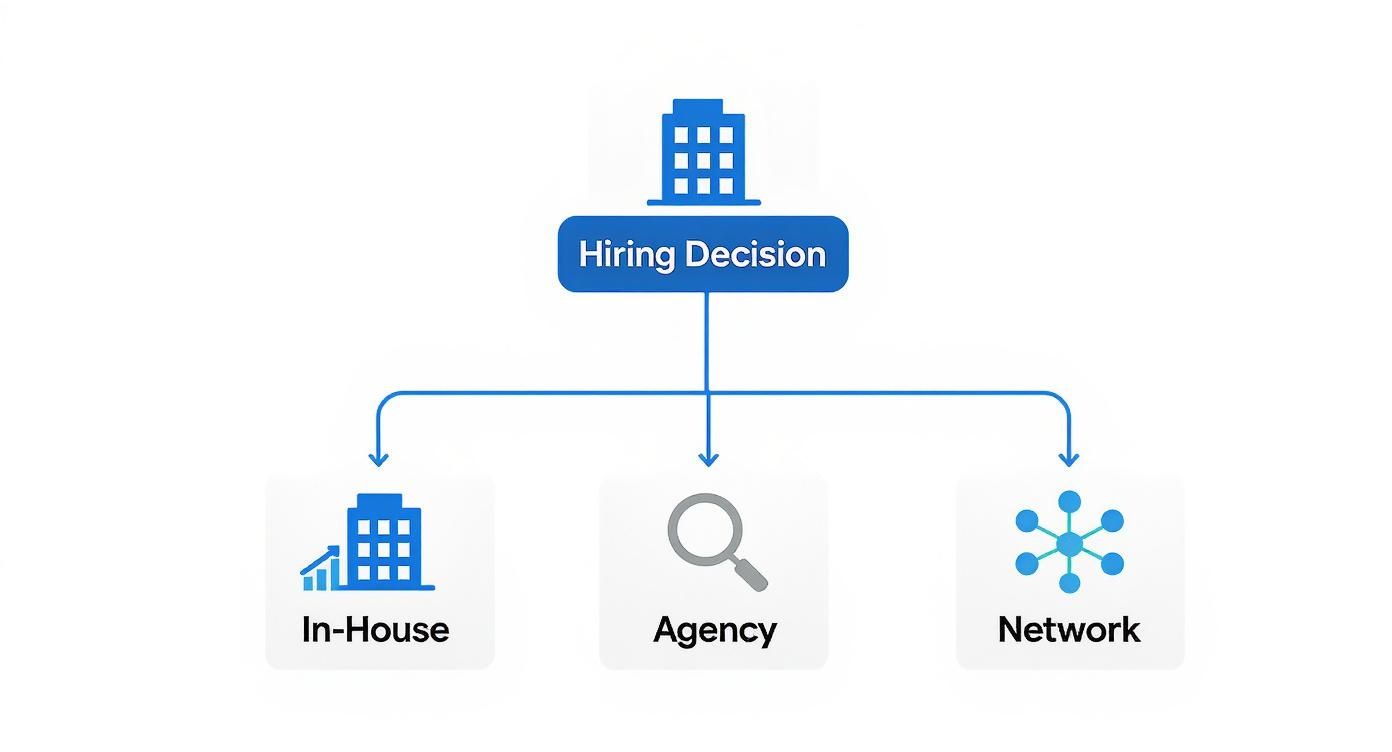
This flowchart shows how to decide on a hiring model based on role volume, speed, and specialization.
The right choice boils down to your hiring volume, urgency, and the rarity of the required skillset.
Practical Example 1: The Vendor Scorecard
Hiring the wrong recruiting partner is a direct tax on your product roadmap. A slow process means competitors ship features while you sift through resumes. You need a system for vetting potential data scientist recruiters that gets past the sales pitch.
This scorecard standardizes your evaluation and forces an objective comparison. It focuses on four critical areas: track record, network depth, vetting process, and performance metrics.
Vendor Evaluation Scorecard: Data Scientist Recruiters
Practical Example 2: The Fast Feedback Template
The single most critical factor in a successful recruiting partnership is a fast, high-quality feedback loop. Vague comments like "not a culture fit" are useless. Actionable feedback is specific and timely.
Use a structured form like this to ensure your team provides feedback that helps the recruiter calibrate their search immediately.
Candidate Interview Feedback Form
This level of detail is gold. Your recruiter now knows to screen for candidates who can clearly articulate the business impact of their work.
Deep Dive: Common Pitfalls and Trade-offs
Your choice of hiring partner always involves trade-offs between cost, speed, and control. Understanding these is key to making the right decision.
Cost Structure Trade-offs
A contingent recruiter (typically 20-30% of first-year salary) feels low-risk, but they are often juggling dozens of roles and may not be fully committed to yours. A retained search (25-33%, with a portion paid upfront) guarantees dedicated focus, which is essential for critical senior roles. This upfront investment can shave weeks off a search, preventing project delays that cost far more than the fee.
Understanding the Market Reality
The data science talent market is incredibly tight. The U.S. Bureau of Labor Statistics projects a 35-36% growth in data scientist jobs from 2022 to 2033. This demand means top candidates are often off the market in 3 to 8 weeks. A delay of even a few days in your process can mean losing your top choice. You must be prepared to move quickly and decisively.
Full-Time Salary Benchmarks (Annual Base, USD)
Red Flags to Watch For
Be wary of any data scientist recruiters who:
- Resist Performance Metrics: A partner who is defensive about committing to an SLA may not be confident in their process.
- Lack Sourcing Transparency: If they can't explain their sourcing strategy beyond "our proprietary database," they are likely just scraping LinkedIn.
- Fail to Calibrate: A recruiter who keeps sending candidates that miss the mark after you've given clear feedback isn't listening.
A great recruiting partner acts like a consultant, not a resume-forwarding service. They should challenge your assumptions and provide real market intelligence. If they aren't asking you tough questions, that's a red flag.
Checklist: How to Set Up Your Recruiter Engagement
Use this checklist to ensure your partnership is set up for success from day one.
Onboarding & Kick-off (First 48 Hours)
- Grant access to your Applicant Tracking System (ATS).
- Share key documents: detailed job description, company mission deck, team/tech stack overview.
- Schedule a 45-minute kick-off call with the hiring manager and a senior technical team member.
- Make direct introductions via email or Slack to the hiring manager and scheduler.
Service-Level Agreement (SLA) Terms
- Initial Pipeline: Define a target for the first candidate shortlist (e.g., "3-5 qualified candidates within 10-14 business days").
- Reporting Cadence: Agree on a standing weekly progress report.
- Feedback Timeline: Commit to providing structured feedback within 48 hours of each interview.
- Performance Metric: Set a target submission-to-interview ratio (e.g., 3:1).
Partnership Management
- Use the structured feedback template for all interviews.
- Review pipeline metrics weekly to identify and address bottlenecks.
- Empower the recruiter with context so they can be a compelling ambassador for your company.
What to Do Next
- Assess Your Need: Use the framework above to decide if you need an in-house team, a specialized agency, or a talent network.
- Vet Potential Partners: Use the vendor scorecard to evaluate at least two potential data scientist recruiters. Ask the tough questions and demand specific evidence.
- Launch a Pilot: Instead of committing to a long-term contract, start with a single, well-defined search. This lets you test a new partner's process and quality with minimal risk.
References & Further Reading
- Hiring Strategy: AI-powered recruiting and sourcing
- Recruiter Metrics: Social Selling Index Score
- Talent Market: Remote data science job landscape
- Process Management: Recruitment project management
Ready to accelerate your AI hiring with a partner who gets it? ThirstySprout connects you with the world's top AI and data science talent. Start a pilot today and see vetted candidate profiles in days, not months.
Hire from the Top 1% Talent Network
Ready to accelerate your hiring or scale your company with our top-tier technical talent? Let's chat.