

TL;DR
- Average Salary: A mid-level Computer Vision Engineer in the US earns an average base salary of $120,000–$140,000. Total compensation, including bonuses and equity, can be much higher.
- Experience Matters: Junior roles start around $90k–$115k, while senior engineers with 7+ years of experience command base salaries of $150k+ and can exceed $200k in tech hubs.
- High-Impact Skills: Proficiency in C++ (for performance), MLOps (for deployment), and domain expertise in areas like autonomous vehicles or medical imaging are major salary multipliers.
- Actionable Framework: To set a competitive salary, (1) define the role's business impact, (2) benchmark against market data for specific skills, and (3) adjust the cash vs. equity mix based on your company's stage.
- Startup Advantage: Use equity to your advantage. A lower base salary combined with a significant stock option grant can be more compelling long-term than a higher cash offer from big tech.
Who This Guide Is For
This guide is for founders, CTOs, and hiring managers who need to budget for and hire a computer vision engineer. If you're scoping a new AI role, trying to make a competitive offer, or deciding whether to hire a contractor versus a full-time employee, this framework will help you make a smart decision. It's written for operators who need to act within weeks, not months.
A Quick Framework for Budgeting Your Offer
Setting the right compensation for a computer vision engineer isn't about finding a single magic number. It's a three-step process to build a competitive package that attracts the right talent for your company's stage.
Define the Role and Business Impact: Before looking at data, define what success looks like. Is this engineer implementing existing models (Junior), owning a feature from end-to-end (Mid-Level), or architecting a new vision system from scratch (Senior)? Tying the role to a business outcome (e.g., "reduce product defects by 15%") directly informs the salary you should budget.
Benchmark Against Market Data: Start with a national average baseline of $120k–$140k for a mid-level engineer. Then, adjust based on two key factors:
- Location: Add a 15–25% premium for candidates in major tech hubs like the Bay Area or New York if you are hiring locally. For remote roles, stick to national averages.
- Skill Set: Add a premium for high-demand skills like C++ for performance-critical systems, MLOps experience for production deployment, or deep domain expertise (e.g., medical imaging, robotics).
Adjust for Your Company Stage (Equity vs. Cash): Your company's stage dictates your offer strategy. Early-stage startups can't compete with FAANG on cash, but they can win on equity and impact.
- Seed/Series A: Lean heavily on equity. It's common to offer a base salary 10–15% below the market rate in exchange for a significantly larger stock option grant (e.g., 0.1%–0.5%).
- Series B and Beyond/Public Co: The cash component becomes more important. Offers should be at or above the market rate, with RSUs providing a more predictable equity value.
- Base Salary: $175,000 (Slightly below the top of the market)
- Equity: 0.5% stock option grant (A substantial stake in the company's future)
- Performance Bonus: 15% target
- The Pitch: "You will be our first computer vision hire, owning the entire vision pipeline from the ground up. Your work will directly impact the company's core product and you'll have a seat at the table in key architectural decisions. This equity grant gives you a real opportunity to share in the value we build together."
- Base Salary: $210,000
- Equity: $400,000 in RSUs (vesting over 4 years)
- Performance Bonus: 20% target
- Signing Bonus: $50,000
- The Pitch: "Join a world-class team working on cutting-edge AR technology at a massive scale. We offer market-leading cash compensation, stability, and the opportunity to work on products used by millions of people."
- Junior Engineer (0–3 Years): $90,000 to $115,000. Focuses on implementing existing algorithms, cleaning data, and supporting senior team members.
- Mid-Level Engineer (4–6 Years): $115,000 to $145,000. Can own features from start to finish, optimize models, and work with more independence. They are the reliable workhorses of the team.
- Senior Engineer (7+ Years): $150,000+ base, often exceeding $180,000. Designs and leads the development of sophisticated vision systems, mentors junior engineers, and makes critical architectural decisions.
Core Technical Skills:
- Deep Learning Frameworks (PyTorch & TensorFlow): Expertise beyond basic use, such as custom layer development or performance optimization, is highly valued.
- Programming Languages (Python & C++): Python is standard, but C++ proficiency is a massive differentiator for performance-critical applications like robotics or embedded systems.
- MLOps and Deployment: Experience with Docker, Kubernetes, and cloud platforms like AWS SageMaker or Google Vertex AI is essential for shipping products. An engineer who can get a model into production is exponentially more valuable. Learn more in our guide on what a machine learning engineer is.
Domain Specializations:
- Autonomous Vehicles and Robotics: Requires expertise in sensor fusion (LiDAR, RADAR), 3D geometry, and safety-critical systems, commanding top-tier salaries.
- Medical Imaging: Involves navigating data privacy (HIPAA) and specialized formats (DICOM), demanding a unique and valuable skill set.
- Augmented & Virtual Reality (AR/VR): Requires skills in 3D reconstruction and Simultaneous Localization and Mapping (SLAM), a rapidly growing field.
- Performance Bonuses: Typically 10–20% of base salary, tied to measurable goals like model accuracy improvements.
- Signing Bonuses: A one-time payment ($10k–$30k for senior roles) to offset a candidate's forfeited bonus or unvested equity.
- Equity (Stock Options vs. RSUs): Startups use stock options to offer high-risk, high-reward upside. Public companies use Restricted Stock Units (RSUs) that have a clear, immediate cash value upon vesting.
- Define Business Impact: What specific problem will this role solve (e.g., "Reduce false positives in QC by 15%")?
- Set Seniority Level: Be honest about whether you need a junior (executes tasks), mid-level (owns features), or senior (architects systems) engineer.
- Establish a Salary Band: Use the framework in this guide to create a realistic range, including base, bonus, and equity.
- Create an Ideal Candidate Profile: What traits, beyond skills, will lead to success on your team (e.g., "self-starter comfortable with ambiguity")?
- Source Proactively: Go beyond job boards. Engage with specialized talent networks like ThirstySprout, contribute to open-source projects, and participate in relevant online communities.
- Write a Compelling Job Description: Sell the mission and the technical challenges, not just a list of required frameworks.
- Behavioral: "Tell me about a time a model failed in production. What did you do?"
- Technical: "Walk me through how you'd design a real-time defect detection system for a manufacturing line."
- Assign a Practical Take-Home Project: A small (3-4 hour) task that mirrors their daily work is the best way to assess their real-world skills.
- Structure the Full Package: Clearly present the base salary, bonus potential, and the full value of the equity grant over four years.
- Be Prepared to Negotiate: Know your walk-away point, but listen to what truly motivates the candidate—it might be title or flexibility, not just cash.
- Get Ahead of Counter-Offers: Reiterate why they were excited about your opportunity in the first place—the mission, the impact, and the team.
- Build a 90-Day Plan: Provide a clear roadmap for their first three months, with goals for learning (30 days), owning a small project (60 days), and contributing to core objectives (90 days).
- Assign an Onboarding Buddy: Pair them with a peer to help them navigate the company culture and answer questions.
- Define Your Role: Use the checklist above to create a precise definition of the role you need and its expected business impact.
- Set Your Budget: Apply our three-step framework to establish a competitive salary band that aligns with your company's stage and hiring goals.
- Start Sourcing: Engage with specialized networks to find pre-vetted talent who can meet your technical bar.
- what is a competitive salary - Salary Guide
- salary statistics on ZipRecruiter.com - ZipRecruiter
- global salary trends - Coursera
- Recruitment Process Outsourcing (RPO) models - Apply Recruiting
- hire AI engineers - ThirstySprout
- what a machine learning engineer is - ThirstySprout
- whether software engineers are in demand - ThirstySprout
Practical Examples: Two Competitive Offers
Here are two real-world examples of how to structure an offer. One for an early-stage startup and another for a more established tech company, both targeting the same senior computer vision engineer.
Example 1: The Series A Startup Offer
A startup in the ag-tech space needs its first senior computer vision engineer to build a system for detecting crop disease from drone imagery. They can't match a FAANG salary but can offer massive impact and ownership.
This offer wins by selling the mission, ownership, and significant long-term financial upside.
Example 2: The Big Tech Offer
A large, publicly traded tech company is hiring a senior engineer for its established AR team. They need someone to optimize existing models and contribute to a large, complex codebase.
This offer wins on immediate cash compensation, brand recognition, and a more predictable financial outcome from vested RSUs.
Deep Dive: What Drives a Computer Vision Engineer's Salary?
A candidate's salary is driven by their experience, location, and specialized skills. Understanding these levers is key to making a competitive offer without overpaying.
Salary Growth by Seniority
Compensation grows significantly as an engineer moves from executing tasks to architecting systems.
The Impact of Tech Hubs
While remote work has leveled the playing field, geography still influences salaries, especially for companies with physical offices. Major tech hubs like the San Francisco Bay Area, New York, and Seattle command higher pay due to intense competition for talent.
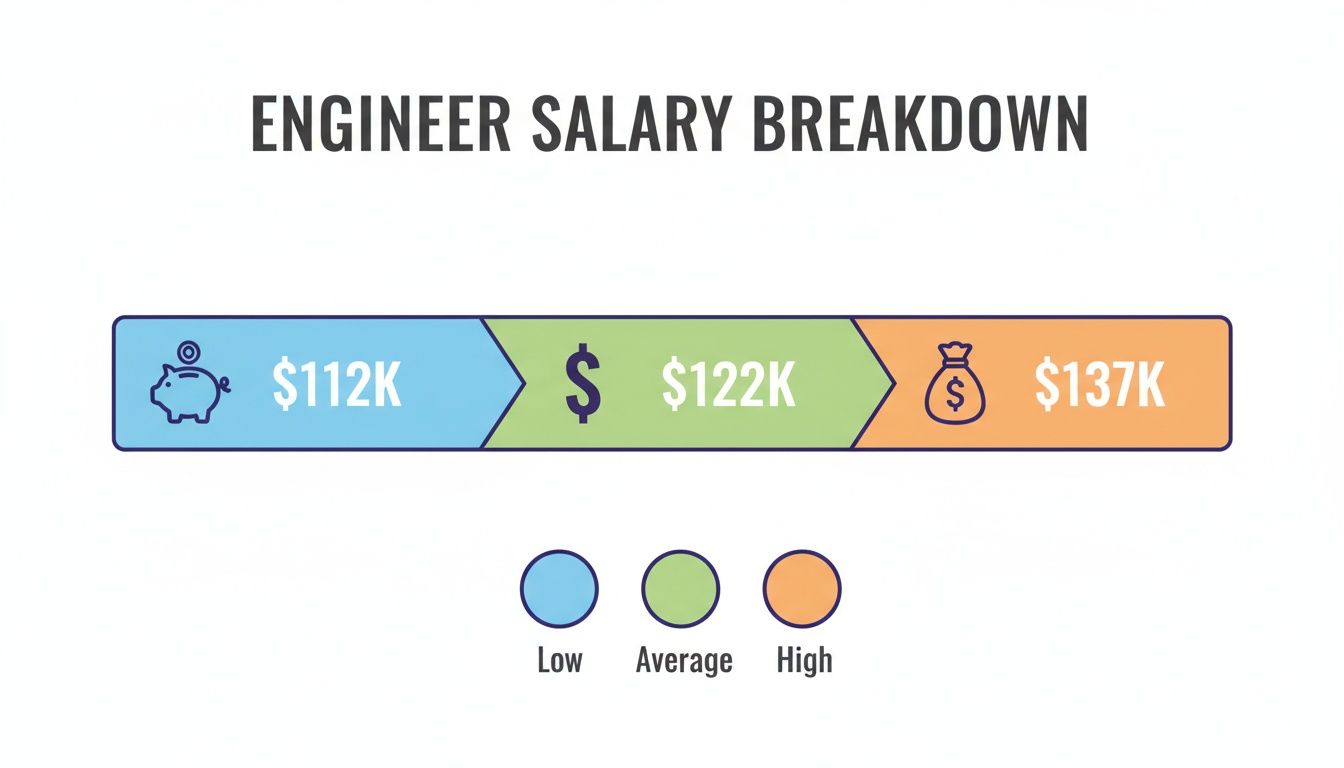
Alt text: Engineer salary breakdown displaying low ($112K), average ($122K), and high ($137K) salary tiers.
Engineers in these high-cost-of-living areas often demand a 15–25% premium on their base salary. A mid-level role that pays $130,000 nationally could easily command $150,000–$165,000 in Silicon Valley. While AI talent is in demand everywhere, as we cover in our guide on whether software engineers are in demand, these hubs are in a league of their own.
High-Impact Skills and Specializations
Beyond experience, specific technical skills act as salary multipliers.
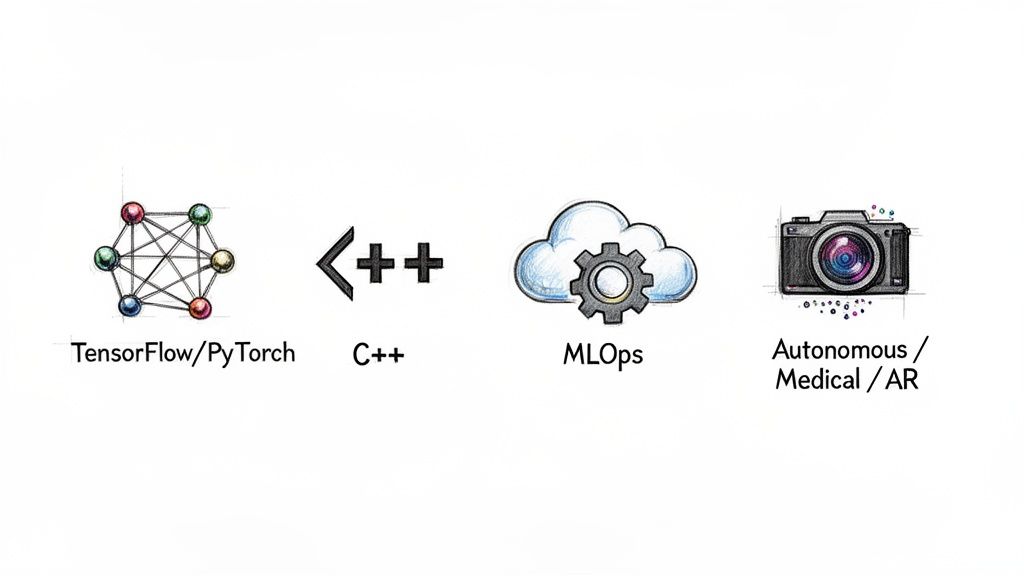
Alt text: Diagram illustrating the workflow from AI frameworks like TensorFlow to real-world applications.
Structuring Total Compensation
A competitive offer goes beyond base salary. The total compensation package tells a story about your company's stability and growth potential.
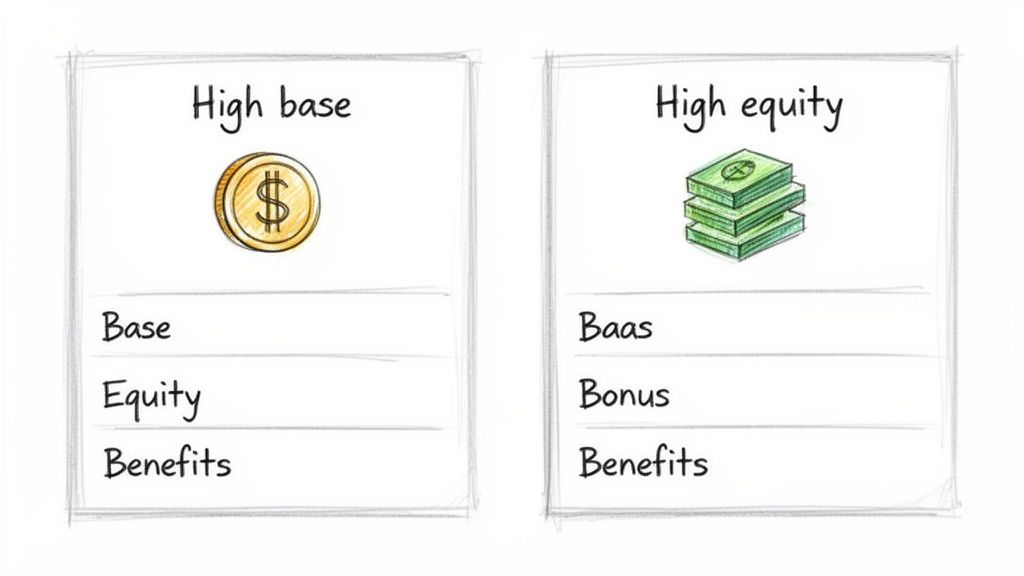
Alt text: An illustration comparing two compensation packages: 'High base' with a dollar coin, and 'High equity' with stacked money.
Hiring Checklist for Founders
Use this step-by-step checklist to scope the role, find talent, and make a winning offer.
Phase 1: Define the Role & Budget
Phase 2: Source & Vet Talent
Phase 3: Make the Offer
Phase 4: Onboard for Success
What to Do Next
Ready to hire the proven AI talent you need to build your vision? ThirstySprout connects you with the world’s top remote AI and ML engineers. Start your pilot project today.
References
Hire from the Top 1% Talent Network
Ready to accelerate your hiring or scale your company with our top-tier technical talent? Let's chat.