

TL;DR
- A Machine Learning (ML) Engineer is a software engineer who builds and deploys production-grade AI systems, turning data science prototypes into scalable products.
- Their core job is to design, build, automate, and monitor the systems that serve model predictions reliably to users. They own the bridge between R&D and a live product.
- Key skills are a hybrid of software engineering (system design, Python), ML theory (model evaluation), and MLOps (Docker, Kubernetes, CI/CD).
- When hiring, focus on production experience. Use a take-home test that involves containerizing a model and exposing it via an API to test for practical skills.
Who This Is For
- CTOs & Engineering Leaders: You need to hire ML talent and must understand the role's responsibilities to scope it correctly and avoid a costly mis-hire.
- Founders & Product Managers: You're planning to build AI features and need to know who builds them, what they do, and how to budget for the role.
- Talent & HR Leaders: You're tasked with sourcing and vetting candidates for a highly specialized technical role and need a clear definition of what "good" looks like.
The Role of an ML Engineer in 3 Steps
A Machine Learning Engineer’s job is to take a promising AI model out of the research lab and make it work in the real world. They build the factory, not just the prototype car. Their work transforms a theoretical model into a scalable, reliable product that serves real users and delivers business value.
Here's a simple framework for their core function:
- System Design: Architect a scalable system to handle data processing, model training, and delivering predictions with low latency. This is where they decide on microservices, databases, and caching strategies.
- Model Deployment & Automation: Package the trained model (using tools like Docker) and deploy it as a robust API on an orchestration platform (like Kubernetes). They build CI/CD pipelines to automate testing, retraining, and deployment.
- Monitoring & Iteration: Implement dashboards and alerts to track model performance, latency, and cost. They watch for "model drift"—when a model's accuracy degrades—and trigger automated retraining to keep the system healthy.
Understanding their role is key to figuring out how to use AI in business for concrete results.
Machine Learning Engineer vs. Data Scientist vs. MLOps Engineer
It's easy to mix these roles up. Each plays a distinct part in the AI ecosystem. This table breaks down the key differences.
A Data Scientist finds the signal, an ML Engineer turns the signal into a product, and an MLOps Engineer builds the automated highways for all the data and models to travel on.
Example 1: Building an E-commerce Recommendation Engine
A common project for an ML Engineer is productionizing a recommendation engine. A data scientist provides a prototype in a Jupyter Notebook. The ML Engineer's job is to build a system that can serve those recommendations to millions of users in milliseconds.
Architecture Diagram:
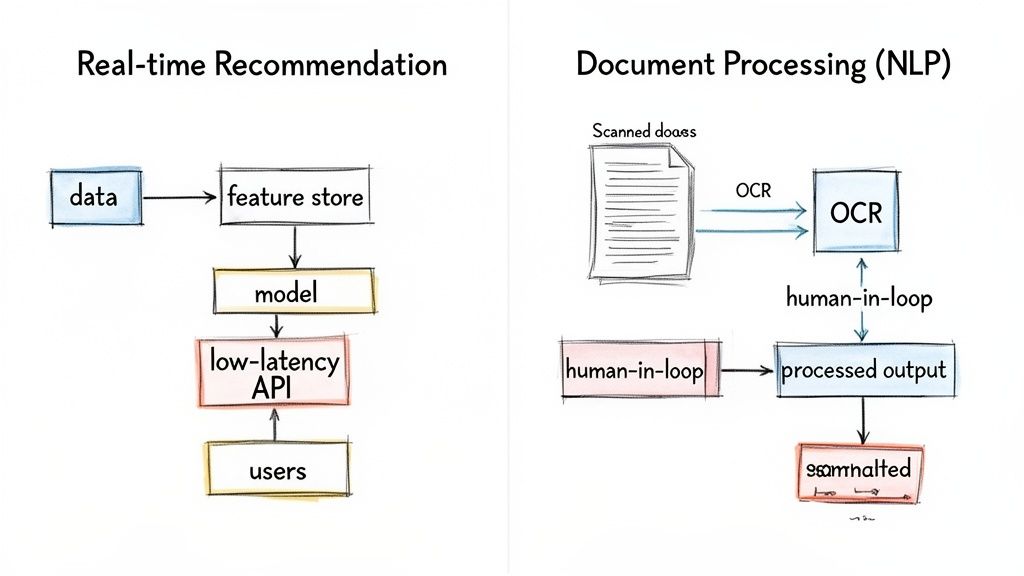
Alt text: Two diagrams illustrating machine learning workflows: real-time recommendation and document processing with NLP.
ML Engineer’s 90-Day Plan:
- Month 1 (System Design & API): Design the microservice architecture. Containerize the model with Docker and deploy a simple REST API using FastAPI. Set up an initial deployment on Kubernetes.
- Month 2 (Pipeline & A/B Testing): Build the automated data pipeline to feed new user interactions into the model. Implement an A/B testing framework to measure the new engine against the old one, tracking click-through rate (CTR) and conversion.
- Month 3 (Monitoring & Automation): Set up Grafana dashboards to monitor API latency, error rates, and model accuracy. Implement the CI/CD pipeline for automated weekly retraining and deployment.
Business Impact: A well-built recommendation engine can directly increase revenue. A typical outcome is a 5–15% lift in click-through rates and a 3–7% increase in average order value within two quarters of launch.
Example 2: Sample Interview Question & Good Answer
When interviewing, you need to test for practical, production-oriented thinking. Here is a typical system design question.
Interviewer Question:
"We have a fraud detection model trained by our data science team. It performs well in offline tests, but it takes 500ms to return a prediction. Our payment processing SLA is 200ms. How would you architect a system to deploy this model in production?"
A Strong Candidate's Answer:
"A 500ms latency is too high for a synchronous call in the payment flow. I'd propose a hybrid architecture.
- Offline Scoring: For most transactions, we can run the model asynchronously. We'll build a streaming pipeline using Kafka that feeds transaction data to the model. The model's score is written to a low-latency key-value store like Redis. The payment service can look up the pre-computed score in under 10ms.
- Real-time Fallback: For high-value transactions or new users with no history, we may need a real-time check. I'd investigate model optimization techniques like quantization or knowledge distillation to try and shrink the model's latency. If we can get it down to ~150ms, we can use it synchronously.
- Monitoring: I'd set up alerts in Prometheus to monitor the end-to-end latency of the async pipeline and the prediction latency of the real-time model. We also need to track model accuracy and drift to ensure it remains effective.
This approach balances business needs (speed) with technical constraints (model latency) and includes critical operational safeguards."
This answer demonstrates an understanding of trade-offs, system design patterns, and the importance of monitoring—hallmarks of a senior ML Engineer.
Deep Dive: Core Competencies and Pitfalls
Hiring the right ML Engineer is a make-or-break decision. A great one builds systems that become core to your revenue, while a poor hire can burn months of runway on brittle prototypes. A top-tier ML Engineer is a hybrid: they have the disciplined coding habits of a software engineer, the theoretical chops of a data scientist, and the pragmatic thinking of a DevOps pro.
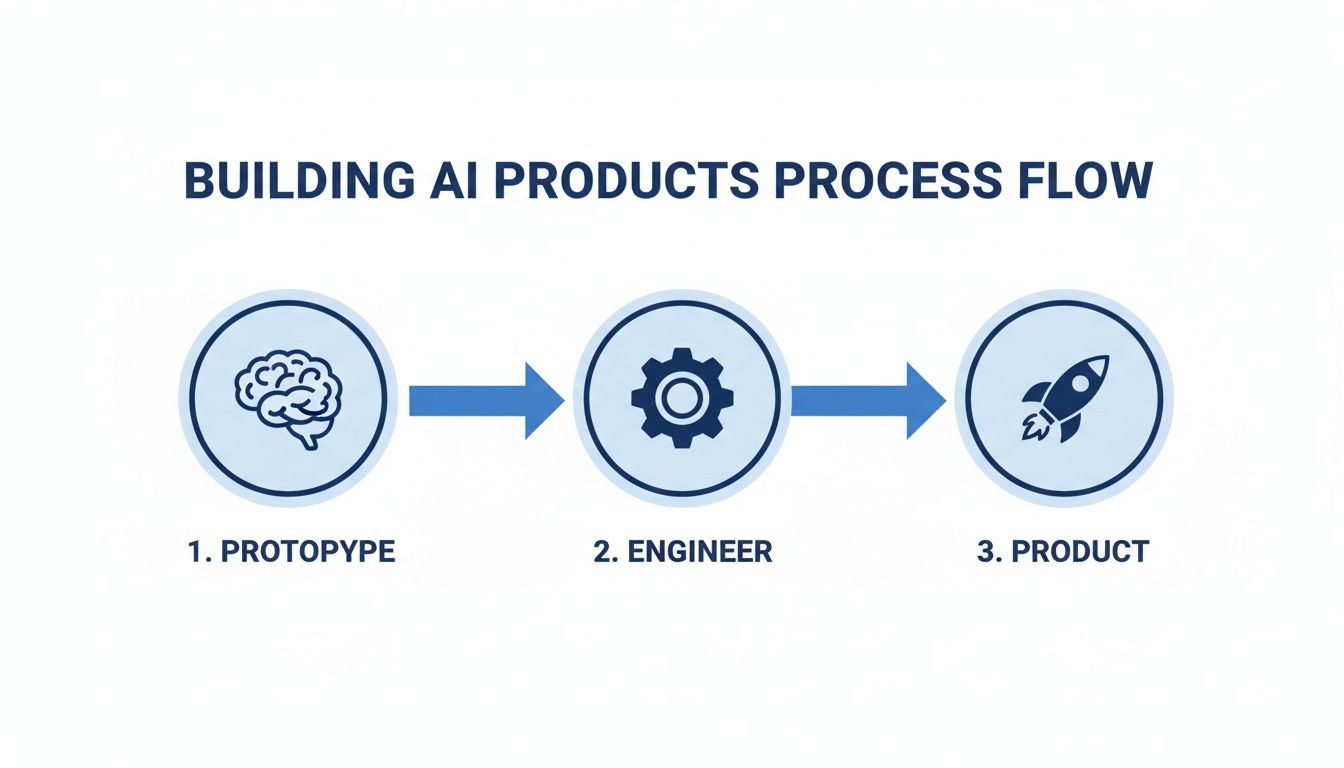
Alt text: A flowchart illustrating the three-step process for building AI products: Prototype, Engineer, and Product.
Key Competencies
- Software Engineering Fundamentals: An ML Engineer is a software engineer first. They need a strong command of Python, data structures, algorithms, and system design. Without this, their code will not survive in a production environment.
- Deep ML Knowledge: They must understand what's under the hood of common models and evaluation metrics. Someone who can't explain the trade-offs between precision and recall for your business problem is a red flag. They should have a framework to compare AI models based on cost, latency, and accuracy.
- Modern MLOps Practices: This is what separates a professional from an amateur. Proficiency in Docker, Kubernetes, CI/CD pipelines, and monitoring tools is non-negotiable for building automated, reliable systems. Following MLOps best practices is essential.
Common Pitfalls to Avoid
- Hiring Too Early: Don't hire an ML Engineer to "figure out your AI strategy." Hire them when you have a validated model prototype from a data scientist and a clear business problem to solve.
- Under-budgeting: Top ML talent is expensive. Total compensation for a senior engineer in the US often exceeds $250,000. Budgeting only for base salary is a common mistake that leads to losing top candidates.
- Focusing on Theory Over Practice: Academic knowledge is good, but production experience is better. The best candidates can tell you stories about systems they built, how they failed, and what they learned. Our guide on how to hire machine learning engineers provides a detailed interview plan.
Checklist: ML Engineer Skill Evaluation Matrix
Use this matrix during interviews to assess a candidate's practical skills. A senior candidate should demonstrate high proficiency across all categories.
What to Do Next
- Assess Your Readiness: Use the "Pre-Hiring Checklist" in this guide. If you don't have a validated prototype and a clear business problem, focus on your data science capabilities first.
- Scope the Role Correctly: Use the skill matrix and example interview questions to draft a hyper-specific job description. Clearly define the business problem the engineer will own in their first 90 days.
- Book a Scoping Call: If you need to hire an expert ML engineer in the next 2–4 weeks, we can help. ThirstySprout connects you with pre-vetted, senior AI talent ready to start a pilot project.
Ready to find the right ML engineer without the hiring headaches?
References
- Payscale, Machine Learning Engineer Salary Data
- Levels.fyi, Machine Learning Engineer Compensation
- ThirstySprout, Machine Learning Salary Guide
Hire from the Top 1% Talent Network
Ready to accelerate your hiring or scale your company with our top-tier technical talent? Let's chat.