

Skills-based hiring is a recruitment model that evaluates candidates on demonstrated abilities, work samples, and structured assessments instead of degrees, job titles, or pedigree. A hire made on skills rather than education is five times more likely to predict job performance than a degree-based hire.
If you're hiring AI engineers, ML engineers, or MLOps talent, that should get your attention fast. A credential-heavy funnel looks tidy, but it misses too many people who can ship.
Skills-Based Hiring in One Minute
Skills-based hiring means you define the capabilities that predict success in a role, then test those capabilities directly. In practice, that means you choose a small set of job-relevant competencies, score every candidate with the same rubric, and use work samples, simulations, or technical interviews to measure what they can do, not where they studied.
The reason this matters is simple. Credentials are a noisy proxy. Skills are the signal.
BCG's finding that a skills-based hire is five times more likely to predict job performance than a degree-based hire is the headline, but the mechanics matter more than the headline. If you're running an AI team, the question isn't whether the model sounds fair. The question is whether it predicts who will debug production systems, make clean trade-offs, and work across product, design, and engineering without drama.
Blunt rule: if your hiring loop still starts with school pedigree, you're optimizing for convenience, not performance.
The rest of this article is the operating manual. You'll see how to define the right competencies, build a scoring system that interviewers can use, design assessments that mirror real work, and measure whether the new process is better than the old one. If you want the short answer, it's this, skills-based hiring works when you treat hiring like an evaluation system, not a resume sorting contest.
Skills-Based Hiring Versus Credential-Based Hiring
Credential-based hiring asks for resumes, degree filters, GPA screens, and prestige signals. It's familiar because it's easy to run, not because it's accurate. A degree tells you something about access to education, but it doesn't tell you whether someone can ship a reliable model, debug a failed pipeline, or explain trade-offs to a product manager under pressure.
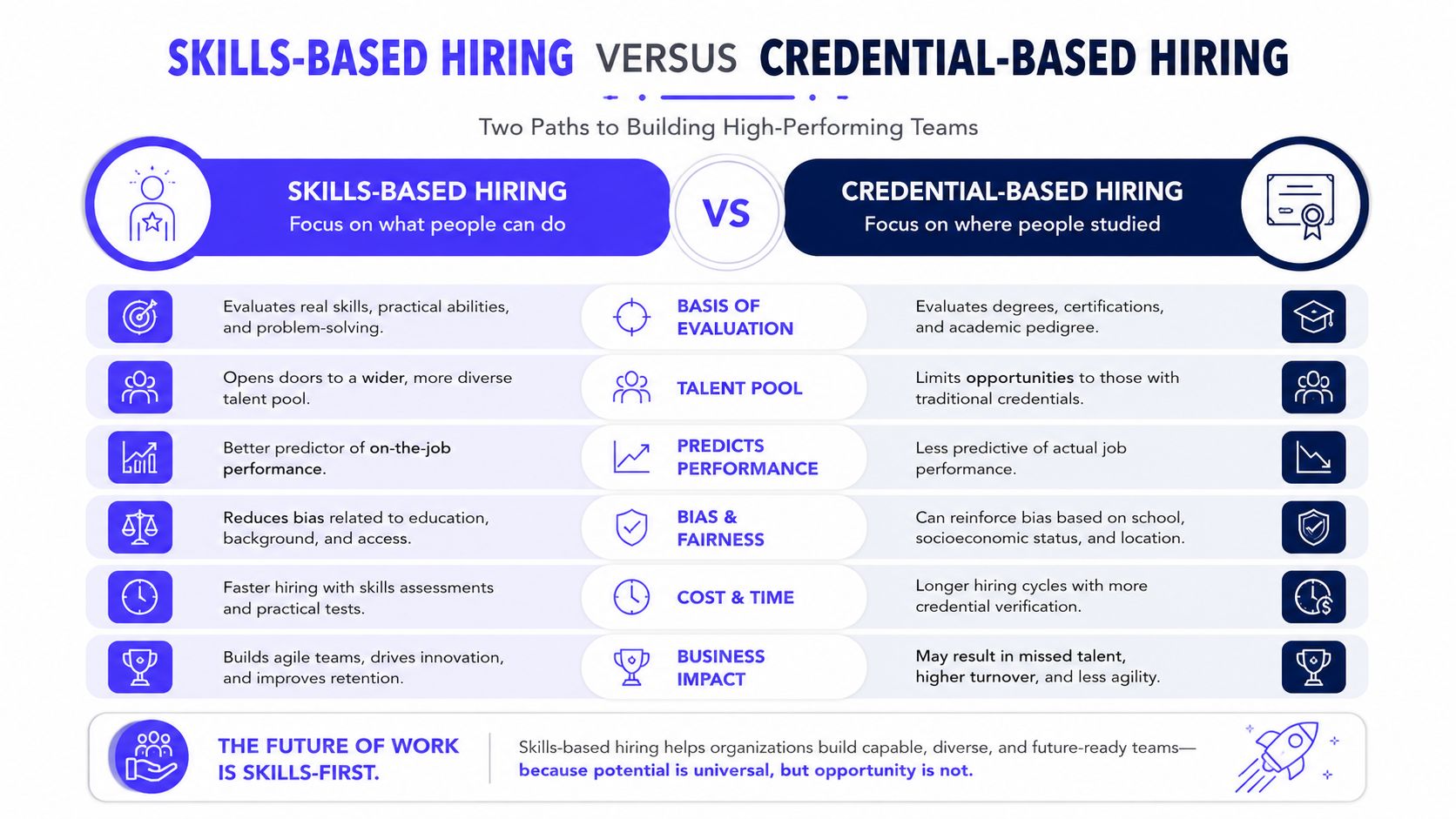
Skills-based hiring flips the logic. It asks for observable proof, then scores that proof against the same job standard for everyone. That's why it's more defensible, and why it works better when the talent pool is messy, which is almost always the case in AI.
What each model really measures
A credential screen asks, “Did this person have access to strong training?” A skills screen asks, “Can this person do the job?” Those are not the same question, and if you're hiring for technical roles, mixing them up is expensive.
For AI teams, the gap shows up immediately. The strongest candidate might be a self-taught engineer who shipped retrieval systems in a startup. Another might be a backend engineer who's already handled latency, observability, and production incidents, even if their title never said “AI.” A credential-first funnel often hides both of them.
A simple decision test
If your current process would surface a new grad from a top program before a senior LLM engineer who has shipped two retrieval systems, your funnel is too dependent on pedigree. That doesn't mean degrees are useless. It means degrees should be context, not the gate.
Use skills to decide who gets in the door. Use experience and education later to understand trajectory, not to substitute for proof.
The Four Mechanics That Make Skills-Based Hiring Work
Most teams say they use skills-based hiring when they really mean they added a coding test. That's not enough. A real process has four mechanics, and if you skip one, the whole thing gets noisy.
1. Define the competency set from job outcomes
Start with what the role owns in the business, not with a recycled job description. If the role is “ship a production RAG feature,” the competencies should reflect that outcome, such as system design, debugging, evaluation judgment, and cross-functional communication. TestGorilla's definition of skills-based hiring centers on job-relevant skills, and NACE frames it the same way, with competencies taking priority over degrees.
2. Score everyone with one rubric
Rubrics stop interviewers from improvising. They also force consistency, which is the difference between a hiring process and a debate club. Every candidate should be scored against the same evidence and the same anchors, or your results will drift fast.
3. Use work samples, not trivia
The best assessments look like the job. A debugging task, a notebook review, a system design exercise, or a customer-facing scenario tells you far more than theory questions do. For engineering and AI roles, this approach tests actual reasoning, not memorized syntax.
4. Calibrate against post-hire performance
If your scores don't line up with what people do in the first 90 days, your rubric needs work. That calibration loop is what turns hiring from opinion into a learning system. Without it, you're just collecting opinions more efficiently.
If you need a lightweight tool to help candidates communicate their evidence before the interview, the AI LinkedIn viral content generator is one of those odd utilities that can surface how someone frames technical work in public. Use it carefully. The point is clarity, not polish theater.
Building the Role From the Skills Up
Start with the outcome, then reverse-engineer the skills. That's the cleanest way to avoid vague job descriptions that attract everyone and predict nothing.
Build the matrix from the work
For a senior AI engineer, pick 3 to 6 competencies that move the role forward. Don't crowd the rubric with every nice-to-have on earth. Too few competencies creates false positives, because almost anyone looks acceptable. Too many spreads the signal so thin that you can't tell who's strong.
| Competency | Job-Relevant Evidence | Assessment Type |
|---|---|---|
| Designs and ships LLM-backed features | Shipped a feature with retrieval, prompt iteration, evaluation, and rollout discipline | Take-home plus system design interview |
| Debugs production ML systems | Has found root causes in data, infra, or model behavior under real constraints | Live debugging exercise |
| Communicates technical trade-offs to PMs and designers | Can explain failure modes, latency trade-offs, and user impact clearly | Structured interview |
| Builds reliable evaluation workflows | Uses repeatable criteria, not vibes, to compare outputs and track regressions | Work sample review |
| Learns fast in ambiguous problem spaces | Adapts approach after seeing a new dataset, bug, or product constraint | Behavioral interview |
That table is the whole move. If you can't write this down cleanly, you don't understand the role well enough to hire for it.
Use your requisition as a filter, not a wish list
Your requisition should describe evidence, not aspirations. “Strong communicator” means nothing unless you say what good communication looks like in this role. “Passion for AI” is worse than useless. It attracts noise and blocks real signal.
If you want a tighter starting point for the role itself, the AI engineer job description gives you a useful baseline for turning role outcomes into hireable competencies.
Practical rule: if you can't tie a competency to a decision the person will make in the first 90 days, cut it.
Two Teams, Two Implementations of the Same Framework
A good framework doesn't need one perfect setup. It needs the right amount of structure for the team you have.
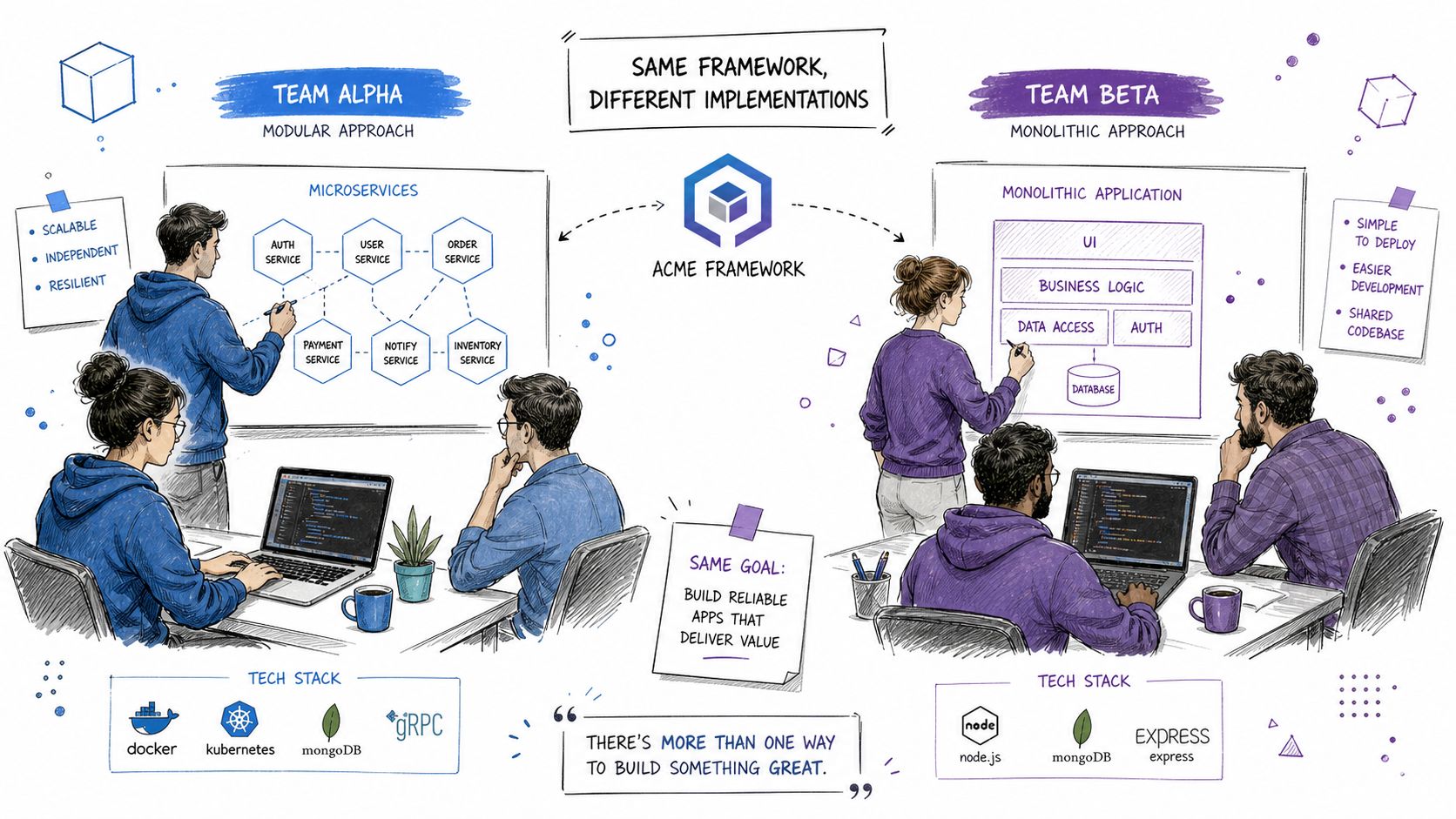
A 12-person Series A startup hiring its first senior ML engineer can't afford a bloated loop. They use a two-hour take-home with two parts, one debugging an ML pipeline, the other a short system design write-up. Then they run a 90-minute structured interview scored against 3 competencies. The result is a narrower funnel with less waste, because they stop screening on pedigree and start screening on evidence.
Startup version, fast and disciplined
The startup keeps the process tight because speed matters. One assessment shows whether the candidate can reason through production issues. One interview shows whether they can explain choices clearly and work with the team. They don't need five rounds. They need one process that's hard to game.
Scaleup version, broader and more durable
A Series B scaleup hiring a staff MLOps engineer across three time zones needs more coverage. They use an asynchronous work sample, a live system design session, and a stakeholder interview with the data product manager. The same five-competency rubric scores everything, but the mix of evidence is broader because the role touches more people and more systems.
Later in the loop, teams can use a short calibration review to compare notes before a final decision. That keeps the process from turning into a popularity contest.
The point is not to copy either setup exactly. The point is to keep the framework stable and vary the assessment mix based on seniority, time pressure, and team complexity.
A Sample Assessment Task and Scorecard You Can Use Today
Use a real job problem, not an abstract puzzle. For a mid-level AI engineer, give a 90-minute take-home centered on a customer-support copilot. Include a small retrieval-augmented generation pipeline with two deliberate bugs, plus a public evaluation set they can run locally.
The task
The candidate gets three deliverables. First, a written diagnosis of what's broken. Second, a fixed pipeline. Third, a short note on how they'd improve retrieval quality at scale. That combination tests reasoning, not just typing speed.
The task should feel like the job. If your real team works on retrieval, evaluation, and rollout quality, then the assessment should too. Don't hand them a puzzle that only tests whether they memorized framework syntax.
The scorecard
| Competency | Weight | 1 | 2 | 3 | 4 |
|---|---|---|---|---|---|
| Debugging under realistic conditions | 30 | Misses the core issue | Finds symptoms but not root cause | Finds the main bug and explains it | Finds both bugs and explains why they happened |
| System design judgment | 25 | Suggests brittle or unsafe changes | Offers partial fixes | Chooses sensible trade-offs | Designs for reliability, scale, and maintainability |
| Written communication | 20 | Hard to follow | Understandable but vague | Clear and organized | Clear, concise, and decision-ready |
| Learning velocity | 25 | Stays stuck | Needs heavy prompting | Adapts after feedback | Learns quickly and improves the solution well |
That adds up to 100 points. Keep the anchors visible during grading, and score the same way every time. If you want a stronger interview library around this kind of loop, the AI engineer interview questions page is a useful companion when you're shaping the live round.
Fairness rule: the same prompt, the same time box, the same rubric, and a calibration meeting before any offer goes out.
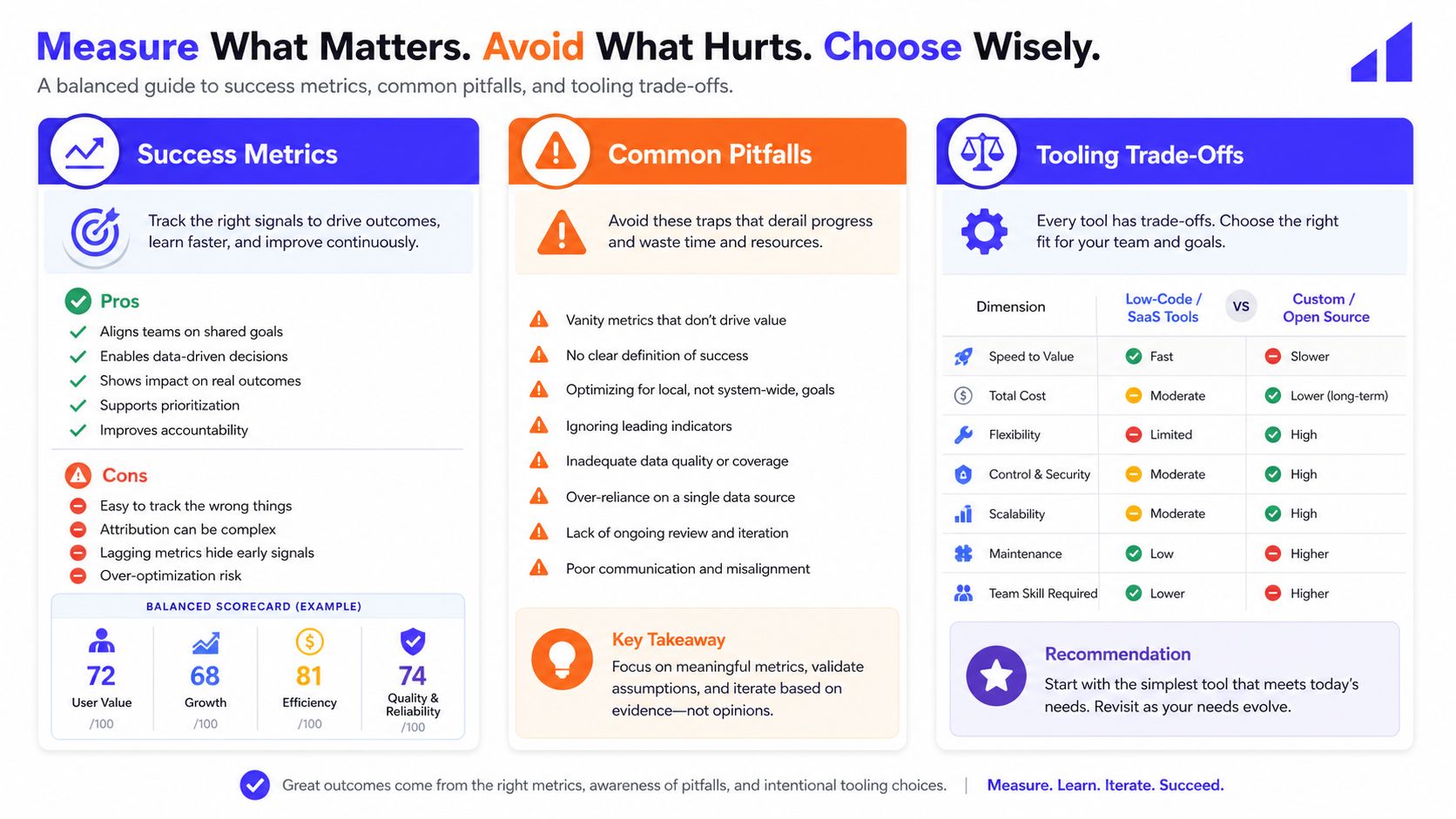
Success Metrics, Common Pitfalls, and Tooling Trade-Offs
If you can't measure the hiring loop, you're guessing. Track pass-through rates by stage, time to shortlist, and quality-of-hire signals at 90 and 180 days. Also monitor adverse impact by demographic so you can catch a process that looks clean but behaves badly.
What usually breaks
Rubric drift is common. One interviewer gets stricter, another starts rewarding confidence over evidence, and the process stops being comparable. Long take-homes also ruin candidate experience fast, and generic coding tests create false positives because they measure test-taking skill more than role fit.
How teams choose tooling
You've got three basic options. You can build scorecards in Notion or Greenhouse if you want full control. You can buy vendor assessments from tools like TestGorilla or Codility if speed matters more than role nuance. Or you can use a partner model, where a team like ThirstySprout runs the loop and adapts the rubric to the role.
The trade-off is real. Vendor tools save time but flatten specificity. In-house scorecards are sharper, but they demand disciplined calibration. Outsourced loops only work if the partner learns your role and doesn't force you into a canned test.
For teams that care about executive-level interviewing discipline, mastering executive presence is a good reminder that technical depth and clear communication need to travel together in the final round.
If you're tracking the business side more closely, the quality of hire metrics page helps connect hiring process data to post-hire outcomes without pretending the numbers are prettier than they are.
Your First 30 Days and What to Do Next
Start small and run the old funnel in parallel. Week one, pick 2 pilot roles and write a 4-to-6 competency matrix for each. Week two, build the scorecard, run one calibration round with 2 interviewers, and choose the assessment mix.
Week three, use the new loop on a live requisition while the old funnel still runs. Week four, compare pass-through rates, candidate experience feedback, and the first quality-of-hire signals from the new hires' first 30 days. If the new process surfaces better people faster, expand it. If it doesn't, tighten the rubric before you scale it.
A simple 30-day checklist
- Pick the roles: Choose one technical role and one adjacent role that matter to the business now.
- Write the matrix: Define the competencies, evidence, and assessment type for each role.
- Run calibration: Get 2 interviewers to grade the same sample so you can catch drift early.
- Launch the pilot: Keep the old process live until you trust the new one.
- Review the signals: Look at shortlist speed, quality of candidates, and early performance.
If you want to move faster, book a short scope call, see sample AI engineer profiles, or download a role-specific skills matrix template. The sooner you put the rubric on paper, the sooner your hiring process stops being a guessing game.
ThirstySprout helps teams turn skills-based hiring into a working process for AI and ML roles, from competency design to vetted candidate matching. If you're hiring senior AI talent and want a faster way to pilot the framework, visit ThirstySprout and start with a scoped search built around the actual skills your role needs.
Hire from the Top 1% Talent Network
Ready to accelerate your hiring or scale your company with our top-tier technical talent? Let's chat.