

TL;DR
- Be specific: A great AI engineer job description sells a mission, not just a list of skills. Focus on the business impact and core technical challenges.
- Filter for production experience: Attract senior talent by demanding proven experience deploying and maintaining live AI systems. This is the most critical filter.
- Use our template: The included template is structured to attract engineers who can ship. It focuses on mission, ownership, and measurable outcomes.
- Assess with a practical task: Use our take-home assignment (build a RAG prototype) and evaluation rubric to test for real-world problem-solving, not just trivia.
- Next step: To bypass the slow, competitive hiring market, tap into a pre-vetted network. Start a Pilot with a senior AI engineer in 2–4 weeks.
Who this guide is for
This guide is for CTOs, hiring managers, and founders who need to hire AI engineers capable of shipping production-ready systems. If you're tired of generic job descriptions that attract under-qualified candidates, this framework will help you write a post that filters for top-tier, senior talent.
A Framework for a Job Description That Attracts Top AI Talent
A great AI engineer job description does more than just list skills. It tells a story—outlining the mission, the specific technical puzzles to be solved, and the real-world business impact of the role. This is your first and most important filter to attract serious, senior talent.
To consistently attract candidates who deliver real-world results, build your job description on these four pillars:
- Mission & Impact: Be direct about the problem they will solve. Instead of "develop ML models," try: "build the AI-driven fraud detection system that protects our users and saves the company an estimated $2M annually." This connects their work to business outcomes.
- Core Technical Challenges: Get specific about the 1-2 biggest hurdles they’ll face. Details like "re-architecting our feature store for real-time processing" or "optimizing our LLM inference pipeline on NVIDIA Triton" are what attract true problem-solvers.
- Production Experience: Make it clear that you need someone who has shipped and maintained AI systems in the wild. This is a crucial filter for senior roles and signals you value practical, applied skills.
- Success Metrics: Lay out what a successful first 6-12 months looks like. This shows candidates you have a clear vision for the role and gives them a concrete understanding of your expectations from day one.
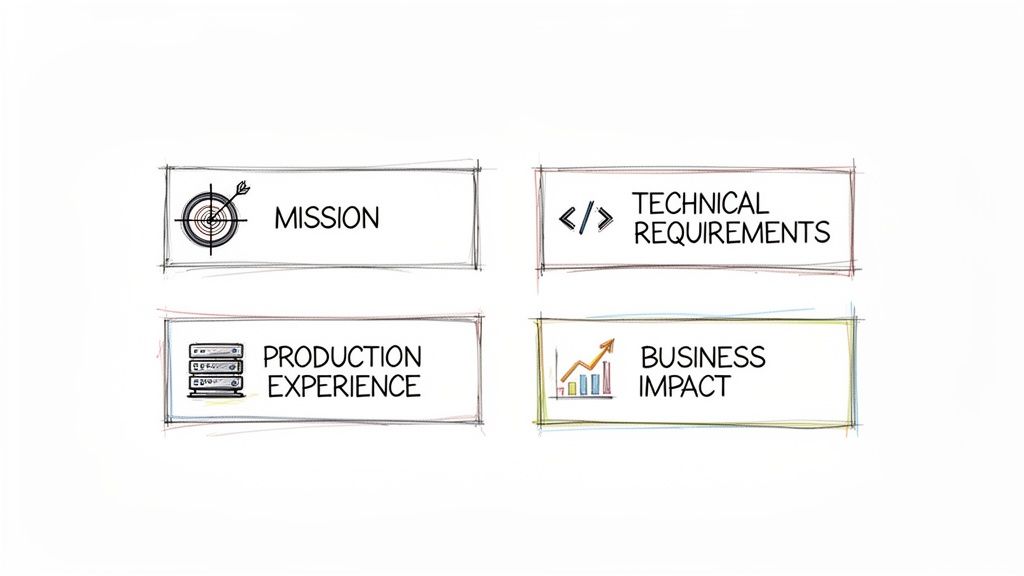
alt text: A diagram showing the four key pillars of an effective AI engineer job description: Mission, Technical Requirements, Production Experience, and Business Impact.
Practical Examples of Job Description Snippets
Here are two real-world examples to illustrate how to apply the framework. One is a high-level job summary, and the other is a specific technical challenge you can include.
Example 1: High-Impact Job Summary
A truly effective job description connects the role directly to your company's bigger goals. It doesn't just answer what the engineer will build; it explains why their work is critical.
Example 2: Sample Interview Question for System Design
To assess a candidate's practical skills, ask them to architect a real-world system. This question tests their ability to think about trade-offs, scalability, and business constraints.
Interview Prompt:
"We need to build a system that can summarize thousands of customer support tickets per day to identify trending issues. Walk me through your high-level architecture. What are the key components? What are the biggest risks or trade-offs you'd consider (e.g., cost vs. accuracy, latency, choice of model)?"
A strong answer would cover data ingestion, choice of summarization model (e.g., fine-tuned T5 vs. a larger general model like GPT-4), the infrastructure for processing, how to handle failures, and a plan for evaluating the quality of the summaries.
The Definitive AI Engineer Job Description Template
A generic job description pulls in generic candidates. If you want to hire specialists who can ship production-ready systems, you need a post that speaks their language—one that zeroes in on impact, autonomy, and the specific technical puzzles they'll solve.
This template is designed for a Senior AI Engineer role but is easily adapted. I’ve included annotations to explain the "why" behind the language, helping you attract engineers who are a genuine fit.
Senior AI Engineer [Generative AI/MLOps/Vision]
[Your Company Name] | [Location: e.g., Remote (US/EU Timezones)]
Mission and Impact
Annotation: Always lead with the "why." Senior talent isn't looking for a list of tasks; they want to solve meaningful problems. Frame the role around the business or user impact they’ll have.
As a Senior AI Engineer, you will own the core intelligence behind our [Product Name]. Your mission is to design, build, and deploy the AI systems that will directly [Primary Business Outcome, e.g., cut customer support resolution time by 30% or boost user engagement by 15%]. You’ll tackle complex challenges in [mention 1-2 key problem areas, e.g., real-time model inference or reducing model hallucinations], and your work will immediately shape a product used by thousands.
Key Responsibilities
Annotation: Use strong action verbs and focus on end-to-end ownership. This signals you trust your engineers to run a project from whiteboard to production.
- Design and build production-grade machine learning systems, starting with our [specific application, e.g., RAG-based Q&A feature].
- Deploy, monitor, and maintain AI models in a live environment, ensuring high availability and performance on our [mention cloud, e.g., AWS/GCP] infrastructure.
- Collaborate closely with product managers and other software engineers to define requirements and integrate AI into our core platform.
- Mentor junior engineers and help establish best practices for MLOps, code quality, and system reliability.
Core Technical Skills
Annotation: Be specific and realistic about the must-haves. This is your most important filter. Mentioning your core stack (like Python, PyTorch, or Kubernetes) attracts people who can hit the ground running.
- 5+ years of hands-on experience building and deploying machine learning models in a real-world production environment.
- Expert-level proficiency in Python and deep experience with at least one major ML framework like PyTorch or TensorFlow.
- Proven experience with MLOps tools for CI/CD, monitoring, and orchestration (e.g., Kubernetes, Docker, Kubeflow, MLflow).
- A strong grasp of [choose a relevant area, e.g., Large Language Models (LLMs), computer vision algorithms, or distributed systems].
Expected Outcomes
Annotation: This section tells candidates what success looks like and shows that you have a clear plan for them. It helps them visualize their impact in the first year.
- Within 3 months: You will ship your first production model or a major system improvement that measurably moves a key metric, like [specific metric, e.g., search result accuracy].
- Within 6 months: You will take full ownership of a core AI service, driving its performance, reliability, and future roadmap.
- Within 12 months: You will be leading the architectural design of a next-generation AI feature and helping shape our long-term technical strategy.
Deep Dive: Tailoring Job Descriptions for AI Specializations
A generic "AI Engineer" title doesn't cut it anymore. Top talent identifies with specific domains. Posting for an "LLM Engineer" or "MLOps Engineer" sends a clear signal: you know what you're looking for and have a well-defined problem to solve. This drastically improves applicant quality.
LLM and Generative AI Engineer
This role is for teams building products on top of Large Language Models (LLMs). These engineers handle everything from Retrieval-Augmented Generation (RAG) to fine-tuning open-source models for specific tasks.
- What they do: Design RAG pipelines, fine-tune models like Llama 3, and create evaluation frameworks to reduce model hallucinations.
- Tech keywords: LangChain, LlamaIndex, Hugging Face, vector databases (Pinecone, Weaviate), PyTorch.
MLOps Engineer
If your biggest challenge is getting models into production reliably, you need an MLOps Engineer. This role bridges machine learning and DevOps, building automated infrastructure for model training, deployment, and monitoring. For a deeper dive, see our guide on the machine learning engineer role.
- What they do: Build CI/CD pipelines for models, manage cloud infrastructure (AWS SageMaker, GCP Vertex AI), and monitor for model drift.
- Tech keywords: Kubernetes, Docker, Kubeflow, MLflow, Terraform, CI/CD tools (Jenkins, GitLab CI).
Computer Vision Engineer
For projects that need to understand images or video, the Computer Vision Engineer is your expert. They tackle object detection, image segmentation, and facial recognition, often involving large-scale web data use cases in AI pipelines.
- What they do: Develop deep learning models for image classification, implement real-time object detection, and optimize algorithms for edge devices.
- Tech keywords: OpenCV, PyTorch/TensorFlow, YOLO, CNNs, GPU programming (CUDA).
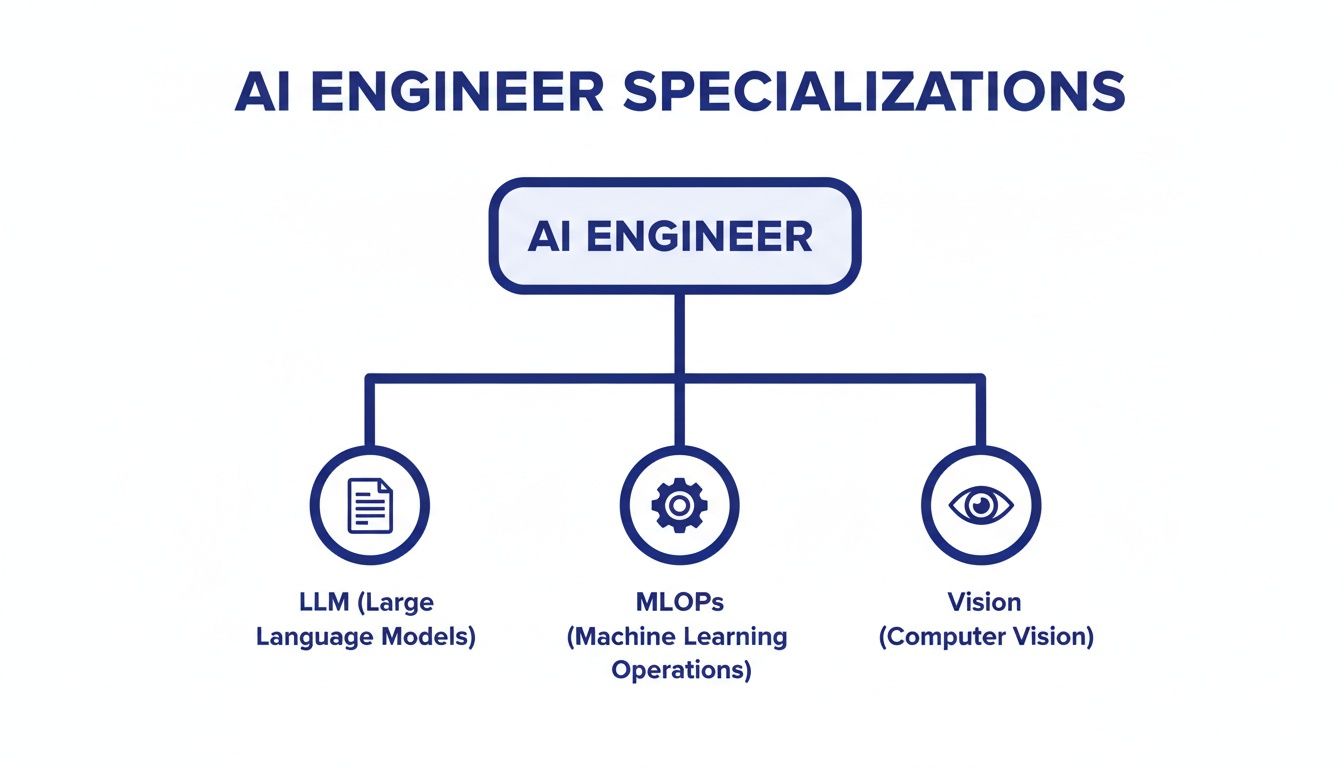
alt text: An organizational chart showing three specializations branching from the core AI Engineer role: Large Language Models, MLOps, and Computer Vision.
Checklist: A Real-World Interview Kit for AI Engineers
A great job description gets people in the door, but the interview reveals if a candidate can build. This kit helps you assess the skills that truly matter: problem-solving, production readiness, and clear communication.
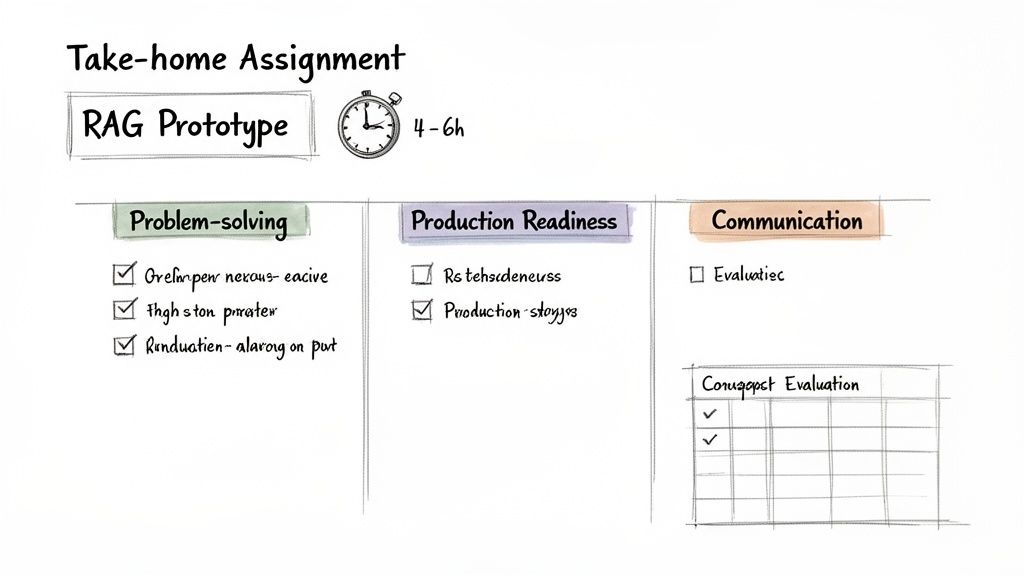
alt text: A checklist for an AI engineer take-home assignment to build a RAG prototype, covering problem-solving, production readiness, and communication skills.
Take-Home Assignment: Build a RAG Prototype
This focused task lets a candidate show end-to-end thinking. It's designed for 4–6 hours to respect their time while providing deep insight.
Assignment Brief:
- Objective: Build a prototype Retrieval-Augmented Generation (RAG) system to answer questions based on a small set of provided documents (e.g., 10–15 company blog posts).
- Ingestion & Chunking: Script document processing, chunking, and embedding creation.
- Retrieval: Implement a method to find relevant document chunks for a given question.
- Generation: Use a pre-trained LLM (from Hugging Face or an OpenAI API) to generate an answer using the retrieved context.
- A Git repository link.
- A
README.mdexplaining design choices and providing clear setup instructions. - Base Salary: Ground your number in current market data for the specific role and location.
- Equity/Stock Options: This is a powerful magnet for senior talent, giving them a stake in the outcome.
- Performance Bonuses: Tie bonuses to clear results, like improved model accuracy or a successful system launch.
- Professional Development: A dedicated budget for conferences and certifications shows you invest in their career growth.
- Draft Your Job Description: Use the template in this guide to create a post that focuses on mission and impact.
- Benchmark Candidates: See Sample Profiles of our vetted AI engineers to understand what top talent looks like.
- Hire Faster: Start a Pilot with a remote expert in as little as two weeks to solve your immediate AI challenges.
- NVIDIA Triton Inference Server Documentation. (NVIDIA Triton)
- Official Python Language Website. (Python)
- Official PyTorch Deep Learning Framework. (PyTorch)
- Kubernetes Official Documentation. (Kubernetes)
- Guide to the Machine Learning Engineer Role. (machine learning engineer role)
- "AI Engineer Salary: A Guide for Hiring Managers". Alldus International. (full analysis on AI compensation)
- "AI has already added 1.3 million new jobs, according to LinkedIn data". World Economic Forum. (World Economic Forum's website)
- How to Hire AI Engineers. ThirstySprout. (hire AI engineers)
Evaluation Rubric
A rubric ensures fair and consistent evaluation, predicting on-the-job success. For more, see our complete guide on AI engineer interview questions.
Understanding what candidates look for gives you an edge. Knowing how to write a cover letter that gets you hired in the AI era offers insight into what they value in a role.
Understanding AI Engineer Compensation Benchmarks
Getting compensation right is critical in the fast-moving market for AI talent. The best candidates know their worth, and you need to meet it to be competitive.
Salaries for AI specialists vary based on experience, specialization, and location. An engineer specializing in Generative AI or MLOps can command a significantly higher salary than a generalist software engineer due to their rare skills and immediate business impact.
The AI Premium in Key Markets
AI skills cost more. We see a consistent 12% salary premium for AI engineers compared to non-AI counterparts because demand outstrips supply in hubs like the U.S., UK, and Europe. A full analysis on AI compensation shows senior AI engineers in the U.S. often command base salaries in the $150k-$250k range, before equity.
Your offer must be a complete package:
Navigating the Global AI Talent Landscape
Hiring AI engineers today is a global race. Demand is explosive—the market added 1.3 million new AI-related jobs in two years, making AI Engineer one of the fastest-growing roles on LinkedIn. You can find full data on the World Economic Forum's website.
The Shift from Potential to Production
Companies are no longer hiring for potential; they need immediate impact. Hiring for junior roles has dropped by 73.4% as foundational work becomes automated. This puts an enormous premium on seasoned engineers who can build scalable, reliable systems from day one.
The pool of proven, senior AI engineers is small, and every well-funded company is competing for them. Posting a generic AI engineer job description and waiting is a recipe for failure.
For founders and CTOs, the takeaway is simple: the old recruiting playbook is broken. Trying to hire a senior AI specialist through traditional channels can take months, torpedoing your product roadmap.
The most effective approach is to tap into a pre-vetted network of senior talent who are open to the right opportunity. This shrinks your hiring timeline from months to weeks and ensures you only evaluate high-quality, relevant candidates.
What To Do Next
References
Hire from the Top 1% Talent Network
Ready to accelerate your hiring or scale your company with our top-tier technical talent? Let's chat.