

Knowledge management is the discipline of creating, sharing, and reusing organizational knowledge to improve decisions and performance. In 2026, it's increasingly the infrastructure layer behind enterprise artificial intelligence, not just internal documentation.
Your remote engineering team probably has the symptoms already. An architecture decision lives in a Slack thread, the current deployment procedure sits in a private document, and an internal copilot answers from an outdated runbook. New engineers ask questions that someone answered before, while senior staff spend part of each week reconstructing context.
The fix isn't another wiki migration. Knowledge management works when useful knowledge reaches people and AI systems at the point of work, with ownership, review, and measurable reuse. This guide shows how to build that operating layer inside a remote AI organization.
A Practical Definition of Knowledge Management
Knowledge management is the discipline of capturing, organizing, sharing, and reusing what an organization knows so people and systems can act on it. That definition includes more than documents. It covers architecture decisions, incident lessons, prompt evaluations, customer patterns, operational judgment, and the context behind important choices.
A useful analogy is a city's water supply. Your experts are the wells. Documentation, review, and validation are the treatment plants. Search, chat, integrations, and application programming interfaces are the pipes. Retrieval at the moment of a decision is the tap.
A city doesn't become resilient by storing water in one enormous tank. It needs clean inputs, processing standards, reliable distribution, and maintenance. Your knowledge system has the same requirements.
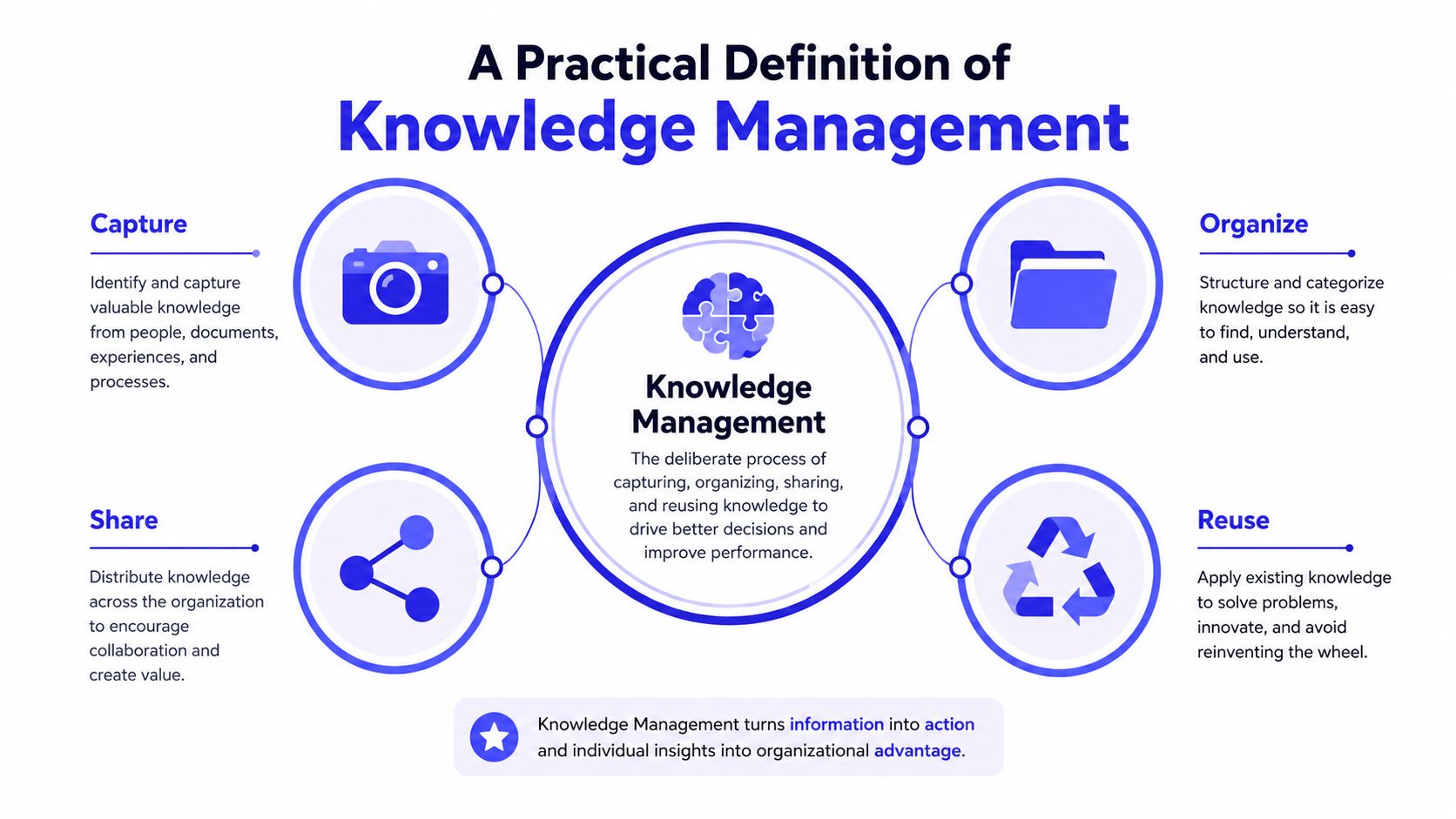
The shift from archives to living assets
A static wiki answers a narrow question: where did someone put the document? A living knowledge asset answers a more useful question: what should a person or system do next, and what evidence supports that action?
For a remote AI team, that asset might be:
- An architecture decision record, linked to the service, owner, alternatives considered, and implementation status.
- A runbook, versioned with code and tested during an incident.
- An evaluation example, labeled with the expected answer, failure mode, and model version.
- A policy, exposed to an internal assistant only after access controls and review.
If you want a second perspective on the distinction between storing information and making it operational, Contesimal's knowledge management approach is a useful complementary resource.
Use three lenses to design the system. People decide what matters and contribute tacit knowledge. Process determines when teams capture, review, and reuse it. Technology makes that knowledge searchable, retrievable, permissioned, and usable by both employees and artificial intelligence tools.
Why Knowledge Management Matters More in 2026
Knowledge management became a formal management discipline when the International Organization for Standardization published ISO 30401:2018 in November 2018, the first international standard dedicated specifically to knowledge management. The standard defines knowledge management as a management system that helps organizations create, use, share, and improve knowledge for value creation, and it applies to organizations regardless of type or size. See the ISO 30401 standard overview.
That framing matters. ISO treats knowledge management as a system connected to strategy, objectives, and performance, not as a folder structure. In an AI organization, the same principle applies to retrieval-augmented generation, copilots, and agentic workflows. Models can only provide dependable context when the organization has decided which knowledge is authoritative, who owns it, how current it is, and who may access it.
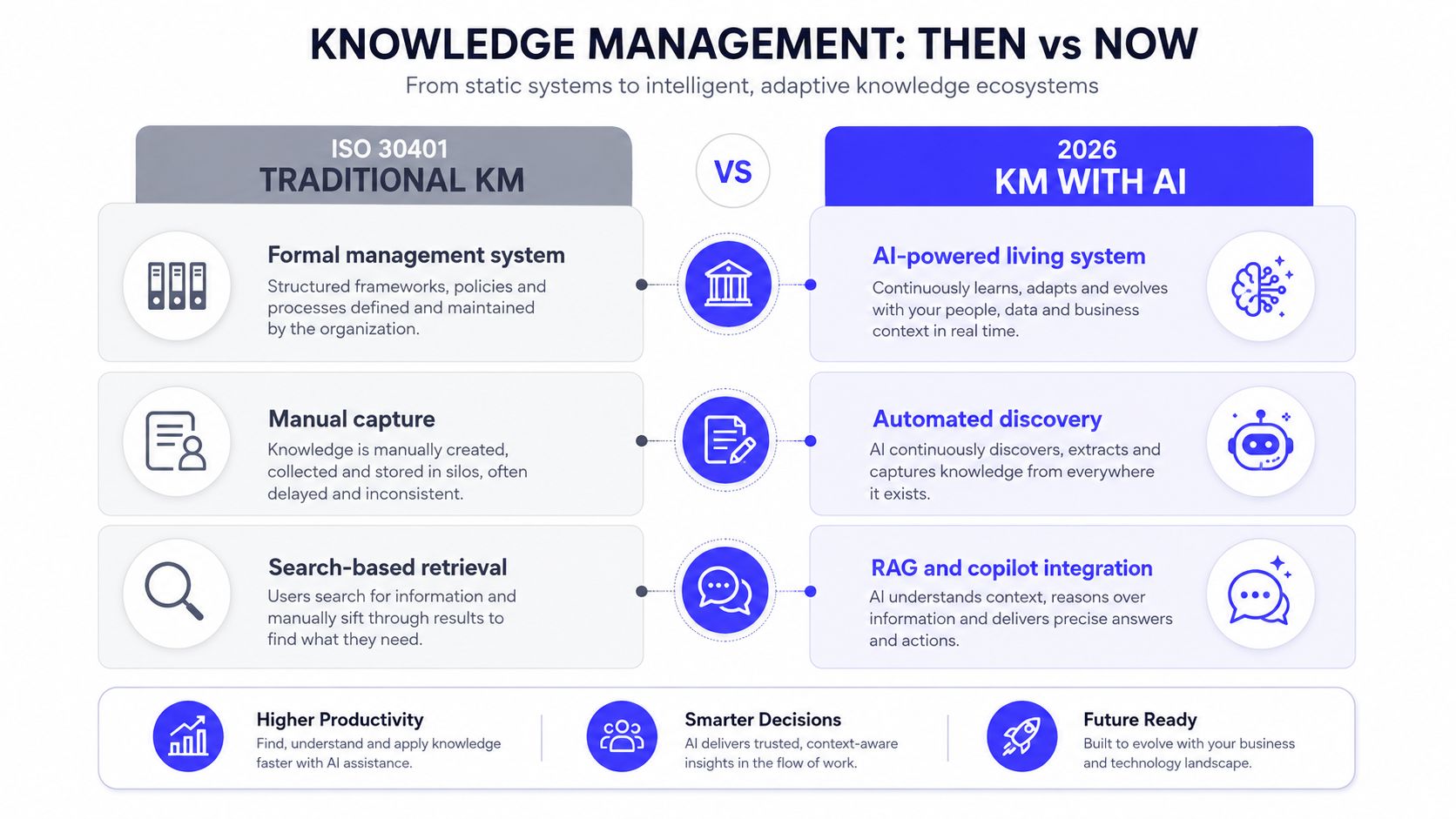
Documents now participate in software systems
A PDF used to be something a person opened and read. Today, an approved operating procedure may be parsed, chunked, embedded, filtered by permissions, and served through an internal application programming interface. A model may use it to draft a response, recommend a troubleshooting step, or route an engineering ticket.
That creates new failure modes. A stale document can produce a confident but incorrect answer. Duplicate pages can create conflicting retrieval results. Poor access boundaries can expose information to the wrong user. Weak metadata can make the right document invisible even when it exists.
Remote teams feel these problems sharply because asynchronous work removes many informal correction mechanisms. In a colocated office, an engineer can interrupt a colleague and discover that a runbook changed. In a distributed organization, the system must surface the current answer without relying on proximity or memory.
Market research reflects this broader shift. One estimate values the knowledge management market at US$931.5 billion in 2026 and forecasts US$4,201.47 billion by 2035, with an 18.22% compound annual growth rate, while another estimates US$961.44 billion in 2025 and US$2,185.66 billion by 2030 at a 17.9% compound annual growth rate. These are market estimates, not guarantees for an individual company, but they show that organizations now treat knowledge management as a major enterprise capability. The estimates are summarized in this knowledge management market research.
Core Components of a Knowledge Management System
A knowledge management system is a loop, not a stack. Teams capture useful context, organize it, store it in an appropriate form, share it, apply it, and govern it. Application creates new evidence, which should feed the next capture cycle.
| Component | Engineering or AI Workflow Example |
|---|---|
| Capture | Record an architecture review in a structured decision template with the problem, options, decision, owner, and date. |
| Organization | Tag incident retrospectives by service, severity, root cause, customer impact, and remediation status. |
| Storage | Keep source-controlled runbooks in a Git repository, team guidance in Confluence or Notion, and retrieval-ready content in a vector store such as pgvector when the use case requires it. |
| Sharing | Publish a Slack digest, hold an office hour, and let an internal agent surface relevant context in a project channel. |
| Application | Use retrieval-augmented generation to pull approved troubleshooting steps into a support assistant before it drafts an answer. |
| Governance | Assign an owner, define a freshness expectation, record access rules, and review content after releases or model changes. |
Make capture part of delivery
Don't ask engineers to document everything. Ask them to document decisions that will be expensive to rediscover. Add a decision record to architecture reviews, a lesson field to incident retrospectives, and an evidence link to evaluation failures.
This keeps the system close to existing work. Your team collaboration tools should support the workflow, but they shouldn't become the source of truth by accident.
Separate storage from retrieval
Not every artifact belongs in a vector database. Source code, policies, incident records, and product specifications have different owners and update patterns. Preserve the authoritative source, then build retrieval indexes or application views from it.
The application layer should also return provenance. An internal copilot that cites the relevant runbook gives an engineer a way to verify the answer. A copilot that provides uncited prose creates review work and hides uncertainty.
Govern the loop
Governance isn't a committee that approves every sentence. It is a set of lightweight rules that answer four questions:
- Who owns this knowledge?
- What makes it authoritative?
- When should someone review it?
- What happens when it conflicts with another artifact?
Without those answers, your system becomes a larger archive with a more expensive search box.
Two Real-World Examples of Knowledge Management in Action
The following examples are operating scenarios, not measured case studies. They show how the same remote team can produce different outcomes depending on whether knowledge management is treated as documentation or infrastructure.
Case A with thin knowledge management
A remote machine learning platform team has scattered Notion pages, long Slack threads, and runbooks without named owners. Engineers capture knowledge when someone remembers, so new hires search across channels and ask senior teammates to reconstruct decisions.
The internal copilot has no retrieval index over approved architecture records or API guidance. It can produce fluent answers, but the team has no disciplined evaluation set for internal questions and no reliable mechanism for detecting stale context. The practical result is predictable: onboarding feels inconsistent, repeated questions interrupt focused work, and engineers hesitate to trust the assistant.
Case B with mature knowledge management
A team of the same size maintains a curated knowledge graph, versioned runbooks, and tagged evaluation examples. Each service has an owner. Architecture decisions link to repositories and deployment procedures. The retrieval pipeline filters by service, status, and permission before passing context to the model.
The team reviews failed answers during a weekly office hour. When an API changes, the relevant runbook and evaluation examples change in the same delivery workflow. Engineers can inspect the source behind an answer, while platform staff can identify missing or conflicting knowledge instead of guessing from usage logs.
The difference isn't the number of pages. It is the operating design.
| Metric | Thin KM, Case A | Mature KM, Case B |
|---|---|---|
| Capture | Optional notes after the work | Structured records attached to reviews, incidents, and releases |
| Retrieval | Keyword search across mixed sources | Permission-aware retrieval over approved, tagged artifacts |
| Ownership | Implied or unclear | Named service and domain owners |
| AI use | General answers with uncertain context | RAG responses grounded in curated sources and evaluation examples |
| Maintenance | Occasional cleanup | Review triggered by releases, incidents, and model changes |
| Remote collaboration | Questions depend on synchronous availability | Async work includes context, provenance, and next actions |
A study of 336 knowledge workers in Pakistan found that knowledge creation and sharing supported productivity mainly indirectly, while knowledge utilization was the only frontline process that directly enhanced productivity. The lesson is blunt: your repository won't create value until workflows make people and systems use it. The finding is documented in this ERIC-indexed knowledge utilization study.
Implementing Knowledge Management in Remote AI and Engineering Teams
Start with one team and one operational problem. Don't launch a company-wide documentation program before you know which decisions are being delayed, repeated, or answered incorrectly.
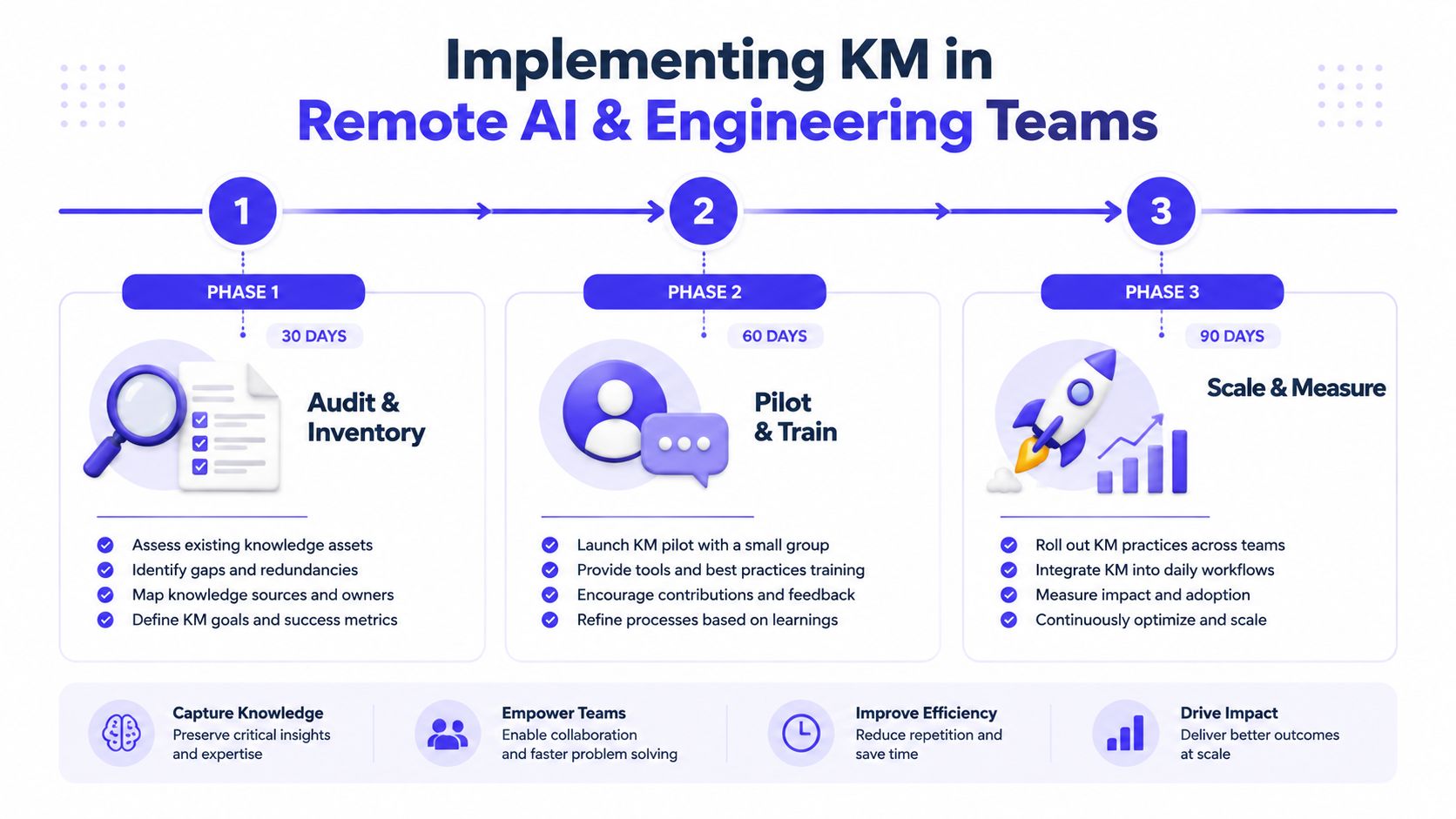
Days 1 to 30
Audit where decisions happen. Inventory the documents, repositories, Slack channels, ticket queues, and evaluation sets that contain important context. Select a pilot squad with a visible pain point, such as model evaluation, incident response, or developer onboarding.
Appoint a knowledge owner per squad. Don't create a centralized content team as the first move. A central function can define standards and provide tooling later, but domain teams must own accuracy because they understand the work.
Choose a small artifact set:
- Architecture decision records.
- Production runbooks.
- Incident retrospectives.
- Prompt and model evaluation examples.
- Onboarding procedures.
Days 31 to 60
Build the capture templates and connect them to existing workflows. Add links to the templates in pull request guidance, incident forms, and architecture review tickets. Run a short weekly office hour where engineers bring failed searches, missing context, and contradictory documents.
For hiring, look for a platform engineer who understands retrieval-augmented generation and evaluation, a technical writer who can model an ontology without slowing delivery, or an AI operations lead who can connect content governance to model behavior. If your roadmap includes autonomous workflows, review the practical responsibilities involved in AI agent development before assigning an agent to consume internal knowledge.
Days 61 to 90
Put a live retrieval layer over the selected runbooks, architecture records, and evaluation datasets. Integrate it with internal search or a copilot, then test it against real questions from the pilot team. Record whether the system found the right source, whether the answer was supported, and whether the user could act without another meeting.
Remote teams need explicit transfer rituals. A knowledge transfer method for AI and machine learning teams can help you turn recorded sessions, templates, vendor documentation, and reference examples into reusable assets instead of isolated events.
Measuring Success and Avoiding Common Pitfalls
Don't measure knowledge management by page count. A large archive can indicate that people are writing, not that anyone can find or trust what they wrote.
Use a balanced scorecard with four categories. The metrics review literature notes that knowledge management lacks mature standards for business metrics, so evaluation should span users, systems, projects, processes, initiatives, and the organization. Its review of knowledge management metrics supports measuring both leading signals and business outcomes.
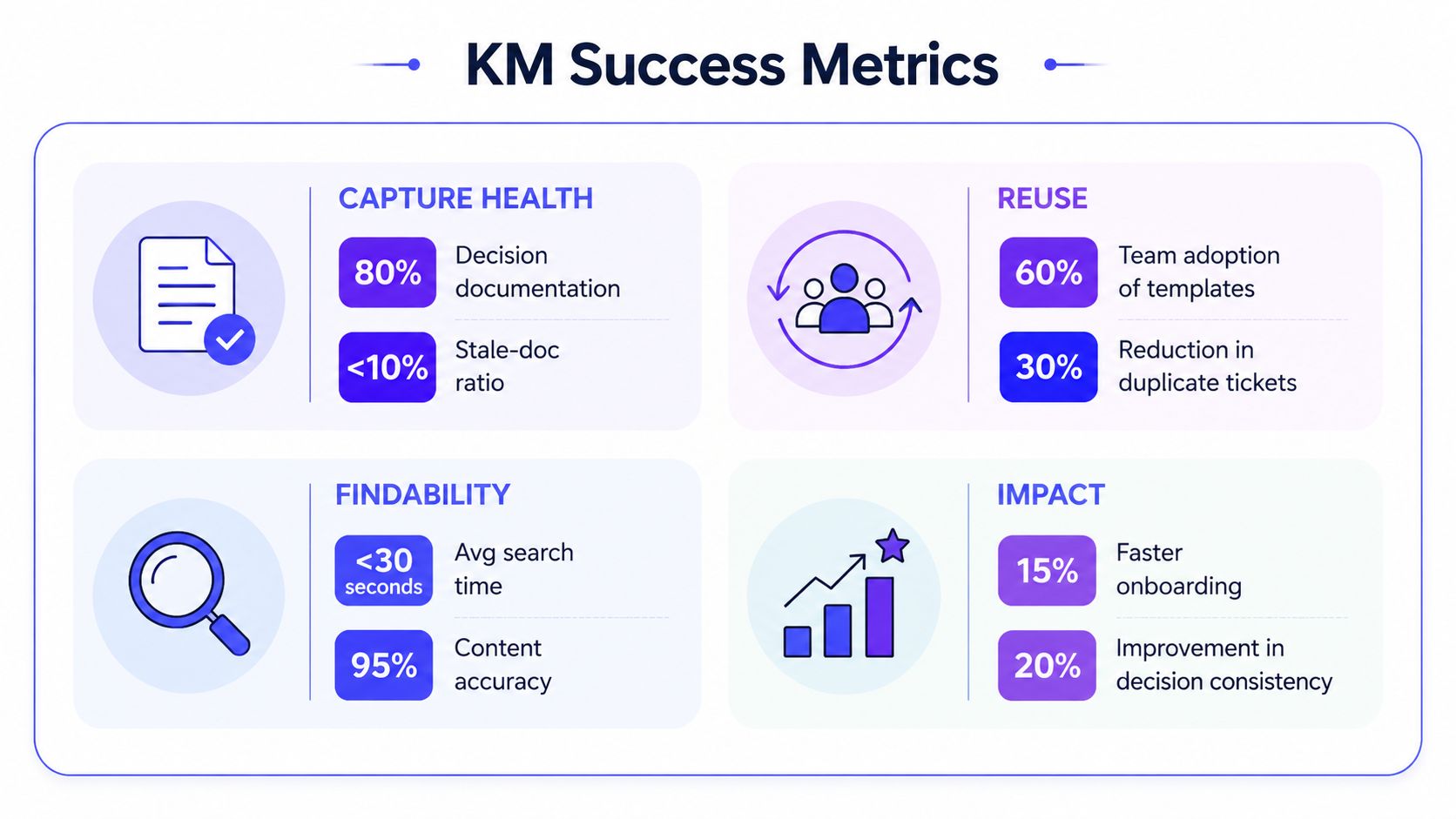
A balanced scorecard
- Capture health: Track whether important decisions enter the system and how much content has become stale.
- Reuse: Measure search-to-answer success, time to answer internal questions, and use of approved templates.
- AI performance: Evaluate retrieval recall on internal corpora, citation accuracy, and drift in labeled evaluation sets.
- Human impact: Watch onboarding experience, decision consistency, repeated questions, and the loss of institutional knowledge when people leave.
Use qualitative review alongside telemetry. Ask engineers which answers they still don't trust. Review failed retrievals with the content owner. Compare the work required to verify an answer with the work required to create it.
Practical rule: Optimize for fewer, better-indexed artifacts that people can use, not more pages that nobody maintains.
A credible estimate from Bloomfire says inefficient knowledge management affects, on average, 25% of a business's annual revenue. Its example says a Fortune 500 company with $9 billion in annual revenue could have about $2.4 billion in enterprise value at stake each year. Treat that as a market-facing estimate, not a forecast for your company, and use it to justify disciplined measurement rather than a blanket investment. The figures appear in Bloomfire's enterprise intelligence report.
A peer-reviewed ERIC-indexed study also found a significant positive impact of knowledge management on productivity, driven largely by time savings from using a useful system across a large employee population. That supports a business case based on time saved and work completed, not documentation activity. See the peer-reviewed productivity study.
Your 30-Day Knowledge Management Checklist and Next Steps
Hand this checklist to your chief of staff or engineering operations lead.
Days 1 to 7
- Find the gaps: Audit the three knowledge gaps that create the most repeated questions, delayed decisions, or unreliable AI answers.
- Pick the pilot: Choose one squad and one workflow, such as incident response, onboarding, or internal API support.
- Name ownership: Assign a domain owner and an engineering partner for the pilot.
Days 8 to 14
- Create the source: Stand up a shared, retrieval-aware knowledge space with clear authority and permissions.
- Capture onboarding: Document two onboarding flows from the perspective of a new engineer.
- Record decisions: Add a lightweight architecture and incident template to existing delivery workflows.
Days 15 to 21
- Wire one dashboard: Track capture, reuse, retrieval quality, and one human outcome.
- Review a failure: Run a blameless retrospective on a knowledge handoff that caused confusion or rework.
- Fix the path: Remove duplicate sources and improve metadata where searches fail.
Days 22 to 30
- Choose the stack: Decide which artifacts belong in Git, Notion, Confluence, a database, or a retrieval index.
- Set maintenance rules: Define owners, review triggers, access controls, and escalation paths.
- Draft the hiring scorecard: Look for an AI operations, platform, developer experience, or knowledge management lead who can own the loop.
A productivity-oriented KM program should connect directly to your time-to-productivity plan, especially when remote hires need reliable context without constant synchronous support.
ThirstySprout helps startups and enterprises hire senior AI engineers, platform engineers, MLOps specialists, and complete remote machine learning teams who can build retrieval pipelines and operationalize knowledge from the start. Visit ThirstySprout to start a pilot or see sample profiles for specialists who can own your KM program in the first delivery cycle.
Hire from the Top 1% Talent Network
Ready to accelerate your hiring or scale your company with our top-tier technical talent? Let's chat.