

61% of companies use digital knowledge transfer procedures, while 28% still rely on analog methods. For a remote AI team, the fastest response is to combine pair programming in weeks 1 to 4 with runbooks for self-service and mentorship for longer-term retention.
Your best AI engineer resigned. The repo still builds, but the people who know why the model thresholds were chosen, how the inference service fails under load, and which alerts matter most are walking out the door too. In remote AI teams, that gap shows up fast, because tacit knowledge lives in Slack threads, code review comments, incident calls, and the half-finished notes nobody planned to trust.
The right move is not to force everything into documentation. Modern knowledge transfer works when you mix live transfer, written transfer, and repeatable review loops so the next engineer can operate the system, not just read about it. A recent systematic review found that Web 2.0 tools and wikis are now the most common transfer methods, with intergenerational learning and mobile technology also playing a major role, which matches what distributed engineering teams already know in practice, reusable systems beat ad hoc handoffs systematic review of organizational knowledge-transfer procedures.
If you lead engineering, your job is to make knowledge transferable before the person who owns it disappears. The list below gives you methods that work for AI, machine learning, and MLOps teams, plus the trade-offs that matter when your team is remote, scaling, or carrying key-person risk.
1. Pair Programming and Live Code Review
Pair programming works best when the work is real, messy, and close to production. One engineer drives while the other spots gaps, asks questions, and catches assumptions before they become incidents. In remote AI teams, that often means screen share, shared IDE sessions, or Copilot-assisted reviews on model pipelines, inference servers, and prompt changes.
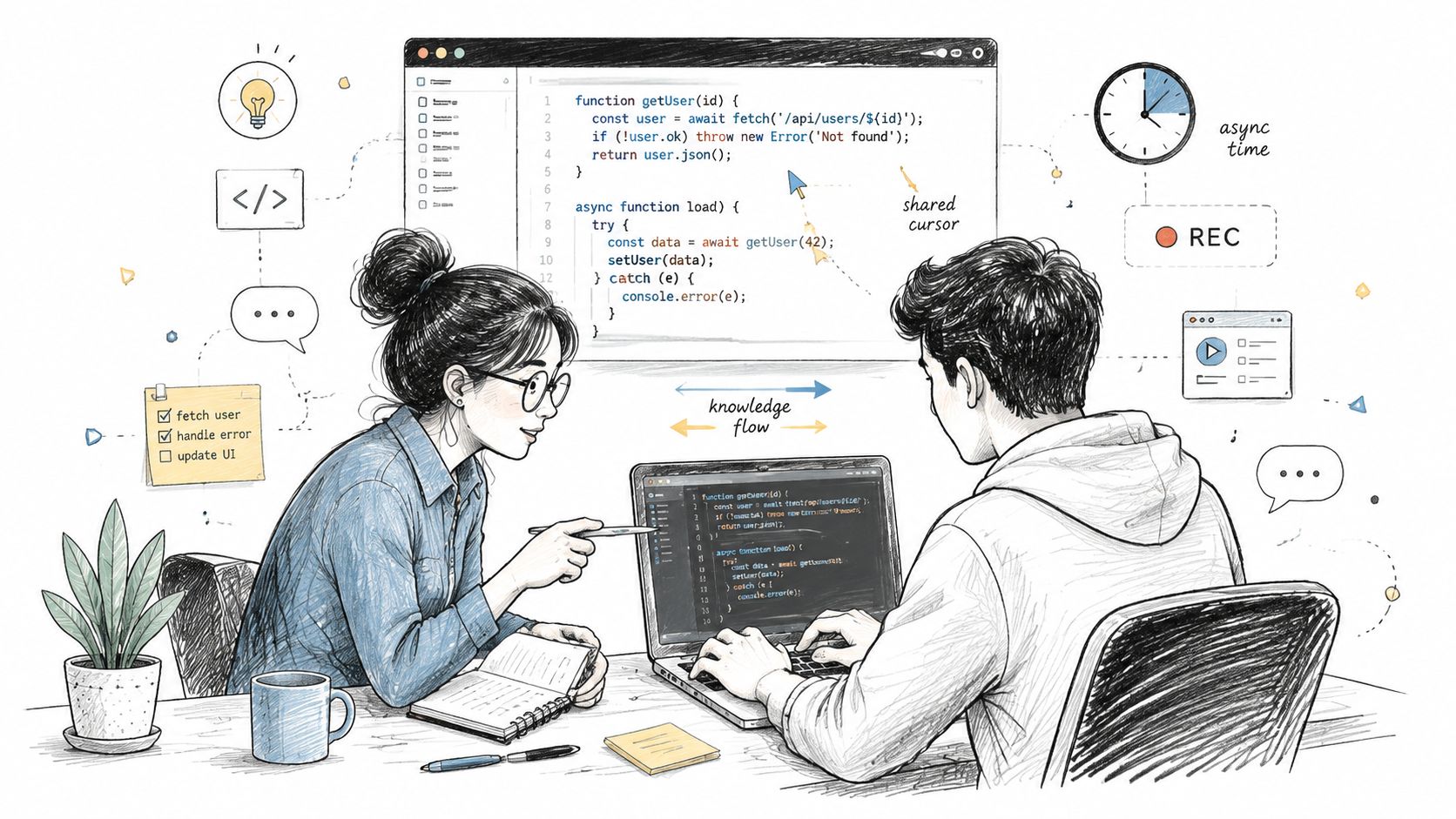
The value here is bidirectional. The junior engineer learns the reasoning behind decisions, while the senior engineer hears fresh questions and finds brittle spots sooner. That aligns with broader knowledge-transfer research showing that mentorship, guided experience, observation, and paired work have long been central mechanisms, not side activities knowledge transfer overview.
Where it works and where it doesn't
Pair on production work, not toy examples. A prompt template bug, a broken feature-store join, or a flaky canary rollout teaches more than a sandbox demo ever will.
Practical rule: Use pair sessions heavily in weeks 1 to 4, then taper them. If you keep pairing forever, you create dependency instead of independence.
One remote fintech team can use this to pair a senior MLOps engineer with a new platform hire three days a week for six weeks. Another team might use it to walk a new ML engineer through incident debugging, model monitoring, and deployment checks before giving them on-call ownership. For a deeper code-management workflow, connect the session to your internal engineering standards through source code management practices.
Make it work with this structure
- Rotate roles every 30 minutes. The observer should become the driver so they're forced to act, not just watch.
- Record sessions for later review. Remote teams in other time zones need searchable clips with chapter markers.
- Use a short rubric. Ask what was learned, what confused the learner, and what the system assumptions were.
- Tie the session to a real task. A deploy, rollback, or hotfix gives the conversation urgency and context.
Pair programming is strongest when speed matters and the knowledge is tacit. It's weaker when you need durable reuse across many people. That's when you layer in written systems.
2. Documented Runbooks and Playbooks
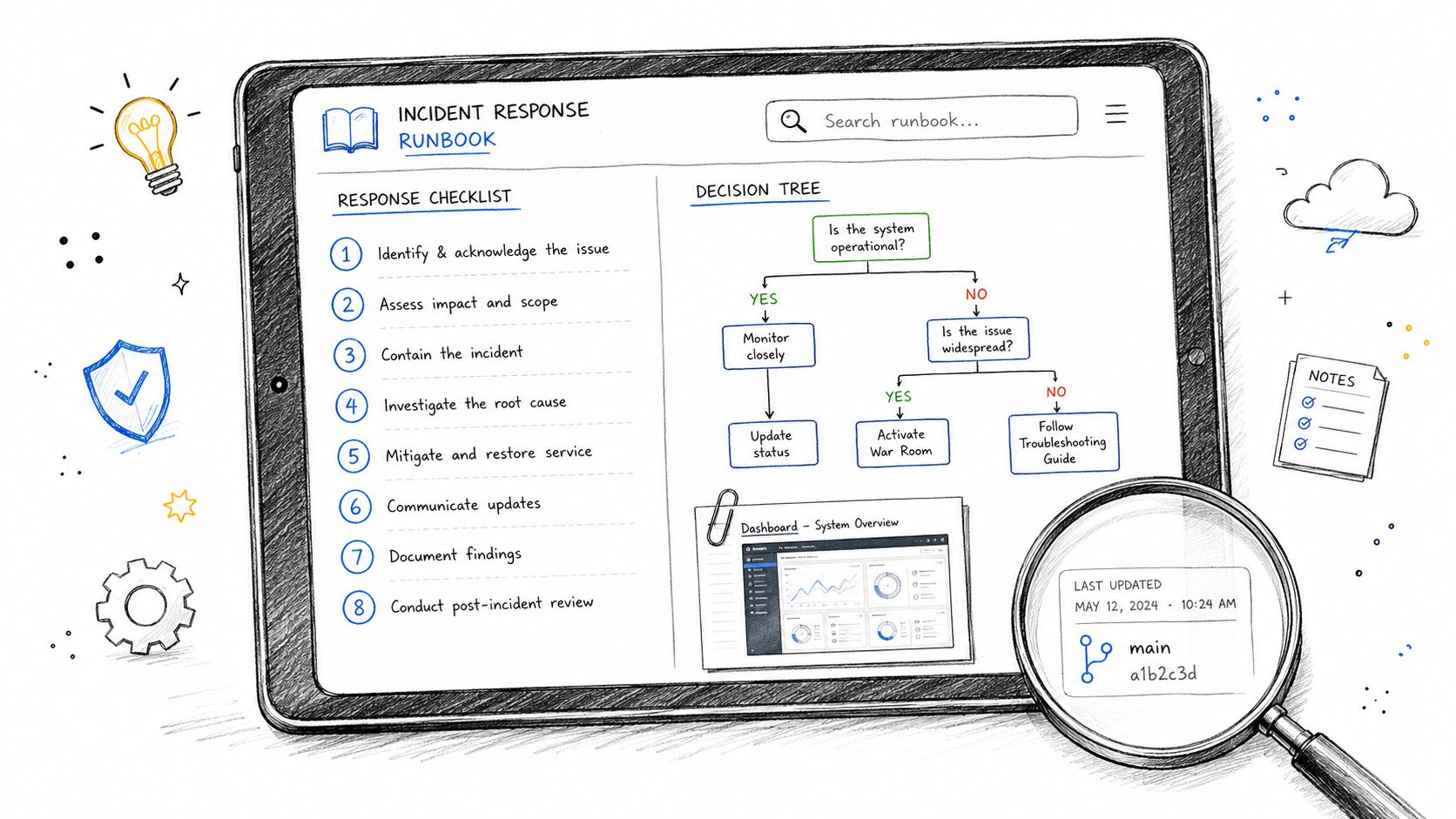
An on-call engineer at 2 a.m. faces a failed inference deploy with no context on why the model thresholds were chosen. That is when a runbook saves the team. It turns recurring operations into steps someone else can follow under pressure. Playbooks sit one level higher. They explain the decision logic behind those steps. For AI teams, runbooks often cover retraining, inference failures, data validation, rollbacks, and alert triage, while playbooks explain when to retrain versus fine-tune versus leave the model alone.
Before writing a runbook, review your incident-response framework at https://www.thirstysprout.com/post/what-is-incident-response so your triage steps match how the team expects to work. A strong operational team treats runbooks as living artifacts, not static docs. The Government of British Columbia frames knowledge transfer in four phases, identify, prioritize, capture and transfer, and share and store, which gives engineering handoffs a clear sequence and forces teams to separate important knowledge from noise BC knowledge transfer guide.
What good runbooks include
A runbook should answer the questions that surface during pressure. The common failure is writing a polished article and leaving out the decision tree the on-call engineer needs.
- Title and objective. State exactly what problem the runbook solves.
- Prerequisites. List the permissions, dashboards, and systems needed before starting.
- Numbered steps. Keep them short and executable.
- Decision branches. Add “if this, then that” logic for the common forks.
- Troubleshooting notes. Capture the things that usually break.
- Related docs. Link to alerts, postmortems, and adjacent runbooks.
A practical MLOps team can write the first version while doing the task, then update it after the incident ends. That is better than trying to reconstruct the steps from memory later. In explicit knowledge transfer research, documentation, interviews and debriefings, and training are the three most common methods for retention, which is why runbooks work best when paired with human explanation, not used alone explicit knowledge transfer methods.
Runbooks are ideal for cutting on-call toil and making response more consistent. They are weaker when the problem is novel, ambiguous, or heavily judgment-based. For those cases, mentorship and walkthroughs fill the gap.
3. Mentorship and 1-on-1 Knowledge Transfer
A staff engineer pairs with a new ML hire for twelve weeks. By month three, the hire owns a roadmap decision, and that is mentorship doing what documentation never could.
Mentorship moves the judgment behind decisions, not just the decisions themselves. A good mentor helps someone understand model evaluation trade-offs, stakeholder communication, architecture choices, and the politics of shipping safely in a fast-moving team.
This method fits remote AI orgs because it creates a predictable channel for tacit knowledge. The literature on knowledge transfer has long emphasized practice-based learning, including mentorship, guided experience, communities of practice, and narrative transfer, because people retain more when they can ask questions and test ideas in context knowledge transfer overview.
Practical rule: Set one or two concrete outcomes by month 3. If the goal is vague, the mentorship turns into a pleasant chat instead of a transfer mechanism.
A staff engineer mentoring a mid-level ML engineer can use the first month to explain evaluation frameworks, the second month to review incident postmortems, and the third month to let the mentee own a small roadmap decision. That progression works because it moves from explanation to application, and it gives both sides a clear checkpoint for whether knowledge is transferring.
A simple mentorship format
- Week 1. Define the goals, owners, and current gaps.
- Weeks 2 to 6. Review work samples, design notes, and blocked decisions.
- Weeks 7 to 12. Shift the mentee into ownership with review only when needed.
- After month 3. Add reverse mentoring so the newer person teaches a tool or workflow back.
Mentorship works well when the organization wants durable skill growth. It is slower than pairing and less scalable than written assets, so do not use it as your only method. It works best as a multiplier, not a replacement.
For teams that want a formalized learning path, connect mentorship to technical training resources so the 1-on-1s reinforce the same system language the team uses elsewhere. For a formalized approach to transferring skills between engineers, see this transfer learning framework for events that maps mentorship outcomes to measurable checkpoints. That makes the conversations easier to reuse across hires.
4. Internal Tech Talks and Lunch-and-Learns
Tech talks turn scattered learning into a shared team memory. A 30 to 60 minute session on a recent model launch, an evaluation failure, or a new RAG pattern can save dozens of small explanations later. In distributed teams, the recording becomes a searchable asset for future hires and adjacent squads.
A review of organizational knowledge transfer found that Web 2.0 tools and wikis are the most common procedures, but human-led internal sessions still matter because they explain the “why” behind the artifacts systematic review of organizational knowledge-transfer procedures. That's why talks work so well for AI teams, where the reasoning behind embeddings, retrieval, and latency trade-offs changes quickly.
A good talk is short, concrete, and reusable. One team might run an “Inference Optimization Tuesday” series, another might hold a monthly session on debugging LLM hallucinations, and a third might use lunch-and-learns to teach the data team how downstream consumers react to schema changes.
Make talks useful, not theatrical
- Keep the live section tight. Aim for 30 to 40 minutes, then leave time for questions.
- Require one takeaway. Every presenter should leave behind a template, checklist, or design pattern.
- Rotate speakers. Junior engineers learn faster when they teach.
- Tag recordings by topic. People should find talks by problem, not by date.
- Use captions and notes. Remote teams need searchable assets, not opaque recordings.
The downside is obvious, talks don't transfer operational muscle memory by themselves. They create vocabulary and shared context, then runbooks and pairing turn that context into action. That combination is much stronger than either method alone.
5. Reverse Engineering and Code Walkthroughs
Sometimes the fastest way to transfer knowledge is to dissect what already exists. A senior engineer walks a junior engineer through a feature store schema, a custom monitoring dashboard, or a prompt template system and keeps asking one question, why is it this way? That style of walkthrough transfers design trade-offs, not just syntax.
The strongest walkthroughs focus on live systems. A feature store can reveal why real-time latency constraints shaped the schema, a Prometheus and Grafana setup can explain why percentiles matter more than averages, and a prompt template layer can show how a tiny change would have broken production evals. Those are the exact kinds of decisions that are hard to recover after key people leave.
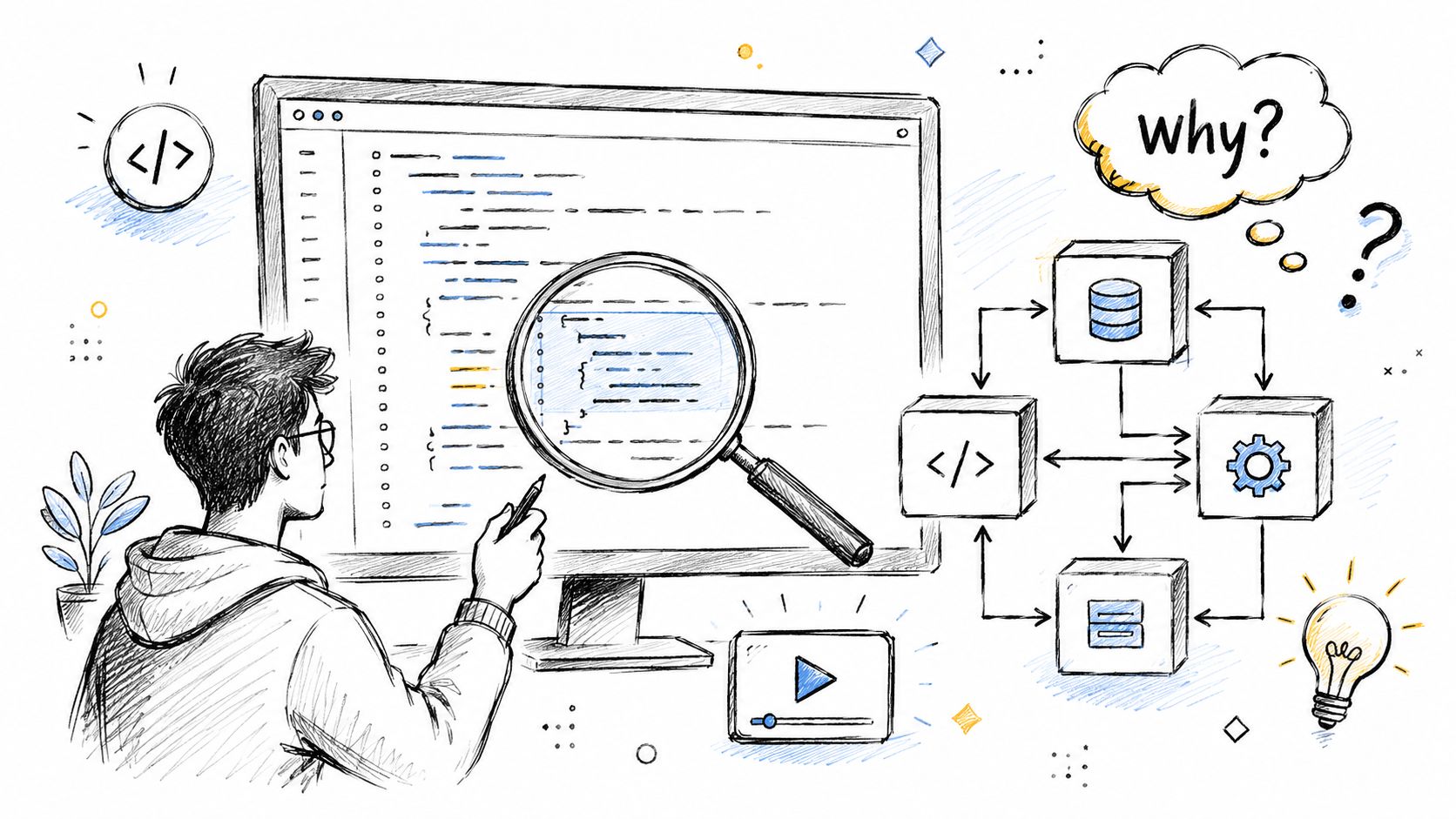
A useful walkthrough often starts with a brief. State the goal, the learner's background, and the expected outcome before anyone opens the IDE. Then pause often enough for the learner to explain the system back in their own words.
A lightweight walkthrough format
- Before the session. Share a short brief and a couple of files to inspect.
- During the session. Stop every 5 to 10 minutes for questions.
- After the session. Ask the learner to write down the logic in their own words.
- In the repo. Link the recording or note in the README or code comments.
Practical rule: If a new hire can't explain what would break after a small change, the walkthrough wasn't deep enough.
This approach is excellent for systems with hidden constraints. It's less efficient for broad onboarding because it relies on expert time, so use it where the architecture is fragile, expensive, or easy to misunderstand. If you also want a visual version of this kind of transfer, the linked video can help teams see how explanation changes when the system is already in production.
6. Async Learning and Self-Directed Resources
Async learning gives engineers a place to go when they need an answer outside a live session. That matters in remote AI teams, where time zones, deep work blocks, and fast-moving product cycles make synchronous learning unreliable.
The best libraries are curated, not bloated. A practical system includes research papers, vendor docs, model evaluation templates, deployment checklists, and short internal guides tagged by skill level and estimated reading time. A 2023 review found that modern organizational knowledge transfer has shifted strongly toward digitally mediated methods, which fits the way distributed engineering teams already work systematic review of organizational knowledge-transfer procedures.
A good library also reduces repeated Slack questions. If the same question comes up three times, it should become a page, a short video, or a linked note in the team wiki.
What to store in the library
- Internal templates. Evaluation rubrics, rollout checklists, and model review notes.
- Vendor docs. Official setup and troubleshooting pages from tools your team uses.
- Short explainers. Two-page summaries of your own architecture decisions.
- Reference examples. Good prompts, good rollback notes, good incident summaries.
- Update history. A “last updated” field and owner name to keep trust high.
Async resources work best when they're searchable and current. They're weaker for judgment transfer because a page can't answer follow-up questions when a decision is nuanced. Still, they're one of the best ways to reduce ramp time for new hires and to preserve knowledge across turnover.
A useful pattern is to make every new incident, design change, or repeated onboarding question feed back into the library. That way the docs get sharper after real use, not just after a quarterly cleanup.
7. Incident Postmortems and Blameless Retrospectives
A production incident is the fastest way to expose what your team really knows, and what only one person knows. If a model starts missing a new fraud segment, an inference service falls over, or a prompt update breaks a downstream integration, the postmortem should turn that event into shared operating knowledge.
The knowledge-transfer literature shows that writing things down is not enough on its own. The useful test is whether the lesson changes behavior or performance, which is the transfer into action gap transfer into action gap. Postmortems are one of the few methods that force that jump because they connect the incident to concrete changes in alerts, runbooks, and deployment checks.
Before writing a postmortem, review your incident-response process at https://www.thirstysprout.com/post/what-is-incident-response to ensure alignment. That keeps the retrospective focused on the right boundaries, owners, and escalation path.
A good review stays short enough to finish while the details are still fresh, but specific enough that the next engineer can act on it without guesswork. The meeting should happen soon after the incident, and every follow-up needs a named owner and a clear date.
A solid postmortem structure
- Timeline. What happened, in order.
- Impact. Who or what was affected.
- Root cause. The technical and process cause.
- Contributing factors. Missing alerts, weak tests, or unclear ownership.
- Action items. Each item needs an owner and a due date.
The strongest teams treat the postmortem as a system review, not a ritual. They update the runbook, alerting, or deployment checklist the same week, while the failure is still easy to remember. That is how one incident turns into a reusable lesson for the rest of the engineering org.
There is a real trade-off here. These meetings can feel uncomfortable, and they pull people away from feature work. They still pay off when they reduce repeat incidents, shorten incident handling time, and preserve context that would otherwise disappear once the pager stops ringing.
8. Cross-Functional Shadowing and Rotations
Shadowing and rotations move knowledge across team boundaries. A machine learning engineer sits with MLOps, a data engineer shadows prompt engineering, or a product manager spends a week with the inference team to understand deployment constraints. That context changes how people make decisions later.
This method matters a lot in remote and hybrid organizations because it prevents each team from optimizing in isolation. The OECD notes that knowledge transfer between generations and across work settings often depends on mentoring, job shadowing, communities of practice, and overlap or partnered work, which is a good reminder that these methods are still highly human even when the team is distributed OECD guidance on knowledge transfer between generations.
A short rotation can expose hidden constraints that don't show up in ticket comments. A PM who sees the inference team's rollout process will write better roadmaps. A prompt engineer who shadows data engineering will stop assuming every transformation is cheap or immediate.
Keep rotations productive
- Set a concrete goal. The shadow should leave with one thing they can explain or improve.
- Start with observation. Let them learn the flow before handing over tasks.
- Add a host mentor. Daily 15 minute check-ins work better than vague availability.
- Capture the learning. Turn it into a write-up or update a runbook.
- Limit the duration. Short rotations are easier for host teams to absorb.
Not every rotation should end with ownership. Sometimes the win is better judgment in the home team.
Rotations are powerful when your org has silo risk or handoff friction. They're not ideal if the host team is already overloaded, so keep the cadence realistic and reserve them for the highest-value cross-functional gaps.
9. Structured Onboarding Program
A new ML engineer starts Monday. By Wednesday they've asked the same three questions four times. That's what happens when onboarding is a link dump instead of a sequence.
A structured onboarding program turns the other methods into a working path. The goal is not to flood a new hire with docs and introductions, but to sequence live practice, runbooks, mentorship, and review so they can start contributing without creating extra load for senior engineers or on-call.
The British Columbia guide's four-phase logic, identify, prioritize, capture and transfer, and share and store, is useful here because onboarding works best when you decide what matters first BC knowledge transfer guide. In AI teams, that usually means production access, core runbooks, escalation paths, and the small set of architectural decisions that would otherwise stay tribal. A strong onboarding plan also reflects the way engineering teams structure ramp-up, with clear ownership, guided practice, and checkpoints that show whether the new hire can operate with less supervision.
A practical version starts with async reading, then moves into daily pairing and weekly mentorship, and later adds walkthroughs, talks, and shadowing. That order matters. It helps a new hire move from observer to contributor to owner without guessing what matters most, and it gives the team a way to spot missing docs before those gaps turn into support pings.
A practical onboarding flow
- Week 0. Read the must-know docs, alert list, and ownership map.
- Weeks 1 to 4. Pair on real work and review runbooks while shipping small changes.
- Weeks 4 to 12. Add rotations, talks, and guided ownership of one service or workflow.
- Ongoing. Track what still feels unclear and feed it back into docs.
The business impact is straightforward. Better onboarding cuts repeated explanations, lowers on-call burden, and gets new engineers to useful work sooner. It also exposes stale docs because new people are the first to notice what is missing, which is especially useful in remote AI and ML teams where key-person risk shows up fast.
The main risk is overload. Too many channels in the first month slow people down instead of helping them. Keep the opening phase focused on a small set of critical systems, then expand once they can handle the basics without constant supervision.
Comparison of 9 Knowledge Transfer Methods
| Method | 🔄 Complexity | ⚡ Resources (time / tools / people) | 📊 Expected outcomes | 💡 Ideal use cases | ⭐ Key advantages |
|---|---|---|---|---|---|
| Pair Programming & Live Code Review | Medium–High, synchronous coordination, facilitator discipline | High, regular 1:1 time, screen-share/IDE plugins, recordings | ⭐⭐⭐⭐, rapid onboarding (30–40%), fewer production bugs, immediate fixes | Onboarding ML/MLOps, incident response, prompt engineering | Immediate feedback, shared ownership, transfers tacit knowledge |
| Documented Runbooks & Playbooks | Medium, authoring + ongoing maintenance | Medium, writing effort, wiki/VC, links to CI/CD | ⭐⭐⭐⭐, reduces onboarding 50–60%, async incident resolution, auditability | Scaling remote teams, incident response, compliance | Searchable, versioned, self-service, reduces interruptions |
| Mentorship & 1‑on‑1 Knowledge Transfer | Low–Medium, relationship-dependent, scheduled cadence | Medium, weekly mentor hours over months, tracking docs | ⭐⭐⭐, improves retention & promotions, slow deep payoff (6–12 wks) | Retaining juniors, career growth, soft-skill and judgment transfer | Transfers tacit judgment and soft skills; reduces key-person risk |
| Internal Tech Talks & Lunch‑and‑Learns | Low, easy to run but needs curation/moderation | Low–Medium, presenter prep, recording & archive tools | ⭐⭐⭐, builds institutional memory; archive value grows over time | Cross-team knowledge sharing, building shared vocabulary | Broad reach, encourages presenting, sparks cross-team collaboration |
| Reverse Engineering & Code Walkthroughs | High, deep prep, focused sessions (2–4 hrs) | Medium, expert time, recordings/annotated code | ⭐⭐⭐⭐, transfers design reasoning, improves debugging intuition | Onboarding senior hires, debugging production, design rationale | Conveys implicit trade-offs, improves future code quality |
| Async Learning & Self‑Directed Resources | Medium, curation upfront, lower operational overhead | Medium, content creation time, LMS/wiki, tagging | ⭐⭐⭐, scalable, immediate when consumed; variable completion rates | Distributed teams, baseline onboarding, self-paced learning | Reusable, decouples knowledge from people, low recurring time cost |
| Incident Postmortems & Blameless Retrospectives | Medium, structured process + cultural buy‑in | Medium, meeting time, documentation, tracked action items | ⭐⭐⭐⭐, converts failures into durable learning; prevents repeats | Improving reliability, surfacing failure modes, feeding runbooks | High‑ROI learning, builds psychological safety, drives concrete fixes |
| Cross‑Functional Shadowing & Rotations | Medium, scheduling and clear goals required | Medium–High, host mentoring time, 1–4 week commitments | ⭐⭐⭐, builds empathy & domain understanding; temporary host cost | Role transitions, breaking silos, improving collaboration | Fast contextual understanding, uncovers process improvements |
| Structured Onboarding Program | High, orchestrates multiple practices and maintenance | High, coordinated tracks, contributors, tracked milestones | ⭐⭐⭐⭐⭐, accelerates time‑to‑productivity; measurable outcomes | Rapid hiring scale, repeatable onboarding, preserving knowledge | Repeatable, measurable, combines complementary methods for max effect |
What to Do Next Build a Resilient AI Team
Knowledge transfer isn't a one-off task, it's a core engineering discipline. The teams that survive turnover, scale across time zones, and keep their incident rate under control are the ones that treat transfer as part of the system, not as a favor to the next hire.
Start with two actions this week. First, schedule one pair programming session for a new hire or a complex task. Second, write the next production incident into a blameless postmortem template and turn the follow-up into a runbook update. Those two moves force your team to transfer both live judgment and durable process knowledge.
After that, build outward. Use mentorship for deeper context, runbooks for repetition, walkthroughs for fragile systems, and onboarding to stitch it all together. That combination is how a remote AI team becomes resilient instead of dependent on a few people who never get enough sleep.
If you're hiring to build that culture, bring in engineers who've already shipped production AI systems and can help you encode knowledge transfer into the way your team works. Read more at recruiting AI for job orders.
ThirstySprout helps you hire remote AI engineers and ML teams who know how to document, transfer, and operationalize knowledge from day one. If you want vetted talent that can reduce ramp time and strengthen your on-call readiness, visit ThirstySprout and start a pilot with a team that fits your stack and time zone.
Hire from the Top 1% Talent Network
Ready to accelerate your hiring or scale your company with our top-tier technical talent? Let's chat.