

You're under pressure to upskill an AI team while shipping real product work. The gap is usually not a lack of content, it's a lack of technical training resources that fit your stack, your timeline, and the way engineers learn. The right choice depends on whether you need broad onboarding, deep platform training, or certification paths that your managers can trust. Use the list below as a buying guide, not a catalog. Pick the resource that matches the job to be done, then build it into onboarding, role-based upskilling, and certification plans that stick.
TL;DR
If you need broad AI and software upskilling, start with Coursera for Business. It works best for mixed teams that need recognizable courses, enterprise administration, and a low-friction way to standardize onboarding and baseline skill building.
For senior engineers who need a reference library they will use, O'Reilly Learning is the better fit. It gives your team depth, not just courses, so it is stronger for self-directed problem solving and advanced technical work.
If you want role-based learning paths with clear skill checks, Pluralsight Skills is the cleaner choice. It fits teams that need measurable progress and a more structured way to track whether people are ready for the next level.
Udemy Business is the fastest option to pilot. Use it for fast-moving tools, short-term gaps, and teams that need current coverage without a long rollout.
Cloud teams should buy for their stack, not for a generic curriculum. Use AWS Skill Builder, Google Skills subscriptions, Microsoft Learn for Organizations, or Databricks Academy depending on which platform your engineers already build on.
For GPU-heavy model work and performance tuning, NVIDIA DLI is the most practical specialist option. For teams that need focused AI curriculum without a lot of noise, DeepLearning.AI is the strongest narrow source.
Who this is for
You're likely a CTO, VP of Engineering, Head of AI, Platform Lead, or engineering manager who has to make training decisions fast. The job is not buying courses. It is getting new hires productive, helping experienced engineers move into stronger roles, and building a clean path to certifications or platform proficiency without turning training into a side project.
Your priorities shift by team size. Smaller teams need focus and fast adoption. Larger teams need consistency and repeatable standards. AI, data, and platform groups usually need all of that at once, because they have to ramp people, reduce skill gaps, and keep pace with changing tools.
The market supports that reality. According to the 2025 Training Industry Report, U.S. training spending in the previous year reached $102.8 billion, and spending on outside products and services rose 29% to $16 billion. That makes training a formal operating expense, not an optional extra.
For CTOs, the decision is simple. Buy training the same way you buy infrastructure, match the platform to the job, then measure whether it changes output.
How to choose the right resource fast
Start with the outcome, not the brand. If you need onboarding, choose a platform with role paths, admin controls, and enough breadth to cover the first 90 days. If you need upskilling, choose one with hands-on labs, assessments, and enough depth for specialists. If you need certification, use the official vendor path whenever the stack is cloud-specific or regulated.
A useful way to decide is simple:
- Onboarding new engineers: pick Coursera for Business, Microsoft Learn, or AWS Skill Builder if your stack is tied to those ecosystems.
- Upskilling senior engineers: pick O'Reilly Learning, Pluralsight Skills, or DeepLearning.AI.
- Certification prep: pick the official platform first, then add a broader library only if your team needs context.
- Emerging tools and fast updates: pick Udemy Business for quick coverage, then curate hard.
- GPU and inference tuning: pick NVIDIA DLI.
- Lakehouse and Databricks specialization: pick Databricks Academy.
The broader workforce data points in the same direction. LinkedIn reported that 88% of organizations were concerned about retention, and learning opportunities were the number one retention strategy in the same dataset. It also said 40% of today's skills may become obsolete within five years, which is exactly why your resource stack needs to be continuous, not one-time. You can read that in the ILO training guidance summary.
1. Coursera for Business
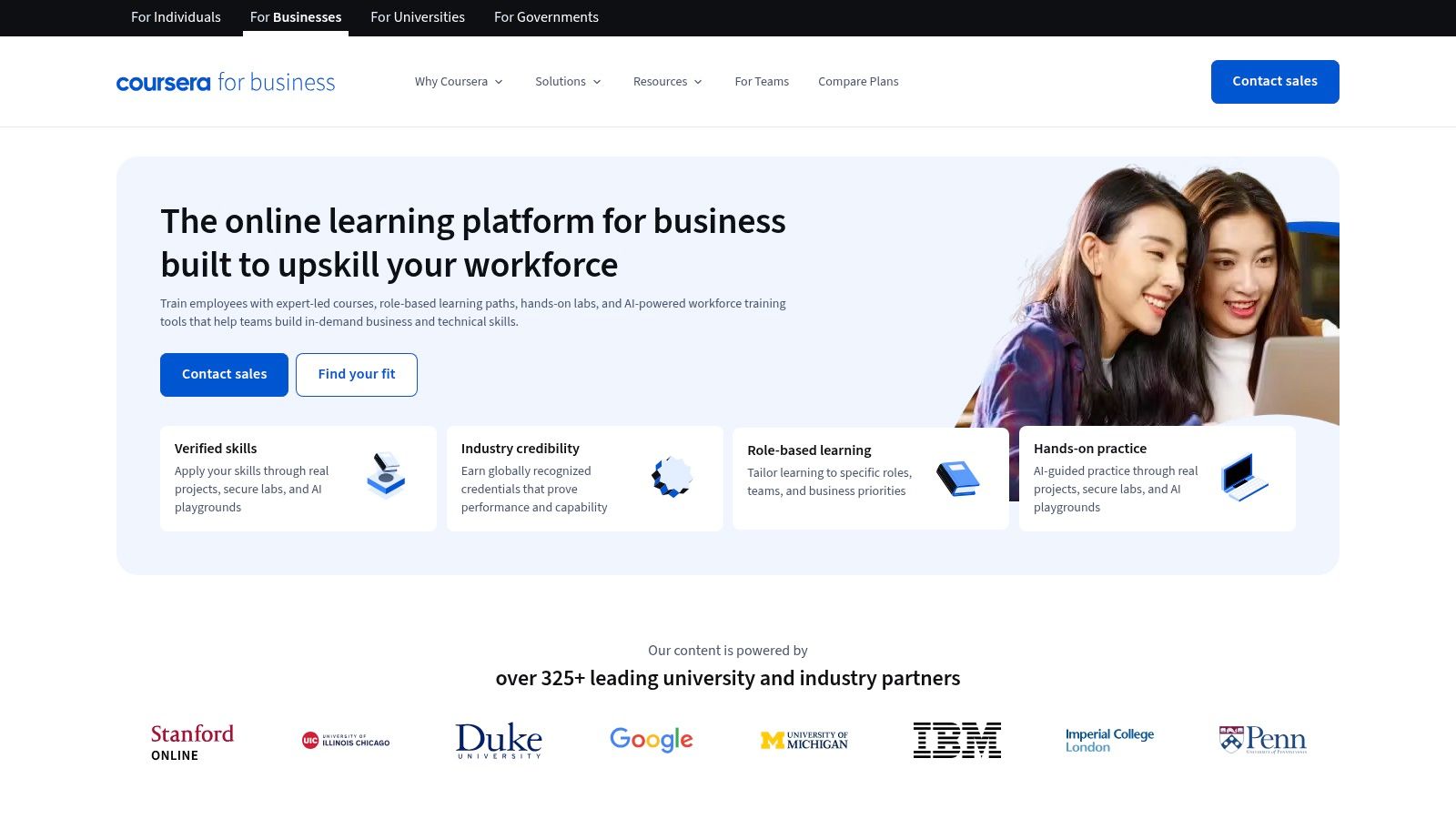
Coursera works best when you need one platform that can serve software engineers, data scientists, product teams, and newer AI hires without building a separate curriculum from scratch. Its biggest strength is breadth. The platform combines university content, partner content from companies like Google, Microsoft, and AWS, and applied Guided Projects on Coursera for Business.
Where it wins
Coursera is the cleanest choice for manager-led learning paths because it can support broad role-based programs, skill tracks, and enterprise integrations like SSO, APIs, and LTI. If you need to push learning into Canvas, Blackboard, Moodle, or D2L, that matters. If you also want AI-assisted curation for custom learning paths, that matters too.
Where it falls short
Choice overload is real. A large catalog helps when you know what you want, but it slows teams down when nobody curates the path. Some hands-on labs depend on the partner course, so don't assume every technical topic has the same depth.
Use Coursera when you want to standardize learning across functions and still keep an applied layer for engineers. Don't use it as a dump of optional courses. Put an owner on each path, then tell learners exactly what to complete and why.
2. O'Reilly Learning
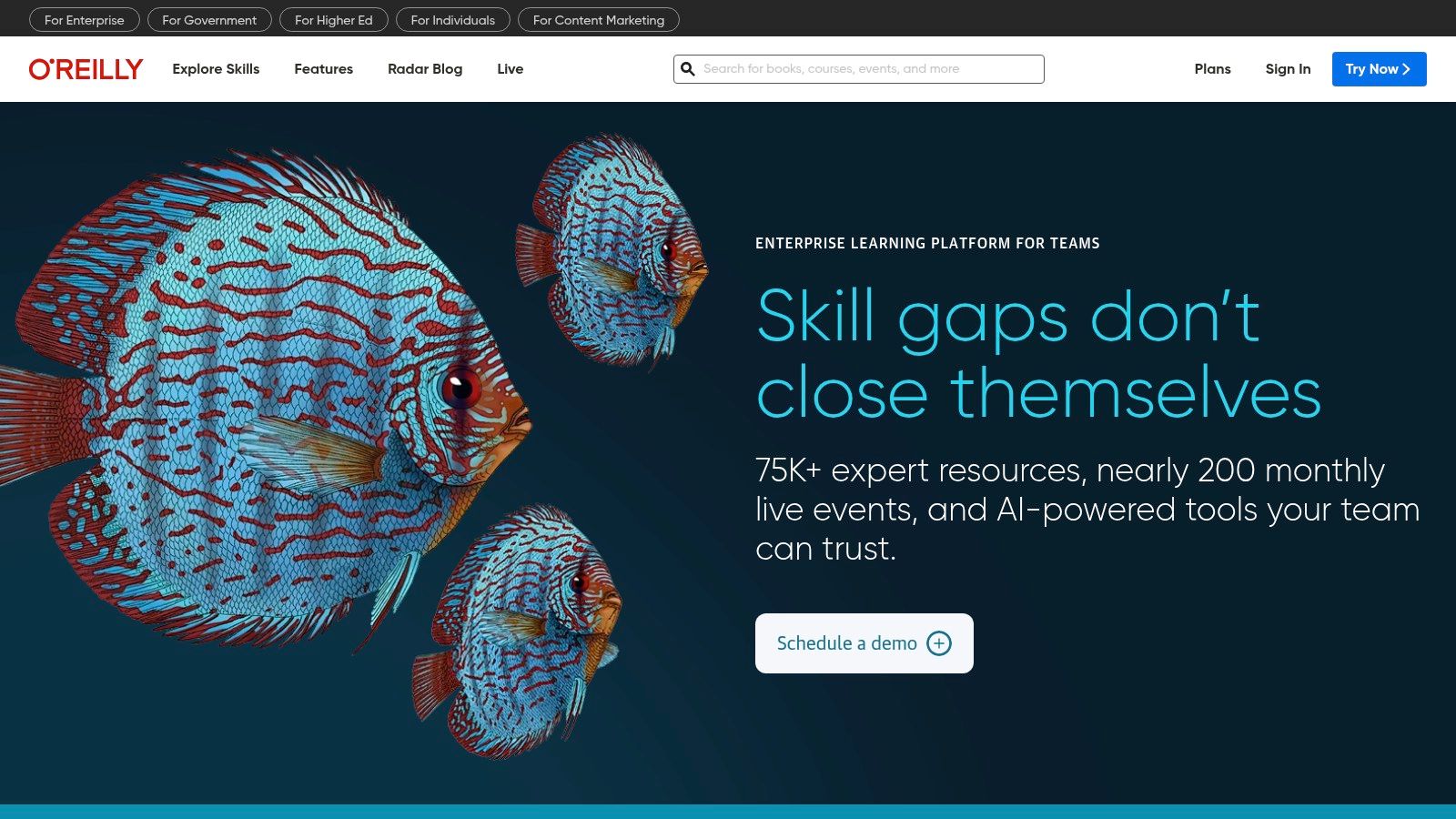
O'Reilly is the strongest choice when your senior engineers need a technical reference library they can return to every week. It combines books, videos, live training, and interactive labs, which makes it useful for architects, staff engineers, and technical leaders who need depth more than badges on O'Reilly Learning Teams.
Why engineering leaders like it
O'Reilly is the closest thing here to a single source of truth for quickly changing tools and patterns. That makes it especially useful for teams working across AI, data, cloud, and systems architecture, where individual blog posts go stale fast.
It also works well when you want senior people to self-direct. A platform like this respects experienced engineers who don't want a beginner-friendly course path forced on them. They can search, compare, and go deep.
The trade-off
Value depends on active use. If your team treats it as a library but never assigns learning time, you'll underuse it. The lesson for CTOs is clear, give your team protected time and a few concrete tasks, such as reviewing a new architecture choice or preparing for a design review.
Engineers use O'Reilly best when it sits inside the work, not beside it.
3. Pluralsight Skills
Pluralsight is the best fit when you want structure plus measurement. It gives you role paths, certification prep, hands-on labs, and Skill IQ assessments, so you can see where engineers stand and where they still need work on Pluralsight Skills.
Why it stands out
For engineering leaders, the value is not just content. It's the ability to build a visible skills baseline and then track whether learning is closing the gap. That makes it useful for promotions, readiness reviews, and standardizing the ramp for platform or cloud teams.
Pluralsight also has specialty libraries for AI, cloud, data, and security, which makes it a practical fit for orgs that need multiple technical tracks but still want one training vendor.
What to watch
The platform works best when you run it as a program. Casual use wastes the subscription. If you buy it, pair it with a concrete target, such as onboarding a new backend engineer, preparing a cloud migration team, or raising the bar for ML deployment readiness.
Use Pluralsight when you need the learning program to produce a measurable signal. Don't use it if you want a loose library with no ownership.
4. Udemy Business
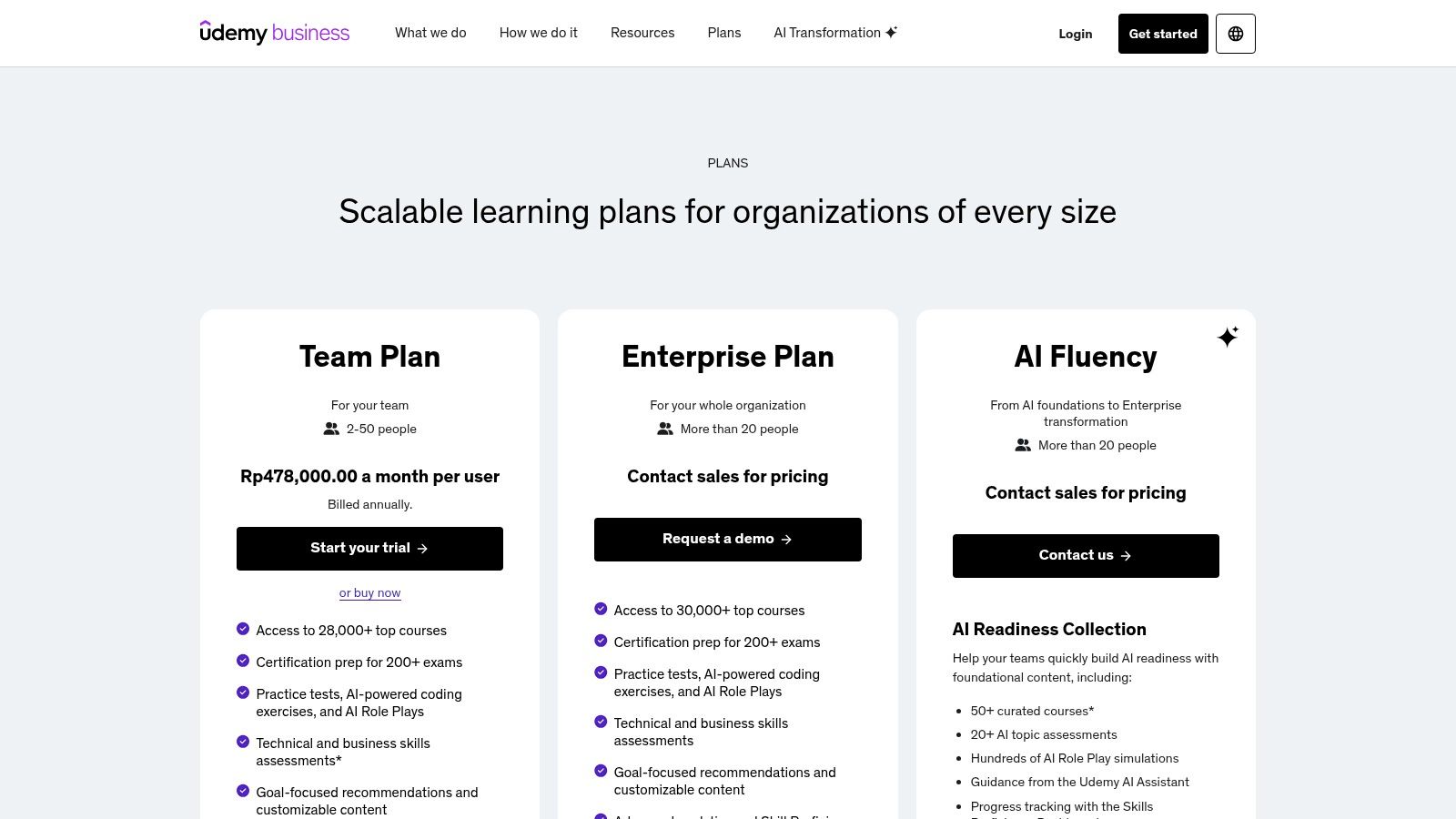
Udemy Business is the fastest way to cover new tools, new frameworks, and short-term skill gaps. It's a good pilot choice because it's low friction to roll out to a small team, and the catalog updates quickly on Udemy Business plans.
Where it fits
Use Udemy when your team needs to get moving on something that's changing right now, such as a new cloud service, a new AI framework, or a tool adoption that can't wait for a full curriculum refresh. The platform is easy to test with a small group before you expand it.
The downside
Quality varies by instructor, so you need curation. Treat it like a marketplace, not a curated academy. For engineering leaders, that means reviewing courses before assigning them and avoiding the temptation to let people self-select without guardrails.
Best practice: use Udemy for rapid coverage, then lock the learning path to one or two approved courses per topic.
That makes it especially useful for teams with immediate gaps, but less ideal when you need a highly standardized enterprise curriculum.
5. AWS Skill Builder
AWS Skill Builder is the right choice if your stack is AWS-first and your team needs to learn from the official source. It gives you role-aligned paths, hands-on labs, and instructor-led classes tied to AWS certifications on AWS Training.
Learning path fit for AWS teams
For ML engineers, focus on SageMaker and adjacent data services. For MLOps, prioritize deployment, infrastructure, security, and automation topics. For data engineers, anchor on storage, orchestration, and service integration. For platform leaders, use the certification paths to align team expectations and hiring signals.
If you're building cloud capability across the org, pair the platform with your own internal roadmap. This cloud computing skills guide helps connect that learning to hiring and architecture decisions.
The trade-off
AWS Skill Builder is authoritative, but it's AWS-centric. That's a strength if you run on AWS, and a weakness if you need cross-cloud breadth. It also makes the most sense when you have at least a few seats and a manager who can track completion.
Use it when platform credibility matters and certification alignment will help your team or hiring pipeline.
6. Google Skills subscriptions
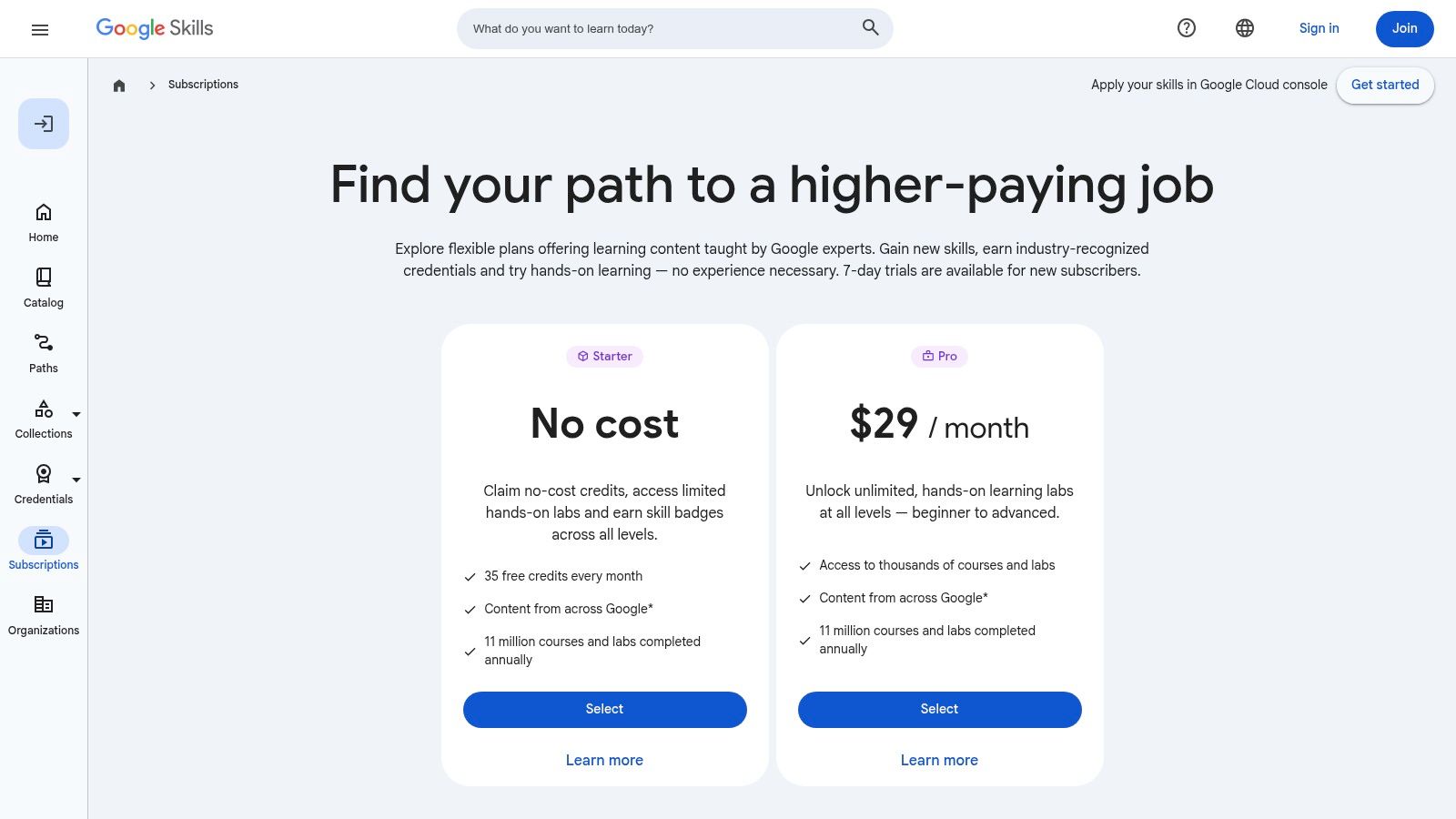
Google Skills is the best option for teams that need practical Google Cloud learning with real environments. Its hands-on labs reduce local setup friction, which makes it attractive for engineers who need to work directly in GCP and AI tooling on Google Skills subscriptions.
What it's good for
Use Google Skills for Vertex AI, Gemini, data engineering, and cloud workflows where direct practice matters more than reading about the platform. Console access makes the experience closer to job work and less like theory.
It also maps well to certification prep, which helps when you want learning paths that your team can recognize and managers can verify.
What to avoid
Don't pick it for a cross-cloud team that needs one neutral curriculum. Don't force it onto teams that don't touch GCP. The platform is strong, but only when the use case is already Google-centric.
For CTOs, the rule is simple. If your product runs on GCP or your AI stack depends on Google tooling, use this. Otherwise, choose a broader option and let your cloud-specific training happen elsewhere.
7. Microsoft Learn for Organizations
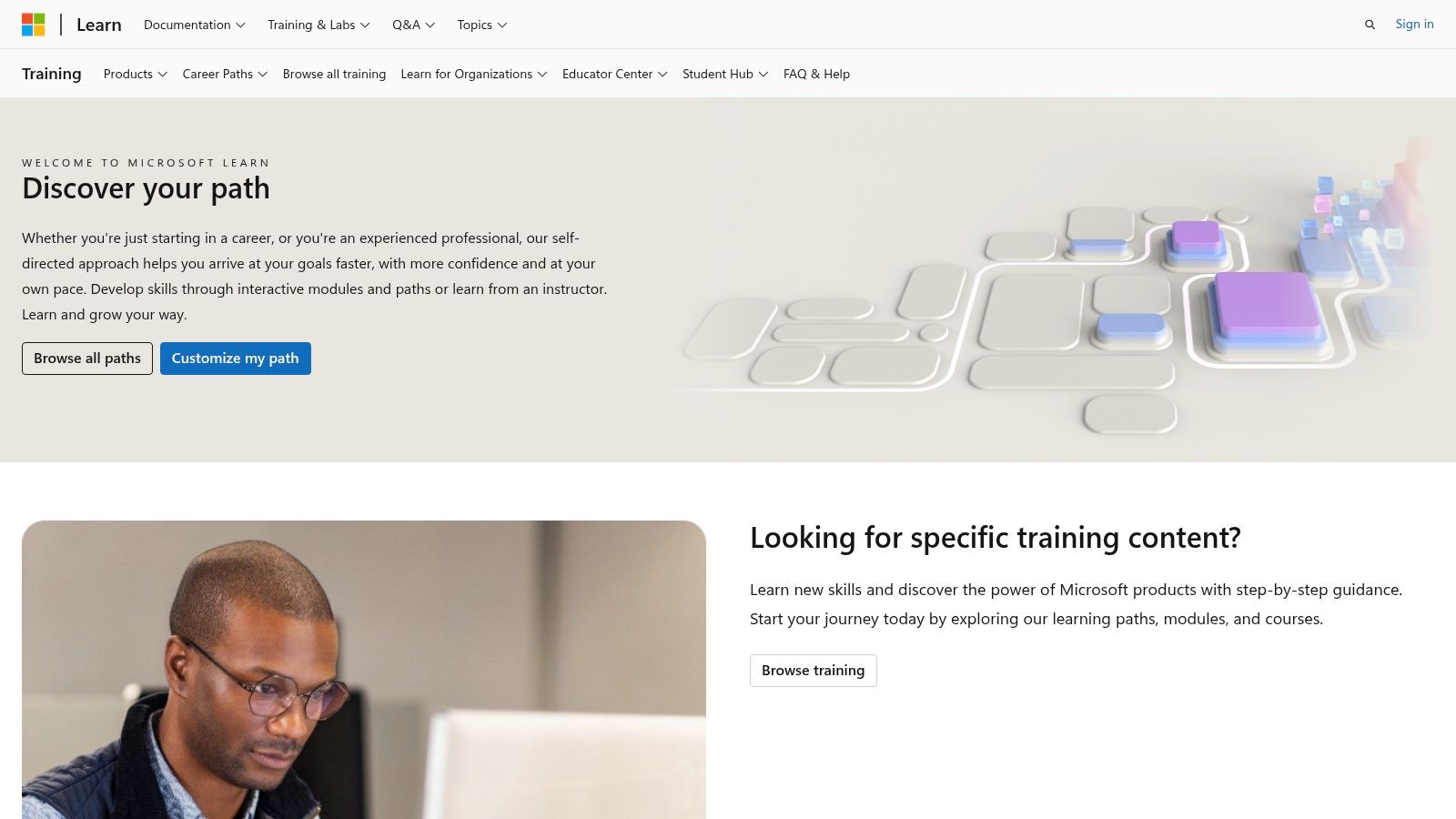
Microsoft Learn is the strongest zero-cost entry point for teams in the Microsoft ecosystem. It offers official learning paths for Azure, Microsoft 365, Copilot, Power Platform, data, AI, and security on Microsoft Learn.
Why it's useful
Microsoft Learn is a smart way to seed broad upskilling without asking for budget approval first. You can start with free modular lessons, then move the people who need deeper validation toward paid certification exams. That makes it ideal for organizations that want to lower the barrier to entry before spending on higher-touch training.
The trade-off
It needs curation if you want a real team program. The platform is rich, but the experience can become scattered if managers don't assign a path and a deadline. Advanced labs, storage, and certification steps may carry their own costs, so don't confuse free content with free implementation.
Use Microsoft Learn when you need a credible foundation for Azure and enterprise Microsoft skills, especially for onboarding and baseline upskilling.
8. NVIDIA Deep Learning Institute
NVIDIA Deep Learning Institute is the right tool when your AI work depends on GPU-accelerated training or inference. It focuses on AI, accelerated computing, and data science using NVIDIA software and hardware stacks on NVIDIA Deep Learning Institute.
Why it matters
If your team is optimizing LLM performance, inference throughput, or CUDA-based workflows, generic AI training won't be enough. NVIDIA DLI gives practitioners labs and workshops that are close to the actual deployment environment, which is what you need when performance matters.
When to use it
Use it for teams already running on NVIDIA hardware or for engineers who own the last mile between a working model and a fast, reliable service. It complements broader AI curricula well, but it shouldn't replace them.
For engineering leaders, this is not a primary learning platform for everyone. It's a specialist tool for the people doing low-level performance work.
9. Databricks Academy and Academy Labs
Databricks Academy is the best fit for organizations standardizing on the Databricks Lakehouse. It gives you self-paced courses, hosted labs, certification pathways, and program options for larger orgs on Databricks Academy.
If your team is deciding whether Databricks is the right machine learning platform, this internal guide on best machine learning platforms is the right next read.
Where it wins
The platform depth is the main value. For data engineering, ML, and LLM workflows, the hosted labs make it easier to train against the actual environment your team uses in production. That lowers friction for teams that need to move from training to implementation quickly.
The trade-off
It's most valuable once you've committed to Databricks. If you need broad multi-platform context, this is too narrow to stand alone. It also makes more sense for transformation programs than casual learning.
Use Databricks Academy when your company has already standardized on the platform and wants certification-aligned learning for the people who run it.
10. DeepLearning.AI
A CTO should use DeepLearning.AI when the team needs fast, practical training on AI fundamentals, generative AI, MLOps, prompt engineering, and fast-moving model tooling. It is a strong fit for teams that need current material without sorting through a lot of weak content. The focus is narrow in the right way, and that makes it useful for hiring ramps, onboarding, and targeted upskilling.
Why it works
Use it for teams that need to get productive quickly. Product leaders, new engineers, and ML practitioners can move through compact lessons and notebook-based exercises without waiting for a long course cycle. That makes it a practical choice for onboarding AI hires, giving software engineers enough context to work with model teams, and building shared vocabulary before a larger platform rollout.
It also fits role-based learning paths. An ML Engineer can use it to understand model workflows and deployment patterns. An MLOps team can focus on operational practices and tool changes. A Data Scientist can use it to tighten fundamentals and stay current on how models are being built and used. This is especially useful for understanding the fundamentals of neural network architecture before diving into specific models, especially if you pair it with a reference like neural network architecture.
The limitation
DeepLearning.AI is a content source first, not a full enterprise training system. SSO, analytics, and LMS integration usually sit with the platform you buy around it, so it works best as a learning input inside a broader program. That matters if you need reporting, assignment tracking, or a formal certification workflow across the company.
Use it where speed and relevance matter most. It is a better fit for keeping technical teams current than for replacing your central training stack.
Practical examples
A mid-stage SaaS company with 12 engineers can use Microsoft Learn to onboard two new hires into Azure basics, then move the platform team to Pluralsight Skills for measured cloud readiness. That gives the CTO a free entry point, a baseline, and a way to prove progress without buying too much too early.
A data platform team at an AI startup can combine Databricks Academy for platform-specific work, NVIDIA DLI for performance tuning, and O'Reilly Learning for architecture reference. That stack works because each tool has a different job. One teaches the platform, one teaches the hardware-aware optimization, and one fills the conceptual gaps.
A strong training stack does not mean more vendors. It means fewer vendors doing the right jobs.
Build learning paths by role
A CTO should not buy training by brand. Buy it by role, then wire it into hiring, onboarding, and promotion paths. For an ML Engineer, start with DeepLearning.AI for AI fundamentals, then add platform-specific training from AWS Skill Builder, Google Skills, or Databricks Academy based on where models run. That sequence keeps the learning path practical, because the engineer first learns the concepts, then learns the stack they will deploy into.
For MLOps, choose Pluralsight Skills, O'Reilly Learning, and the relevant cloud vendor training. That mix works because MLOps teams spend most of their time on deployment, observability, incident response, and infrastructure drift, not on theory alone. If the goal is to shorten onboarding for a new platform hire, vendor training should come first. If the goal is to build judgment across tools and patterns, O'Reilly Learning belongs in the middle of the path.
A Data Scientist should usually start with Coursera for Business or DeepLearning.AI for breadth, then move to hands-on platform work only if the role includes production ownership. If the team expects the scientist to hand work off to engineering, keep the path lighter and focus on model literacy, experimentation, and communication. If the scientist is expected to ship models, add the same platform training the engineers use so the gap does not show up later in handoffs.
For a Data Engineer, begin with Databricks Academy, AWS Skill Builder, or Microsoft Learn based on the warehouse and pipeline stack. That choice should match the company's production environment, not the engineer's personal preference. A strong learning path for this role also has a clear checkpoint. The engineer should prove they can build, operate, and troubleshoot data flows in the system the company runs.
The signal for CTOs is simple. Start this year, the technical skills development software category is projected to grow from USD 1,397.59 million in 2026 to USD 2,695.84 million by 2035 at a 7.5% CAGR according to Market Growth Reports. That points to a broader shift away from one-off courses and toward structured learning systems that support hiring, onboarding, and continuous upskilling.
Top 10 Technical Training Platforms, Comparison
| Platform | Core features | UX / Quality | Pricing & Value | Target audience | Unique selling points |
|---|---|---|---|---|---|
| Coursera for Business (Teams & Enterprise) | 10k+ courses, Professional Certs, Guided Projects, SSO/LMS, AI curation | ★★★★, mix of theory + hands‑on | 💰 Enterprise plans; strong exec ROI | 👥 Org L&D, cross‑functional teams | ✨ University & partner content, 🏆 Guided Projects |
| O'Reilly Learning (Teams/Enterprise) | 60k+ titles, live training, interactive labs, team analytics | ★★★★, deep technical reference | 💰 Team/enterprise quotes; best with active use | 👥 Senior engineers, architects, tech leads | ✨ Library depth, 🏆 single source for tooling |
| Pluralsight Skills (AI+/Cloud+/Data+) | 6.5k courses, 3.5k labs, Skill IQ, role paths, AI assistant | ★★★★, measurable skill benchmarking | 💰 Tiered subscriptions; best for structured programs | 👥 Engineers, cloud & data teams | ✨ Skill IQ & analytics, 🏆 role-based learning paths |
| Udemy Business (Team & Enterprise) | Large, fast-refresh catalog, labs, admin analytics | ★★★, variable quality; easy to pilot | 💰 Team & Enterprise tiers; low friction pilot | 👥 Small teams, fast pilots, emerging tools | ✨ Rapid content refresh, 💰 easy to start |
| AWS Skill Builder (Individual & Team) | AWS-authored courses, hands-on labs, cert-aligned paths | ★★★★, authoritative AWS content | 💰 Individual/team subs; volume discounts | 👥 AWS-centric engineers, ML & infra teams | ✨ Direct AWS mapping, 🏆 official cert prep |
| Google Skills (Cloud Skills Boost) | Hands-on GCP labs, badges, skill paths, real consoles | ★★★★, real GCP environments | 💰 Starter vs Pro tiers; lab credits | 👥 GCP engineers, data & ML teams | ✨ Real GCP consoles, 🏆 certification-aligned |
| Microsoft Learn (for Organizations) | Free modular lessons, sandboxes, cert-aligned paths | ★★★★, current MS ecosystem content | 💰 Free entry; paid exams/storage as needed | 👥 Azure/M365 teams, enterprise MS shops | ✨ Zero-cost entry, 🏆 authoritative MS content |
| NVIDIA Deep Learning Institute (DLI) | GPU/ML workshops, CUDA/Triton, inference & perf labs | ★★★★, performance-focused hands-on | 💰 Workshop/event pricing varies | 👥 Teams optimizing GPU-accelerated AI/LLMs | ✨ GPU & inference expertise, 🏆 vendor-grade labs |
| Databricks Academy + Labs (Pro) | Databricks courses, hosted Academy Labs, certs | ★★★★, platform-specific hands-on | 💰 Academy Pro/org pricing; sales-based | 👥 Databricks customers, data engineering teams | ✨ Hosted labs + cert pathways, 🏆 platform alignment |
| DeepLearning.AI | GenAI/LLM programs, MLOps, notebooks, events | ★★★★, high signal, applied notebooks | 💰 Free short courses; paid specializations (Coursera) | 👥 AI practitioners, product leaders, researchers | ✨ Andrew Ng-led curriculum, 🏆 focused AI expertise |
From Learning to Launch
Pick training the same way you pick engineering tooling, by matching the platform to the workflow. If you need broad onboarding, choose a general-purpose platform with strong admin controls and clear paths. If you need deeper role growth, choose a library or specialist source that senior engineers will use. If you need certification or platform-specific capability, choose the official vendor training and stop trying to reinvent it.
Your next move should be practical. First, benchmark your team's current skills against the roadmap you're shipping. Second, pilot one or two platforms with a focused project team, not the whole company, so you can see whether people finish the content and use it in their work. Third, close urgent gaps with senior talent if the timeline is tighter than your training ramp.
The bigger point is simple. Training only matters if it changes how your team hires, onboards, and ships. Build role-based paths, assign owners, and tie each resource to one outcome, such as faster onboarding, stronger certification readiness, or better platform execution. Then review the stack every quarter and remove anything your team isn't using.
ThirstySprout helps you hire senior AI engineers and ML teams that can start fast while your team upskills on the right technical training resources. If you need vetted help for LLMs, MLOps, data engineering, or AI product work, visit ThirstySprout and start a pilot that matches your stack and timeline.
Hire from the Top 1% Talent Network
Ready to accelerate your hiring or scale your company with our top-tier technical talent? Let's chat.