

The cloud market is projected to reach $912.77 billion by 2025, while 77% of employers report unfilled vacancies tied to skills shortages and 87% of companies say they face or expect skills gaps (TrueAbility cloud skills statistics). For AI teams, that's not a background hiring problem. It's the bottleneck that slows launches, inflates spend, and leaves security decisions to people who are still learning the platform under pressure.
TL;DR
- Cloud computing skills now sit at the center of AI delivery, not just infrastructure maintenance.
- The strongest hires combine infrastructure, security, IaC, observability, FinOps, and MLOps judgment.
- Don't hire for generic platform familiarity alone. Test how candidates design, recover, explain trade-offs, and control cost.
- Use a nine-domain skill matrix to decide whether to hire, upskill, or bring in fractional help.
- If you need cloud and MLOps talent quickly, start with a scoped pilot instead of a broad search.
Who this is for
This is for CTOs, engineering leaders, founders, and talent teams who need to ship AI products without building a fragile cloud stack first. It also fits platform leads and MLOps managers who are tired of resumes that list every cloud service but can't explain how the system stays secure, observable, and affordable in production.
A useful way to think about the role is simple. Cloud skills are no longer just about “can deploy.” They now touch reliability, governance, model serving, data movement, and cost discipline.
Practical rule: If a candidate can't explain a cloud trade-off to product, security, and finance without hiding behind jargon, the team will feel that gap later in production.
Why Cloud Computing Skills Are the Bottleneck for AI Teams
ISC2's cloud security research shows why this keeps surfacing in hiring. Cloud computing security is one of the areas organizations keep asking for, yet the workforce still has a thin layer of people with strong cloud security knowledge (ISC2 cloud security research deep dive). As noted in the introduction, the market pressure is also high, with employers reporting persistent cloud skills gaps. Together, those signals make cloud work a delivery constraint for AI teams, not a background operations task.
Why generic cloud lists fail in AI hiring
Many teams still screen for old cloud checkboxes. They ask whether someone knows a provider console, basic networking, or a migration path. That does not match the job in AI systems, where the engineer has to combine deployment, governance, data movement, and model operations in one workflow.
The stronger signal comes from security. In ISC2's Cybersecurity Workforce Study, organizations with security needs identified cloud computing security as one of those needs, and the same research showed a gap between demand and the depth of cloud security knowledge across the workforce. That matters because AI teams ship customer-facing systems, and the people shaping the cloud layer need to handle access controls, failure modes, and auditability from the start.
The skill set also has to cover the money side. If a candidate can design a clean environment but cannot explain why model training, feature storage, and inference traffic affect spend in different ways, the team will feel it later in production. For practical cloud and MLOps hiring, a focused DevOps for machine learning lens helps separate people who know service names from people who can keep an AI pipeline running under real delivery pressure.
The AI-era cloud skill set is broader
For AI teams, cloud work now blends MLOps, FinOps, security, and governance. TechTarget's skills-gap coverage points to shortfalls in AI and machine learning integration with cloud apps, cloud AI services, and cloud compliance around data sovereignty (TechTarget cloud skills gap). That is the right framing. AI delivery depends on platform work, not just infrastructure setup.
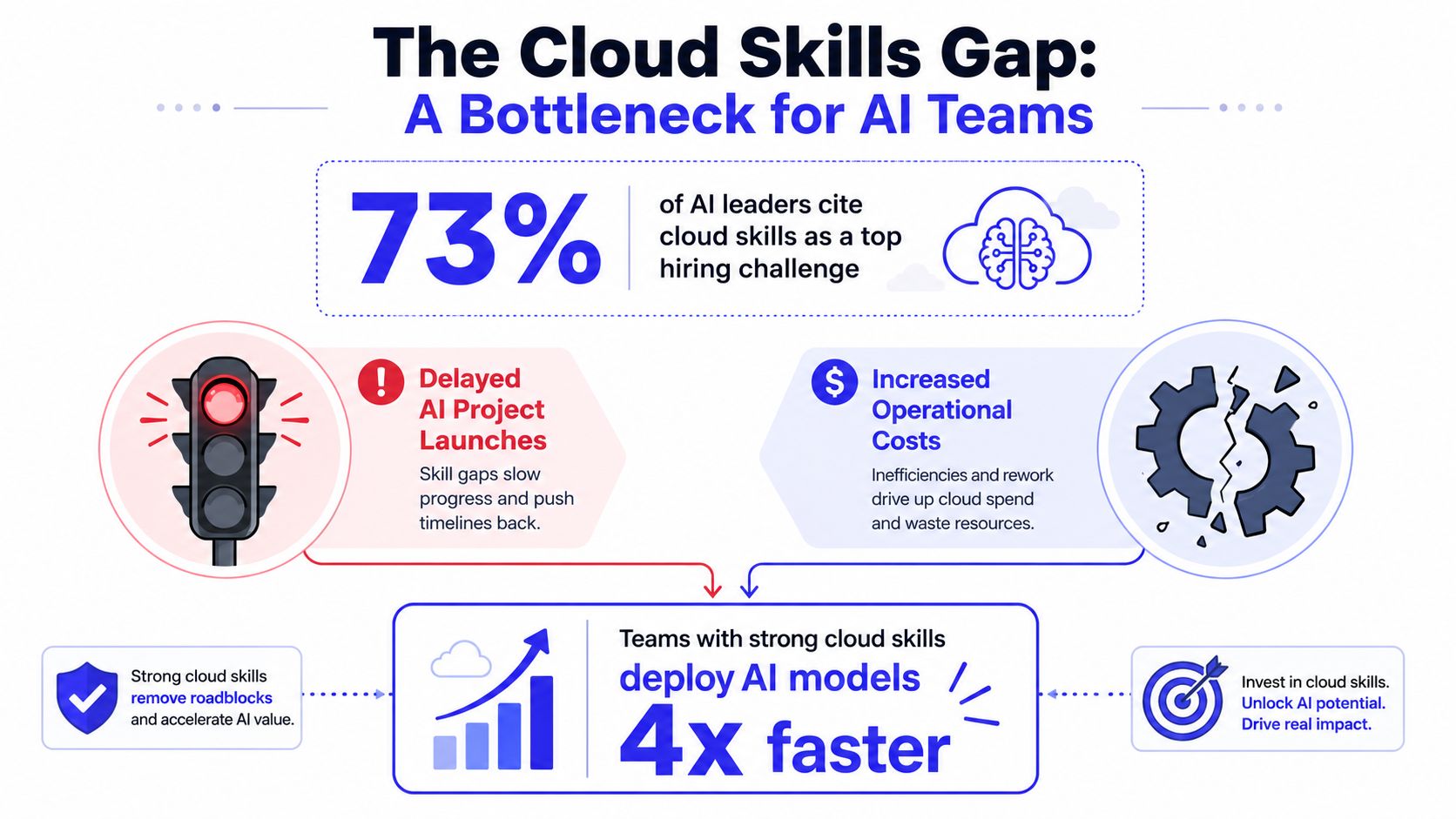
A strong cloud hire reduces rework because they design for repeatability, recovery, and reviewability. A weak one leaves the team with brittle scripts, ad hoc permissions, and surprise bills. In AI, that usually shows up just as the model starts to matter to customers and the stakes get higher.
If you want a concrete example of how ops quality shows up in the day-to-day, you can browse the VM control panel and see how much discipline it takes to keep even basic infrastructure understandable and manageable.
The Nine Core Cloud Computing Skill Domains
Cloud work gets easier to hire and manage when you break it into domains instead of treating it as one vague skill. The practical set is nine parts: architecture, networking, security, Infrastructure as Code, observability, data services, cost optimization, CI/CD and DevOps, and governance. Each one shows up differently in interviews and on the job.
What each domain looks like in practice
IaaS, PaaS, SaaS architecture means a candidate can choose the right level of managed service for the problem. Junior engineers usually know provider building blocks, mid-level engineers can compare options with trade-offs, and senior engineers can defend an architecture choice against reliability, compliance, and team bandwidth.
Networking and DNS show up when systems have to talk to each other safely and predictably. A junior might connect services in one environment, a mid-level engineer can reason about segmentation and routing, and a senior can avoid designs that become hard to secure or impossible to debug.
Security and compliance go beyond turning on encryption. Early-career engineers should understand identity and access basics, while senior people need to review controls, permissions, and evidence paths with audit and legal teams.
Infrastructure as Code is where cloud competence becomes visible in code review. Terraform and AWS CloudFormation let teams define compute, networking, IAM, and storage declaratively, which improves repeatability and reduces configuration drift compared with manual console changes (HackerRank cloud computing skills). That's also why practitioners often ask candidates to browse the VM control panel before they talk about provisioning. It reveals whether they think in systems or in clicks.
Cost optimization and FinOps are undertested but important. S&P Global notes 85% of organizations reported cloud expertise deficits, and nearly 35% lacked cloud-centric specialist skills and vendor-stack expertise (S&P Global cloud maturity and skills). The operational skill is knowing how to stop spend from drifting faster than value.
The domains that separate good from great
Observability means the team can detect failure before customers do. Data services and storage cover the systems that move, retain, and serve data safely. CI/CD and DevOps make releases boring in the best way. Governance ties all of it together so policy, permissions, and standards don't depend on tribal knowledge.
If you want one rule of thumb, use this: junior candidates can name services, mid-level candidates can build with them, and senior candidates can explain why the system will still work six months later.
Practical rule: The best cloud engineers don't just know what to deploy. They know what to automate, what to measure, and what to keep off the critical path.
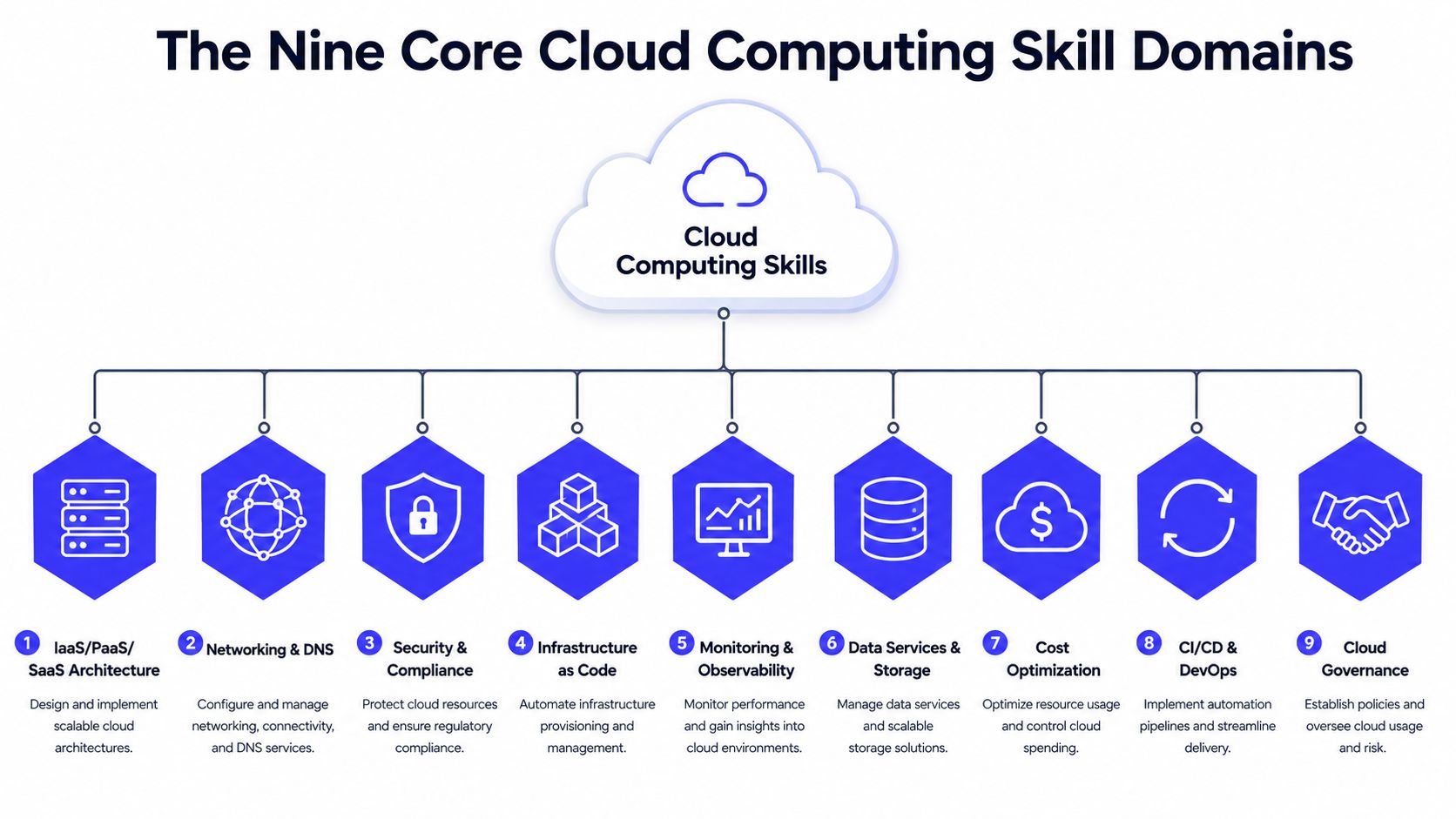
| Domain | What proficiency looks like |
|---|---|
| Architecture | Chooses the right managed or self-managed pattern for the workload |
| Networking and DNS | Keeps service communication predictable and secure |
| Security and compliance | Applies identity, access, and audit controls with care |
| Infrastructure as Code | Builds repeatable infrastructure with version control |
| Observability | Detects issues early with logs, metrics, and alerts |
| Data services and storage | Handles data movement, durability, and access needs |
| Cost optimization | Spots waste and controls cloud spend before it spreads |
| CI/CD and DevOps | Ships changes safely and consistently |
| Governance | Keeps standards, policy, and reviews aligned |
For teams building AI products, the best reference point is usually the MLOps layer. A practical internal benchmark is the hiring guidance in DevOps for machine learning, because it forces the conversation toward deployment, automation, and operational ownership instead of theory.
Mapping Cloud Skills to Roles and Seniority Levels
Hiring gets clearer when you tie skills to the job that needs to be done. A cloud engineer does not need the same depth as a platform engineer, and an AI product manager should not be screened like a staff infrastructure architect. Skills-based hiring helps close the gap between a job post and the work by forcing a rubric, not a resume, to do the heavy lifting. For a broader view, skills-based hiring 2026 trends is a useful lens.
Cloud Skills by Role and Seniority
| Role | Essential Skills | Important Skills | Nice-to-Have |
|---|---|---|---|
| Cloud Engineer | Architecture, IaC, security, observability | Networking, data services, CI/CD | Cost optimization, governance |
| MLOps Engineer | IaC, observability, CI/CD, data services | Security, architecture, cost optimization | Deep networking, provider breadth |
| Data Engineer | Data services, architecture, governance | Security, observability, cost optimization | Advanced CI/CD, deep networking |
| Platform Engineer | Architecture, IaC, security, observability, governance | Networking, data services, CI/CD, cost optimization | Specialized provider edge cases |
| AI Product Manager | Governance, cost awareness, security basics | Architecture, observability | Deep IaC, low-level networking |
| Security Specialist | Security, governance, observability | Architecture, IaC, networking | Data engineering depth |
This matrix is more useful than a generic cloud checklist because it reflects where AI teams feel pain. A first cloud hire for an AI product usually needs enough breadth to keep infrastructure, security, and spend under control. A senior MLOps hire needs deeper automation, release discipline, and an ability to keep model deployment stable without turning every change into a manual fire drill.
How seniority changes the bar
Junior candidates should show learning speed and safe execution. Mid-level candidates should be able to own a well-scoped system without constant direction. Senior candidates should show judgment, documentation habits, and the ability to defend trade-offs in front of security, product, and operations.
The soft skills matter because cloud work crosses team boundaries every day. An exploratory analysis of cloud roles found 22 competency areas and 46 skills, with the top three individual skills being Communication Skills, DevOps Tools, and Software Development (exploratory analysis of cloud computing jobs). That should change how hiring teams run interviews. If a candidate cannot explain a design in plain language, they are likely to create friction later with security reviews, release planning, or incident response.
The interview bar should rise with scope. A junior engineer can be strong with one domain and still be useful. A senior engineer has to explain why a choice helps product launch speed, keeps support load manageable, and avoids creating a larger operational problem later.
For adjacent hiring teams, the role design in hire DevOps engineer is a practical comparator because many cloud roles now overlap with deployment automation and platform ownership.
Two Real-World Hiring Scenarios for Cloud Talent
A Series A startup and an enterprise AI lab do not need the same cloud profile. One needs speed and enough breadth to avoid early mistakes. The other needs depth, process maturity, and someone who can keep multiple stakeholders aligned. The hiring choice should follow the pressure point, not the title.
Scenario one, first cloud engineer for a RAG startup
A Series A team building a retrieval-augmented generation support product usually needs someone who can get the platform into production without creating a future cleanup project. The job description should stress IaC, security basics, observability, and the ability to work across product and customer support, because early AI support products fail when infrastructure, retrieval, and incident handling are treated separately.
In interviews, I'd test for one thing above all else, whether the candidate can make safe trade-offs quickly. A strong candidate might be deep in six of the nine domains and “good enough” in the rest. That's often better than a specialist who can tune one area but won't own the full system.
A practical loop for this role usually includes a short design review, a Terraform exercise, and a conversation about how they'd react when the retrieval pipeline degrades under load. The candidate who can explain alerting, rollback, and access boundaries usually beats the one who only names services.
Scenario two, senior MLOps hire for an enterprise AI lab
An enterprise AI lab scaling a model platform needs different signals. Here, I'd weight IaC maturity, FinOps awareness, and cross-team communication more heavily, because the work touches multiple internal customers. A senior MLOps engineer should be able to explain how to keep deployments repeatable, how to avoid spend surprises, and how to work with security and data teams without slowing every release.
The second scenario also changes what “senior” means. I don't expect a platform leader to know every service in every cloud. I do expect them to make the system easier to operate after they leave a room. That usually means their designs are legible, their changes are reviewable, and their operating assumptions are written down.
A senior cloud hire should lower the coordination cost of the whole team, not just improve one technical metric.
The hiring lesson across both scenarios is simple. Breadth matters early, but only if the candidate can still reason about the parts that carry risk. Depth matters later, but only if the person can translate it into operating discipline.
Interview Kit and Assessment Tasks for Cloud Roles
A useful interview loop tests real work, not vocabulary. It should also be consistent enough that two interviewers would score the same candidate in roughly the same way. The strongest format I use combines take-home infrastructure work, live debugging, and systems thinking.
A practical assessment stack
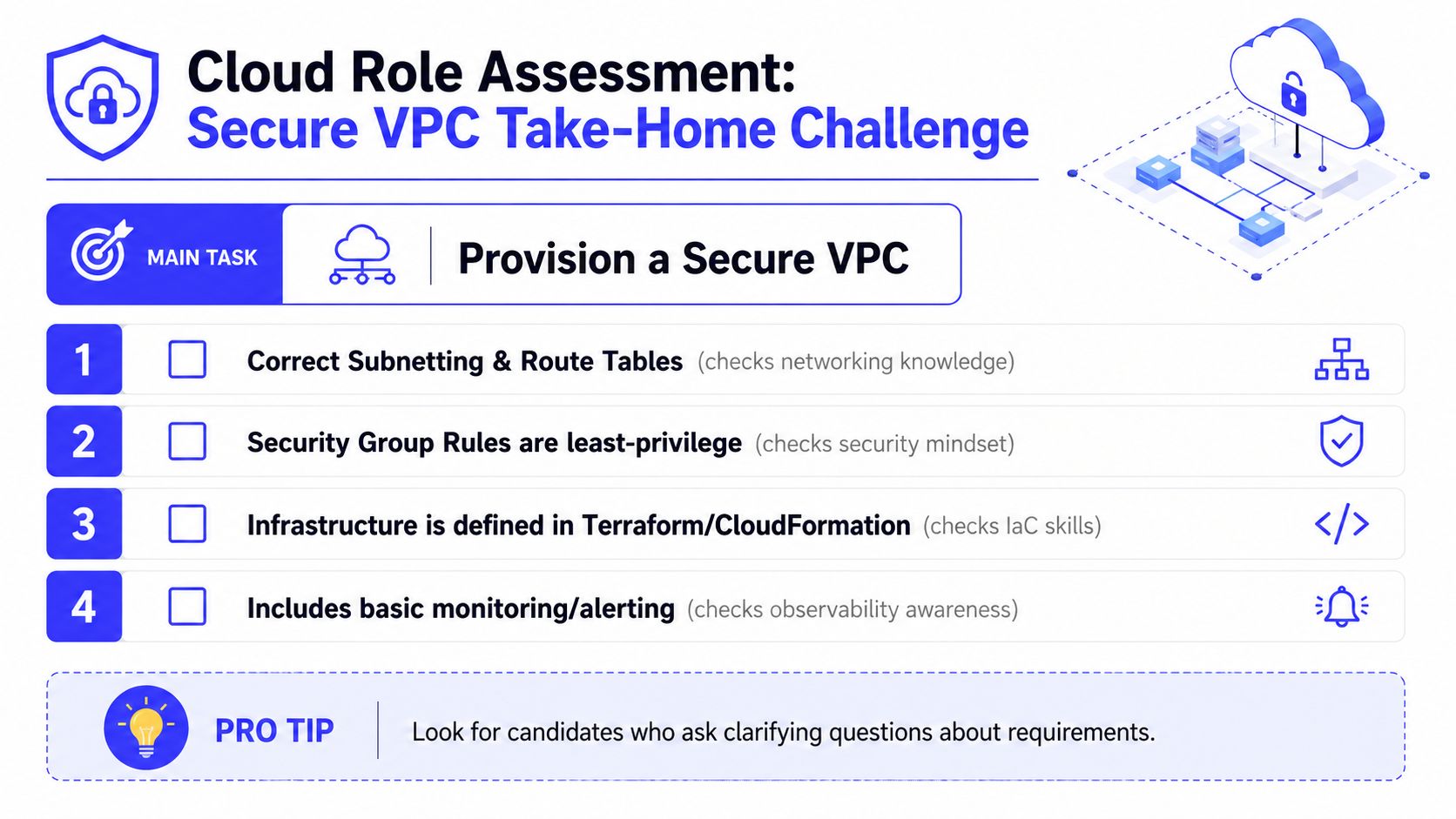
Take-home task: Ask the candidate to provision a secure VPC with a containerized API behind a load balancer using Terraform or CloudFormation. Score subnetting, route design, security group rules, and whether another engineer could maintain the infrastructure without guessing what the original author intended.
Live-coding prompt: Have them write a Python script that parses CloudWatch logs and flags cost anomalies. The goal is not perfect code. It is whether they can think about signal, thresholds, and operational usefulness.
System design question: Ask them to design a multi-region ML inference pipeline with failover and cost controls. Good answers mention deployment safety, observability, and the trade-off between resilience and spend.
Rubric for scoring
Use a four-part rubric for every task.
- Correctness: The system works and matches the requirements.
- Security: Access is least-privilege and assumptions are explicit.
- Operability: Logs, alerts, and recovery are part of the design.
- Communication: The candidate explains trade-offs clearly to a non-technical stakeholder.
A strong cross-functional prompt asks the candidate to explain a cloud architecture trade-off to a product manager. The answer should be plain English, not a lecture. If they cannot simplify the problem, they will struggle when security or finance joins the discussion.
For teams that want a broader cloud readiness view, the role guide at hire DevOps engineer pairs well with this assessment, because it helps separate platform ownership from generic infrastructure familiarity.
A second useful reference is practical cloud skill development guidance. It gives hiring teams and learners a way to connect interview performance with the habits that matter after the offer is accepted.
Learning Pathways to Build Cloud Computing Skills
Upskilling works when it's sequenced. Start with fundamentals, then give people a sandbox, then move them into one domain where they can become useful fast. That order matters because cloud learning falls apart when teams jump straight to advanced services without the base layers of Linux, networking, and provider fluency.
A simple three-phase path
Phase 1, Foundation: Pick one provider and one certification target. AWS Solutions Architect, Azure Security Engineer, or GCP Professional Cloud Architect all create a baseline, but the primary goal is to make the team comfortable reading cloud diagrams and navigating service boundaries.
Phase 2, Application: Move into labs and a real sandbox. Terraform Cloud workshops, Kubernetes the Hard Way, and FinOps Foundation training all help because they force hands-on judgment, not just memorization.
Phase 3, Specialization: Choose one domain to go deep on. That could be security, IaC, or cloud AI services. The best people then lead one initiative, even if it's small, so the learning turns into operational behavior.
What to assign this week
- Linux and networking first: Syracuse's cloud management guide says effective cloud management depends on hands-on experience with at least one of the big three providers, and it notes that Linux runs on approximately 90% of public cloud workloads (Syracuse cloud management skills).
- Automation next: Use one IaC project and make it reviewable.
- Cost awareness last: Ask the learner to audit a workload for waste, then explain the findings in plain English.
- AI-adjacent practice: For teams already shipping models, pair the learning with the MLOps material in developing in the cloud.
A mid-level engineer can become useful on IaC in a focused window if they practice every week and apply it to a live system. The key is not the badge itself, it's whether the person can ship repeatable infrastructure without handholding.
The video below is a useful companion for team leads who want to talk through the learning sequence with engineers.
Your Cloud Hiring and Skills Action Plan
Start with a blunt audit. Score your current team against the nine-domain matrix and mark the two gaps that are blocking AI delivery right now. If the gap is broad and urgent, hire senior talent. If the gap is narrow and repeatable, upskill someone already inside the team. If you need speed without long-term headcount, bring in a fractional specialist.
Use this checklist this week.
- Map the current team: List who can own architecture, IaC, security, observability, and cost control.
- Name the blockers: Identify the top two skill gaps slowing your AI roadmap.
- Write the role against outcomes: Use the role matrix, not a generic cloud job description.
- Run one structured interview loop: Include a take-home, a live exercise, and a systems conversation.
- Pick one learner: Assign a 90-day development path to one existing engineer.
If you need vetted cloud and MLOps talent without a long search cycle, a focused pilot is the fastest next move.
ThirstySprout helps teams scope cloud and AI roles, then matches them with vetted engineers who can work across infrastructure, MLOps, security, and product delivery. If you're hiring now, visit ThirstySprout to start a pilot and get a shortlist that fits your stack and timeline.
Hire from the Top 1% Talent Network
Ready to accelerate your hiring or scale your company with our top-tier technical talent? Let's chat.