

TL;DR
- Shift from Local to Cloud: Stop building for the cloud and start building in it. Use cloud-based IDEs and managed services to accelerate your entire software development lifecycle (SDLC).
- Focus on Four Pillars: Standardize on containers (Docker), automate with Infrastructure as Code (Terraform), adopt serverless for efficiency, and embed security and cost controls (FinOps) from day one.
- Structure Your Team: Hire key roles like Cloud, MLOps, and Site Reliability Engineers. Start with a small, centralized platform team to build a "paved road" for development, then embed experts in product squads as you scale.
- Avoid Common Pitfalls: Prevent runaway costs with strict resource tagging and budget alerts. Mitigate security risks by automating checks in your CI/CD pipeline. Avoid vendor lock-in by favoring open-source tools like Kubernetes.
- Recommended First Step: Containerize one non-critical application and deploy it to a simple managed service like AWS Fargate. This delivers a quick win and builds foundational skills with minimal risk.
Who This Is For
This guide is for technical leaders who need to act within weeks, not months:
- CTO / Head of Engineering: You need to decide on a cloud development strategy that improves team velocity and reduces operational drag.
- Founder / Product Lead: You're scoping the budget and team structure required to build and scale new features, particularly those involving AI.
- Staff Engineer: You are responsible for architecting scalable, reliable systems and need a practical framework for implementation.
A Framework for Cloud Development Adoption
Adopting cloud development is a strategic shift to connect engineering effort directly to business impact—faster time-to-market and reduced operational cost. It’s a move from coding locally and pushing to the cloud, to a model where providers like AWS, Google Cloud, or Azure become your team's end-to-end workspace.
Follow this step-by-step framework to get started.
- Standardize on Containers: Mandate Docker for all new services. This eliminates "it worked on my machine" issues by ensuring code runs identically from a developer's laptop to production.
- Automate Infrastructure with IaC: Use tools like Terraform or Pulumi to define and manage your infrastructure as code. This makes your environments repeatable, auditable, and less prone to human error.
- Implement a Serverless-First Approach: For event-driven tasks or APIs with variable traffic, default to serverless functions (e.g., AWS Lambda). This minimizes cost by ensuring you only pay for compute time you actually use.
- Embed Security and Cost Controls: Integrate automated security scans and cost-tracking tools directly into your Continuous Integration/Continuous Deployment (CI/CD) pipeline. Treat security and budget as core development concerns, not afterthoughts.
Practical Examples of Developing in the Cloud
Theory is one thing, but execution is another. Here are two real-world examples that show how these principles translate into practice.
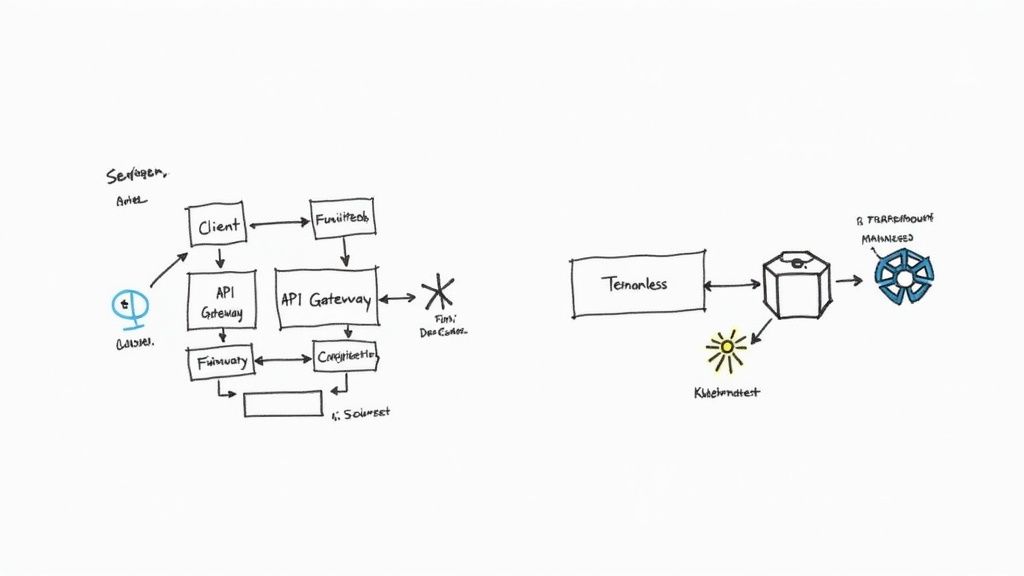 Alt text: Diagram showing two cloud architectures. The first is a serverless API with a client, API Gateway, and Lambda. The second is a containerized application managed by Kubernetes.
Example 1: Serverless AI Inference API on AWS
Scenario: You need an API that accepts an image and returns an AI-generated description. Traffic is unpredictable, ranging from a few requests per hour to thousands.
A serverless architecture is the ideal fit. It scales automatically and eliminates the cost of idle servers, a massive source of wasted cloud spend.
Architecture Breakdown:
- Client Request: A user's application sends an image via HTTPS to an Amazon API Gateway endpoint.
- API Gateway: This managed service acts as the front door, handling authentication, traffic throttling, and request routing.
- AWS Lambda: The gateway triggers a Lambda function containing Python code. The function loads a machine learning model, processes the image, and generates the text description.
- Model Storage: The ML model is stored in a cost-effective Amazon S3 bucket and loaded by the Lambda function on demand.
- Response: The function returns a JSON response containing the description, which flows back through API Gateway to the client.
Business Impact: The pay-per-use model is a game-changer for AI. For the first million requests per month, the AWS free tier often brings the cost to near zero. After that, you pay pennies, a fraction of what a 24/7 dedicated server would cost.
Example 2: IaC for a Reusable Staging Environment (Terraform Snippet)
Scenario: You need a staging environment that is a perfect, repeatable clone of production to eliminate "environment drift."
This Terraform snippet defines a Google Kubernetes Engine (GKE) cluster that can be spun up or torn down with a single command. It's a blueprint for reliable testing.
# Define the Google Cloud providerprovider "google" {project = "your-gcp-project-id"region = "us-central1"}# Create a GKE cluster for the staging environmentresource "google_container_cluster" "staging_cluster" {name = "staging-primary-cluster"location = "us-central1-c"initial_node_count = 1remove_default_node_pool = true}# Define the node pool for staging workloadsresource "google_container_node_pool" "staging_node_pool" {name = "staging-node-pool"cluster = google_container_cluster.staging_cluster.namelocation = "us-central1-c"node_count = 2node_config {# Use a cost-efficient machine type for stagingmachine_type = "e2-medium"# Apply labels for cost tracking and policy enforcementlabels = {environment = "staging"team = "product-alpha"}}}Business Impact: This declarative code removes manual setup errors, a major cause of deployment failures. Any developer can now create an identical test environment, dramatically improving test reliability and reducing time spent debugging environment-specific issues.
Deep Dive: Trade-offs, Alternatives, and Pitfalls
Shifting to cloud-native development offers immense benefits, but it introduces new risks. Being aware of these trade-offs is key to a successful strategy.
By 2025, over 94% of enterprises will use cloud services. However, a staggering 82% report managing cloud spend as their top challenge, according to recent cloud adoption statistics.
Pitfall 1: Uncontrolled Cost Overruns
The biggest surprise for many is the monthly cloud bill. This often happens when teams "lift and shift" old applications without re-architecting them for the cloud's pay-as-you-go model.
- Solution: Implement a FinOps culture. Mandate resource tagging for all assets to attribute costs to specific teams or features. Set up automated alerts for budget anomalies and use scripts to shut down non-production environments overnight.
Pitfall 2: Critical Security Blind Spots
Cloud flexibility can create subtle security holes. The leading cause of breaches isn't sophisticated hacks but simple misconfigurations, like a public S3 bucket or overly permissive Identity and Access Management (IAM) roles.
- Solution: "Shift security left." Integrate automated security scans into your CI/CD pipeline using tools that check for vulnerabilities and misconfigurations against benchmarks from the Center for Internet Security (CIS). Enforce the principle of least privilege for all user and service accounts.
Pitfall 3: Unintentional Vendor Lock-In
Leaning too heavily on a single provider’s proprietary, high-level services can make it technically or financially impossible to switch clouds later.
- Solution: Be deliberate. Prefer open-source technologies like Kubernetes, PostgreSQL, and Docker that are portable. When you must use a proprietary service, abstract it behind an internal API. This way, if you need to swap it out, you only change code in one place.
Checklist: Your Cloud Development Launch Plan
Use this checklist to ensure your transition to cloud development is structured and effective.
Phase 1: Foundation (Weeks 1-2)
- Define your primary cloud provider (AWS, GCP, Azure).
- Select and standardize one tool for Infrastructure as Code (e.g., Terraform).
- Establish a mandatory resource tagging policy for cost attribution.
- Set up initial budget alerts in your cloud provider's console.
Phase 2: Pilot Project (Weeks 3-6)
- Choose one non-critical application for your first cloud-native pilot.
- Containerize the application using Docker.
- Define its infrastructure using your chosen IaC tool.
- Deploy the container to a managed service (e.g., AWS Fargate, Google Cloud Run).
- Build a basic CI/CD pipeline to automate deployment.
Phase 3: Scale & Govern (Weeks 7-12)
- Document the pilot project's architecture as a reusable template.
- Hire or train for key roles: Cloud Engineer, MLOps Specialist (if using AI). See our guide on roles in agile software development.
- Establish a small, central platform team to manage core services.
- Implement automated security scanning within your CI/CD pipeline.
- Conduct the first monthly cost review based on your tagging data.
What to Do Next
- Scope Your Pilot: Identify a single, low-risk service to containerize and move to a managed cloud platform in the next 2–4 weeks.
- Define Key Roles: Map out the skills you need for your cloud team, focusing on Cloud Engineering and MLOps.
- Book a Scoping Call: Use our expertise to refine your cloud talent strategy and get access to pre-vetted engineers.
Ready to build your high-performance cloud team? ThirstySprout helps you hire elite, pre-vetted AI and software engineering talent to scale your cloud development initiatives. Start a Pilot.
References
- Core Cloud Development First Principles (AWS Study Guide)
- MLOps Best Practices (ThirstySprout)
- Report on 2025 Cloud Computing Statistics (TechDogs)
- Secure Big Data in the Cloud (ThirstySprout)
Hire from the Top 1% Talent Network
Ready to accelerate your hiring or scale your company with our top-tier technical talent? Let's chat.