

TL;DR
- For teams committed to a single cloud: AWS SageMaker, Google Vertex AI, or Azure ML are the most integrated choices. They simplify MLOps but risk vendor lock-in.
- For data-centric teams: Databricks Lakehouse Platform and Snowflake Cortex AI bring AI tools directly to your data, reducing data movement and improving governance.
- For open-source flexibility: Hugging Face Inference Endpoints and Anyscale (Ray) offer rapid, vendor-neutral deployment for teams that prioritize speed and control over infrastructure.
- For regulated enterprises: Domino Data Lab and H2O AI Cloud provide strong governance, auditability, and on-premise/VPC deployment options essential for compliance.
- Recommended Action: Shortlist 2-3 platforms based on your current cloud provider and team skills. Run a 2-week pilot project on a single, well-defined use case (e.g., deploying a RAG bot) to test developer experience and total cost.
Who This Is For
This guide is for CTOs, Engineering Leaders, and Founders who need to select a machine learning platform. You are likely in one of these situations:
- Scoping a new AI feature: You need to choose the right infrastructure to support development without creating long-term technical debt.
- Scaling your ML practice: Your current ad-hoc scripts and notebooks are becoming unmanageable, and you need a standardized platform for reproducibility and governance.
- Evaluating total cost of ownership (TCO): You are comparing the cost-benefit trade-offs between managed cloud services and more flexible, open-source-based solutions.
Quick Answer: A 4-Step Decision Framework
Choosing a platform is an architectural commitment. Avoid vendor marketing and use this framework to make a decision based on your team's constraints.
- Cloud-Native: If you're 80%+ on AWS, Azure, or GCP, start with their native ML platforms (SageMaker, Azure ML, Vertex AI). The integration benefits are significant.
- Data Warehouse/Lakehouse: If your data lives in Databricks or Snowflake, their platforms (Databricks Lakehouse, Snowflake Cortex) are the path of least resistance.
- Multi-Cloud/On-Premise: If you require flexibility, platforms like Domino, H2O, or NVIDIA AI Enterprise offer more control over deployment environments.
- Traditional ML (e.g., forecasting, classification): Platforms with strong AutoML and tabular data support like H2O.ai or DataRobot excel here.
- GenAI/LLM Applications (e.g., RAG, agents): Look for strong foundation model access, vector databases, and fine-tuning tools (Vertex AI, Databricks, watsonx.ai).
- High-Performance Distributed Training: For massive models or complex simulations, a platform built on Ray like Anyscale is purpose-built for the job.
- Small, Agile Team: Prioritize speed and ease of use (Hugging Face, Anyscale).
- Large, Diverse Team: Prioritize governance, collaboration, and reproducibility (Domino, Azure ML, Databricks).
- Data Analysts/SQL-Natives: Platforms that bring AI to SQL are best (Snowflake Cortex).
- Run a Scoped Pilot: Pick your top 2 candidates and run a time-boxed (e.g., 2-week) pilot for a single, non-critical use case. This surfaces hidden costs and developer friction better than any feature comparison.
- Architecture Choice: Hugging Face Inference Endpoints.
- Why: It allows them to deploy a pre-trained open-source embedding model and a cross-encoder for re-ranking with a few clicks. The per-minute, instance-based pricing is predictable and avoids the complexity of a full MLOps platform.
- Mini-Case: The team selects
sentence-transformers/all-MiniLM-L6-v2from the Hub, deploys it on a small CPU endpoint for embedding, and serves it via a simple API. The entire process from model selection to a live API endpoint takes less than a day. Business Impact: This avoids a 2–4 week setup time for a more complex platform, accelerating product feedback. - Architecture Choice: AWS SageMaker with SageMaker Pipelines.
- Why: The company is already on AWS. SageMaker provides a governed, end-to-end environment that integrates directly with S3 (data lake) and IAM (security).
- Architecture Diagram:
Caption: This diagram shows a standard MLOps workflow in SageMaker, ensuring each step from data prep to deployment is versioned and auditable.S3 (Raw Data) -> SageMaker Data Wrangler (Feature Engineering) ->SageMaker Training Job (XGBoost) -> SageMaker Model Registry (Versioning) ->SageMaker Pipeline (Orchestration) -> SageMaker Endpoint (Real-time Inference) - Business Impact: Using a managed pipeline reduces the risk of manual errors in retraining and deployment, ensuring forecast accuracy and reliability. The total cost is transparently tracked via AWS cost allocation tags.
- Best For: Companies heavily invested in AWS infrastructure seeking an end-to-end, managed ML environment with strong enterprise features.
- Trade-offs: The tight coupling to AWS can complicate a multi-cloud or hybrid-cloud strategy. Cost management is a key challenge, as pricing is a composite of multiple underlying AWS services (EC2, S3, etc.) requiring diligent monitoring.
- When Not to Use: If your team prioritizes open-source flexibility or operates in a multi-cloud environment, the lock-in may create more friction than value.
- Best For: Teams building on GCP, particularly those with a data-centric workflow in BigQuery or developing advanced generative AI and agent applications.
- Trade-offs: The platform is heavily optimized for the GCP ecosystem, creating friction for multi-cloud deployments. Its breadth can present a steep learning curve for teams new to Google Cloud.
- When Not to Use: If your data is not in BigQuery or you need to deploy models on-premise, other platforms offer a more direct path.
- Best For: Companies standardized on Microsoft Azure, especially those using Azure AD for identity management and requiring strong governance for ML models.
- Trade-offs: Its tight Azure integration is a drawback for multi-cloud strategies. Availability of specific high-performance GPU instances can be constrained by region and quotas.
- When Not to Use: If your organization doesn't use the Microsoft stack, the deep integrations provide limited value and can feel cumbersome compared to more vendor-neutral options.
- Best For: Companies building their data and AI strategy around a lakehouse architecture, especially those standardizing on Spark for large-scale data processing.
- Trade-offs: The Databricks Unit (DBU) pricing model can be complex to forecast and requires monitoring to manage costs. Feature availability can differ across cloud providers (AWS, Azure, GCP).
- When Not to Use: For teams without a heavy data engineering workload or those not invested in Spark, the platform can be overkill. Adhering to MLOps best practices is key here.
- Best For: Companies with significant data assets in Snowflake looking to apply AI/LLM functions to their governed data using SQL-first workflows.
- Trade-offs: It is not a general-purpose ML platform but an integrated feature set for the Snowflake ecosystem. The cost model combines a per-million-token fee with standard Snowflake service costs.
- When Not to Use: If your data lives outside of Snowflake or your team needs to build custom, complex models, this platform is too restrictive.
- Best For: Teams that want to deploy open-source models quickly on dedicated infrastructure with predictable pricing and minimal MLOps overhead.
- Trade-offs: While deployment is simple, you are responsible for production uptime and meeting your own SLOs, unless subscribed to an enterprise plan with specific service-level agreements (SLAs).
- When Not to Use: For large-scale, complex training jobs or workflows requiring deep data integration and governance, it may lack the end-to-end capabilities of a full MLOps platform.
- Best For: Enterprise customers in regulated sectors (finance, healthcare) needing a mature, governed AI lifecycle management solution with hybrid-cloud flexibility.
- Trade-offs: It is a premium offering with sales-led, enterprise-focused pricing. The comprehensive nature can feel overly complex for projects that only require basic model training.
- When Not to Use: For startups or teams with small budgets, the cost and complexity may be prohibitive.
- Best For: Regulated enterprises (finance, healthcare) or companies with strict data sovereignty rules needing a hybrid or on-premise AI platform.
- Trade-offs: The enterprise licensing model, often priced per GPU, can be a significant investment. Its ecosystem is smaller than those of major cloud providers, meaning fewer pre-built integrations.
- When Not to Use: If you are a cloud-native company without strict data residency requirements, fully managed cloud platforms offer a lower operational burden.
- Best For: Enterprises in regulated sectors that require a self-managed, auditable MLOps platform to enforce governance and centralize data science operations.
- Trade-offs: The self-managed nature means your team is responsible for maintaining the platform's Kubernetes-based infrastructure. This introduces operational overhead that may be too demanding for smaller organizations.
- When Not to Use: If you lack a dedicated platform engineering team, the maintenance burden will likely outweigh the benefits of control.
- Best For: Enterprises with hybrid cloud strategies or those needing strong AI governance, model lifecycle management, and transparent pricing for foundation model usage.
- Trade-offs: The breadth of the platform can present a steep learning curve. Availability of specific foundation models and GPU runtimes can vary by region.
- When Not to Use: For teams looking for a simple, lightweight platform focused purely on open-source models, the enterprise-grade features can be excessive.
- Best For: Companies running mission-critical AI on self-managed NVIDIA GPUs (on-premise or cloud) who need predictable performance, security, and access to expert support.
- Trade-offs: You are responsible for provisioning and managing the underlying hardware. It adds a software licensing cost on top of your existing hardware or cloud compute expenses.
- When Not to Use: If you are not managing your own GPU fleet and prefer a fully managed cloud service, this adds an unnecessary layer of complexity and cost.
- Best For: Companies building LLM-based applications or complex AI products that require distributed computing for training or serving at scale.
- Trade-offs: While Anyscale manages the Ray infrastructure, you are still responsible for building and operating the ML stack on top of it. Some hosted features may have limited availability across cloud regions.
- When Not to Use: For simple, single-node model training and deployment, the power of a distributed computing framework like Ray is unnecessary.
- Shortlist 2-3 Platforms: Use the decision framework and checklist to select the top contenders that align with your team's existing cloud ecosystem and skill set.
- Define a Scoped Pilot Project: Choose a high-value, medium-complexity use case, like deploying a recommendation model or an internal RAG-based search tool. Set clear success metrics, such as "reduce model deployment time from 3 weeks to 3 days."
- Execute the Pilot (2-4 Weeks): Assign a small team to build the PoC. Document developer friction, hidden costs, and integration roadblocks. Your final decision should be backed by this hands-on data, not just a feature list. As you move toward production, incorporate AI audit best practices from the start.
Practical Examples: Two Common Scenarios
Example 1: Startup Building a RAG-based Support Bot (<50k Docs)
A seed-stage startup needs to build a search tool for their internal knowledge base. The goal is speed-to-market with minimal MLOps overhead.
Example 2: Enterprise Deploying a Demand Forecasting Model
A retail company needs to deploy a production-grade forecasting model that retrains weekly on new sales data from their existing AWS data lake. Governance and reproducibility are critical.
Deep Dive: 12 Best Machine Learning Platforms
1. Amazon SageMaker (AWS)
For teams already operating within the Amazon Web Services (AWS) ecosystem, SageMaker is the default choice for building, training, and deploying machine learning models. It presents a unified environment, SageMaker Studio, that consolidates everything from data preparation to MLOps pipelines. This deep integration is its greatest strength; you can directly access data in S3 and secure endpoints within your existing Virtual Private Cloud (VPC).
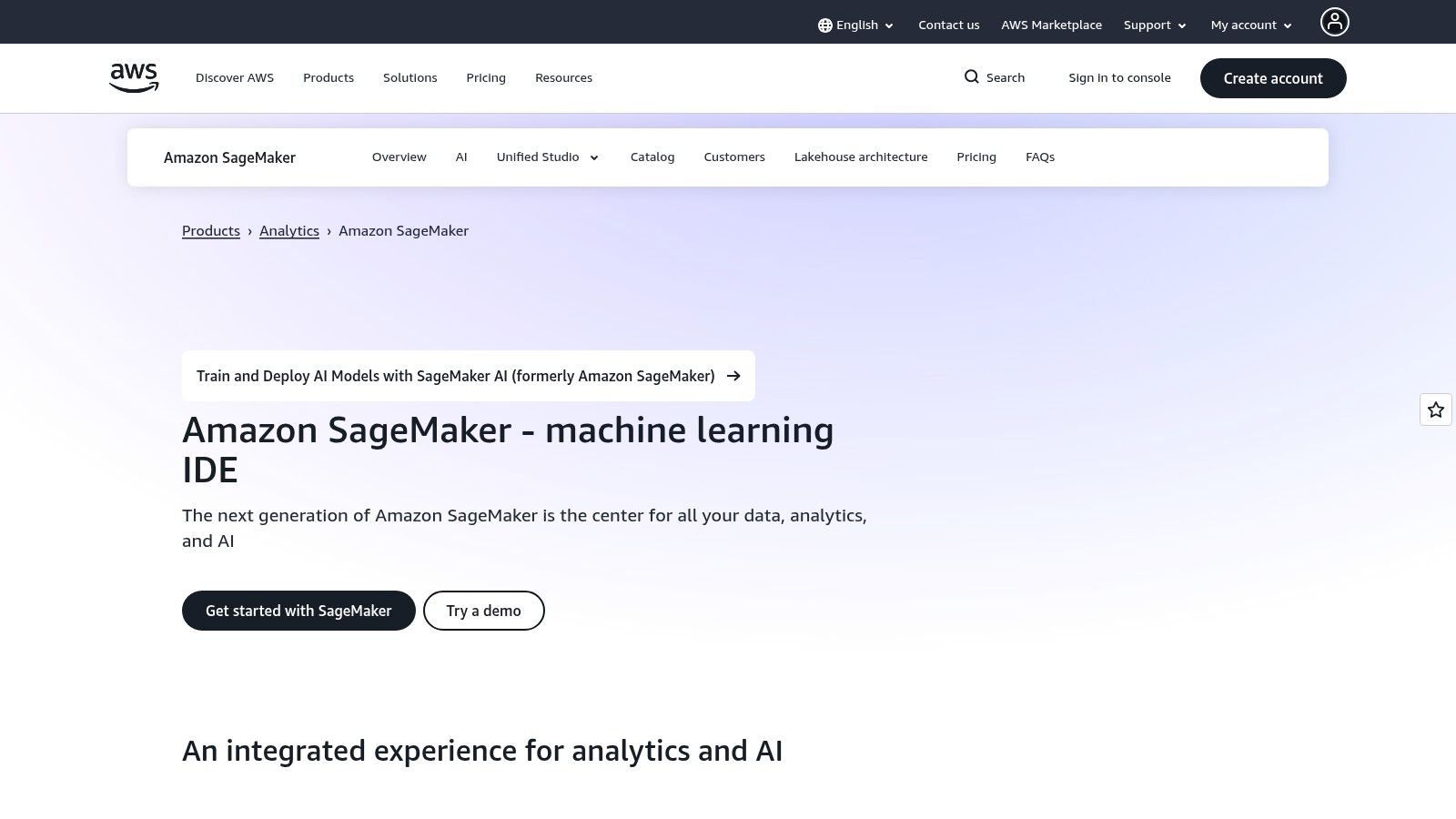
alt text: The Amazon SageMaker Studio interface, showing a notebook environment and data science tools.
SageMaker is one of the best machine learning platforms for enterprises that need robust governance and operational tooling. Its native support for CI/CD, model monitoring, and multiple deployment patterns makes it ready for production workloads at scale.
Key Considerations
Website: aws.amazon.com/sagemaker/
2. Google Cloud Vertex AI
For organizations integrated with Google Cloud Platform (GCP), especially those reliant on BigQuery, Vertex AI provides a unified platform for both machine learning and generative AI. It brings together data preparation, MLOps pipelines, and agent tooling into a single managed environment. Its standout feature is native integration with GCP's data ecosystem, offering a direct path from SQL-based analysis in BigQuery to model deployment.
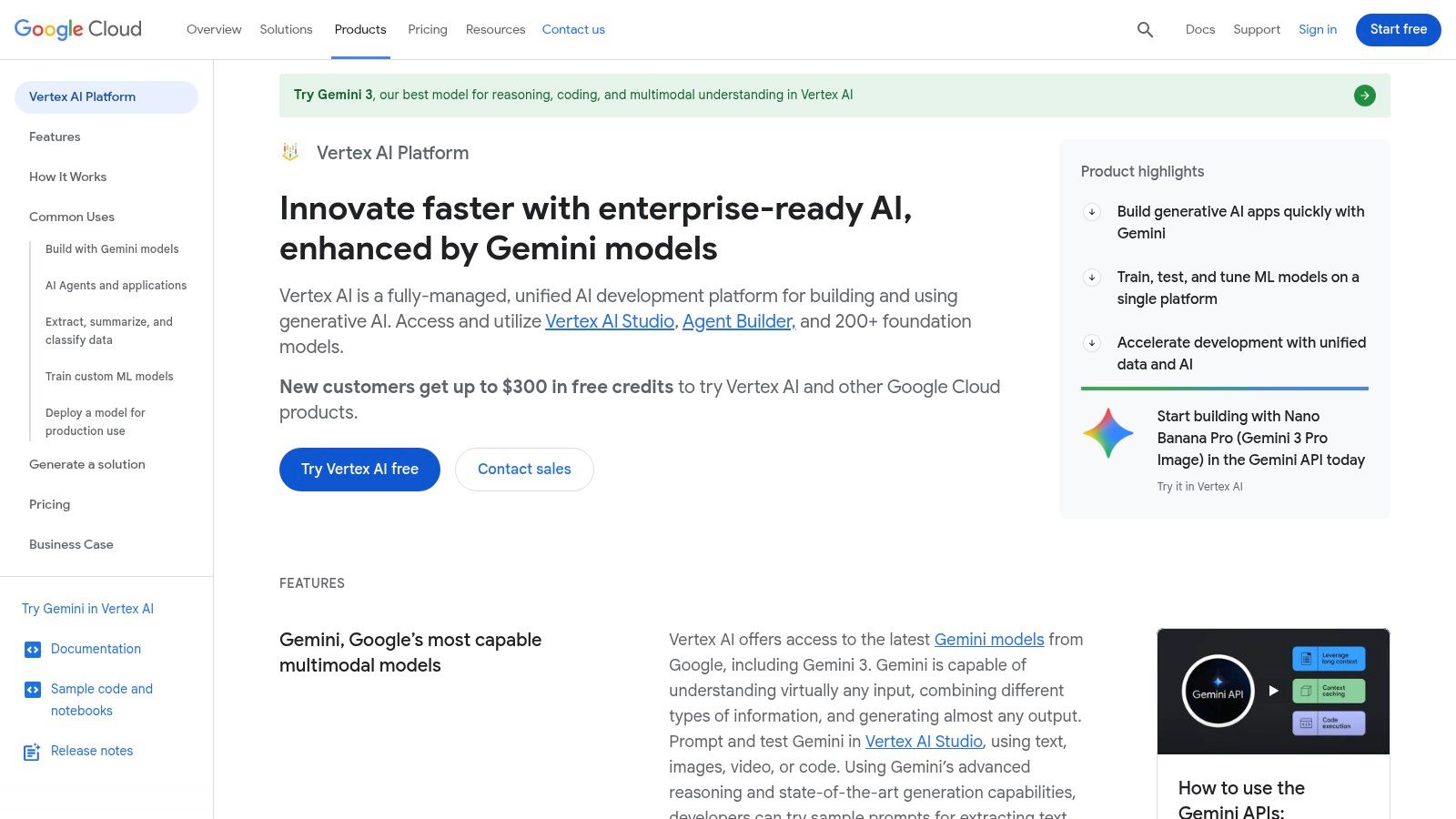
alt text: Google Cloud's Vertex AI dashboard, displaying model management and pipeline orchestration features.
This platform is ideal for companies building retrieval, search, or agent-based applications. The Model Garden, with access to Google's foundation models, provides a strong foundation for developing complex AI systems.
Key Considerations
Website: cloud.google.com/vertex-ai/
3. Azure Machine Learning
For organizations rooted in the Microsoft ecosystem, Azure Machine Learning provides a familiar, integrated environment. It is designed for enterprise workflows, offering managed services for the entire machine learning lifecycle. It excels at connecting data sources from Microsoft Fabric and Synapse while enforcing security through Azure Active Directory (Azure AD), making it ideal for regulated industries.
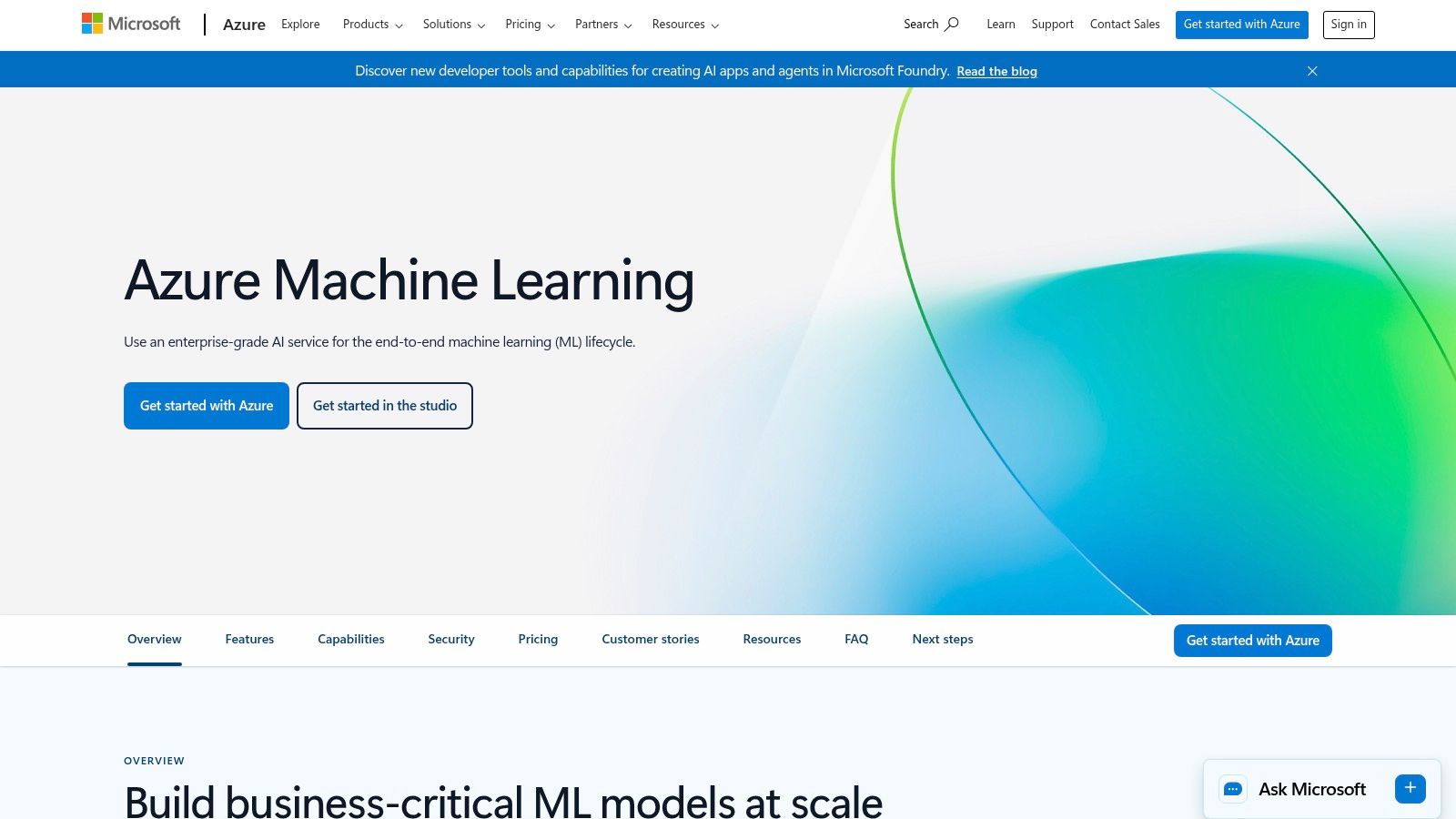
alt text: The Azure Machine Learning Studio interface, showing options for authoring notebooks, automated ML, and pipelines.
This platform stands out with its robust MLOps capabilities and Responsible AI dashboards, which provide critical tools for model fairness and explainability. These features address key governance requirements for production systems. Explore other machine learning model deployment tools for a broader view.
Key Considerations
Website: azure.microsoft.com/en-us/products/machine-learning/
4. Databricks Lakehouse Platform
For data-centric teams wanting to eliminate silos between data engineering and machine learning, the Databricks Lakehouse Platform offers a unified environment. Built on Apache Spark and Delta Lake, it allows teams to move from raw data ingestion directly to model training and serving on a single platform.
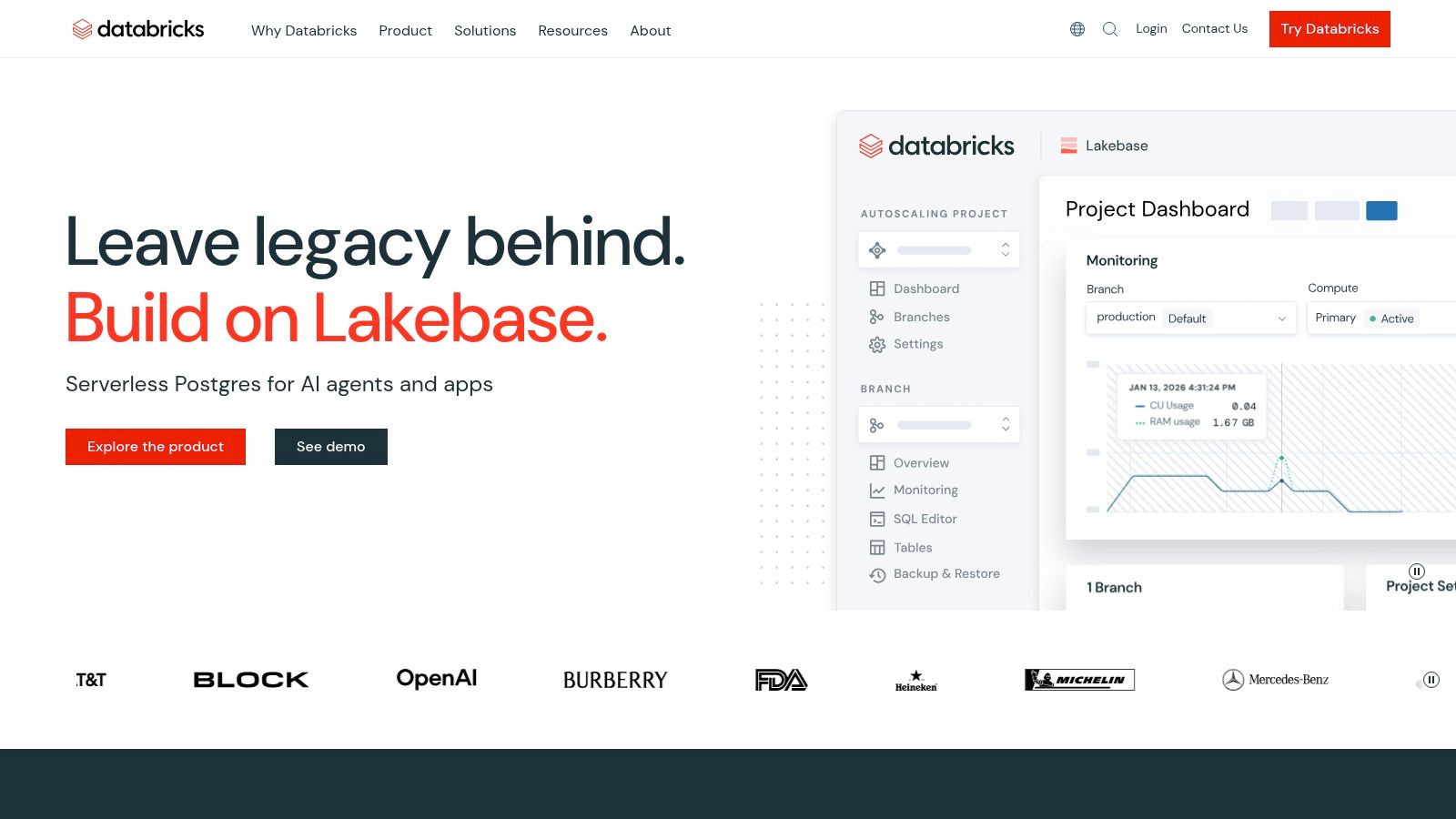
alt text: The Databricks Lakehouse Platform dashboard, showing a unified view of data, analytics, and machine learning workspaces.
This platform is ideal for organizations standardizing their data and AI operations. Its native support for model serving, integrated vector search, and a managed model registry simplifies data governance and lineage tracking, a critical requirement for production systems.
Key Considerations
Website: www.databricks.com/
5. Snowflake Cortex AI
For organizations with data centralized in Snowflake, Cortex AI brings machine learning and large language models (LLMs) directly to the data. This eliminates the security risks and overhead of moving information to external services. By providing native, serverless AI functions accessible via SQL, it lowers the barrier for data analysts to perform tasks like classification and summarization.
alt text: The Snowflake Cortex AI interface, demonstrating how to use SQL commands to call machine learning functions on data.
Cortex AI is perfect for data-centric organizations that prioritize governance. Its core strength is keeping compute inside Snowflake’s security perimeter, ensuring existing access controls and lineage tracking remain intact.
Key Considerations
Website: snowflake.com/en/data-cloud/cortex/
6. Hugging Face Hub + Inference Endpoints
For teams prioritizing rapid deployment and open-source flexibility, the combination of Hugging Face Hub and Inference Endpoints is a powerful, vendor-neutral option. It decouples model choice from infrastructure, allowing you to deploy a model from the extensive Hub with a few clicks on AWS, Azure, or GCP.
alt text: The Hugging Face platform interface, showing the process of deploying a model to a managed inference endpoint.
This platform is one of the best for startups that need to quickly test and serve open-weight models without committing to a single cloud. Its transparent, instance-level pricing provides fine-grained control over costs.
Key Considerations
Website: huggingface.co
7. DataRobot
DataRobot has evolved from an AutoML platform into a comprehensive enterprise AI solution focused on operationalizing models and agentic workflows. Its primary strength lies in providing a governed, end-to-end lifecycle for AI assets, from automated model creation to deployment and monitoring, on-premise or across multiple clouds.
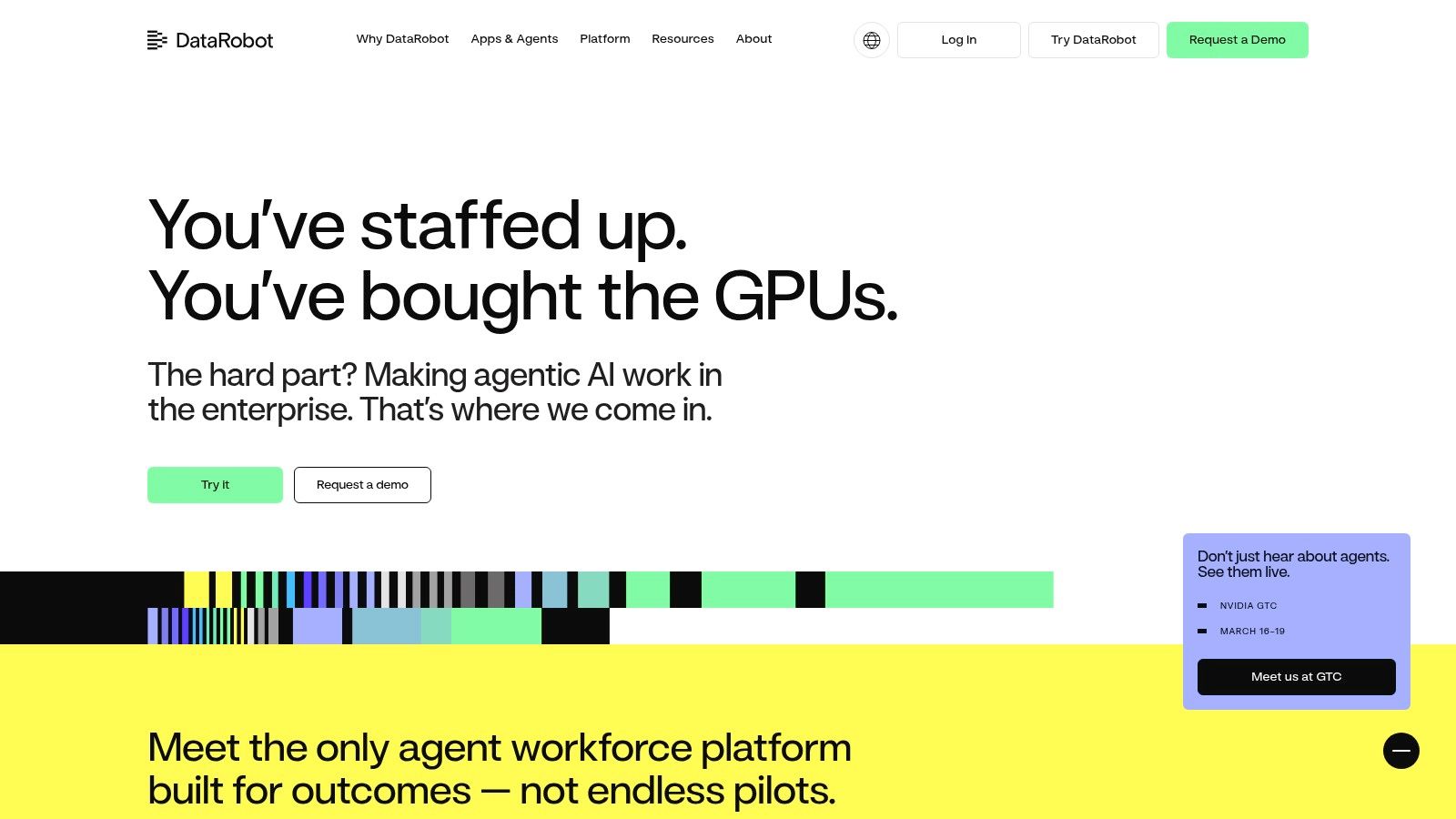
alt text: The DataRobot AI platform dashboard, showing tools for building, deploying, and managing AI applications.
This platform is ideal for regulated industries or large enterprises that prioritize governance, compliance, and observability. Its focus on orchestrating AI agents with built-in guardrails helps deploy complex systems safely.
Key Considerations
Website: www.datarobot.com/
8. H2O AI Cloud (H2O.ai)
H2O AI Cloud offers a platform rooted in its popular open-source libraries, catering to enterprises that need both powerful automated machine learning (AutoML) and generative AI. It uniquely supports customer-managed deployments, either on-premises or in a virtual private cloud, making it a strong contender for organizations where data residency is non-negotiable.
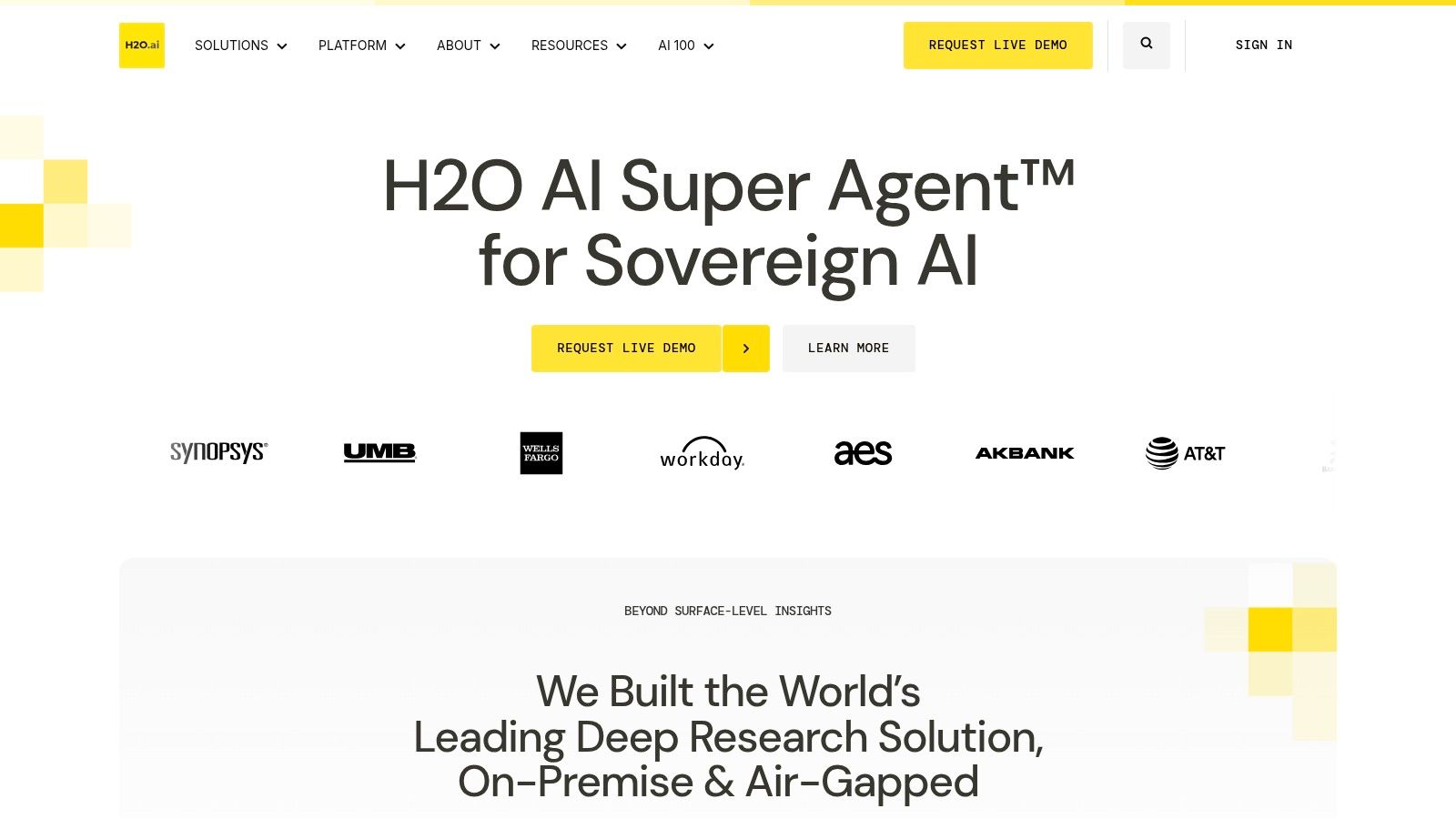
alt text: The H2O AI Cloud platform interface, highlighting features for building and deploying both predictive and generative AI models.
This platform is excellent for teams that need to balance traditional machine learning on tabular data with emerging LLM capabilities. Its emphasis on model explainability is a key feature for sectors requiring auditable AI systems.
Key Considerations
Website: https://www.h2o.ai/
9. Domino Data Lab — Domino Enterprise AI Platform
For organizations in highly regulated industries like finance or pharmaceuticals, Domino Data Lab provides a centralized MLOps platform built for strict governance and reproducibility. It allows teams to self-manage their entire ML lifecycle within their own virtual private cloud (VPC) or on-premises, ensuring data never leaves a secure perimeter.
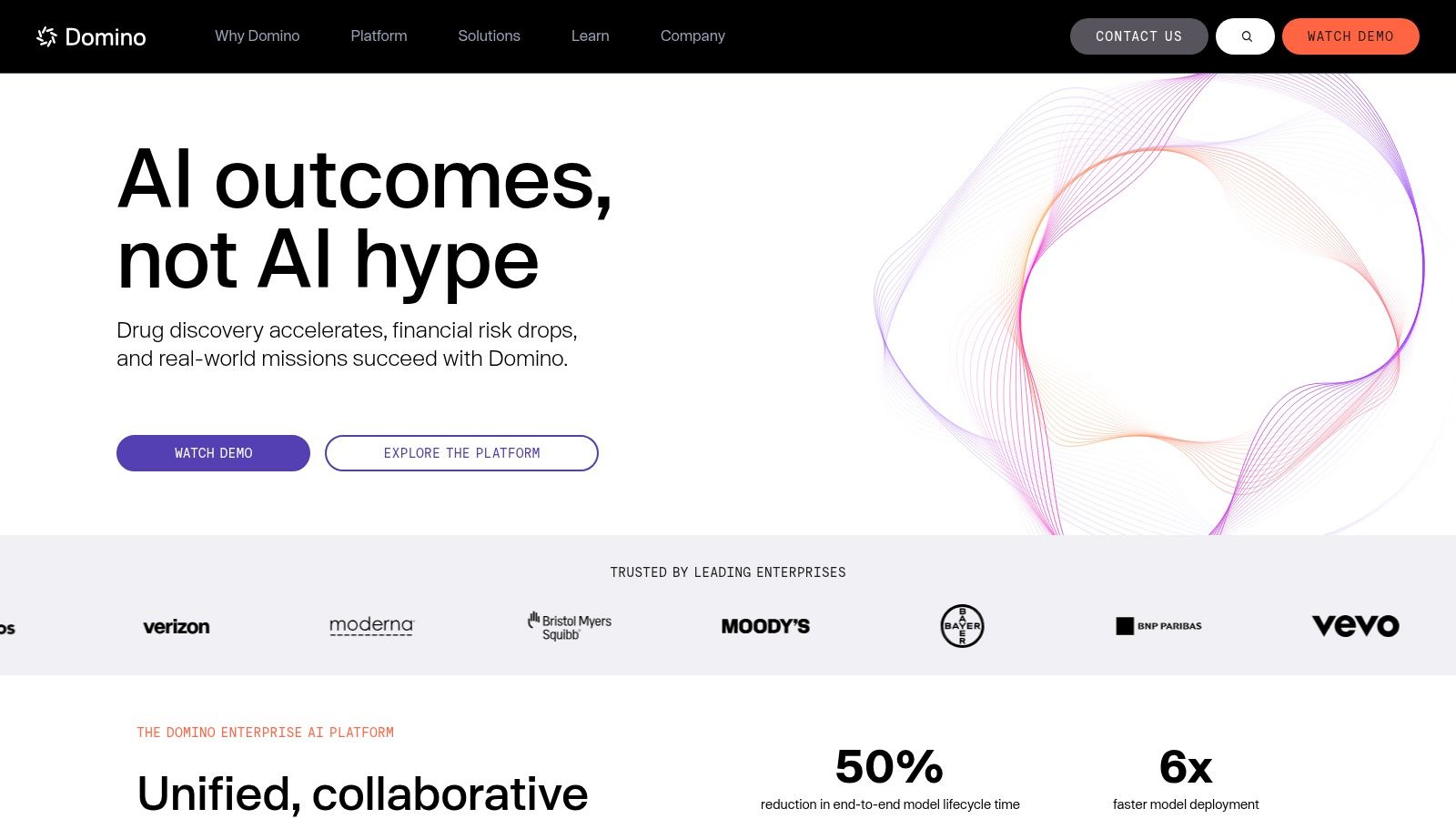
alt text: The Domino Enterprise AI Platform, showing a centralized environment for managing data science projects, models, and infrastructure.
This focus on security and auditability makes Domino ideal for enterprises where compliance is non-negotiable. Its core strength is creating an unbreakable chain of custody for every model, which is essential for passing regulatory audits.
Key Considerations
Website: domino.ai/
10. IBM watsonx.ai
IBM watsonx.ai is an enterprise-grade studio for both traditional machine learning and generative AI workloads. It offers tools for accessing, fine-tuning, and serving foundation models. Its design prioritizes governance and hybrid cloud deployment, making it a strong contender for organizations integrating AI with existing on-premises infrastructure.
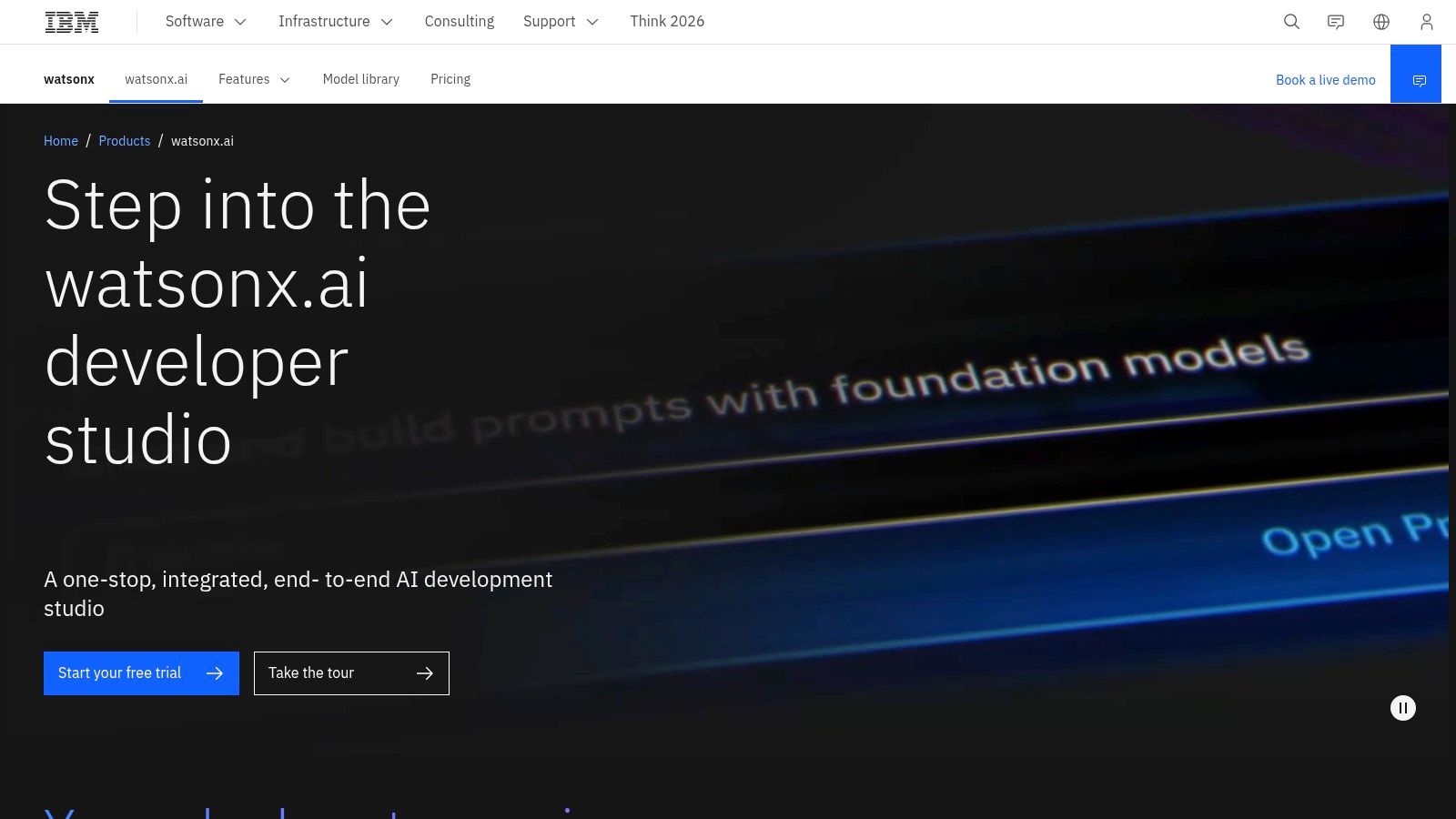
alt text: The IBM watsonx.ai studio interface, featuring tools for foundation models, machine learning, and data management.
This platform is ideal for businesses that require robust control, security, and a clear path from experimentation to production. The integrated PromptLab, tuning studio, and synthetic data generators provide a cohesive environment for building reliable AI applications.
Key Considerations
Website: https://www.ibm.com/products/watsonx-ai
11. NVIDIA AI Enterprise
For organizations managing their own GPU infrastructure, NVIDIA AI Enterprise provides a standardized and supported software layer. It is not a cloud platform itself but an enterprise-grade software suite that certifies and optimizes key AI frameworks like RAPIDS, TensorRT, and Triton Inference Server. This de-risks open-source AI development by ensuring components are pre-tested and secure.
alt text: An overview of the NVIDIA AI Enterprise software suite, showing various tools and frameworks for AI development and deployment.
This offering is one of the best for teams seeking to standardize their software stack across hybrid environments. It simplifies maintaining and optimizing GPU-accelerated software for production, allowing MLOps teams to focus on building models.
Key Considerations
Website: www.nvidia.com/ai-enterprise/
12. Anyscale (Ray Platform)
For engineering teams building demanding AI applications requiring massive parallelism, Anyscale offers a managed platform built on the open-source Ray framework. It is designed to scale distributed Python workloads, making it a strong choice for compute-heavy tasks like LLM fine-tuning and high-throughput inference.
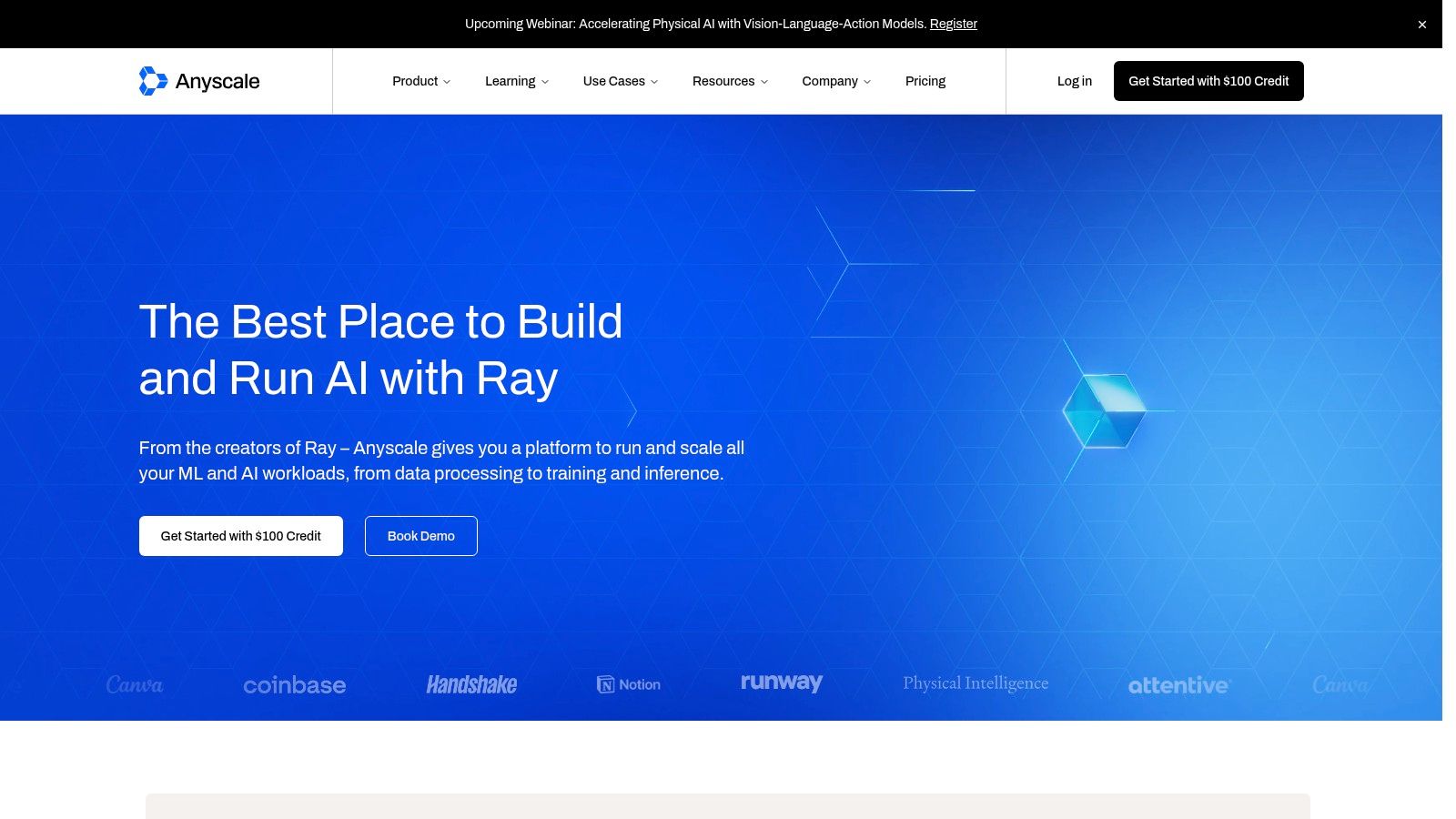
alt text: The Anyscale platform for Ray, showing monitoring and management of distributed AI and Python workloads.
This platform is ideal for teams that need to run scalable Python applications without becoming distributed systems experts. By providing serverless Ray clusters, it bridges the gap between a powerful open-source tool and a production-ready service.
Key Considerations
Website: www.anyscale.com
Checklist: Choosing Your ML Platform
Download this checklist to run a structured evaluation with your team.
Platform Selection Criteria Checklist
You can download a CSV version of this template to use internally.
What To Do Next
There is no single "best" machine learning platform. The optimal choice is a direct function of your specific context: your cloud infrastructure, team skills, and business goals.
Here are three clear next steps:
This structured evaluation de-risks a major technical commitment. The right platform is a force multiplier for your team; the wrong one is a constant tax on productivity.
A platform is only as good as the team implementing it. If you need to augment your team with senior MLOps or AI engineers who have production experience with these platforms, ThirstySprout can help. We connect you with vetted, remote-first AI talent to de-risk your platform choice and accelerate time-to-value. Start a pilot with a pre-vetted AI engineer in just a few days.
References
Hire from the Top 1% Talent Network
Ready to accelerate your hiring or scale your company with our top-tier technical talent? Let's chat.