

Functional requirements are the behaviors a system must do, like login or summarize. Nonfunctional requirements are the measurable quality constraints under which it must do them, like latency, accuracy, or availability.
You're probably dealing with this because the feature itself looks clear, but the product still feels risky. A chatbot can answer a support question correctly and still fail if it gets slow, goes offline, or starts drifting on edge cases.
Why This Distinction Matters for AI Products
A lot of teams write requirements once, treat them like paperwork, and then move straight into build mode. That works until the AI feature is live and the product team is arguing about whether the system is broken, slow, or just not specified well enough.
Functional requirements are the system's behavioral contract. Nonfunctional requirements are the measurable quality constraints under which that behavior must operate. In classic software terms, that difference became formal in requirements engineering and still anchors how teams describe performance, reliability, availability, usability, portability, and security today functional and nonfunctional requirements in software engineering.
The AI product trap
A support chatbot can satisfy the functional requirement “answer the user's question.” It can still fail the product if it takes too long, gives inconsistent output, hallucinates on unusual prompts, or lacks auditability when a customer disputes an answer.
That's where classic FR/NFR theory starts to bend. Standard guidance still treats NFRs as system-wide quality properties such as security, reliability, maintainability, scalability, and external interfaces, but AI products add concerns like hallucination risk, model drift, output consistency, and traceability AI and ML quality concerns.
Practical rule: if the product can “work” and still create an incident, you're probably looking at a nonfunctional gap, not a functional one.
The fastest way to spot confusion is to ask one sentence. If the answer names a user action, it's functional. If the answer names a measurable condition that action must meet, it's nonfunctional.
Functional Requirements Explained
A checkout flow that accepts payment, creates an order, and sends a receipt is a functional requirement in plain form. Functional requirements describe what the system must do so someone gets a real outcome. They define the inputs, the processing rules, and the outputs the product has to produce so the user's goal is satisfied functional requirement definition.

Three ways to recognize one
A login flow is functional because the product must accept credentials and return a session. Invoice generation is functional because the system must collect order data, apply business rules, and create the invoice file or record. A RAG retrieval endpoint is functional because it must take a query, retrieve relevant context, and return an answer payload.
You can also describe the same requirement in a user story or a shall statement. “As a customer, I want to log in so I can access my account” names the user goal. “The system shall authenticate a valid user and create a session token” states the behavior in a more formal way. The wording changes, but the requirement is still about the product doing a specific job.
What good functional requirements look like
A good functional requirement can be tested as pass or fail. If QA cannot verify the behavior in a deterministic way, the requirement is probably incomplete.
The cleanest functional requirement names an actor, an action, and an expected outcome. Anything less usually hides scope.
For a junior dev or PM, the easiest way to check your own AI feature is to write three functional requirements from scratch:
- Login: The system shall authenticate a user with valid credentials and start a session.
- Invoice generation: The system shall create a PDF invoice from a completed order and email it to the customer.
- RAG retrieval: The system shall accept a text query, retrieve matching documents, and return the top context snippets to the model.
If you are writing the spec, the PM or AI PM usually owns the business intent, while the tech lead helps make the statement precise enough to build and verify. That split is also a useful hiring signal. A strong PM can turn a fuzzy need into a clear action, and a strong engineer can tell when the action is still too vague for testing or implementation.
Nonfunctional Requirements Explained
A feature can be correct and still fail in production because it is too slow, too fragile, or too hard to use. Nonfunctional requirements describe those quality constraints, and they become clearer when you tie them to a concrete operating condition or measurable limit behavioral vs quality constraints.
The quality bar is the point
Performance, security, scalability, usability, reliability, and maintainability are the usual buckets. A requirement like “the login page will appear within 500 milliseconds” is nonfunctional because it sets a speed target for a behavior the product already has. A requirement like “95% of requests must complete in under 200 ms” does the same thing in a more measurable form behavioral vs quality constraints.
A useful NFR is specific enough that QA, engineering, and security can test it without guessing. Examples include a page-load target of “load in 3 seconds with the total number of simultaneous users <5 thousand,” a scale target like “handle 20 million users without performance deterioration,” and a compliance constraint like “the payment processing gateway must be PCI DSS compliant” NFR examples and categories.
For AI products, the classic split starts to get messy. A chatbot can satisfy the functional flow and still fail because response quality drifts, hallucinations appear under edge prompts, or the system degrades in ways that a simple feature checklist never catches. Those concerns are still quality constraints, and interviewers often use them as a signal that someone can think past the happy path and toward real operating risk.
One feature can carry many NFRs
A profile photo at login is functional. The time to log in, the look and feel of the page, and the number of users who can log in at once are all nonfunctional constraints attached to that same feature requirement attachment example.
That pattern shows up everywhere in production systems. The feature ships, but the central question is whether it behaves well enough under load, failure, or partial outage to still earn trust. In an AI spec, the same idea applies to retrieval quality, response consistency, safe fallback behavior, and how the system responds when the model is uncertain.
That's also why NFRs are a strong hiring signal. A PM who can name the quality bar, a tech lead who can translate it into tests, and a QA or security engineer who can spot the missing edge cases usually write better requirements than a team that only lists features.
Functional vs Nonfunctional at a Glance
| Dimension | Functional | Nonfunctional |
|---|---|---|
| Core question | What should the product do? | What quality must that behavior meet? |
| User-visible? | Usually yes | Sometimes indirect, often noticed when it fails |
| Best phrasing | Action oriented, “The system shall…” | Constraint oriented, “The system must…” |
| Typical examples | Login, checkout, summarize, classify | Latency, availability, security, scalability |
| Verification style | Scenario, use case, acceptance test | Benchmark, load test, audit, monitoring |
| Common failure | Missing feature or broken flow | Slow, unreliable, insecure, unmaintainable system |
| Docs location | Product spec, backlog, user story | Nonfunctional section, SLA, architecture, test plan |
| AI-specific wrinkle | Prompt or tool flow can be functional | Drift, hallucination, consistency, traceability need separate treatment |
If a planning meeting gets stuck, this table usually settles the argument fast. A requirement that describes a user action belongs on the functional side. A requirement that sets a measurable quality bar belongs on the nonfunctional side.
AI and ML Requirements That Break the Classic Split
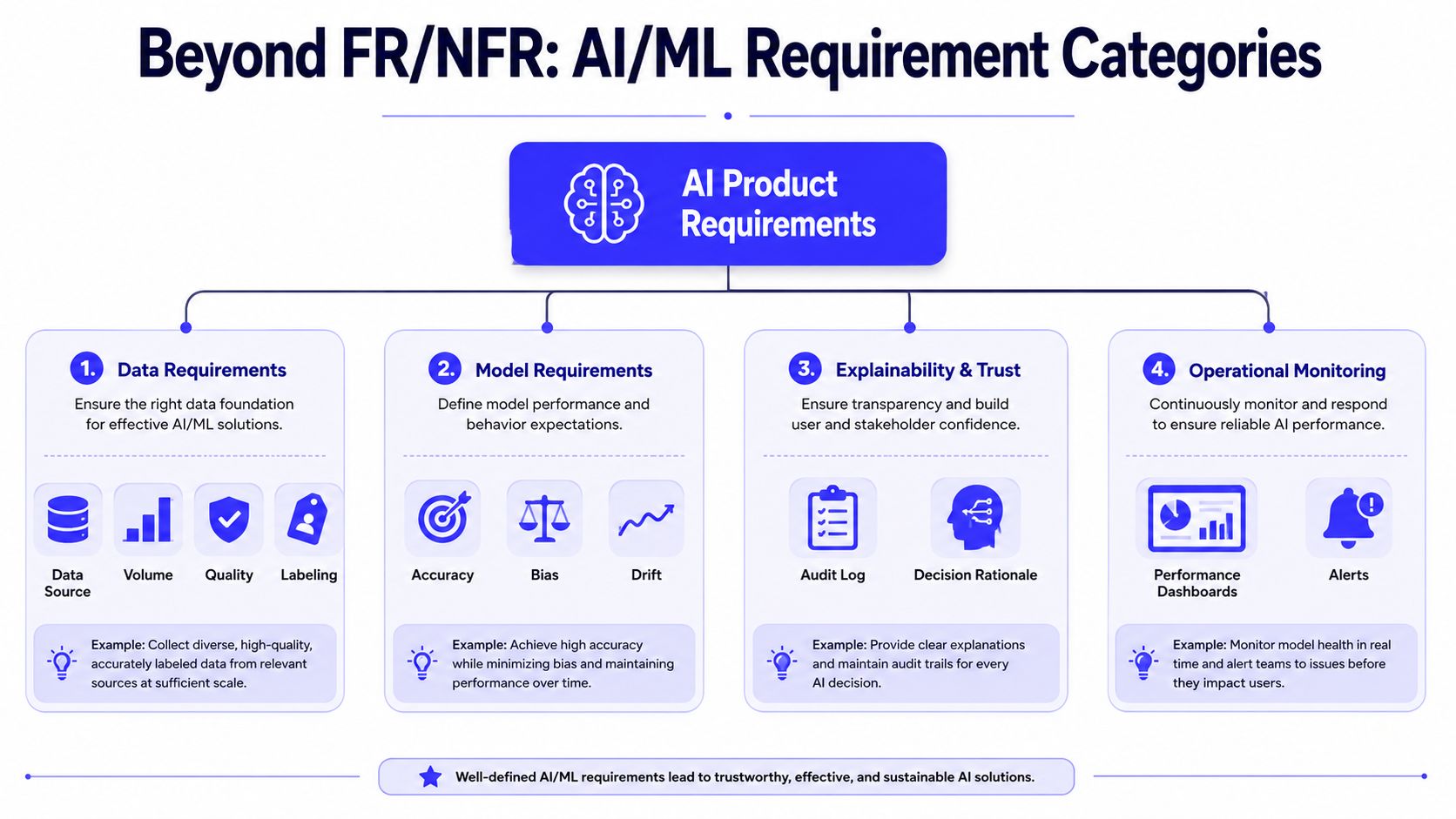
The classic FR/NFR split helps, but it's not enough for modern AI products. LLM systems need more than “what” and “how,” because they also depend on data freshness, model behavior, evaluation quality, and operational controls that don't fit neatly into beginner templates.
The categories you need for AI work
Data requirements should cover freshness, labeling quality, and PII handling. A testable version sounds like, “Support tickets older than 30 days must not be used in retrieval unless they've been revalidated.”
Model requirements should cover accuracy, drift detection, and evaluation thresholds. A practical statement is, “The model shall be re-evaluated when the offline score drops below the team's approved threshold.” Use a real AI delivery framework if you need a broader operating model, for example, find an AI delivery framework can help teams map work across data, model, and deployment concerns.
Explainability and trust should cover audit logs and decision rationale. A good requirement is, “Each answer shown to a user must include the source documents used to generate it.”
Operational monitoring should cover performance dashboards, alerts, and safe degradation. That means the product can still respond in a limited mode if a model or external tool fails.
The extra quality attributes AI teams forget
AI products also need requirements for hallucination risk, output consistency, human override, and traceability. Those are not prompt details. They're product-level constraints that shape architecture, evaluation, and support processes.
A chatbot can meet its functional requirement by generating an answer, while still failing the operational requirement that users can trust it in production. That's why prompt text is not a requirements document.
If you're hiring or scoping delivery, this is one place where a partner like ThirstySprout can fit naturally alongside in-house design and engineering, because the hard part is not just building the model, it's defining the system around it.
How to Write Requirements That Actually Pass QA
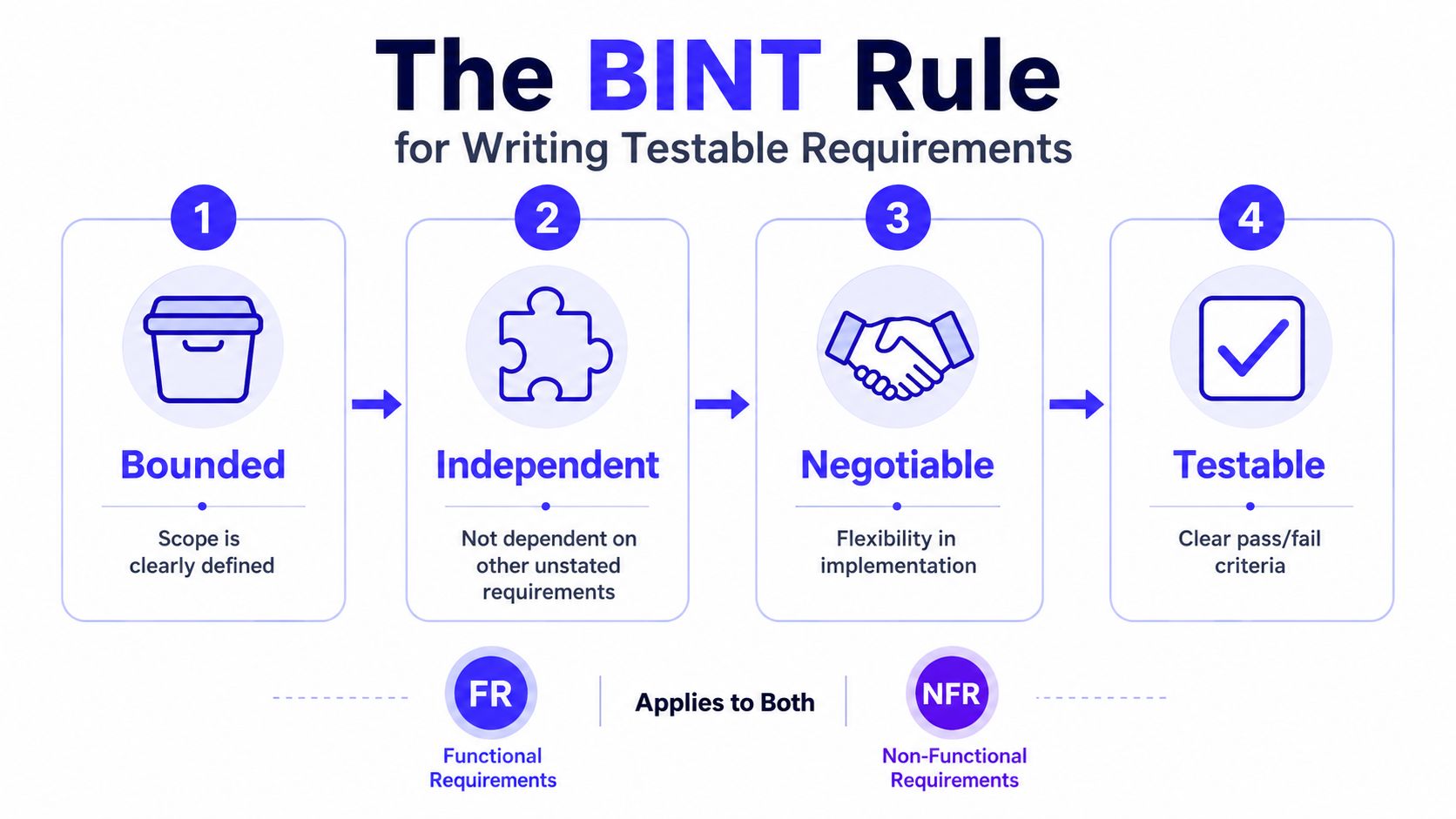
Strong requirements are bounded, independent, negotiable, and testable. That BINT rule is useful because it forces you to move from vague intent to something QA, architecture, and delivery can all verify BINT framework.
A simple rewrite pattern
Start with the vague version. “The system shall be fast.” Then add scope, dependency, trade-off room, and a pass/fail test. The rewrite becomes, “For authenticated users on the support chat page, the first response shall appear in under 2 seconds under normal production load.”
That same pattern works for functional requirements too. “The system shall let users upload files” is better than “The system shall handle documents,” because the action and scope are clear.
Copy-ready requirement template
Use this structure in your spec:
- Requirement ID: FR-07 or NFR-03
- Statement: The system shall...
- Acceptance criteria: Given, when, then
- Load condition or scope: Under what traffic, data size, or user state
- Owner: PM, AI PM, tech lead, QA, security, or platform
- Verification method: Unit test, integration test, load test, manual check, or audit
If you need to protect scope, use MoSCoW or weighted scoring before you cut requirements. A low-priority NFR often disappears until production teaches the team why it mattered.
For a deeper testing lens, ThirstySprout also publishes non-functional testing guidance that pairs well with this template. If your team works in robotics or complex data workflows, a data spec generator for robotics can also help define cleaner data inputs before the model work starts.
Rule of thumb: if you can't point to the test that proves the requirement, the requirement isn't ready yet.
Common Pitfalls and How to Avoid Them
The most common failure is vague language. “Fast,” “secure,” and “reliable” sound useful, but they don't tell engineering what to build or QA what to check. The fix is to attach a threshold, a condition, and an owner.
Another failure is writing NFRs that nobody can verify. That usually happens when the team writes a value statement instead of an acceptance criterion. Advanced guidance keeps pushing measurable thresholds, validation, and system-wide observability for exactly this reason why vague NFRs fail.
The mistakes that show up late
- Vague quality words: The symptom is endless debate in review. The fix is to replace adjectives with metrics.
- Untestable NFRs: The symptom is a spec QA can't execute. The fix is a finite test condition and a pass or fail result.
- Missing data requirements: The symptom is a model or retrieval layer that works in demo data and breaks on real inputs. The fix is to write data freshness, labeling, and PII rules early.
- Prompts treated as requirements: The symptom is an overly clever prompt doc with no acceptance criteria. The fix is to separate prompt behavior from product-level constraints.
- No observability for quality: The symptom is that the team learns about the issue from users. The fix is logs, metrics, and alerting tied to the NFRs.
If you want a practical place to compare this with incident handling, ThirstySprout's bug life cycle guide helps teams map quality failures into triage and remediation.
Hiring and Interview Signals for Requirements Work
Strong requirements writing is a hiring signal. Senior AI engineers and AI PMs should be able to turn a vague goal into a testable functional requirement and a measurable NFR without hand-holding.
If you want a broader hiring lens, Underdog.io's recruitment insights are useful because they push teams to look beyond resume keywords and test for delivery judgment.
A simple interview rubric
Score candidates on four things. Can they define the behavior clearly? Can they attach measurable quality constraints? Can they separate prompt content from system requirements? Can they name the test or monitoring signal that proves the spec is real?
Three questions surface this quickly:
- Question 1: “Write a functional requirement for an AI support agent that answers billing questions.”
Strong signal, they define the input, the retrieval or reasoning step, and the output. Weak signal, they describe the model instead of the user outcome. - Question 2: “Add two nonfunctional requirements to that same feature.”
Strong signal, they give thresholds or conditions. Weak signal, they say “make it fast and accurate.” - Question 3: “What would you log or alert on if the system starts hallucinating?”
Strong signal, they mention monitoring, traceability, or fallback behavior. Weak signal, they only mention prompt tuning.
For more interview depth, the internal AI engineer interview questions guide is a useful companion if you're building a hiring loop around delivery quality, not just model familiarity.
The best candidates don't just describe features. They describe how to prove the feature is safe enough to ship.
What to do next
First, audit your current spec and mark every vague requirement. Second, rewrite the two weakest NFRs using the BINT template. Third, book a 20-minute scope call and decide whether you need help from an in-house team, a contractor, or a vetted AI partner.
If you need help turning a loose AI idea into a spec your team can build and test, ThirstySprout can match you with senior AI engineers, ML talent, and AI product operators who've shipped production systems. Visit ThirstySprout to start a pilot, compare sample profiles, and scope the work with a team that can help you define both the feature and the quality bar.
Hire from the Top 1% Talent Network
Ready to accelerate your hiring or scale your company with our top-tier technical talent? Let's chat.