

You’re likely here because a team member said, “Let’s just use Flask,” and you need to know whether that’s a smart shortcut or technical debt in disguise.
The short answer is simple. Flask is a Python micro web framework that works especially well for APIs, internal tools, model-serving layers, and early-stage AI products where speed and control matter more than having every feature built in. The harder question is whether it still deserves a place in a 2026 stack when Django and FastAPI are both strong options. It does, but only in the right situations.
TLDR Who Should Use Flask in 2026
- Flask is best understood as a minimal Python web framework for building APIs and web services without forcing a heavy project structure.
- Choose Flask when your AI product needs a clean API layer fast. It fits MVPs, model inference endpoints, admin utilities, and small service boundaries well.
- Don’t choose Flask by habit. If you need a full built-in admin, opinionated conventions, and lots of default components, Django is often the better fit. If your core problem is high-concurrency API work and strict typed request models, FastAPI may be the better starting point.
- The deciding factor is team shape. Flask works best when your engineers are comfortable making framework choices themselves and can keep architecture disciplined as the codebase grows.
- Recommended action: run a short architecture review using the checklist later in this guide before locking in your first backend.
If you searched what is flask, the practical answer is this: Flask gives you routing, request handling, templating, and an extensible core, then gets out of your way. That’s useful when your product team is still validating workflows like prompt orchestration, model evaluation, retrieval APIs, or customer-facing AI features.
This guide is for CTOs, founders, engineering leads, and heads of AI who need to make a stack decision quickly. Usually the situation looks the same. You have a product deadline, a small team, a lot of Python already in the company, and a backend choice that will affect hiring, speed, and future maintenance.
Practical rule: If your main risk is shipping the wrong product, Flask is often a strong first backend. If your main risk is organizational complexity, stronger framework opinions can help.
A Quick Framework for Choosing Your Python Backend
A CTO doesn’t need a philosophical debate. You need a fast filter.
Start with the business constraint
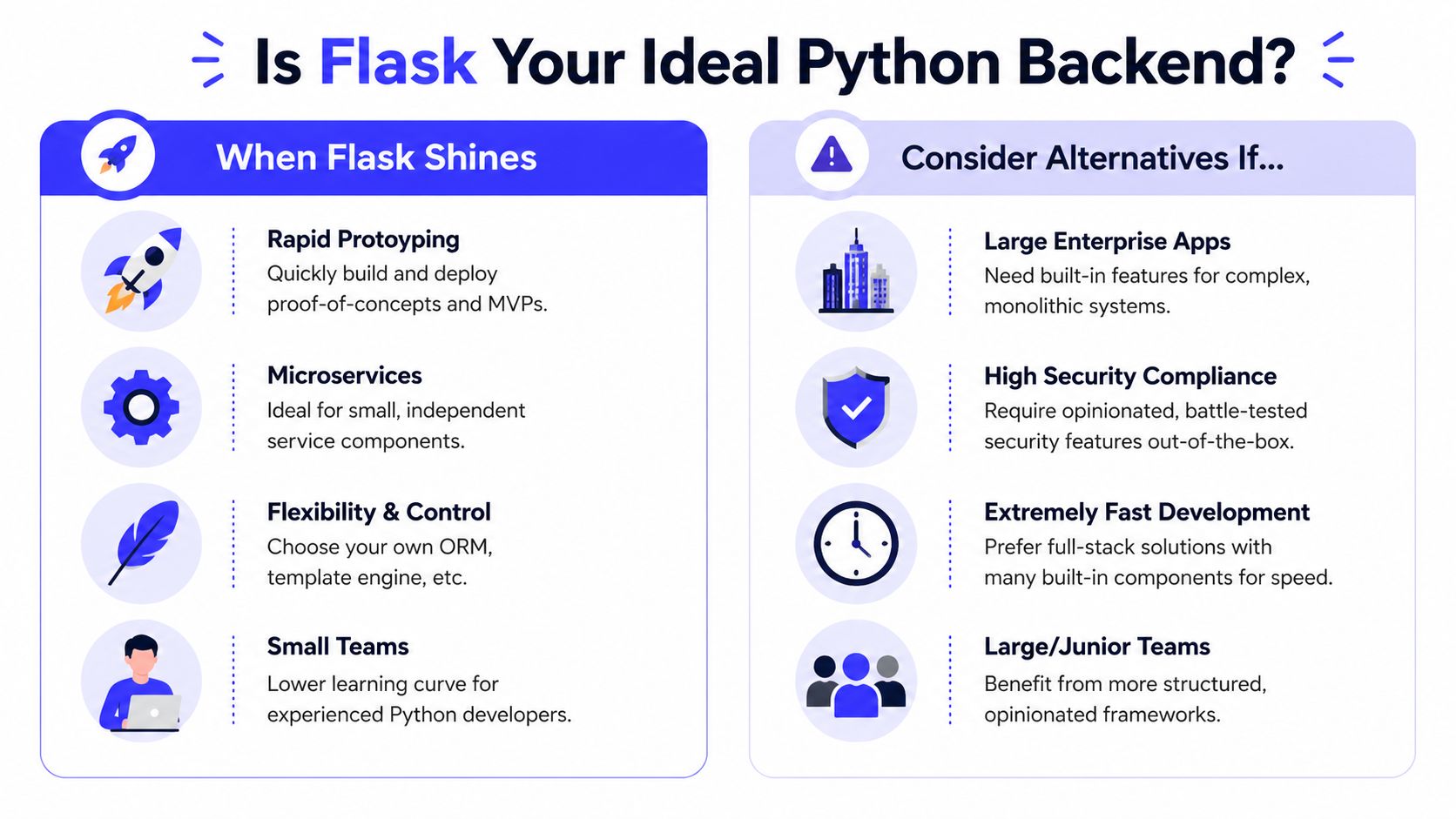
Ask one question first. What hurts more right now: slow delivery, architectural inconsistency, or concurrency pressure?
If slow delivery is the main problem, Flask deserves real consideration. If inconsistency is the bigger risk, Django often wins because it gives teams more rails. If concurrency and API schema generation are central from day one, FastAPI becomes hard to ignore.
A useful companion read when you’re still validating the broader language direction is this PHP vs Python comparison, especially if your product team is comparing backend ecosystems rather than only Python frameworks.
Use this decision rubric
Use Flask when these are true:
- You need a narrow backend fast. Typical examples are model inference APIs, webhook processors, moderation tools, and lightweight orchestration services.
- Your team already writes Python daily. Flask has a low conceptual barrier for experienced Python developers.
- You want framework choice, not framework policy. You can add the ORM, auth layer, or serialization tools that fit your stack.
- Your product architecture will likely split into services. Flask works well as a thin service layer around models, queues, or data pipelines.
Lean toward Django when these are true:
- You need many built-in features immediately. User management, admin workflows, forms, and standard app conventions matter.
- You expect a broader engineering team. Opinionated structure helps reduce variation across teams and repos.
- You’re building one large application, not several narrow services.
Lean toward FastAPI when these are true:
- Your API contract is the product. Typed payloads, interactive docs, and request validation are central.
- You know you’ll spend most of your time on async I/O, integrations, and API throughput concerns.
- Your developers already like strongly typed Python service patterns.
The simplest tie-breaker
If your team says “we can keep this small,” assume it won’t stay small. Then ask whether you trust the engineers who will own the code to keep it clean without strong framework defaults.
That’s usually the key Flask decision.
For teams tracking where Python itself is headed, the future of Python matters more than any single framework choice. The language momentum keeps Flask relevant even as newer frameworks gain attention.
Two Practical Examples of Flask for AI Products
A definition only helps if you can picture where Flask sits in a real product.
Example one, a minimal model inference API
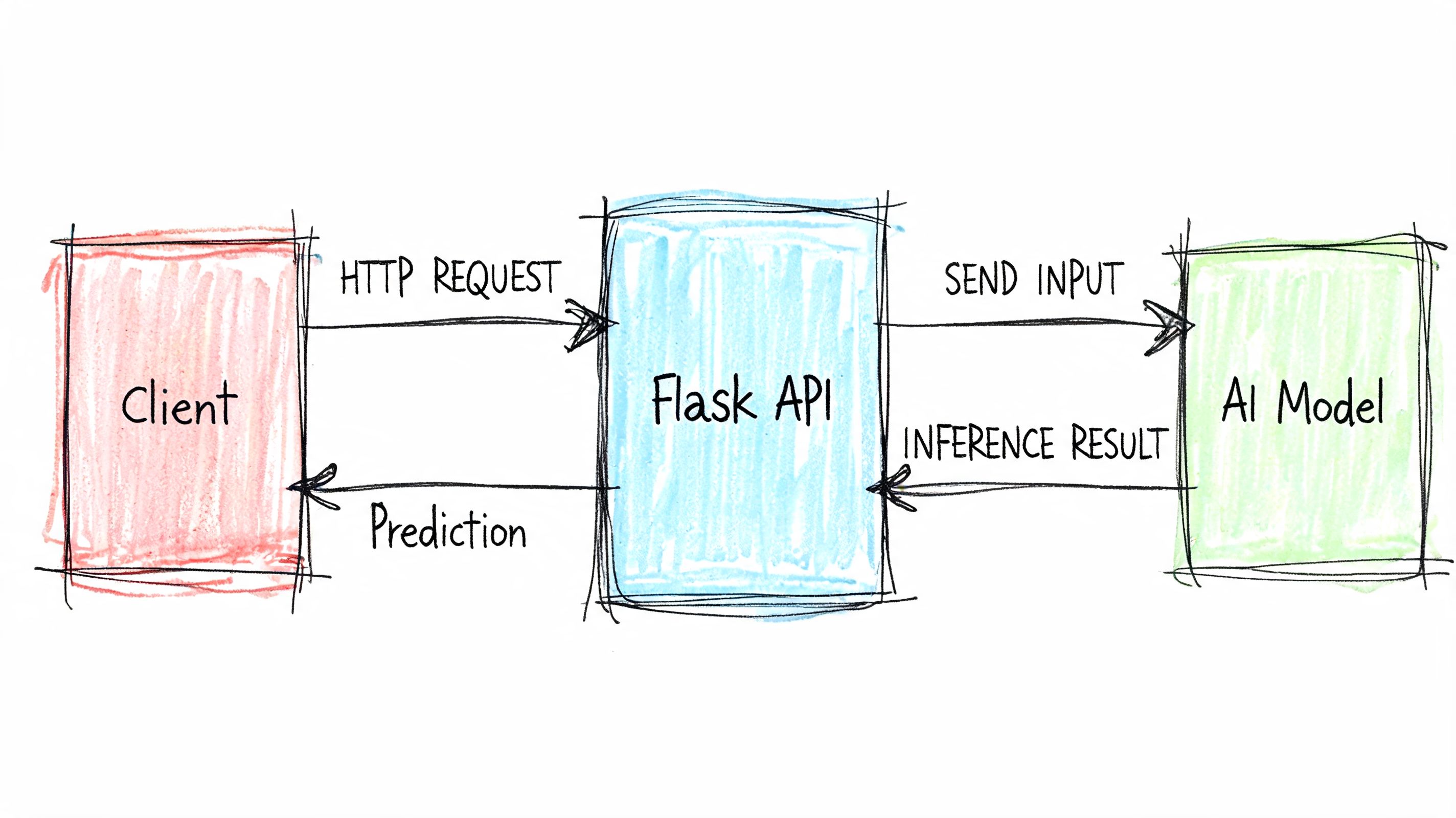
This is the kind of service teams build in the first week of an AI feature launch.
from flask import Flask, request, jsonifyapp = Flask(__name__)def predict(text):return {"label": "support", "input": text}@app.route("/predict", methods=["POST"])def run_prediction():payload = request.get_json()result = predict(payload["text"])return jsonify(result)Why this works:
- The route is obvious. One endpoint, one responsibility.
- The model boundary is separate.
predict()can later call a local model, an LLM gateway, or another service. - The JSON contract is easy to test. Product teams can wire this into a web client or mobile app quickly.
This pattern is common when you’re exposing a classifier, summarizer, scoring function, or retrieval wrapper. It also maps cleanly to AI integration layers. If you’re stitching external model providers into your app, TranslateBot’s AI integrations show the sort of integration surface many teams eventually need to normalize behind their own API.
A good Flask service does one small thing clearly. The trouble starts when one repo tries to become your model gateway, admin panel, batch processor, and product backend at the same time.
Example two, Flask as part of a small AI service mesh
Flask also works well when you split responsibilities early.
A practical service layout
| Service | What it does | Why Flask fits |
|---|---|---|
| Inference API | Accepts requests and returns predictions | Thin HTTP layer around model logic |
| Validation service | Checks payload shape and business rules | Easy to keep focused and separate |
| Feedback logger | Records prompts, outputs, and user actions | Small internal API with clear scope |
A common flow looks like this:
- The client app sends a request to the inference API.
- The inference service calls a validation service before model execution.
- The model runs and returns a result.
- A feedback logger stores the request, response, and user metadata for later review.
- Evaluation jobs consume those records downstream.
That structure is often enough for an early AI product. It gives you separation of concerns without dragging in a large platform prematurely.
For teams building consumer-facing interfaces around these services, the product side matters too. This AI app for iPhone guide is a useful reference if you’re thinking about how a Flask backend supports mobile AI features.
Where teams get this wrong
The mistake isn’t choosing Flask. The mistake is keeping everything in one Flask app after the team has outgrown it.
Signs you’ve crossed that line:
- route files turn into business-logic dumping grounds
- different teams adopt different patterns for auth, validation, and data access
- shared utilities become hidden dependencies
- every deployment feels risky because one service does too much
This walkthrough is worth watching if you want a visual refresher on how a Flask app comes together in practice:
Flasks Core Architecture and Key Features
A CTO evaluating Flask for an AI product should read its architecture as a set of decisions, not a feature checklist.
Flask is a microframework on purpose
Flask keeps the core small. That is the point, not a limitation.
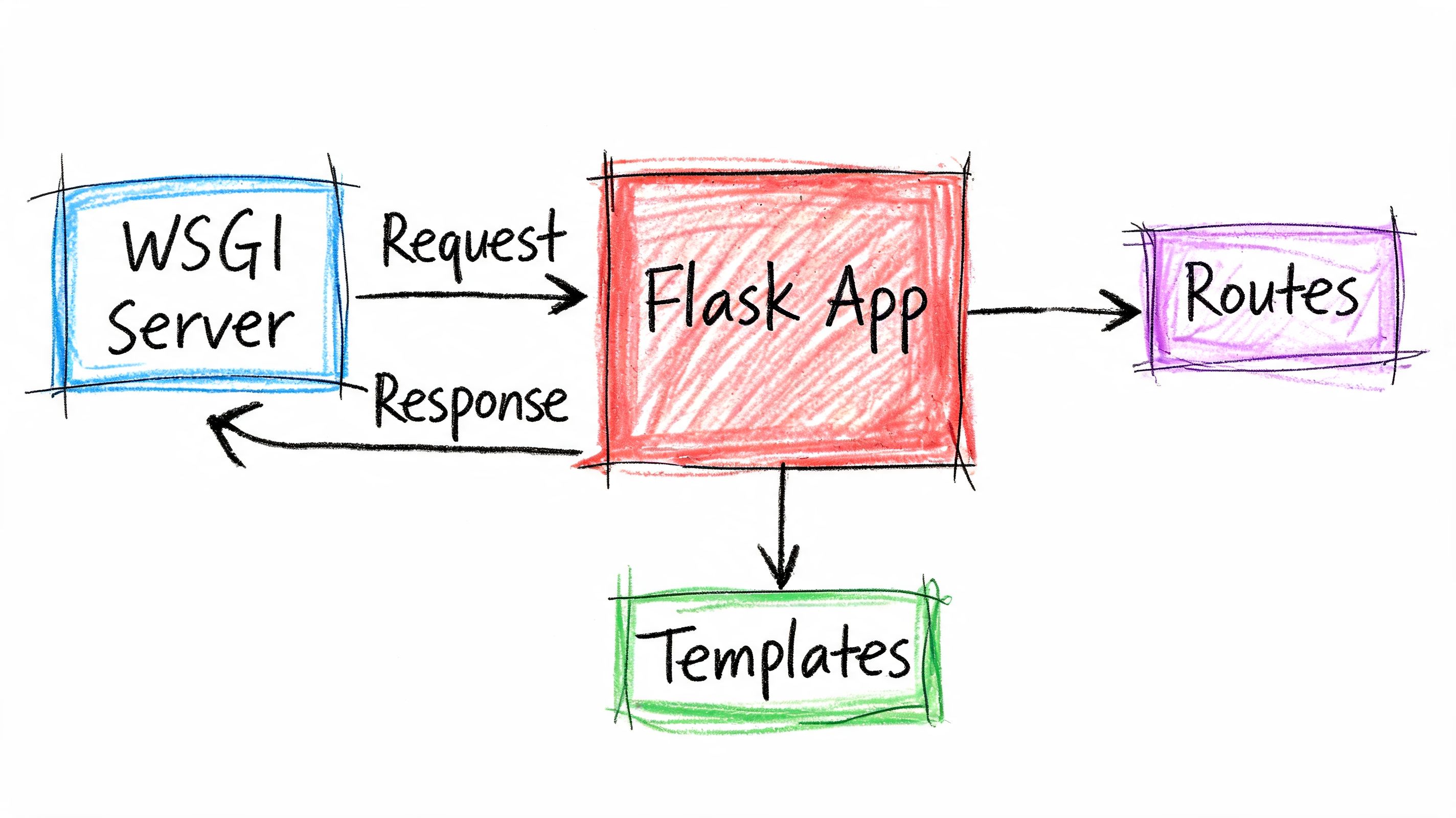
For AI teams, that usually means you can put an HTTP layer in front of model inference, orchestration code, evaluation jobs, or internal tooling without adopting a large framework before the product shape is clear. You define routes, request handling, response logic, templates if you need them, and the rest is your choice. That makes Flask attractive in the early stages of an AI platform, especially when the backend is mostly glue code between a client, a model service, a queue, and a database.
The trade-off is straightforward. Flask gives flexibility first, conventions second. If your engineers are comfortable choosing libraries for validation, auth, data access, background work, and observability, that flexibility speeds up delivery. If your team needs stronger defaults, Flask can become a framework you have to finish yourself.
What you get in the core
Flask’s core is intentionally narrow:
- Routing and request handling for lightweight APIs and service endpoints
- Jinja templating for dashboards, admin utilities, and internal tools
- Sessions and secure cookie support for common web application needs
- WSGI compatibility with standard Python deployment setups
- An extension system that lets teams add only the pieces they need
That combination still works well for many AI products in 2026. A thin API layer for model calls does not always need a full-stack framework. It needs predictable request flow, clear composition, and room to integrate the rest of your stack.
What you do not get by default
Flask does not prescribe your ORM, admin interface, serializer layer, form handling, or project structure. Your team has to choose those pieces and keep them consistent.
The cost of Flask is not the first endpoint. It is the time spent defining conventions that Django would provide by default.
That trade-off matters more than the microframework label. On a senior team, shared judgment can keep the codebase clean. On a mixed-seniority team, the same freedom often produces uneven patterns across services, which shows up later in onboarding time, review quality, and incident response.
How this affects architecture choices
Flask also sits in an awkward but useful middle ground for modern Python backends. It has async support, but async-first design is still not the main reason teams choose it. If your AI product depends on high-concurrency API patterns, typed request models, and OpenAPI-first workflows, FastAPI often gives a cleaner starting point. If your product needs a built-in admin, strong defaults, and a larger hiring pool for conventional web development, Django usually reduces decision load.
Flask is strongest when the backend is a focused service, not a sprawling application. It works well when your architecture is already split into clear components and you want the web layer to stay thin.
A useful way to evaluate Flask is simple: choose it when you want control over composition and your team can enforce standards without framework pressure. Skip it when you need the framework to enforce those standards for you.
Flask vs Django vs FastAPI The AI Stack Showdown
A CTO choosing a backend for an AI product is usually balancing three risks at once. Shipping too slowly. Overbuilding too early. Hiring into a stack the team cannot keep consistent six months later.
That is the Flask versus Django versus FastAPI discussion in 2026.
A comparison that matters in practice
| Criterion | Flask | Django | FastAPI |
|---|---|---|---|
| Best fit | Thin APIs, model-serving services, internal tools, controlled MVP scope | Full product backends, admin-heavy systems, teams that need conventions | API products with typed contracts, async-heavy integrations, partner-facing docs |
| Team model | Senior Python engineers who can set patterns and review for consistency | Mixed-seniority teams that benefit from framework structure | Engineers comfortable with Pydantic, type hints, and explicit API design |
| Built-in components | Minimal by design | Many defaults included | API-focused defaults |
| Speed to first release | Fast for narrow services | Fast if you need the built-ins Django already provides | Fast if your API contract is central from day one |
| Main scaling risk | Service conventions drift across teams | Extra framework surface for simple services | Added complexity if the team adopts patterns it does not fully understand |
Where Flask is the right call
Flask still makes sense when the web layer should stay small and the product value sits somewhere else. Usually that means the model pipeline, the orchestration logic, or the workflow around an internal AI task.
I recommend Flask most often in three cases:
- Inference or orchestration APIs where the backend mainly validates input, calls model services, and returns results
- Early commercial products where time-to-market matters more than framework completeness
- Teams with strong Python judgment that already know how they want to handle auth, validation, logging, and project structure
This is common in AI companies from seed through early growth. The product is still finding its shape, and committing to a heavier framework too early adds process before it adds value.
Flask's async support is better than it used to be, but async maturity is still not the main reason to choose it. Choose Flask because you want control and a thin service boundary, not because you want the most opinionated async API framework.
Where Django is the safer business choice
Django wins when the backend is becoming a product platform, not just a service.
If the roadmap already includes admin workflows, user roles, approval steps, relational data models, internal operations tooling, and multiple engineers touching the same codebase, Django usually reduces delivery risk. Its value is not elegance. Its value is constraint.
That matters for hiring too. It is easier to scale a team on top of established conventions than on top of custom ones. For CTOs planning org growth, that often outweighs Flask's lighter footprint.
Where FastAPI has an edge
FastAPI is often the better fit when the API itself is the product contract.
That shows up in AI platforms with multiple consumers, external partners, SDK plans, or a service architecture built around typed request and response models. The automatic docs are useful. The type-driven development style is useful too, especially when several teams need clarity on payloads and error handling.
FastAPI also starts cleaner for workloads that are async-heavy from day one, such as systems coordinating many external calls, streaming responses, or high-concurrency integrations.
For teams reviewing broader operating workflows alongside backend choices, SubmitMySaas's AI tool guide is a useful reference point.
The hiring and scaling trade-off
Many technical comparisons in this domain often remain excessively abstract.
Flask is easy to start and harder to standardize. Django is heavier at the beginning and easier to govern across a growing team. FastAPI sits in the middle. It gives structure around APIs, but it still expects the team to be comfortable with its design style.
If I were advising a CTO on stack choice for an AI product, I would frame it this way:
- Choose Flask when the service is narrow, the team is senior, and speed matters more than built-in framework policy.
- Choose Django when organizational scale and consistency matter more than keeping the service layer minimal.
- Choose FastAPI when typed contracts, async-first patterns, and API consumer experience are central requirements.
A practical rule for 2026
Pick the framework that fails in ways your team can recover from.
Flask fails through inconsistency. Django fails through excess structure for small services. FastAPI fails when a team adopts an API-first style without enough discipline to keep it clean.
For many AI products, Flask is still a strong choice. It is just no longer the default answer. It is the right answer when the backend should stay intentionally small while the product learns what it is.
The Flask Decision Checklist for CTOs and Founders
A common 2026 scenario looks like this. The AI team has a model working, product wants an API in market this quarter, and the question is not "what is Flask?" but whether Flask will still be the right choice after the first three hires, the first enterprise customer, and the first reliability incident.
Use this checklist at that level.
Team and talent questions
Start with the people who will own the service six months from now, not the framework your founding engineer prefers.
- Do you have senior Python engineers who can set patterns for project layout, validation, testing, auth, and observability? Flask gives freedom. Senior teams turn that into speed. Inexperienced teams often turn it into inconsistency.
- Will one product squad own this service, or will several teams touch it within a year? Shared ownership usually favors more opinionated defaults.
- Are you hiring engineers who have built production APIs before, or mainly ML engineers who need a thin serving layer around model logic? That distinction matters.
- Can you hire for architecture judgment, not just Flask syntax? If hiring is the bottleneck, it helps to hire AI engineers with backend and service design experience, not only framework familiarity.
If your team is small, senior, and comfortable defining its own standards, Flask stays on the table. If you expect rapid team expansion or mixed skill levels, framework policy starts to matter more than initial developer speed.
A useful side read for founders shaping the broader operating stack around the product team is SubmitMySaas's AI tool guide, especially when the backend decision sits inside a larger tooling and workflow review.
Product and architecture questions
The next filter is product shape.
- Is the first release mostly a narrow API, internal service, or model gateway? Flask fits well when the backend should stay thin.
- Do you need admin workflows, authentication patterns, and conventional data models early? Django usually reduces custom setup.
- Will external developers, enterprise buyers, or internal platform teams depend on strict schemas and predictable API contracts? FastAPI often has an advantage there.
- Do you expect heavy async I/O from the start, such as long-lived connections, many concurrent upstream calls, or streaming-heavy endpoints? Flask can handle some async use cases now, but it is still not the default recommendation for async-first system design.
For AI products, this usually comes down to where the complexity lives. If complexity sits in the model layer or orchestration layer, a lighter web framework is often enough. If complexity sits in the application itself, stronger conventions usually pay off.
Delivery and scaling questions
Flask is a good choice when speed matters and scope is controlled.
Ask these questions directly:
- Can the first service remain intentionally narrow for the next 12 to 18 months?
- Will the team commit to explicit standards for routing, business logic boundaries, config management, and test structure?
- Is shipping the first production API faster more important than getting batteries-included framework features?
- Can you tolerate some refactoring later in exchange for lower friction now?
That last point is the key trade-off. Flask often wins the first milestone. It does not automatically win the standardization phase that comes after product-market validation.
A simple interpretation
Choose Flask if your near-term goal is to ship a focused AI API with a senior team that can keep the codebase disciplined.
Choose Django if the product needs built-in operational structure and more teams will join the codebase soon.
Choose FastAPI if typed contracts, async-first patterns, and API ergonomics are part of the product requirement, not just implementation detail.
What to Do Next Build Your Flask-Ready AI Team
A CTO usually feels this decision in hiring before they feel it in code. The first Flask service ships quickly. Six months later, the key question is whether the team can keep that service clean while model endpoints multiply, product requirements shift, and reliability work starts competing with feature work.
That is why hiring for Flask should center on engineering judgment, not framework familiarity alone.
For an AI product, the strongest Flask candidates usually bring a mix of API design, service decomposition, Python packaging, test strategy, model integration, and production operations. A developer who has shipped one Flask app can still struggle if they have never set boundaries between inference code, request handling, and platform concerns such as auth, observability, and deployment. Seniority shows up in those decisions.
What to look for in interviews
Use interview questions that force candidates to make trade-offs under realistic constraints:
- How would you structure a Flask service that starts with one inference endpoint but may split into multiple services after the first enterprise customers arrive?
- What would you harden first in a production Flask API: input validation, authentication, logging, error handling, rate limiting, or tests? What risk are you reducing first?
- Where would you draw the line between web layer code, model orchestration, and background jobs?
- At what point would you keep Flask and add conventions internally, versus migrating a service to FastAPI or introducing Django for adjacent product surfaces?
Good candidates explain sequence, not just tooling. They can say why Pydantic might help at the boundary, why Celery or a queue may belong outside the request path, and why a small Flask codebase can remain healthy if the team agrees on project structure early.
What strong answers usually include
| Signal | What you want to hear |
|---|---|
| Service design | Clear boundaries between routes, business logic, model-serving code, and infrastructure concerns |
| Reliability | Specific plans for validation, error handling, observability, auth, and failure modes around model calls |
| Scaling judgment | A view on when to keep one Flask service simple and when to split workloads or standardize further |
| Team fit | Comfort working in a lightweight framework where conventions must be defined by the team |
This matters more with Flask than with Django. Django gives new hires more built-in structure. FastAPI gives them stronger typed request patterns out of the box. Flask gives experienced engineers freedom, but that freedom turns into maintenance cost if your team is junior, growing fast, or inconsistent about standards.
In practice, I would hire Flask for an AI product only if the early team includes engineers who can define conventions and review for them. If hiring will skew toward generalist Python developers or newer backend engineers, Django or FastAPI can lower coordination cost.
If you are staffing this team now, this guide on how to hire AI engineers for backend, MLOps, and product integration work is a useful starting point.
If you’re building an AI product and need senior engineers who can make sound backend choices fast, ThirstySprout can help you Start a Pilot with vetted AI and ML talent. If you want to compare profiles before you commit, you can also See Sample Profiles and evaluate engineers who’ve already shipped production APIs, LLM systems, and MLOps workflows.
Hire from the Top 1% Talent Network
Ready to accelerate your hiring or scale your company with our top-tier technical talent? Let's chat.