

Federated learning is a machine learning approach where models train across decentralized devices or servers holding local data, without that data leaving its source. In one communication-efficient study, an improved method reached 80.5% test accuracy on FEMNIST by round 50, while a baseline needed 200 rounds to reach 74.5%.
That distinction matters when your training data sits across hospitals, phones, regional servers, or partner organizations. You may have enough data to build a valuable model, but privacy rules, contracts, security policy, or simple data gravity can make centralizing it impractical.
Understanding Federated Learning and Why It Matters
A CTO may face this problem with a hospital network. Each site has useful records, but patient data can't move freely into a central warehouse. A product team may face the same constraint with mobile behavior, where uploading raw user activity creates privacy and trust concerns. A manufacturer may have sensor data distributed across plants that cannot share proprietary operational details.
What is federated learning in practical terms? It's a way to train a shared model while keeping the underlying data in the environment that already owns it. The model travels to the data. The data doesn't travel to the model.
Centralized machine learning takes a different route. Teams copy data into a shared environment, clean it there, train a model, and manage one central pipeline. That approach is often simpler when the organization can legally and safely consolidate its data.
A useful analogy is a chef learning regional recipes. Centralized training ships every ingredient to one headquarters kitchen. Federated learning sends the chef to each local kitchen, where the recipes are prepared with local ingredients. The chef returns with lessons from each kitchen, not with every ingredient.
The operating model
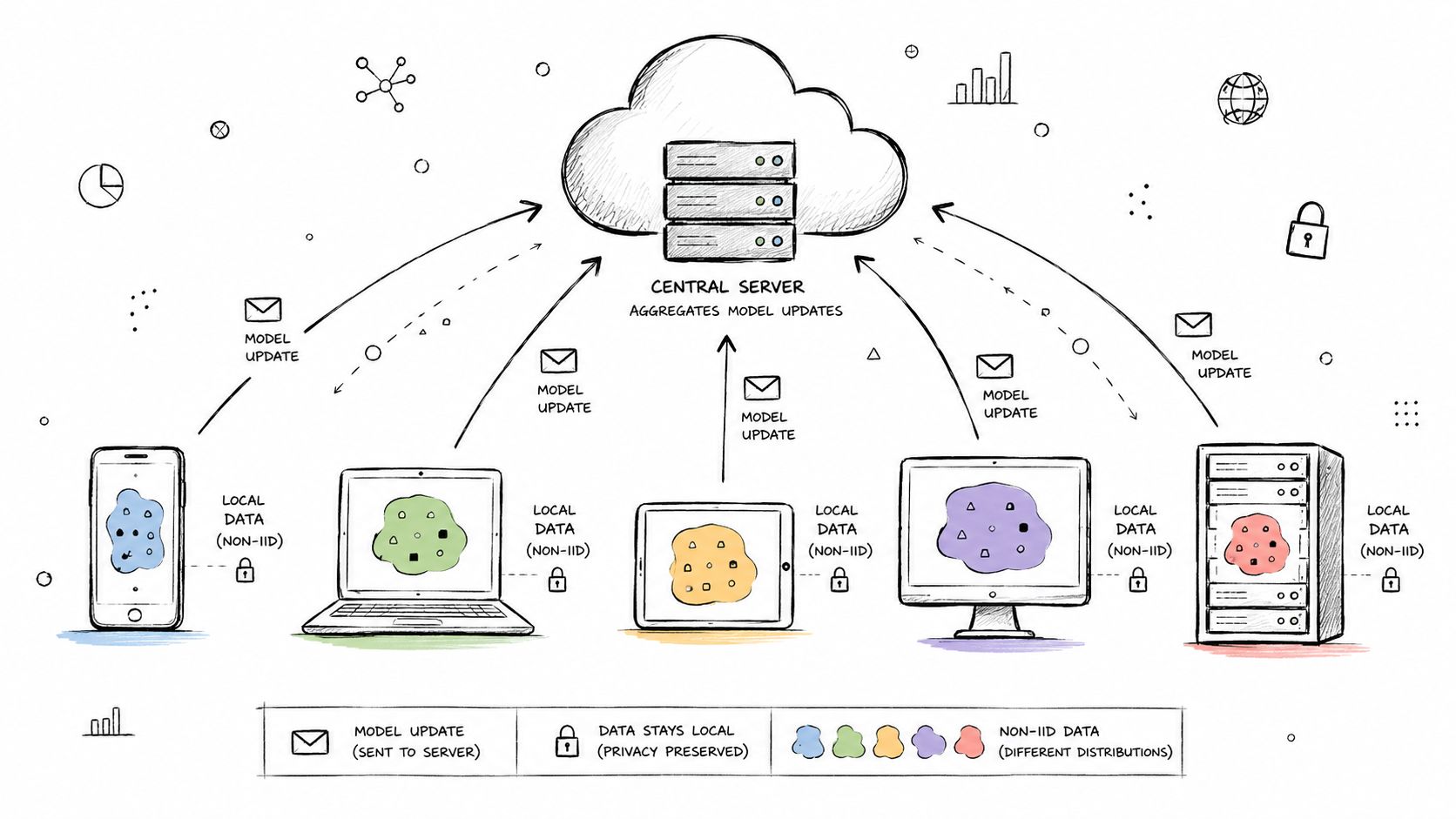
A federated learning system usually has a coordinator and multiple clients. The coordinator distributes a model, each client trains against local records, and clients return model updates for aggregation. The raw training records remain at the client site.
That design can create value in three ways:
- Privacy preservation: Raw records stay within their originating boundary, although additional protections are still necessary.
- Lower data movement: Teams transfer model information rather than repeatedly copying complete datasets.
- Access to siloed data: Organizations can learn from data that would otherwise remain isolated by policy, ownership, or infrastructure.
Federated learning isn't automatically cheaper or easier. The central team still has to operate a distributed training system, authenticate participants, validate updates, monitor model behavior, and support inconsistent connectivity. In many startups, centralized training with carefully governed access is the better first choice.
Practical rule: Choose federated learning because centralization is genuinely blocked or risky, not because distributed architecture sounds more privacy-friendly.
This guide is for engineering leaders deciding whether to invest, ML practitioners designing the training loop, and hiring leaders evaluating the skills required to operate it. The key decision isn't just whether FL can work. It's whether its privacy and collaboration benefits justify the orchestration and MLOps burden.
Federated Learning Architecture and Types Explained
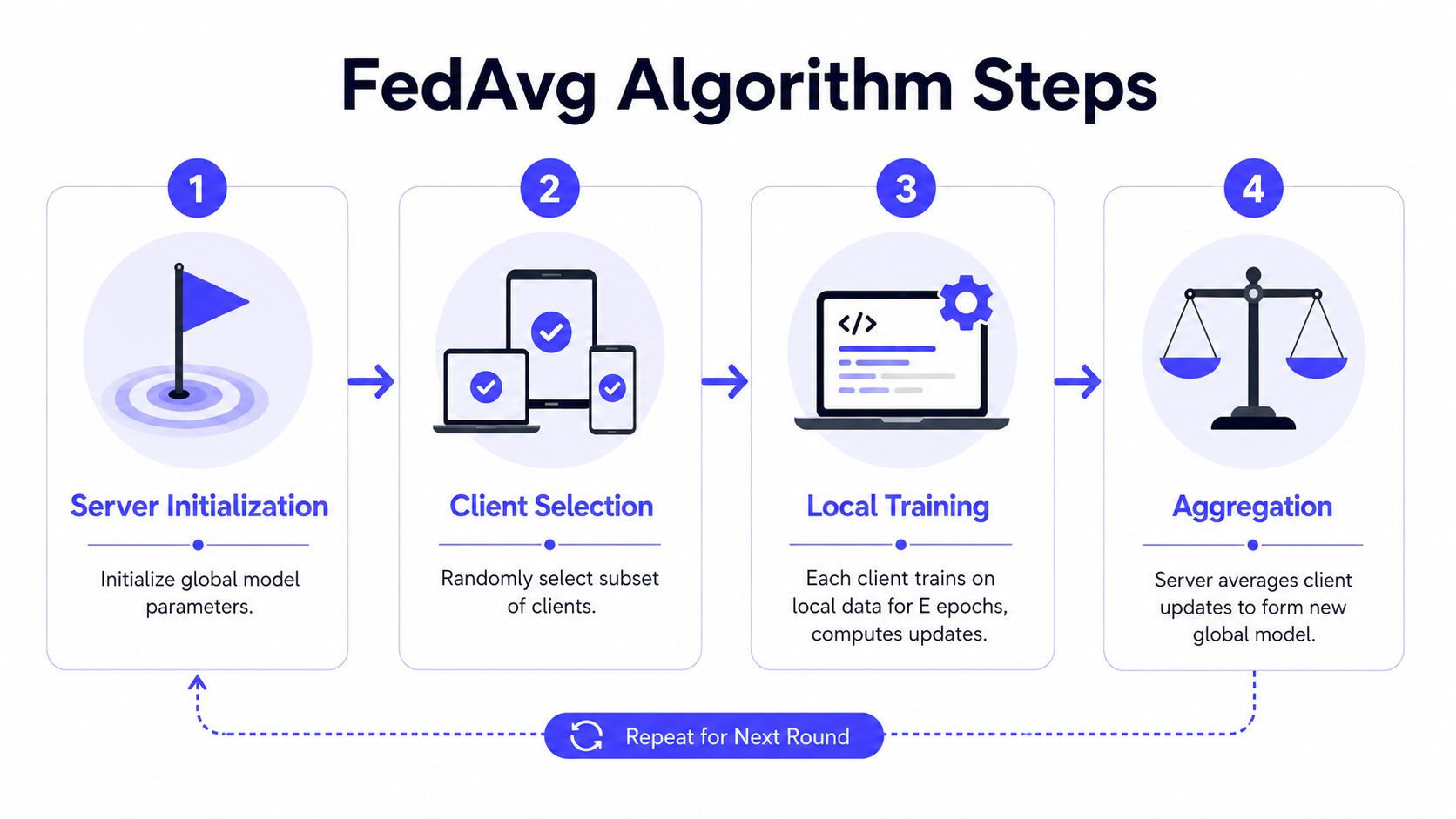
The architecture becomes easier to evaluate when you separate one training round into concrete steps.
- Server initialization: The coordinator creates or loads a global model.
- Client selection: It chooses a participating subset based on availability, policy, or sampling rules.
- Model broadcast: Selected clients receive the current model parameters.
- Local training: Each client trains against its own local dataset.
- Update return: Clients send model updates and relevant training metadata.
- Aggregation: The coordinator combines the updates into a revised global model.
- Redistribution: The revised model goes to the next client cohort.
The server typically receives parameters or gradients, not raw examples. That boundary reduces data movement, but it doesn't eliminate the need for security controls around the messages and the resulting model.
The three data topologies
The right FL type depends on how participant datasets overlap.
| Type | Data relationship | Practical example | Main design question |
|---|---|---|---|
| Horizontal federated learning | Clients share features but hold different samples | Hospitals use a similar clinical schema for different patient populations | Can one model generalize across local populations? |
| Vertical federated learning | Clients share sample identities but hold different features | A bank and an e-commerce company have overlapping customers and different behavioral fields | How can parties align records without exposing identities or features? |
| Transfer federated learning | Clients differ in both samples and features | Organizations operate in related domains with limited structural overlap | Which knowledge can transfer without forcing one common schema? |
Horizontal FL is usually the easiest mental model. Multiple hospitals may use comparable feature definitions while contributing different patient records. Vertical FL is more difficult because the parties need to coordinate shared entities while protecting each organization's fields. Transfer FL addresses the least aligned setting, where both the populations and feature spaces differ.
A useful concept map
Think of the selection process this way:
- Same features, different people or events: horizontal FL.
- Same people or entities, different attributes: vertical FL.
- Different people and different attributes: transfer FL.
- No meaningful alignment or shared objective: FL may be the wrong tool.
That last test matters. Federated learning can train across silos, but it won't automatically reconcile incompatible labels, definitions, or data quality. Before choosing a framework, document the feature schema, label policy, participant boundaries, and ownership of the resulting global model.
Key Algorithms and the Communication Bottleneck
Federated Averaging, or FedAvg, is the standard starting point. The coordinator sends the current model to selected clients. Each client performs local training, then returns its updated parameters. The coordinator averages those contributions, often weighting them by the amount of local training data, and sends the combined model into the next round.
FedAvg is attractive because it maps cleanly onto existing training code. It also exposes the main production problem quickly: clients don't train in identical conditions.
Choosing an algorithm
FedProx adds a constraint that discourages a local model from drifting too far from the global model. It can help when client datasets differ substantially or local optimization becomes unstable.
SCAFFOLD uses control variates to correct client drift. The goal is to reduce the divergence that appears when each participant sees a different data distribution.
These algorithms aren't interchangeable performance upgrades. They change convergence behavior, tuning requirements, and the evidence you need from experiments. Start with FedAvg as a baseline, then test alternatives against the same client availability, data partitioning, privacy controls, and evaluation protocol.
Communication determines time-to-value
In production, computation often isn't the only constraint. A client may have enough processing capacity but a weak connection, limited battery, a maintenance window, or an intermittent route to the coordinator. Every additional synchronization round creates another opportunity for delay or failure.
A recent communication-efficient federated learning study reported 80.5% test accuracy on FEMNIST by round 50, while a baseline required 200 rounds to reach 74.5%. The paper also reported 48.03% to 93.18% less communication to reach target accuracy across its benchmarks (communication-efficient federated learning study).
That result illustrates a production principle. A model that reaches useful accuracy with fewer rounds can shorten time-to-accuracy when clients have constrained bandwidth or unreliable connectivity. It can also reduce the amount of coordination infrastructure your team must keep active.
For a broader deployment perspective, compare training communication with the constraints discussed in AI inference optimization. Inference and training have different bottlenecks, but both reward teams that measure data movement, latency, and failure recovery instead of looking only at model quality.
Privacy and Security Realities Beyond the Hype
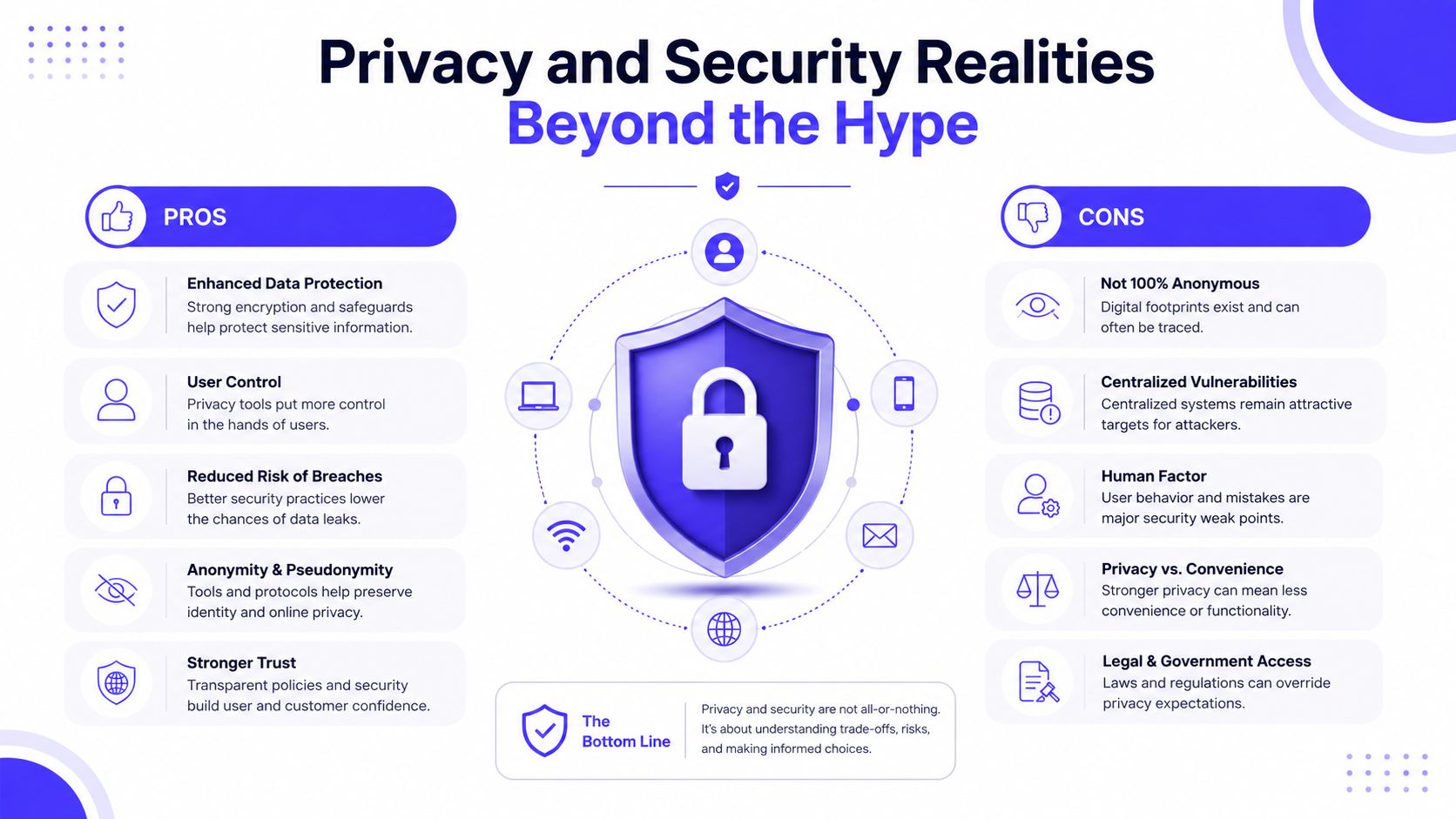
Keeping raw data local is useful, but it isn't the same as proving that training is private. Model updates can contain information about local examples, and a central coordinator may still learn from the aggregate model over time.
Secure aggregation addresses one specific exposure. A cryptographic protocol prevents the server from inspecting each individual client update. The coordinator receives a combined result instead of a readable contribution from every participant.
That protection changes what the server can see, but it doesn't make leakage disappear. A privacy analysis of federated learning with secure aggregation found that leakage decreases linearly with the number of participating users in FedSGD. The same analysis found that leakage increases with more training rounds and can still occur through the aggregated model (privacy analysis of federated learning with secure aggregation).
Build layered protection
A defensible design usually combines several controls rather than relying on FL alone.
- Secure aggregation: Hide individual updates from the coordinator while preserving aggregate training.
- Differential privacy: Add calibrated noise so the model reveals less about particular records or participants.
- Participation strategy: Use cohort rules that avoid exposing unusually small groups or repeatedly isolating one participant.
- Update validation: Inspect incoming updates for malformed, extreme, or suspicious behavior before aggregation.
- Auditability: Record who participated, which model version they received, what controls applied, and how the result was evaluated.
Differential privacy creates a utility trade-off. More noise can strengthen privacy protection, but it may reduce the model's ability to learn useful patterns. The right setting depends on the sensitivity of the data, the permitted risk, the model's quality threshold, and the number and diversity of participants.
Security posture: Say precisely what your system protects. “Raw records remain local” is a defensible architectural statement. “The model cannot leak information” is not.
Privacy reviews should also cover membership inference, model inversion, poisoning, compromised clients, and coordinator abuse. The practical design question is whether your threat model, aggregation protocol, privacy budget, participation rules, and incident process align with the claims made to customers and regulators.
For a broader control framework, pair this design work with AI security best practices. Federated learning belongs inside a privacy and security program, not outside it.
Real-World Use Cases and Performance Metrics
Federated learning fits problems where local data is valuable but central access is restricted. The use case determines the topology, client behavior, evaluation method, and staffing burden.
Healthcare teams may train a diagnostic model across hospital networks while keeping patient records at each institution. This is usually a horizontal setting, with evaluation focused on local and cross-site model quality, calibration, subgroup behavior, and update reliability.
Mobile keyboard systems represent a cross-device pattern. The model learns from local typing behavior without requiring raw messages to leave the device. Product teams must balance personalization, battery and network constraints, privacy protection, and the risk that local behavior differs sharply across users.
Financial institutions can collaborate on fraud detection while retaining transaction data within each organization. The model's value depends on detection quality, false-positive control, adaptation to new attack patterns, and strong participant validation.
Industrial IoT teams can train predictive maintenance models across factory floors. They need to evaluate failure prediction, alert usefulness, site-level drift, sensor coverage, and the impact of disconnected edge systems.
Federated learning use cases at a glance
| Use Case | FL Type | Typical Clients | Key Metric | Team Size |
|---|---|---|---|---|
| Healthcare diagnostics | Horizontal | Hospitals or clinical sites | Local and cross-site diagnostic quality | Depends on governance and deployment scope |
| Mobile keyboard personalization | Cross-device horizontal | User devices | On-device prediction quality and privacy risk | Depends on product scale and client platform |
| Financial fraud detection | Horizontal or vertical | Banks, payment providers, or branches | Fraud detection quality and false positives | Depends on compliance and partner model |
| Industrial predictive maintenance | Horizontal across sites | Plants, lines, or edge systems | Failure prediction quality and alert usefulness | Depends on edge integration and operations |
The table is a screening tool, not a promise of uniform performance. Each use case needs a local holdout strategy and a global evaluation set that doesn't hide poor results at individual participants.
Two practical starting points
Example one, hospital collaboration: Start by defining one shared label, one minimum feature contract, and one evaluation protocol. Have each hospital run a local baseline first. If the sites can't produce comparable labels or metrics, adding federated orchestration won't solve the underlying data problem.
Example two, factory maintenance: Begin with a simulation that reproduces missing clients, delayed updates, and different sensor distributions. Then move to a controlled edge pilot. A model that performs well only when every plant participates on schedule isn't production-ready.
System Challenges and MLOps Considerations
Federated learning turns model training into a distributed system. That means the hardest failures may come from client behavior, network timing, data variation, or governance rather than from the optimizer.
Statistical heterogeneity appears when clients have non-identical data distributions. A hospital may serve a different population from another hospital. A factory may use a different machine configuration. Local training can pull the global model in conflicting directions.
Systems heterogeneity is just as practical. Clients may differ in memory, compute, operating system, network quality, maintenance windows, and local storage. The coordinator must decide whether to wait for slow participants, proceed with partial participation, or support asynchronous updates.
Operational controls that matter
A production team should monitor more than global loss.
- Client selection: Define eligibility rules for availability, data quality, trust status, and recent participation.
- Straggler handling: Set clear round behavior for slow or disconnected clients. Don't let one unreliable site control delivery.
- Adaptive aggregation: Adjust how updates influence the global model when client quality, volume, or drift differs.
- Per-client evaluation: Track local quality so an acceptable global score doesn't conceal regressions at one participant.
- Model and data drift: Compare local distributions, labels, update norms, and outcomes across training periods.
- Audit logs: Preserve model versions, participant events, validation decisions, and privacy-control settings.
A useful monitoring dashboard should answer four questions: Which clients participated? Which updates were rejected? How did local quality change? What happens when the coordinator receives fewer or slower updates than expected?
Tool selection
TensorFlow Federated suits teams already invested in TensorFlow and looking for a research-oriented environment for federated algorithms and simulation. PySyft is aimed at privacy-preserving and secure data science workflows, with emphasis on working across data boundaries. Flower provides a framework-agnostic way to connect common ML workloads to federated coordination.
Tool choice should follow the training stack, deployment boundary, security requirements, and team experience. A platform that works in simulation but can't fit the participant environments will create a migration problem later.
Hiring signal: Look for engineers who can explain failure recovery, update validation, data heterogeneity, and evaluation design. Familiarity with FedAvg alone doesn't demonstrate production readiness.
Treat federated training as part of machine learning operations, not as an isolated research experiment. The team needs model development, platform engineering, privacy engineering, security review, and participant support.
Regulatory Implications and Practical Next Steps
Federated learning can support data minimization and purpose limitation because it reduces the need to copy raw records into a shared training environment. It may help teams explain why data stays within a hospital, bank, device, or regional boundary.
It doesn't remove compliance obligations. Teams still need appropriate processing agreements, impact assessments, access controls, retention rules, audit trails, and a clear explanation of what updates and models reveal. Legal and security teams should review the complete system, including the coordinator, client software, logs, model artifacts, and incident process.
Decide whether FL is justified
Use centralized training when data can be moved lawfully, safely, and repeatably, and when the primary need is fast experimentation. Choose FL when data movement is blocked by regulation, contracts, sovereignty, partner trust, or operational risk, and when participants share a meaningful objective.
For a four-week pilot, scope one model, a small representative participant group, a defined local evaluation protocol, secure update transport, and an explicit go or no-go decision. Hire a full-time engineer when FL is a core product capability. Bring in a fractional specialist when you need architecture, threat modeling, and pilot leadership before committing to a permanent team.
Readiness checklist:
- Data topology: Are features, samples, labels, and ownership documented?
- Participant operations: Can each site run approved client software and return updates?
- Privacy design: Have secure aggregation and complementary controls been assessed?
- Evaluation: Can you measure global and participant-level quality?
- Reliability: Have you planned for offline clients and delayed updates?
- Team coverage: Do you have ML, MLOps, security, and compliance ownership?
ThirstySprout helps companies find vetted remote AI engineers and ML teams with experience across machine learning, MLOps, data engineering, and AI product delivery. If you're evaluating federated learning, visit ThirstySprout to scope a focused pilot and connect with the specialist or fractional team your architecture requires.
Hire from the Top 1% Talent Network
Ready to accelerate your hiring or scale your company with our top-tier technical talent? Let's chat.