

Most AI inference optimization advice starts with quantization. That's often the wrong first move. A lower-precision model can reduce memory pressure, but it won't fix a queue that waits too long, a KV cache that thrashes, or a serving layer that moves data inefficiently between memory tiers.
For production systems, the practical question is broader: where does each millisecond and dollar go as a request moves through the stack? This guide gives you a framework for finding that answer, choosing the right intervention, and validating it against real latency SLOs, quality requirements, and cloud economics.
Why Model Tricks Are Not Enough
A model can be mathematically efficient and still serve slowly. In production, latency often comes from prefill computation, queueing, memory bandwidth, and KV-cache size, not from floating-point operations alone. A recent survey organizes efficient large language model inference into four layers, architectural foundations, decoding algorithms, model compression, and hardware and systems, while defining Time-to-First-Token (TTFT) and Time-Per-Output-Token (TPOT) as core operational metrics (survey of efficient LLM inference).
TTFT measures how long a user waits before seeing the first generated token. TPOT measures the delay between generated tokens during decoding. Those metrics expose different failures. A long prompt can create poor TTFT even when token generation is fast, while a memory-bound decoder can produce an acceptable first token and then stream slowly.
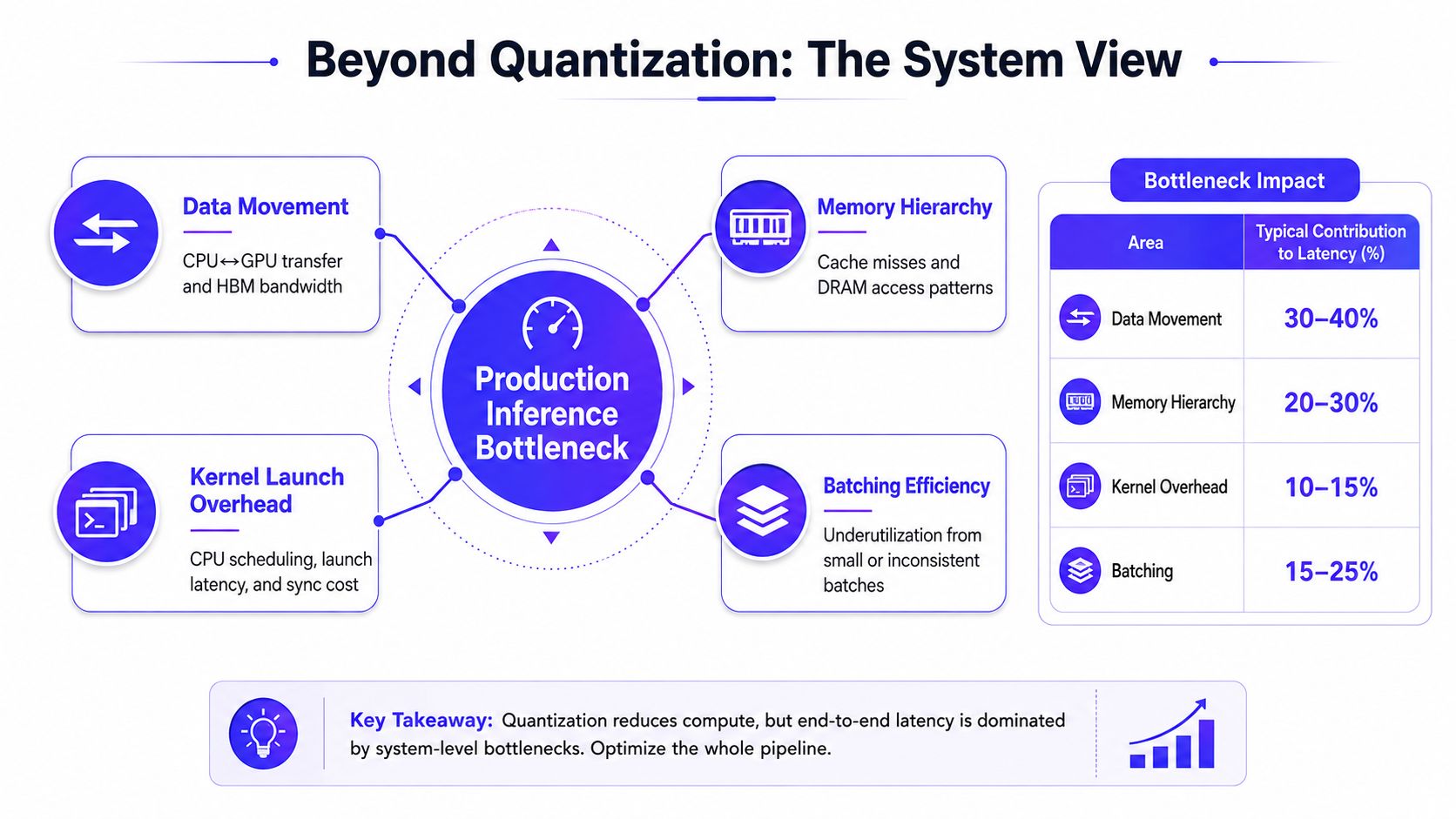
The bottleneck is often data movement
During decoding, the system repeatedly reads model weights and attention state, then writes new state for the next token. As context grows, the key-value cache, or KV cache, consumes more memory and increases pressure on memory bandwidth. A faster compute kernel can't compensate if the GPU spends much of its time waiting for data.
That's why optimization needs a system view:
- Data movement: Track transfers between the CPU, GPU, and high-bandwidth memory.
- Memory hierarchy: Watch cache behavior, allocation patterns, and KV-cache residency.
- Queueing: Separate model execution time from time spent waiting for a worker.
- Batching efficiency: Increase shared work without pushing interactive requests beyond their SLO.
Practical rule: If your profiler shows the accelerator waiting on memory or request scheduling, quantization alone probably won't solve the user-visible problem.
The market has formalized around this reality. A JPMorgan Chase technology report cites one estimate that the AI inference optimization market could exceed $100 billion over the next five years, and another forecast values the software market at $2.17 billion in 2025, with a projected 22.1% compound annual growth rate from 2026 to 2030 and $3.72 billion in added value during that period (JPMorgan Chase technology report). These are projections, not guaranteed outcomes, but they reflect a clear operational shift. Inference performance now affects product economics directly.
Model Compression Techniques That Actually Work
Compression remains valuable. The mistake is treating it as a universal remedy instead of a controlled experiment. Start with the least invasive method, measure quality and serving behavior, then move toward techniques that require more training or architectural change.
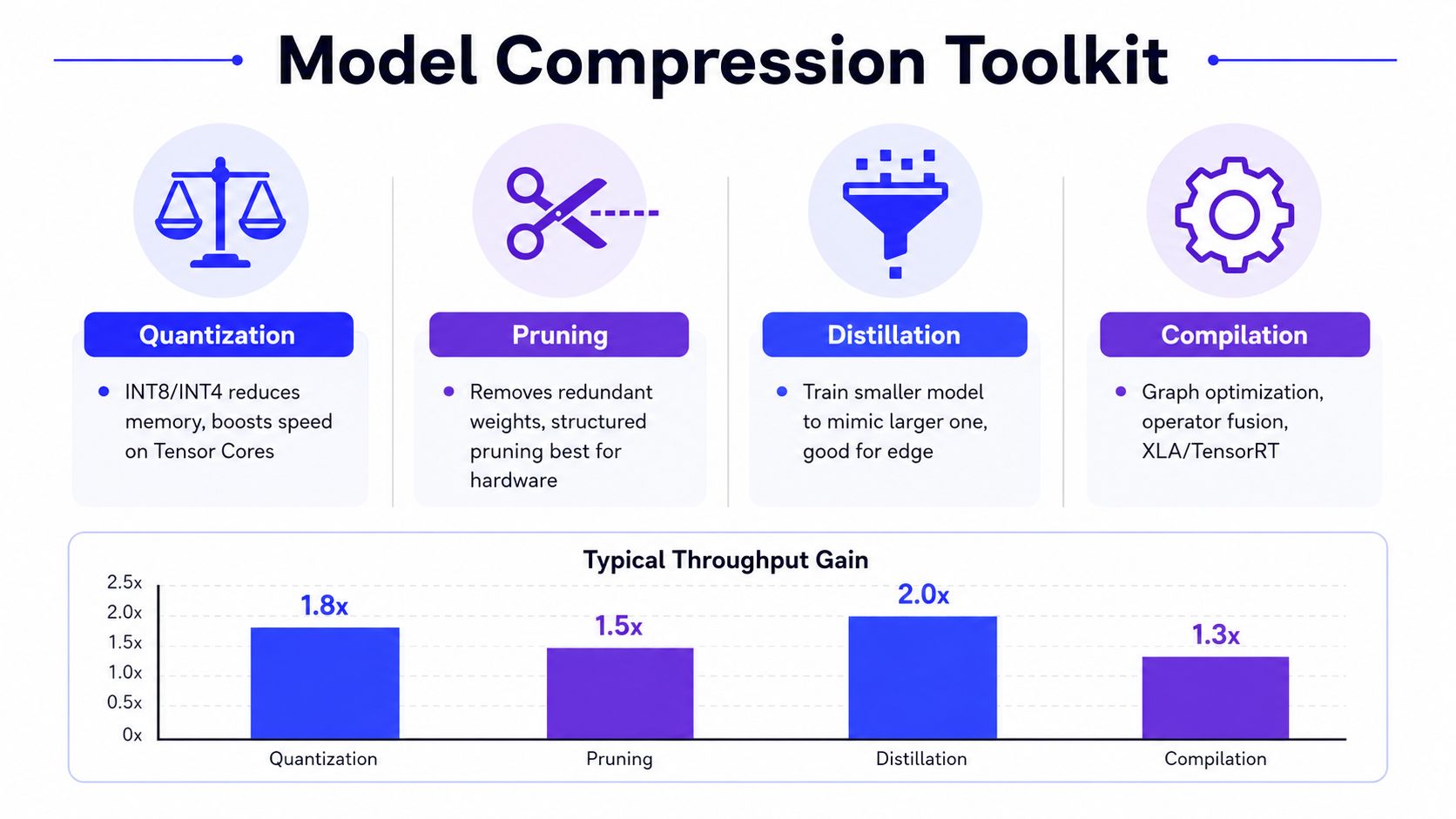
Start with calibrated precision changes
Post-training quantization is usually the fastest first test. It maps weights, activations, or cache values into lower-precision formats using representative calibration data. INT8 and INT4 can reduce memory demand, while newer formats such as NVFP4 target supported hardware. The quality impact depends on the model, task, layer sensitivity, and calibration set, so evaluate factual accuracy, refusal behavior, structured output, and retrieval-grounded answers separately.
NVIDIA's TensorRT Model Optimizer supports NVFP4 for Blackwell GPUs and integrates SmoothQuant, AWQ, and AutoQuantize (NVIDIA's post-training quantization guidance). That combination matters because production quantization is rarely one toggle. Calibration and layer-specific choices can determine whether a compressed model remains usable.
If post-training quantization damages quality, quantization-aware training can teach the model to tolerate the reduced precision. Distillation can go further by training a smaller student model to reproduce the behavior of a larger teacher. Pruning is more structural. Removing unimportant weights, heads, or layers can reduce computation, but unstructured sparsity often delivers little benefit unless the runtime and hardware exploit it. Structured pruning is easier for serving systems to use, though it can create a larger quality trade-off.
For teams working on asset-heavy or multimodal systems, the same principle applies outside language models. These Sculpty 3D compression tips provide useful context for reducing representation size while preserving the information a downstream application needs. For LLM serving, pair compression with graph compilation, operator fusion, and a runtime such as TensorRT or an optimized serving engine. The broader AI model optimization guide is useful when you need to compare these interventions as part of a wider model lifecycle.
Use a quality gate, not a guess
A practical compression review should record:
- Task quality: Compare the outputs that matter to users, not only generic language benchmarks.
- Latency behavior: Measure TTFT and TPOT under representative concurrency.
- Memory behavior: Check whether the reduced model allows a larger batch or prevents cache eviction.
- Operational risk: Confirm that the selected runtime supports the precision format consistently across deployment targets.
A smaller model that fails a critical extraction task isn't cheaper. It moves cost into human review, retries, and customer support.
Serving Patterns for Production Traffic
Serving optimization begins with traffic shape. A workload with repetitive prompts and stable output lengths can benefit from caching and predictable batching. A workload with long, irregular prompts and strict interactive latency may need priority scheduling and careful admission control instead.
Batch size creates a direct trade-off. A systematic GPU study found that tokens per second initially rise as batch size increases, but gains diminish while average decoding latency grows. In one configuration, single-GPU execution reached 22.2 tokens per second with 45.1 milliseconds per token. In another setup, tensor parallelism increased throughput by 36.6% and reduced latency by 27%, showing that the best choice depends on the balance between model, hardware, and workload (systematic GPU study of LLM inference).
Compare the serving choices
| Technique | Best For | Watch Out For |
|---|---|---|
| Continuous batching | Mixed interactive traffic that arrives continuously | Long requests can interfere with short requests if scheduling is weak |
| Exact-match caching | Repeated prompts, stable system instructions, deterministic work | Low reuse produces overhead without meaningful savings |
| Semantic caching | Similar requests that tolerate carefully validated reuse | Incorrect similarity matches can return the wrong answer |
| Prompt compression | Long prompts with repeated or low-value context | Removing context can reduce answer quality |
| Request routing | Multiple models, GPU classes, or priority tiers | Poor routing can increase queueing and cross-device movement |
In a realistic serving benchmark, Sarathi-Serve improved throughput within latency SLOs by up to 2.6× on one A100 GPU for Mistral-7B and up to 6.9× on 8 A100 GPUs for Falcon-180B, compared with Orca and vLLM (Sarathi-Serve benchmark). Those results are workload-specific. They support a useful conclusion, not a universal promise: scheduling and batching can matter as much as model changes, but you must test against your own SLO.
Validate cache economics before enabling caching
Caching works when requests repeat enough to offset lookup, storage, invalidation, and correctness costs. Prompt caching can be effective for shared instructions or repeated retrieved passages. Semantic caching needs stricter evaluation because two prompts can look similar while requiring different answers.
Use a shadow mode first. Log candidate hits, compare cached and fresh outputs, and measure the effect on TTFT, TPOT, quality, and storage overhead. For broader deployment concerns, see this guide to machine learning model deployment tools.
Choosing the Right Hardware for Your Workload
Hardware selection should follow the workload, not the vendor's most recognizable product. A single GPU can be the better choice when the model fits comfortably in memory and communication overhead would outweigh the benefit of distributing execution. Multi-GPU serving becomes more attractive when the model cannot fit on one device or when the target workload benefits from parallel execution.
The GPU study above illustrates the point. Tensor parallelism improved throughput and latency in one setup, but single-GPU execution was optimal in another. Scaling out isn't automatically scaling up. Interconnect bandwidth, synchronization, memory placement, request size, and batch behavior all affect the result.
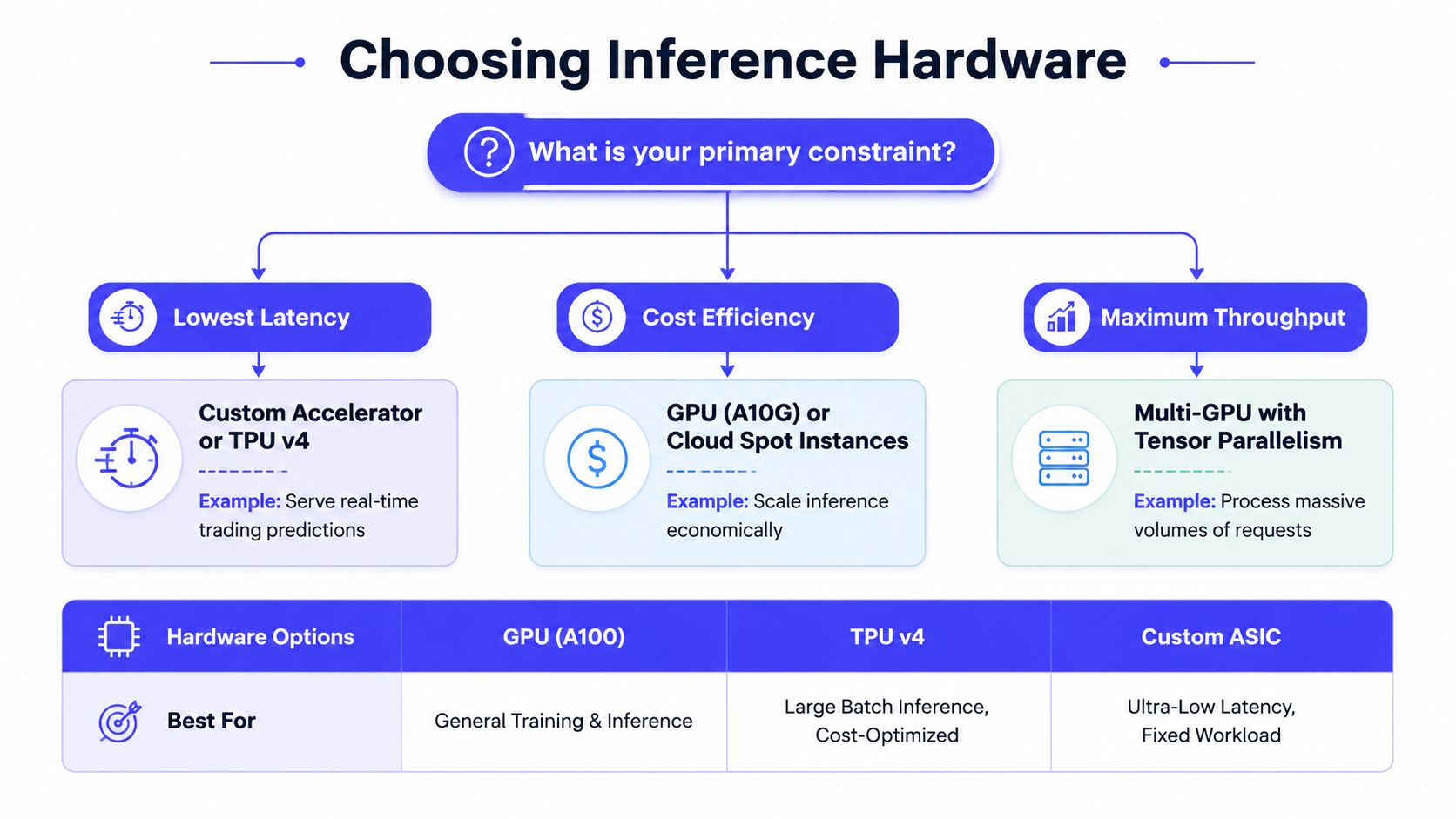
Match hardware to the constraint
- Latency-sensitive interaction: Favor a configuration with enough memory bandwidth and predictable queueing. Specialized accelerators can make sense when the model and workload are stable.
- High-throughput generation: Consider multi-GPU execution and tensor parallelism, but benchmark communication overhead rather than assuming linear gains.
- Cost-sensitive batch work: Use hardware and scheduling that keep accelerators busy without reserving premium capacity for requests that can wait.
- Large-context workloads: Prioritize memory capacity and KV-cache behavior. A device with more raw compute may still perform poorly if cache pressure causes movement or eviction.
A100 systems remain common for general inference, while TPUs and custom accelerators can fit stable, specialized workloads. The right choice depends on model support, compiler maturity, observability, procurement, and the cost of engineering around a less familiar stack.
A hardware decision should include an exit condition. If a multi-GPU design only helps under an unrealistic batch profile, keep the simpler deployment. Simplicity reduces failure modes, operational burden, and the time required to diagnose tail latency.
Profiling and Benchmarking Your Inference Pipeline
You can't optimize inference responsibly without separating queue time, prefill time, decode time, and infrastructure overhead. Start with production-shaped traces. Include short and long prompts, different output lengths, bursty arrivals, cache misses, and the concurrency levels your service experiences.
Build the measurement loop
- Instrument request stages. Record queue entry, worker start, prefill completion, first token, every subsequent token, and request completion.
- Track TTFT and TPOT separately. A single end-to-end latency number hides whether the problem sits in prompt processing or generation.
- Profile GPU behavior. Use PyTorch Profiler for operator-level timing and NVIDIA Nsight for kernel launches, memory transactions, utilization, and synchronization.
- Inspect cache behavior. Record KV-cache allocation, reuse, eviction, and transfer events. A cache hit that still requires expensive movement isn't a free win.
- Replay realistic traffic. Compare median behavior with tail behavior, and preserve the prompt and output distributions that drive production cost.
A useful benchmark report has one row per configuration. Include model version, precision, runtime, GPU type, batch policy, concurrency, prompt profile, output profile, TTFT, TPOT, throughput, quality score, and estimated cost. Keep the test harness versioned so later comparisons remain meaningful.
Measure the bottleneck you intend to change. If you change precision but don't observe memory bandwidth, cache pressure, and output quality, you won't know what caused the result.
Benchmarking discipline also transfers from other infrastructure domains. The principles in this resource on benchmarking for telecom networks are relevant because repeatable workload definitions, controlled comparisons, and clear acceptance criteria matter in any performance program. For production visibility, connect traces and GPU metrics to an AI observability platform.
Interpret common profiler outcomes
If GPU utilization is low and queue time is high, inspect scheduling and request routing. If utilization is high but TPOT remains poor, examine memory bandwidth and KV-cache movement. If TTFT rises with prompt length while TPOT stays stable, focus on prefill, prompt construction, retrieval volume, and admission control.
Don't promote an optimization because a synthetic benchmark improved. Promote it when the quality gate passes and the production-shaped test meets the SLO at an acceptable operating cost.
Advanced Techniques for Latency-Critical Applications
Speculative decoding targets the sequential nature of autoregressive generation. A smaller draft model proposes several tokens, and the larger target model verifies those proposals in parallel. Accepted tokens allow the system to advance more quickly without changing the target model's output distribution when the method is applied correctly.
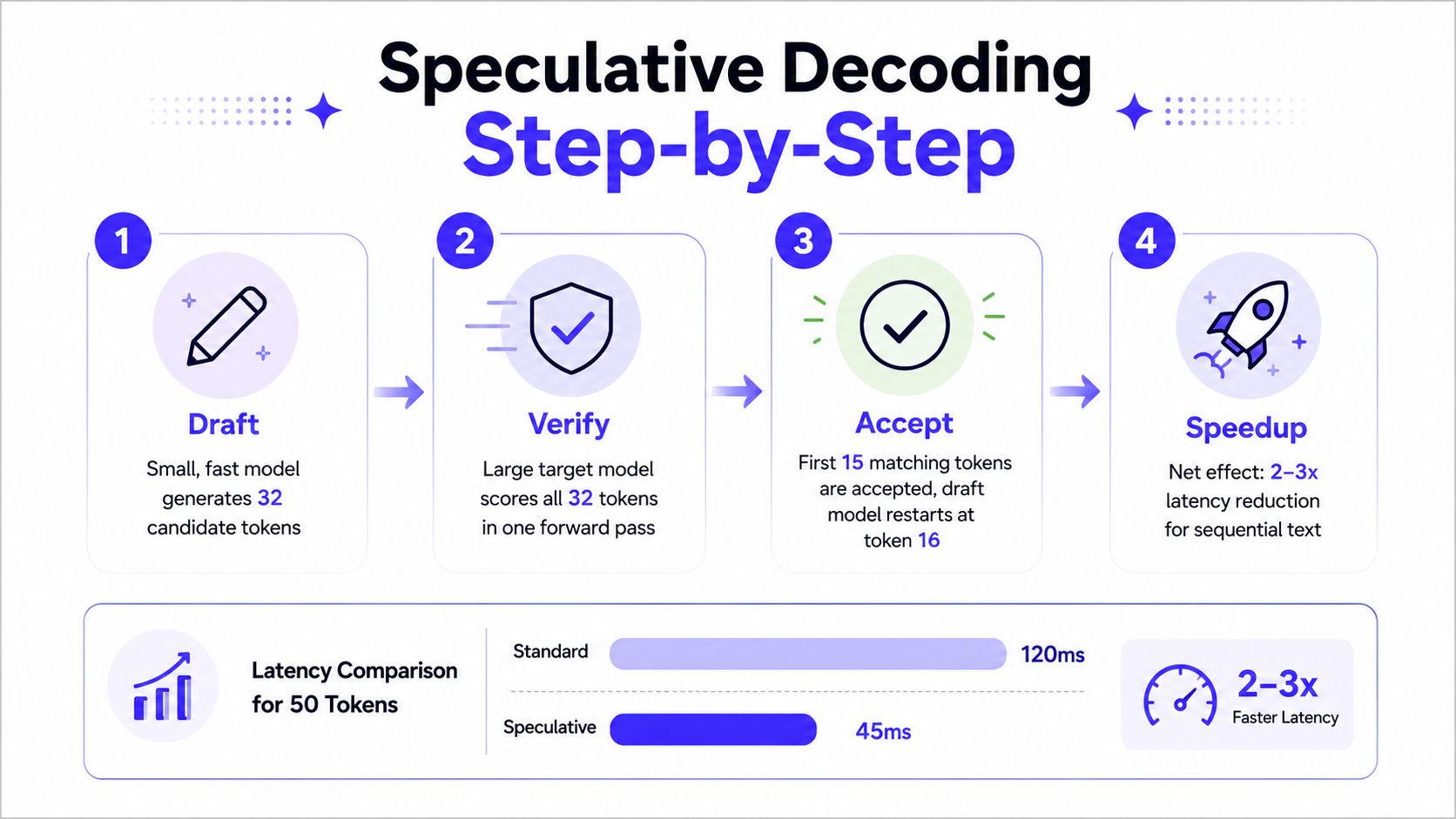
The original speculative decoding method reported 2× to 3× acceleration on T5-XXL versus standard T5X with identical outputs (original speculative decoding paper). A later survey describes the process as drafting several future tokens, verifying them together, and decoding multiple tokens per step instead of one at a time (speculative decoding survey).
Decide whether speculation fits
Speculative decoding works best when the draft model predicts the target model's likely continuation often enough to amortize the extra model work. It can disappoint when the draft model is poorly aligned, prompts vary widely, or verification overhead dominates. Treat acceptance behavior as a production metric, not a detail hidden inside the runtime.
Live traffic also changes. Berkeley's Online Speculative Decoding framework continuously adapts draft models to the evolving query distribution during serving (Berkeley technical report). That matters for products whose users, prompts, or retrieval sources shift over time.
For strict latency applications, combine a decision rule with a quality rule:
- If the target model is oversized for the task, test a smaller model first.
- If decode dominates and a suitable draft model exists, test speculative decoding.
- If prefill dominates, improve prompt construction, retrieval, batching, and prefill scheduling.
- If the workflow calls the model repeatedly, redesign the workflow before adding more hardware.
The cheapest inference call is sometimes the call you remove.
Production Deployment Checklist and Decision Framework
Use this sequence before changing the model or buying more GPUs.
Establish the service contract
Write down the latency SLO, quality floor, availability target, maximum context policy, and acceptable cost behavior. Define TTFT and TPOT separately, because users experience them differently and each points to different engineering work.
Baseline the complete path
Capture representative traces from request arrival through response completion. Include queueing, prompt assembly, retrieval, prefill, decoding, serialization, network transfer, and cache activity. Store the model, runtime, precision, hardware, and batching configuration beside every benchmark result.
Choose the least disruptive intervention
- Queueing problem: Tune scheduling, priorities, routing, and admission control.
- Prefill problem: Reduce unnecessary context, improve retrieval, and separate long prompts from short interactive requests.
- Decode problem: Test KV-cache policies, serving runtimes, batching, and speculative decoding.
- Memory problem: Evaluate quantization, cache compression, placement, and hardware capacity.
- Quality-cost problem: Compare a smaller model or a narrower workflow before applying aggressive compression.
Promote with a scorecard
| Gate | Pass Condition |
|---|---|
| Quality | Task-specific evaluation remains above the agreed floor |
| Latency | TTFT and TPOT meet the SLO under production-shaped load |
| Capacity | The service handles expected bursts without unstable queue growth |
| Cost | The configuration fits the approved serving budget |
| Operations | Rollback, monitoring, and model-version controls are ready |
Run a canary with rollback protection. Keep the baseline available, because an optimization that helps average latency can still harm tail behavior or quality for a valuable request class.
For a high-traffic consumer application, prioritize continuous batching, request classes, cache measurement, and capacity planning. For a low-latency enterprise tool, prioritize predictable TTFT, short prompt paths, and isolation from background work. For batch processing, optimize throughput and utilization first, then use lower-cost capacity where the workload allows it.
A practical team can complete a disciplined pilot in 2–4 weeks when the model, traffic traces, quality tests, and deployment controls already exist. The work should produce a measured baseline, a ranked bottleneck list, one validated intervention, and a decision about whether further optimization is worth its engineering cost.
ThirstySprout helps companies bring in senior AI engineers and MLOps specialists who can profile inference pipelines, tune serving systems, and ship production changes across LLM, data, and cloud stacks. Visit ThirstySprout to start a pilot, book a scope call, or review sample profiles for your inference optimization work.
Hire from the Top 1% Talent Network
Ready to accelerate your hiring or scale your company with our top-tier technical talent? Let's chat.