

Your AI Is a Target: A Practical Security Framework
Your lead ML engineer's laptop gets stolen on a Friday night. By Monday, you need clear answers. Were model API keys stored locally? Can that laptop reach your vector database? Could someone use cached credentials to run inference, pull prompts, or access customer data?
That's the reality for startup teams shipping AI fast. You probably don't have a dedicated AI security team yet. You still need guardrails that work in production, don't slow delivery to a crawl, and reduce the biggest risks first. That's where many teams get stuck. They either over-engineer controls they can't maintain, or they rely on a generic cloud checklist that misses AI-specific failure modes.
The gap is real. Only 36% of organizations have AI-informed security policies in place or in progress, which means the remaining organizations are still adapting old controls to new attack surfaces. If you're also working through mastering AI privacy, treat this guide as the operational side of that work.
Use this as a practical shortlist. These are the AI security best practices that give startup and scale-up teams the fastest risk reduction with the least organizational drag. They focus on access, prompts, data boundaries, artifacts, monitoring, and incident response. You can implement most of them this month with the tools you already use.
1. Model Access Control & API Key Rotation
If engineers can call production models from local laptops with long-lived keys, you've already expanded your blast radius.
Start with role-based access control. In practice, that means your product backend, batch jobs, and evaluation services each get separate credentials and scoped permissions. Engineers shouldn't share a single team key in Notion, Slack, or a .env file that gets copied between machines.
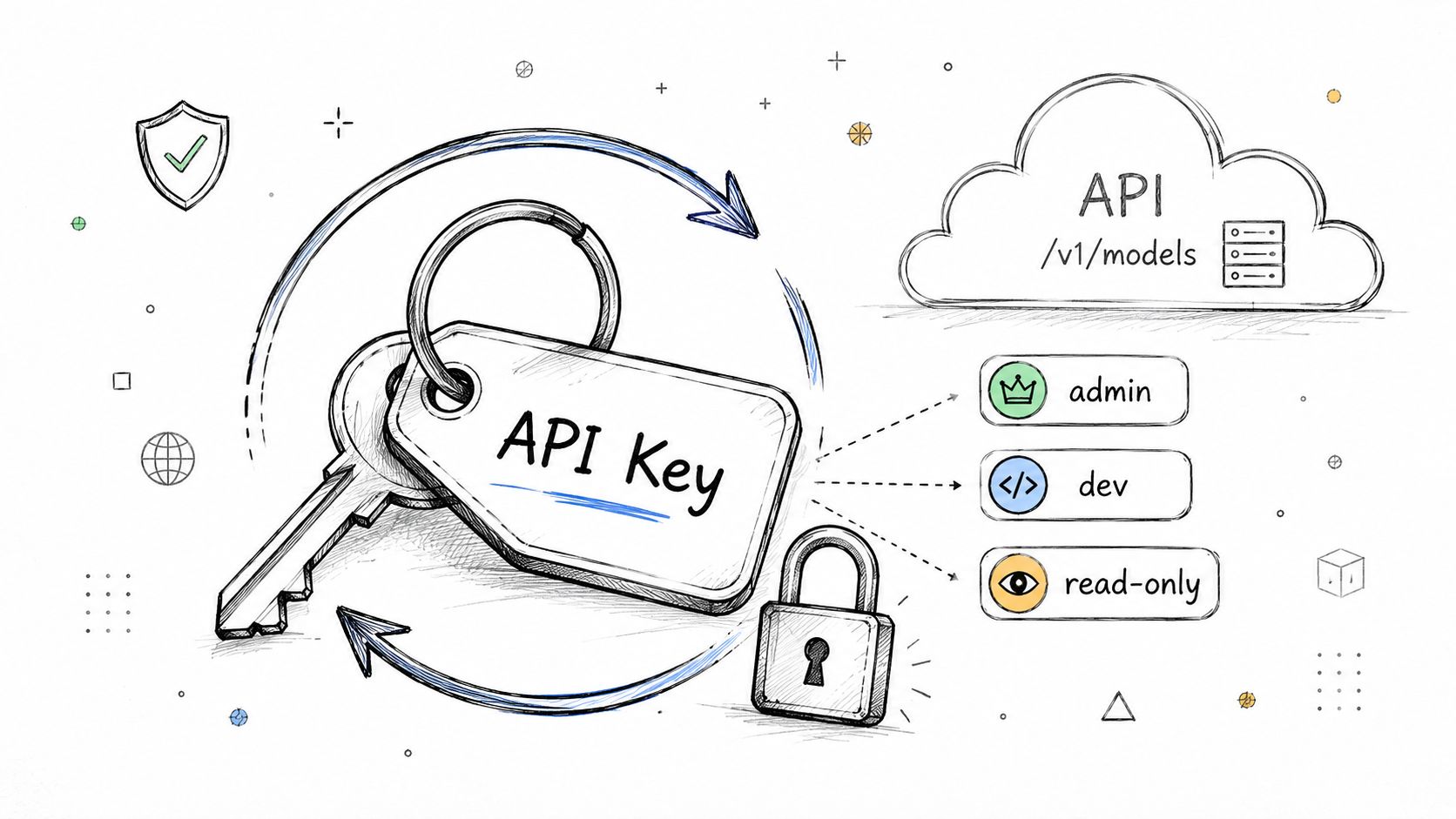
Alt text: A hand-drawn illustration showing an API key attached to a keychain with permission roles and cloud connectivity.
A setup I trust looks boring. Anthropic or OpenAI keys live in AWS Secrets Manager, Google Secret Manager, or HashiCorp Vault. Services pull them at runtime. Humans don't. When someone leaves the company, access is removed through Okta or your identity provider first, and any dependent secrets are revoked the same day.
What good looks like
A Series B fintech team rotates Anthropic API keys every 60 days and ties ownership to Okta groups. If the ML engineer who owns the evaluation pipeline leaves, their access disappears with their SSO account instead of waiting for a manual cleanup.
Another team I've seen do this well uses AWS Identity and Access Management roles for inference calls from Lambda only. Their engineers can test in staging, but production inference access is bound to workloads, not laptops.
Practical rule: if a key's owner is unclear, retire it.
A few controls matter more than the rest:
- Automate rotation: Rotate keys through CI/CD or a scheduled job, then reload them without downtime.
- Set expiration alerts: Use your secret manager to warn the team before a credential expires.
- Centralize logs: Send successful and failed API calls to Datadog, CloudTrail, or your security information and event management system.
- Track ownership: Every key should map to one service or one accountable owner.
The trade-off is operational overhead. Rotation can break brittle integrations. That's not a reason to skip it. It's a reason to fix how your services load secrets.
2. Input Validation & Prompt Injection Defense
Prompt injection is where fast AI launches usually get humbled.
There isn't a single fix. The most practical answer is layered defense. StackHawk's guidance on AI security best practices is right on this point. Use context isolation, output validation, least-privilege access, maximum prompt lengths to block token-stuffing, and strict validation that model parameters match supported versions.
A support chatbot is a good example. Lock the system prompt at deploy time. Wrap user input in explicit delimiters. Reject malformed requests before they ever hit the model. Then inspect the output before you return it to the browser or downstream system.
A simple enforcement pattern
Here's a lightweight request schema that catches more issues than is commonly expected:
- Limit prompt length: Cap request size so a single payload can't blow up cost or hide malicious text in excess context.
- Allow-list model names: Accept only approved models your app supports.
- Validate structured fields: Temperature, tools, and mode flags shouldn't be free-form.
- Reject suspicious input: Block script tags, unsafe tool instructions, and known jailbreak patterns when appropriate.
One healthcare startup I advised used a regex gate for internal RAG queries. It enforced a maximum query length, stripped obvious script fragments, and rejected requests containing database-oriented syntax that had no legitimate place in a clinical search tool. It wasn't perfect, but it stopped low-effort abuse immediately.
For deeper implementation patterns, use ThirstySprout's guide on how to prevent prompt injection.
No single prompt defense holds for long. Teams that do well treat prompt injection like spam filtering. Layered, continuously tuned, and never “done.”
What doesn't work is blind trust in a moderation API. That catches some abuse. It doesn't replace template discipline, context boundaries, logging, and weekly review of rejected inputs.
3. Data Isolation & Federated Learning
Some data should never leave your boundary. That's not ideology. It's architecture.
If you're building in fintech, healthcare, or enterprise SaaS, a third-party model API may be fine for low-risk workflows and completely wrong for core workloads. Training data, fine-tuning corpora, customer support transcripts, and proprietary documents need explicit isolation decisions. Don't leave this to whoever wires up the first proof of concept.
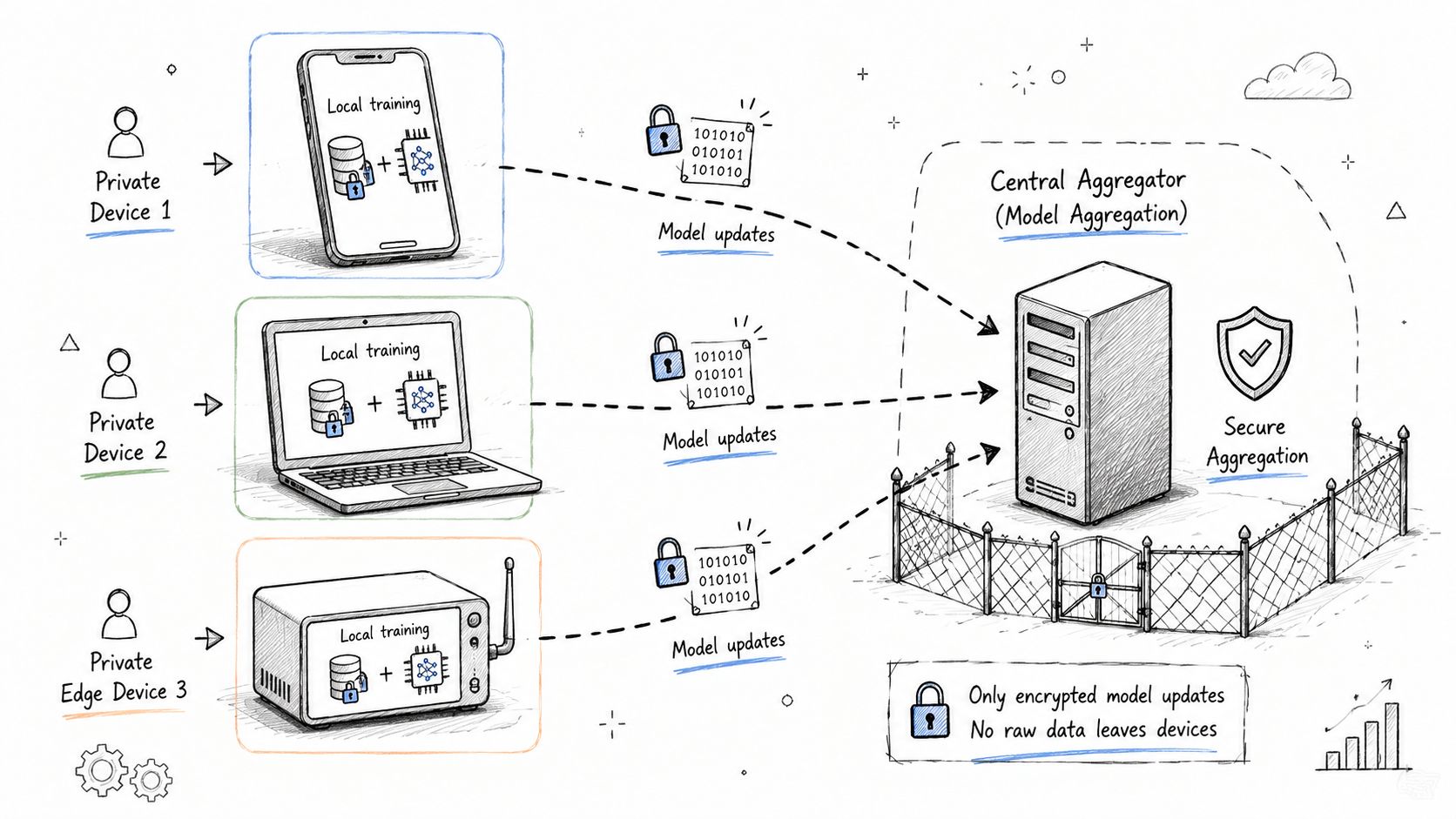
Alt text: A diagram illustrating federated learning where private devices send encrypted model updates to a central aggregator server.
A financial services startup can run vLLM or another self-hosted inference stack inside its own AWS Virtual Private Cloud. That reduces exposure and gives the team direct control over network policy, encryption, and auditability. A healthcare consortium can go further and use federated learning so hospitals train locally and share model updates instead of raw patient records.
Where teams usually overreach
Founders often jump straight to full self-hosting before they're ready. That can backfire if nobody on the team owns GPU operations, networking, and on-call support. Managed options such as AWS SageMaker or Azure Machine Learning are often the right middle ground for teams that need stronger data control without becoming an infrastructure company.
A practical isolation baseline looks like this:
- Segment networks: Put model servers in private subnets and restrict access to approved services.
- Encrypt model and data paths: Use customer-managed keys in AWS KMS, Azure Key Vault, or Vault.
- Separate environments: Training, evaluation, and production inference shouldn't share the same broad access path.
- Minimize third-party exposure: Send only the context the model needs, not whole records.
If your roadmap includes data-intensive analytics or platform work, this also affects who you hire. Teams often need stronger data platform ownership before they can secure AI systems well. That's one reason engineering leaders evaluate expert rankings of Databricks consultancies when they need help hardening data workflows around model training and retrieval.
The trade-off is obvious. Isolation improves control, but it adds operational burden. For regulated workflows, that burden is usually worth it.
4. Model Versioning & Reproducibility
Security incidents get worse when you can't answer a simple question. What model is running right now, and what exactly produced it?
Every model should have a traceable lineage. That includes the training code commit, dataset version, prompt template version when relevant, dependency lockfile, container image, and evaluation results. If you can't reproduce the artifact, you can't audit it and you can't roll it back cleanly.
The minimum reproducibility stack
A startup doesn't need an elaborate platform to do this well. Git for code, MLflow for experiment tracking, DVC for large datasets, Docker for packaging, and a model registry are enough for many teams.
One clean pattern looks like this:
- Tag artifacts with commit SHAs: Your container, model artifact, and deployment record should point to the same source revision.
- Pin dependencies: Use
requirements.txt,poetry.lock, or equivalent lockfiles. - Promote deliberately: Move artifacts from dev to staging to production with approvals and automated tests.
- Document intended use: A model card should note training data scope, limitations, known failure modes, and who approved release.
A machine learning platform team I've worked with used Docker multi-stage builds and image tags tied to git commit SHA plus build date. Kubernetes always pulled exact images, which meant production and staging behavior stayed aligned. When an evaluation regression surfaced, rollback was simple because nobody had to guess which build was live.
Reproducibility is a security control. It's not just an MLOps nice-to-have.
What doesn't work is using notebook filenames as version control, then pushing “final_v3_really_final” models into a bucket. That creates ambiguity exactly when you need precision.
5. Continuous Model Monitoring & Drift Detection
A model can be secure at deploy time and unsafe a month later because the world changed around it.
That's why monitoring matters. You need visibility into prediction drift, data drift, prompt anomalies, error rates, and business outcomes that suggest silent failure. AI systems don't fail only through direct attack. They also fail through distribution changes that create bad outputs, risky decisions, or expensive behavior.
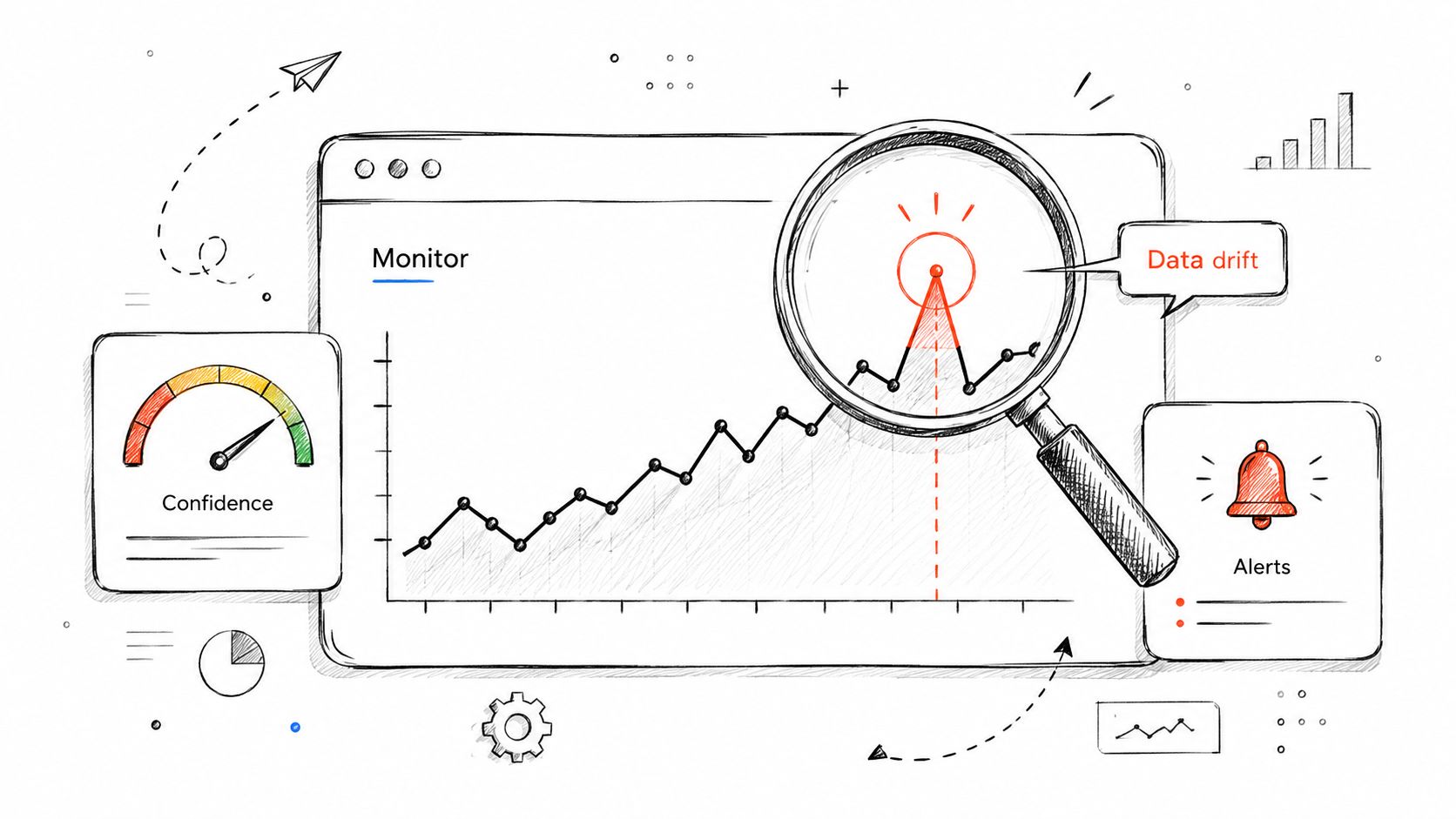
Alt text: A sketched illustration of a computer monitor displaying data performance metrics with magnifying glass highlighting data drift.
A fraud team might use Evidently, Arize, or WhyLabs to monitor shifts in transaction features and review prediction quality by cohort. An e-commerce team might log retrieval quality, fallback rate, tool-call errors, and user-reported bad answers in Grafana.
Start with business-facing signals
Most early monitoring setups fail because they start with abstract metrics nobody acts on. Monitor the things that can trigger a decision.
- Output quality: Wrong answers, unsafe answers, or escalation rate.
- Cost behavior: Token spikes, repeated retries, or runaway tool loops.
- Input changes: New prompt patterns, unusual document formats, or long-context outliers.
- Segment performance: Specific customer tiers, languages, geographies, or document types.
For agentic systems, there's another gap teams often miss. Cyberhaven's discussion of AI security best practices highlights the need for endpoint-level visibility. That matters because autonomous agents can access and exfiltrate data in ways traditional alerts won't catch. If you can't see which agent ran, what it touched, and what left the endpoint, your monitoring story is incomplete.
Don't build everything from scratch. Prometheus and Grafana are fine for infrastructure metrics. AI-specific observability platforms shorten the path to useful alerts.
6. Secure Model Artifact Storage & Encryption
Model weights, fine-tuning data, prompt assets, and evaluation artifacts are part of your software supply chain. Treat them that way.
Teams often protect app code reasonably well, then leave model artifacts in a bucket with broad internal access. That's a mistake. A tampered model, poisoned dataset, or swapped prompt template can create security failures that look like ordinary bad outputs until the damage spreads.
A practical storage pattern
A fintech startup can store model artifacts in Amazon S3 with AWS Key Management Service encryption using a customer-managed key. Write access is limited to the build pipeline. Read access is limited to deployment services and a small set of approved operators. Before deployment, a verification step checks a signature such as Ed25519 or a Cosign signature.
That same pattern works with a private container registry. Enterprise teams often sign model-serving images with Cosign and verify signatures during deployment using admission controls or a sidecar.
A solid baseline includes:
- Encrypt at rest and in transit: Use AWS KMS, Azure Key Vault, or HashiCorp Vault backed workflows.
- Restrict artifact writes: Humans shouldn't casually upload production model files.
- Enable versioning: Keep prior copies so you can investigate tampering and recover safely.
- Verify integrity before deploy: Check signatures, hashes, or both.
There's also a data lifecycle angle. When models and training artifacts are retired, your disposal process matters. Many teams overlook secure destruction of exported datasets, old drives, and local backups. If you handle sensitive records, it's worth reviewing operational standards around certified data destruction for business.
The trade-off is friction in release pipelines. That friction is healthy. Silent artifact changes should be hard.
7. Bias & Fairness Audits (Automated & Manual)
Security and governance intersect faster than many startup teams expect.
If your model affects hiring, lending, insurance, healthcare prioritization, or access to services, harmful bias becomes a business risk, a legal risk, and a release risk. This isn't separate from AI security best practices. It's part of safe deployment, because an unsafe model can trigger customer harm, regulatory scrutiny, and emergency rollback.
How to audit without building a research lab
Start with automated checks in the pipeline, then add manual review from people who understand the domain. Fairness Indicators, Aequitas, and IBM AI Fairness 360 are good places to start. The point isn't to chase every metric. It's to choose a few that map to your use case and make release decisions explicit.
A hiring product, for example, can compare rejection behavior across groups and fail a release if differences exceed the company's documented threshold. A credit team can sample approved and denied cases each quarter and ask loan officers and compliance staff to inspect whether outputs align with policy and human judgment.
For policy scaffolding, ThirstySprout's guide to AI governance best practices is a useful companion.
Release gate: if domain experts won't sign off on fairness risk, the model doesn't ship.
This work matters because governance maturity correlates strongly with readiness. Vanta reports that only 36% of organizations have AI-informed security policies in place or in development, and it notes that mature AI governance is the strongest predictor of AI readiness, as covered earlier in the opening source.
What doesn't work is treating fairness as a one-time ethics review. Data shifts. Products expand. Risk returns.
8. Adversarial Testing & Red Teaming
Teams often test for happy paths, then act surprised when users or attackers find the weird paths first.
Red teaming should be routine for AI systems that touch users, data, or actions. For large language model applications, that means jailbreaks, prompt injection variants, unsafe tool calls, retrieval poisoning attempts, and weirdly formatted inputs. For classical machine learning, that may include adversarial examples, label tampering, and out-of-distribution cases.
Here's a useful talk to share with the team before you formalize the process:
Turn attacks into regression tests
A content moderation team I respect runs monthly manual red teaming. They try fresh slang, indirect requests, near-duplicate phrasing, and prompt wrappers designed to bypass prior controls. Every successful bypass becomes a test case in CI.
For model-level testing, tools such as IBM Adversarial Robustness Toolbox, CleverHans, and TextAttack can save time. For LLM apps, build a small internal corpus of attacks that reflect your product, not just public benchmarks.
Useful red team prompts usually target these areas:
- System leakage: Attempts to reveal hidden instructions or internal policy text.
- Tool abuse: Prompts that coerce unintended reads, writes, or external calls.
- Data disclosure: Requests that try to extract secrets, PII, or cached context.
- Format confusion: Inputs that hide instructions in documents, markup, or long context.
The trap is running one red team exercise before launch and calling it done. New features create new attack surfaces. Treat findings like bugs. Log them, prioritize them, and make sure they stay fixed.
9. Secure Fine-Tuning & Differential Privacy
Fine-tuning can improve product quality and subtly increase privacy risk at the same time.
If your training or adaptation data contains sensitive records, you need to assume someone will eventually ask whether the model can leak them. That question gets sharper when customers, auditors, or partners want proof that your tuning process wasn't casual with regulated data.
A sensible approach combines data minimization, selective training sets, and privacy-preserving methods where the use case justifies the trade-off. Differential privacy, differential private stochastic gradient descent, federated updates, and secure aggregation all belong in that toolbox. They are not free. You usually give up some utility, engineering simplicity, or training speed.
Where privacy controls earn their keep
A healthcare startup can use differentially private stochastic gradient descent when fine-tuning a smaller clinical model for internal summarization. A mobile keyboard provider can rely on secure aggregation in federated learning so the central service never sees individual device updates.
The most useful operational habits are straightforward:
- Measure leakage risk: Run membership inference tests on checkpoints before release.
- Document privacy decisions: Record chosen privacy parameters and why they're acceptable.
- Start small: Calibrate privacy-utility trade-offs on smaller runs before scaling.
- Reduce raw data dependence: Use minimization and synthetic augmentation where appropriate.
This is also where zero trust needs to extend beyond the perimeter. Market.us reports that AI-powered security adoption is at 51% of enterprises globally, and that effective AI security requires zero-trust architecture extending to AI agents, with authentication, authorization, and audit logging for every API call and model inference. That principle applies just as much to training and tuning paths as it does to production inference.
What doesn't work is saying “the vendor handles privacy.” If you choose the data and run the workflow, you own the risk.
10. Incident Response & Playbooks for Model Failures
Every serious AI system needs an incident plan that assumes the model, the data, or the agent can fail in a distinctly AI-specific way.
That includes prompt injection, data leakage, model poisoning, retrieval contamination, runaway agent actions, drift-driven outages, and unsafe outputs making it to customers. Standard application runbooks don't cover enough of that detail.
Build the playbook before the incident
A good runbook is short enough for an on-call engineer to use under pressure. It should define containment steps, rollback conditions, logging requirements, legal escalation paths, and who owns customer communication. If your system can take actions, include a kill switch for tool use or write access.
One enterprise machine learning team I've seen did this well with canary rollback. If a monitored production metric crossed a threshold, traffic shifted back to the last known-safe model and the on-call engineer received a prefilled incident ticket with model version, recent prompt samples, and deployment metadata.
For a broader primer, ThirstySprout's overview of what is incident response is worth sharing with engineering managers and product leads.
When an AI incident starts, your first job is containment, not diagnosis.
There's a direct financial reason to take this seriously. AI-related security incidents cost enterprises an average of $4.88 million per breach, which is a strong reminder that AI security is a financial control, not just a policy exercise.
At minimum, your playbook should include:
- Containment steps: Disable tools, isolate endpoints, revoke credentials, or roll back models.
- Forensic capture: Save artifacts, input logs, retrieved context, and deployment metadata.
- Communication paths: Security, legal, support, leadership, and customer-facing messaging.
- Post-incident actions: Turn the failure mode into tests, alerts, or permission changes.
Run tabletop exercises. Short ones are fine. The point is to learn where your process breaks before production does.
Top 10 AI Security Best Practices Comparison
| Solution | Implementation Complexity 🔄 | Resource Requirements ⚡ | Expected Outcomes ⭐ | Ideal Use Cases 📊 | Quick Tip 💡 |
|---|---|---|---|---|---|
| Model Access Control & API Key Rotation | Medium, RBAC + automated rotation and CI/CD integration | Low–Medium, secret manager, IAM, ops time | ⭐⭐⭐⭐, limits blast radius; improves offboarding & compliance | Enterprises using third‑party APIs, production model endpoints | Automate rotation into CI/CD; store keys in secret backend and alert before expiry |
| Input Validation & Prompt Injection Defense | Medium, prompt engineering, validators, moderation hooks | Medium, regex/classifiers, moderation API (latency/cost) | ⭐⭐⭐, blocks common injections; not foolproof against advanced attacks | User-facing chatbots, RAG systems, public input channels | Combine structured prompts, input validation, and moderation; log rejected inputs |
| Data Isolation & Federated Learning | High, federated orchestration, on‑premise serving, network isolation | High, GPUs/servers, networking, robust DevOps | ⭐⭐⭐⭐, strong privacy/residency guarantees; reduces third‑party exposure | Healthcare, finance, regulated workloads requiring data residency | Start with a small PoC; consider managed on‑prem services and benchmark latency |
| Model Versioning & Reproducibility | Medium, git, registries, containerization, CI workflows | Medium, model registry, storage, CI/CD compute | ⭐⭐⭐⭐, enables rollback, traceability, reproducible training | Regulated deployments, teams needing audits or A/B testing | Use model cards, pin dependencies, and promote via staged workflows |
| Continuous Model Monitoring & Drift Detection | Medium–High, pipelines for metrics, drift tests, alerts | Medium–High, logging, storage, monitoring tools, labeled data | ⭐⭐⭐⭐, detects degradation early; supports SLA and retraining | Fraud detection, recommendations, high‑impact production models | Start with business metrics; use ML monitoring platforms and log ground truth |
| Secure Model Artifact Storage & Encryption | Medium, KMS, signing, IAM controls, audit logging | Medium, key management, storage, signing tooling | ⭐⭐⭐⭐, prevents theft/tampering; aids compliance and forensics | Proprietary IP, regulated industries, private deployments | Use CMKs and Sigstore/Cosign; enable versioning and audit access logs |
| Bias & Fairness Audits (Automated & Manual) | Medium, fairness metrics, CI checks, manual reviews | Medium, fairness libraries and expert audit time | ⭐⭐⭐, reduces discriminatory risk; metric‑dependent effectiveness | Hiring, lending, HR, public decision systems | Choose context‑aligned metrics and include domain experts in reviews |
| Adversarial Testing & Red Teaming | High, automated attacks plus manual red teaming and playbooks | High, compute for attacks, expert testers, adversarial tooling | ⭐⭐⭐⭐, uncovers vulnerabilities before real users exploit them | Safety‑critical systems, content moderation, security‑sensitive apps | Combine libraries (ART, TextAttack) with human red teams and log findings |
| Secure Fine‑tuning & Differential Privacy | High, DP training, secure aggregation, leakage testing | High, longer training, DP expertise, secure infra | ⭐⭐⭐, measurable privacy guarantees with utility trade‑offs | Healthcare, user‑data models, privacy‑sensitive training scenarios | Tune DP on small models first; document privacy budgets and leakage tests |
| Incident Response & Playbooks for Model Failures | Medium, runbooks, rollback automation, cross‑team coordination | Medium, on‑call, drills, playbook maintenance | ⭐⭐⭐⭐, faster containment and recovery; reduces customer impact | Production ML services, SLA‑driven products, regulated customers | Run quarterly tabletop exercises; keep runbooks short, actionable, and indexed |
Your 30-Day AI Security Action Plan
Most startup teams don't need a giant AI security program first. They need a sane order of operations.
In the next 30 days, focus on the controls that cut obvious risk without creating months of process debt. First, automate API key rotation and remove production model access from local developer environments wherever possible. If a laptop is compromised, your response shouldn't depend on someone remembering which keys lived in a shell profile.
Second, implement basic input validation for every AI endpoint. Cap prompt length, allow-list supported models, lock system prompts, and reject malformed requests before they hit the model. Prompt injection doesn't have a silver bullet, so your goal isn't perfection. It's reducing the easy wins for attackers and forcing issues into logs you can inspect.
Third, stand up a simple monitoring dashboard. Don't overbuild it. Track prompt volume, token spend, error rate, rejected inputs, model version in production, and one business metric that tells you whether outputs are going sideways. If you run agents, add visibility into what tools they invoked and what data they touched.
If you have extra bandwidth, the next layer is artifact signing, versioned model releases, and an AI-specific incident runbook. Those controls matter a lot, but they pay off best after access, input validation, and monitoring are already working.
The main mistake I see is trying to solve every AI risk at once. That usually leads to policy decks, half-finished tooling, and no operational change. A tighter plan works better. Pick the few controls your team is able to own. Wire them into CI/CD and runtime. Review them every sprint. Then expand.
There's also a resourcing reality here. Plenty of startups know what they should implement and still don't have the people to do it. AI security often lands across backend, MLOps, platform, and product engineering. If no one owns those seams, the work stalls.
That's where specialist help changes the timeline. If you need senior engineers who've secured production AI systems before, ThirstySprout can help you move faster without building the whole team from scratch. Get the key rotation, prompt defenses, model monitoring, and deployment controls in place now. Then improve from a stable base instead of reacting after an incident.
Start a pilot today.
Need experienced AI and MLOps engineers who can implement these controls fast? ThirstySprout matches startups and enterprises with vetted senior talent in LLMs, machine learning, MLOps, data engineering, and AI product. If you're shipping new AI features and need hands-on help with secure architecture, monitoring, or production hardening, start a pilot or see sample profiles.
Hire from the Top 1% Talent Network
Ready to accelerate your hiring or scale your company with our top-tier technical talent? Let's chat.