

TL;DR
- Establish a Governance Committee: Form a cross-functional team (product, legal, engineering) to review high-risk AI projects. Start with a monthly 30-minute sync.
- Mandate Model Documentation: Require a "Model Card" for every production model, detailing its purpose, data sources, performance, and known limitations.
- Implement Automated Monitoring: Track model performance, data drift, and fairness metrics in production. Set up automated alerts for significant deviations.
- Manage Third-Party Risk: Vet all AI vendors (e.g., foundation models, APIs) for security, compliance, and transparency. Maintain an inventory of all external AI services.
- Action: Start by conducting a 1-week gap analysis using the checklist below to identify your top 2 risks.
Who this is for
- CTO / Head of Engineering: Needs to de-risk the AI roadmap, ensure compliance, and build scalable, reliable systems.
- Founder / Product Lead: Needs to launch trustworthy AI features that build customer confidence and avoid reputational damage.
- Talent Ops / Procurement: Needs a framework for evaluating AI vendors and hiring specialized governance talent.
This guide is for operators who need to implement a practical AI governance framework within the next 90 days.
Quick Framework: The AI Governance Maturity Model
Effective governance isn't a single project; it's a journey. Use this 3-stage model to assess your current state and prioritize your next steps.
1. Establish an AI Ethics and Responsible AI Framework
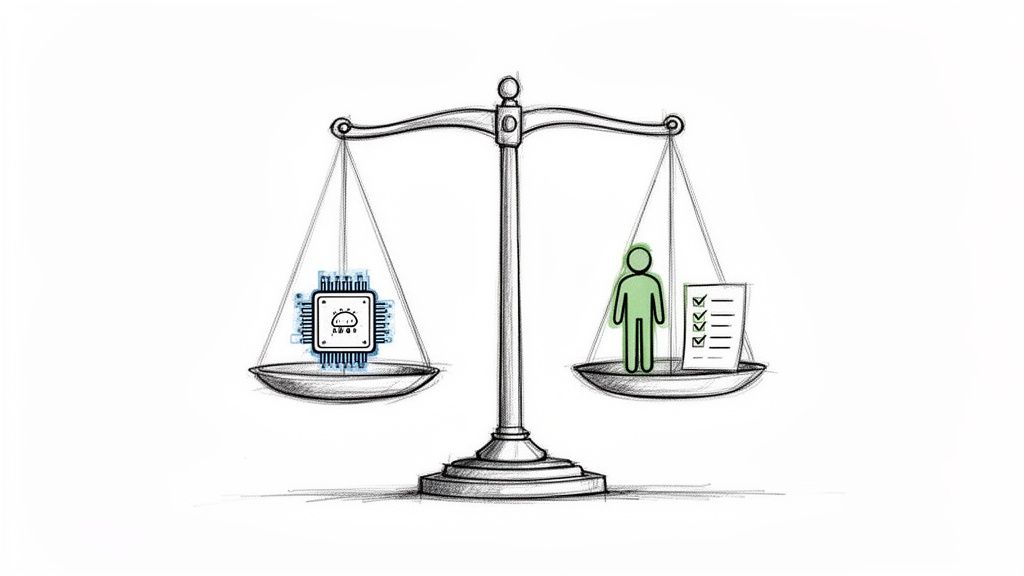
Effective AI governance starts with a documented, shared understanding of what "responsible" means for your organization. A Responsible AI (RAI) framework translates values like fairness and transparency into concrete engineering requirements. For high-growth teams, embedding these principles early prevents costly technical debt and reputational damage.
 Alt text: A balance scale depicts a microchip outweighing a human figure and checklist, symbolizing AI governance.
This isn't a theoretical exercise. Adapting principles from Microsoft's Responsible AI Standard or Google's AI Principles to your specific domain is one of the most crucial ai governance best practices. A framework for a healthcare diagnostic tool will have different red lines than one for an e-commerce recommendation engine.
How to Implement an AI Ethics Framework
Your goal is to make ethical considerations a non-negotiable part of your development workflow.
- Create a Cross-Functional Review Board: Assemble a team with representatives from product, engineering, legal, and data science. Empower them to review high-risk projects.
- Document Ethical Decision-Making: When trade-offs are made (e.g., accuracy vs. fairness), document the rationale and stakeholders. This creates an audit trail.
- Integrate Ethics Checkpoints into Your MLOps Pipeline: Add mandatory review gates in your CI/CD process. A model cannot be promoted to production without a documented bias assessment and an approved model card.
2. Implement an AI Governance Committee
An AI ethics framework is only as effective as the people who enforce it. An AI governance committee translates principles into practice by creating a formal body for decision-making and accountability. This cross-functional group is the central hub for reviewing high-risk AI initiatives and setting deployment standards.
The core idea behind this ai governance best practice is to prevent siloed decision-making where critical legal, ethical, or security risks might be overlooked.
How to Implement an AI Governance Committee
Your goal is to create an efficient oversight body, not a bureaucratic bottleneck.
- Form a Core Charter Group: Start with a lean team of 5-7 leaders. Define their charter, specifying decision-making authority and the scope of projects requiring review.
- Standardize the Intake Process: Create a simple project intake form that outlines the AI model's purpose, data sources, potential risks, and mitigation strategies.
- Document Decisions: Maintain a clear record of all committee decisions. This creates an invaluable audit trail for compliance and internal learning. For practical advice on structuring these groups, see our guide on cross-functional team building.
3. Develop Data Governance Standards for AI Training
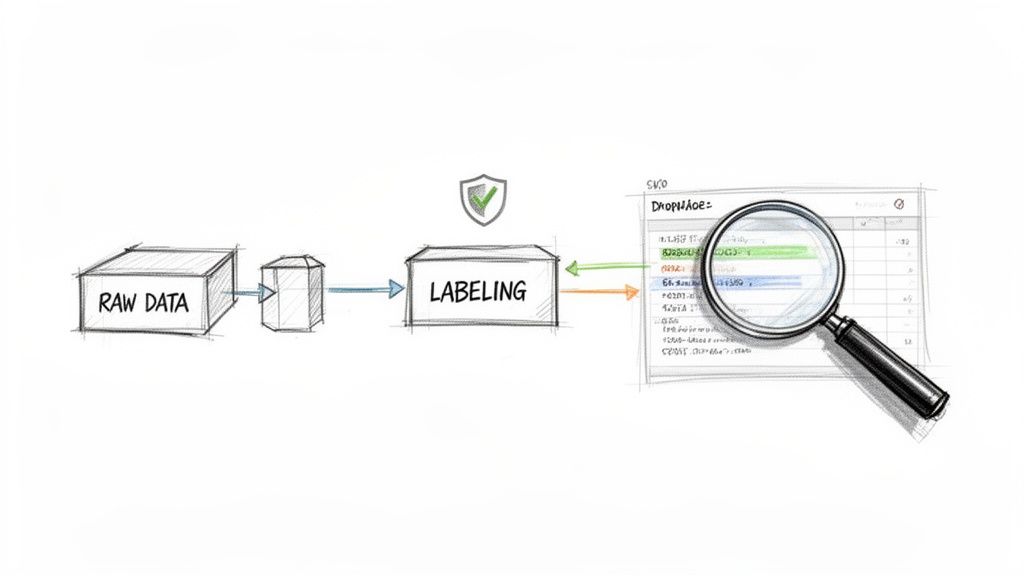
An AI model reflects the data it’s trained on. Poor data quality directly translates to poor model performance, biased outcomes, and operational risk. Establishing robust data governance is a core component of effective ai governance best practices that prevents costly model failures.
 Alt text: Diagram showing raw data processing, labeling, and inspection with a magnifying glass for quality.
Without strong data governance, teams face the "garbage in, garbage out" problem. For example, a fintech using inconsistent customer data for fraud detection could see a spike in false positives. If you handle large datasets, it is also important to learn more about securing big data.
How to Implement Data Governance for AI
Your goal is to build a reliable data foundation for training and retraining your models.
- Implement Data Versioning and a Data Dictionary: Use tools like DVC to version control datasets. Create a data dictionary documenting all features, sources, and formats.
- Establish Data Quality SLAs: Define service-level agreements (SLAs) for data quality, such as >95% accuracy for human-provided labels. Integrate automated validation checks into your CI/CD pipeline.
- Conduct Regular Data Audits: Schedule quarterly audits of key training datasets to identify and fix quality degradation or emerging biases.
4. Create a Model Risk Management and Monitoring Framework
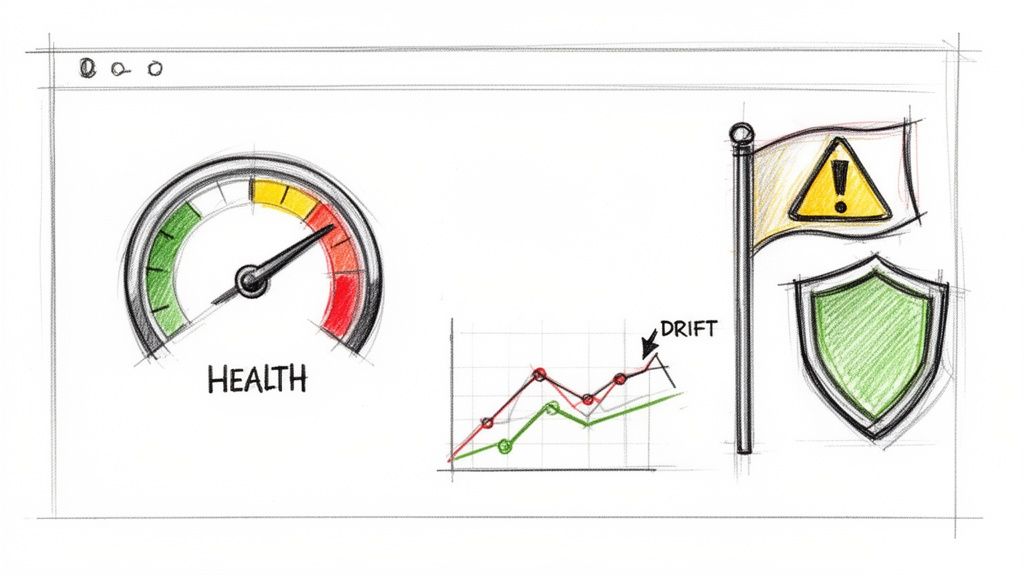
An AI model is not a "set-it-and-forget-it" asset. Once deployed, its performance can degrade due to data drift or concept drift. A Model Risk Management (MRM) framework is essential for maintaining the reliability and safety of your AI systems by systematically tracking model behavior in production.
 Alt text: A sketch of a dashboard displaying health metrics, data drift, a warning flag, and a shield symbol.
Implementing these ai governance best practices turns reactive firefighting into proactive oversight, which is critical for any company whose revenue depends on automated decisions.
How to Implement a Model Monitoring Framework
Your objective is to create a feedback loop that ensures model health. To learn more, see our guide on MLOps best practices on thirstysprout.com.
- Define and Track Key Metrics Before Deployment: For every model, document its core business Key Performance Indicators (KPIs) alongside technical metrics like accuracy and latency.
- Set Up Automated Alerting Systems: Configure your monitoring tools to trigger alerts when key metrics deviate beyond a predefined threshold (e.g., a 10% drop in precision).
- Create Incident Response Runbooks: Develop clear, step-by-step playbooks for common model failure scenarios, including who to contact and whether to roll back.
5. Establish Model Transparency and Documentation Standards
Stakeholders, from internal auditors to customers, demand to know not just what a model predicts but why. Establishing clear standards for model transparency, explainability, and documentation is critical for building trust and ensuring compliance.
For example, the explainability required for a credit scoring model in fintech is a regulatory mandate under laws like the Equal Credit Opportunity Act (ECOA). This moves explainability from a technical feature to a legal and business necessity.
How to Implement Model Transparency and Documentation
Your objective is to make every production model auditable and maintainable.
- Mandate a Standardized Documentation Template: Create a "Model Card" required for every model before deployment. This template should include intended use, performance metrics, data sources, and known limitations.
- Integrate Explainability into the MLOps Workflow: Require developers to include feature importance analysis and methods for generating per-prediction explanations (using tools like SHAP or LIME) as part of model validation.
- Maintain a Centralized Model Registry: Implement a model registry as a single source of truth. Each entry should link to the model's documentation, data lineage, version history, and deployment status.
6. Implement AI Talent and Skills Governance
Effective AI governance is impossible without the right people. This means creating specialized roles, defining clear responsibilities for oversight, and building a culture where governance is a shared engineering concern.
One of the most critical ai governance best practices is to build this capability internally, not just buy it. This means creating clear career pathways that allow technical staff to grow into oversight and risk management functions.
How to Implement AI Talent Governance
Your goal is to embed governance expertise across the AI lifecycle.
- Define and Hire for Key Governance Roles: Establish clear roles like an AI Ethics Lead or Model Risk Manager. For leaner teams, use services like ThirstySprout to source fractional AI leaders with immediate governance experience.
- Develop Internal Training: Create internal training programs focused on your AI ethics framework, risk assessment methods, and compliance requirements.
- Allocate Budget and Resources for Governance: Earmark 15-20% of the team's budget for work that directly supports governance, risk management, and ethical oversight.
7. Enforce AI Development Standards with Continuous Evolution
An ad-hoc approach to AI development creates chaos. Establishing and enforcing clear development standards provides a unified playbook for your engineering and data science teams, building a reliable, secure, and compliant AI factory.
One of the most critical ai governance best practices is recognizing that governance is not static. You must build mechanisms to review and adapt your standards quarterly or semi-annually.
How to Implement and Evolve AI Development Standards
Your aim is to create a living framework that accelerates development while managing risk.
- Establish Core Technical Standards: Define requirements for model reproducibility, mandatory security reviews, and automated testing benchmarks in your CI/CD pipeline.
- Create a Centralized Standards Hub: Document your standards in a central wiki or GitHub repository. Include project templates and checklists for model deployment.
- Schedule Quarterly Governance Reviews: Assemble leadership to review the effectiveness of current standards and create a "governance backlog" to track necessary improvements.
8. Integrate Regulatory Compliance and Legal Frameworks
Ignoring the legal landscape is a direct route to significant fines and loss of customer trust. A systematic process to ensure AI systems comply with all applicable regulations is a non-negotiable aspect of modern AI governance.
A core component of ai governance best practices is building a forward-looking compliance function that anticipates changes and integrates legal checks into the AI development lifecycle. Navigating the evolving landscape of AI regulations requires expert insights into AI Regulatory Compliance.
How to Implement Regulatory Compliance
Your objective is to make legal adherence a repeatable, auditable part of your AI operations.
- Map Regulations to AI Use Cases: Create a compliance matrix that links each AI model to relevant laws (e.g., GDPR, CCPA, HIPAA).
- Conduct and Document Impact Assessments: For any new AI system processing personal data, conduct a formal Data Protection Impact Assessment (DPIA) to identify and mitigate risks.
- Establish a Regulatory Watch Process: Designate a team to monitor upcoming AI legislation and provide quarterly briefings to the governance committee.
- Maintain Verifiable Audit Trails: Ensure your systems log all critical model decisions, user consent actions, and changes to the model or data.
9. Establish Third-Party AI Risk Management
Your AI ecosystem extends to third-party models from APIs (OpenAI), cloud services (Google, AWS), and open-source hubs (HuggingFace). Your governance framework must manage the risks these components introduce.
Failing to govern your AI supply chain is a critical oversight. A change in a vendor's API or a bias in a pre-trained model can directly impact your product. This is one of the most important ai governance best practices for modern, composite AI systems.
How to Implement Third-Party AI Risk Management
Your objective is to gain visibility and control over risks inherited from your AI suppliers.
- Develop a Vendor Risk Assessment Template: Create a standardized checklist for vetting any potential AI vendor, covering data handling, model transparency, and security.
- Enforce Strict Contractual Safeguards: Mandate Data Processing Agreements (DPAs) and negotiate clear terms on data usage, liability for model errors, and breach notification.
- Maintain a Third-Party AI Inventory: Create a documented inventory of all external AI services and models—an "AI Bill of Materials" (AIBOM)—including vendor, version, and purpose.
- Implement Continuous Monitoring and Contingency Planning: Monitor API performance and establish quarterly reviews. Build contingency plans for key vendor failures.
10. Create an AI Incident Response Framework
Even robust AI systems can fail. An incident response framework is a pre-defined process to detect, contain, diagnose, and learn from AI-specific issues like severe model drift or catastrophic hallucinations.
A mature incident response plan is one of the most critical ai governance best practices for maintaining operational stability and user confidence.
How to Implement an AI Incident Response Framework
Your goal is to minimize the impact of an AI failure and use every incident as a learning opportunity.
- Establish a Tiered Incident Classification System: Define clear severity levels (e.g., Critical, High, Medium, Low) to prioritize responses effectively.
- Develop AI-Specific Playbooks (Runbooks): Document step-by-step procedures for common AI failure scenarios, such as handling sudden accuracy drops or rolling back a biased model.
- Implement a Blameless Post-Mortem Process: After resolving a critical incident, conduct a post-mortem focused on identifying systemic causes ("what failed?") rather than blaming individuals ("who failed?").
Practical Examples of AI Governance in Action
Theory is good, but practical application is better. Here are two real-world scenarios demonstrating how to apply these governance practices.
Example 1: Pre-Launch Review Scorecard for a Fintech Lending Model
A Series B fintech company is launching a new AI model to approve small business loans. The AI Governance Committee uses this scorecard to ensure a safe and compliant launch.
Outcome: The committee greenlights the launch, contingent on the MLOps team finalizing the monitoring alerts within 48 hours. This structured review prevents a high-risk deployment and creates a clear audit trail.
Example 2: Incident Response Runbook for a Customer Support Chatbot
A SaaS company's support chatbot, powered by a third-party LLM, starts providing inaccurate and inappropriate answers to customers. The on-call engineer uses the following runbook.
Incident: SEV-1: Chatbot HallucinationTime to Detect (TTD): 5 minutes (via automated sentiment analysis alert)
Outcome: The issue is contained in under 10 minutes, minimizing customer impact. The post-mortem leads to a new policy requiring staged rollouts for all prompt changes, strengthening the governance process.
Deep Dive: Trade-offs and Pitfalls to Avoid
Implementing AI governance involves balancing speed with safety. Here are common trade-offs and how to manage them:
- Innovation vs. Oversight: A rigid governance committee can become a bottleneck. Solution: Use a tiered review process. Low-risk projects can proceed with an async review or checklist, while only high-risk projects require a full committee sync.
- Performance vs. Fairness: Optimizing for raw accuracy can sometimes introduce bias against certain user groups. Solution: Define fairness as a primary model constraint, not a secondary metric. Accept a minor accuracy trade-off if it significantly improves fairness.
- Cost vs. Compliance: Proper governance requires investment in tools and talent. Solution: Frame governance spending in terms of risk reduction. The cost of a compliance tool is minimal compared to a multi-million dollar fine or the loss of customer trust from a major incident.
Checklist: Your First 90 Days of AI Governance
Use this checklist to build your foundational AI governance program.
Phase 1: First 30 Days (Foundation)
- Form a Governance Committee: Identify 5-7 key stakeholders from Legal, Product, and Engineering.
- Create an AI Inventory: Document all AI models currently in production or development.
- Draft a Model Card Template: Create a simple Markdown template for model documentation.
- Conduct a Gap Analysis: Use this checklist to score your current maturity and identify your top 3 risks.
Phase 2: Days 31-60 (Implementation)
- Hold First Committee Meeting: Review one high-risk project using your intake form.
- Mandate Model Cards: Require a completed Model Card for all new models entering production.
- Develop a Vendor Risk Checklist: Create a simple scorecard for evaluating third-party AI services.
Phase 3: Days 61-90 (Operationalization)
- Set Up Basic Monitoring: Implement alerts for accuracy drops or data drift on your most critical model.
- Draft a Simple Incident Response Runbook: Document the steps to take for a critical model failure.
- Review and Iterate: Assess what's working and refine your processes for the next quarter.
What to Do Next
Effective AI governance is the difference between building products that accumulate unmanaged risk and products that create lasting value. It transforms governance from a perceived bottleneck into a strategic accelerator.
Here’s a practical, three-step plan to get started today:
- Conduct a 1-Week Governance Gap Analysis: Use the checklist above to score your organization’s current maturity in each area. This will immediately highlight your most critical vulnerabilities.
- Launch Two High-Impact "Quick Wins": Start with Model Documentation Standards (a simple
model_card.mdtemplate) and a Lightweight AI Governance Committee (a monthly 30-minute sync). - Define Your 90-Day Roadmap: Outline your next priorities. For example, if data quality is a risk, a 90-day goal could be to "Implement automated data validation checks for our top 3 training datasets."
Building a mature AI governance program requires specialized talent. ThirstySprout connects you with top-tier, vetted AI and MLOps experts who can build and scale the very systems discussed in this guide. Start your pilot project with world-class remote AI talent today.
References
- Google AI Principles: ai.google/responsibility/principles/
- Microsoft Responsible AI Standard: microsoft.com/en-us/ai/responsible-ai
- NIST AI Risk Management Framework: nist.gov/itl/ai-risk-management-framework
- For a foundational overview of AI governance, see artificial intelligence governance.
Hire from the Top 1% Talent Network
Ready to accelerate your hiring or scale your company with our top-tier technical talent? Let's chat.