

TL;DR
- Structure Your Team: Define clear roles for AI/ML Engineers, Data Scientists, and AI Product Managers using a responsibility matrix to eliminate overlap and ensure clear ownership.
- Hire for Collaboration: Use behavioral questions and paired take-home assignments to vet for communication and teamwork, not just technical skill. A candidate’s ability to explain trade-offs is as important as their code.
- Implement Key Rituals: Establish non-negotiable team rhythms like joint planning sessions, weekly metric reviews, and engineer-led demos to build shared context and align everyone on business impact.
- Measure What Matters: Track a balanced scorecard of technical metrics (Lead Time for Changes, MTTR) and business outcomes (User Adoption) to connect engineering effort directly to value.
- Recommended Action: Start with a 30-day onboarding sprint for new hires that focuses on integration, including 1-on-1s with key stakeholders and shipping a small, collaborative feature in the first two weeks.
Who this is for
- CTO / Head of Engineering: You need to structure your AI teams to ship features faster and reduce project risk.
- Founder / Product Lead: You're scoping AI features and need to build a high-velocity team with the right mix of talent to deliver on your roadmap.
- Talent Ops / Hiring Managers: You are responsible for sourcing, vetting, and onboarding technical talent that can thrive in a collaborative, remote-first environment.
This guide is for operators who need to build or refine a high-performance, cross-functional AI team in weeks, not months.
Quick Answer: Your Framework For High-Performance AI Teams
Building a cross-functional AI team requires a deliberate, three-step framework. It’s not about finding mythical "10x engineers"; it's about designing an operational system that empowers capable people to work together effectively.
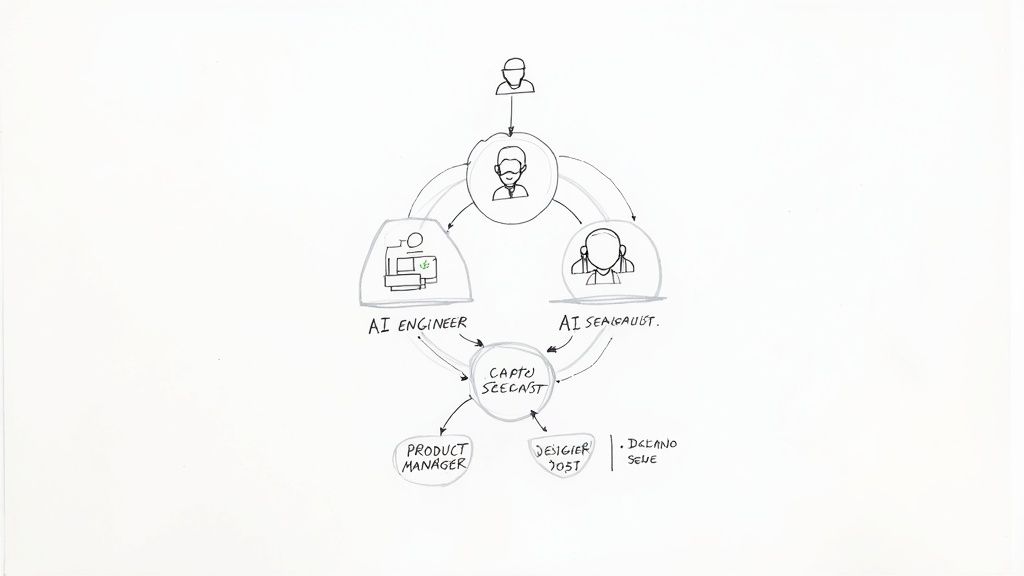
Alt Text: A hand-drawn diagram illustrating a cross-functional team collaborating on an AI product development workflow.
- Define Roles & Boundaries: Use a responsibility matrix to clarify who owns what. Your AI/ML Engineer owns the production pipeline. Your Data Scientist validates the model. Your AI Product Manager owns the business problem and success metrics. This prevents duplicated work.
- Vet for Collaboration: Structure your hiring process to test for teamwork. Ask behavioral questions about past cross-functional conflicts. Use a paired take-home assignment where two candidates (e.g., a data engineer and an ML engineer) must collaborate on a mini-project.
- Establish Collaboration Rituals: Implement lightweight, high-impact processes. Run joint planning sessions where engineers and product managers map out work together. Hold weekly reviews of a shared dashboard that tracks both technical and business KPIs. Mandate engineer-led demos to stakeholders.
Following this framework moves you from a group of individual specialists to an integrated team focused on business impact.
Practical Examples of Cross-Functional Team Building in Action
Theory is one thing; execution is another. Here are two real-world examples of how to apply these principles.
Example 1: The Responsibility Matrix for an AI Feature Launch
A startup is building a new AI-powered recommendation engine. Without clear roles, the Data Scientist and ML Engineer both start building data processing pipelines, leading to wasted effort.
The Fix: They implement a simple responsibility matrix.
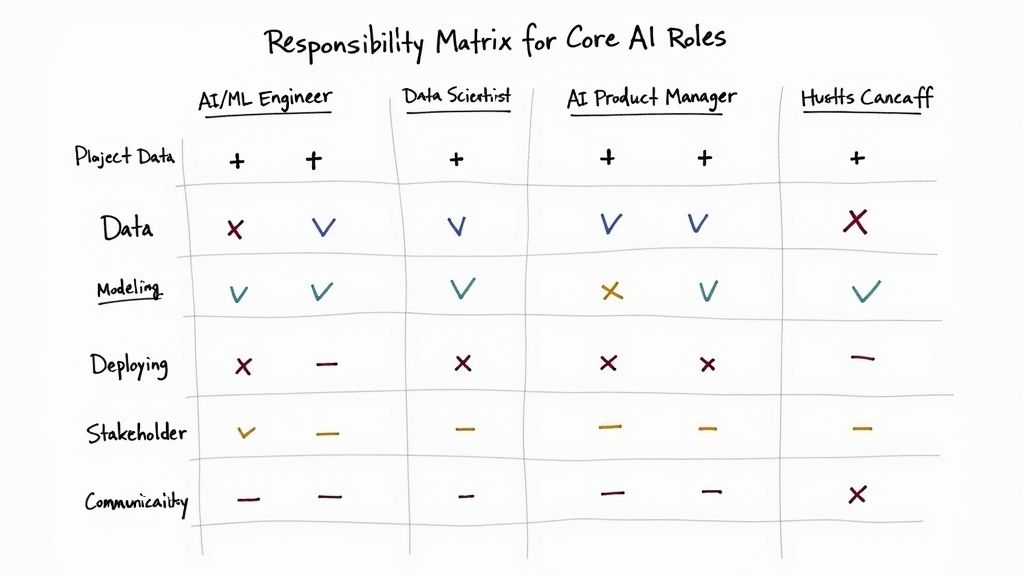
Alt Text: A responsibility matrix for core AI roles, detailing tasks for AI/ML Engineer, Data Scientist, and AI Product Manager.
Business Impact: By clarifying the handoff—where the Data Scientist delivers a validated model and the AI/ML Engineer productionizes it—they eliminated redundant work. This simple tool cut their time-to-deployment for the new feature by an estimated 2-3 weeks.
Example 2: The Collaborative Take-Home Assignment
A company needs to hire a Data Engineer and an ML Engineer for their new AI squad. Instead of a standard coding test, they create a collaborative take-home assignment.
The Task:
We provide a raw dataset of customer support tickets. The Data Engineer candidate must build a clean data pipeline. The ML Engineer candidate then uses that data to build a simple classification model. They have three days, a shared Git repository, and must record a short Loom video explaining their joint process.
The Result: One pair of candidates delivered functional code but a video filled with tension, revealing poor communication. Another pair submitted slightly less optimal code but a video that demonstrated clear negotiation, defined handoffs, and a collaborative spirit. The company hired the second pair.
Business Impact: This exercise directly tests the skills needed for a cross-functional team. It identifies candidates who can navigate the messy, human side of building software, reducing the risk of a bad hire who disrupts team chemistry. This saves months of lost productivity and potential team friction.
For a deeper look at team roles, our guide on roles in agile software development provides additional context.
Deep Dive: Team Structures, Rituals, and Pitfalls
How your team works together is far more important than the specific tools they use. For AI teams, getting this wrong leads to siloed work, redundant efforts, and features that miss the mark. You have two primary models for structuring your teams.
Team Structure 1: The Embedded Squad Model
This is the classic "two-pizza team" approach. Your AI engineers, data scientists, and AI PMs are fully dedicated—or embedded—within a specific product team.
- Best for: Startups and scale-ups where AI is the product or a mission-critical feature. This model is built for speed and intense focus on a single business problem.
- Trade-off: You gain speed and business alignment but risk duplicated work across squads (e.g., multiple teams building similar data pipelines) and inconsistent MLOps standards.
Team Structure 2: The Centralized Platform Model
As a company scales, you can create a core AI/ML platform team that acts as an internal service provider to various product squads.
- Best for: Larger organizations with AI features across multiple products that need common infrastructure like a feature store or model registry.
- Trade-off: You gain standardization and build deep technical expertise, but the platform team can become a bottleneck and lose touch with specific business problems. The fix is to treat internal squads like customers with clear Service Level Agreements (SLAs).
Regardless of structure, a repeatable talent integration process is non-negotiable.
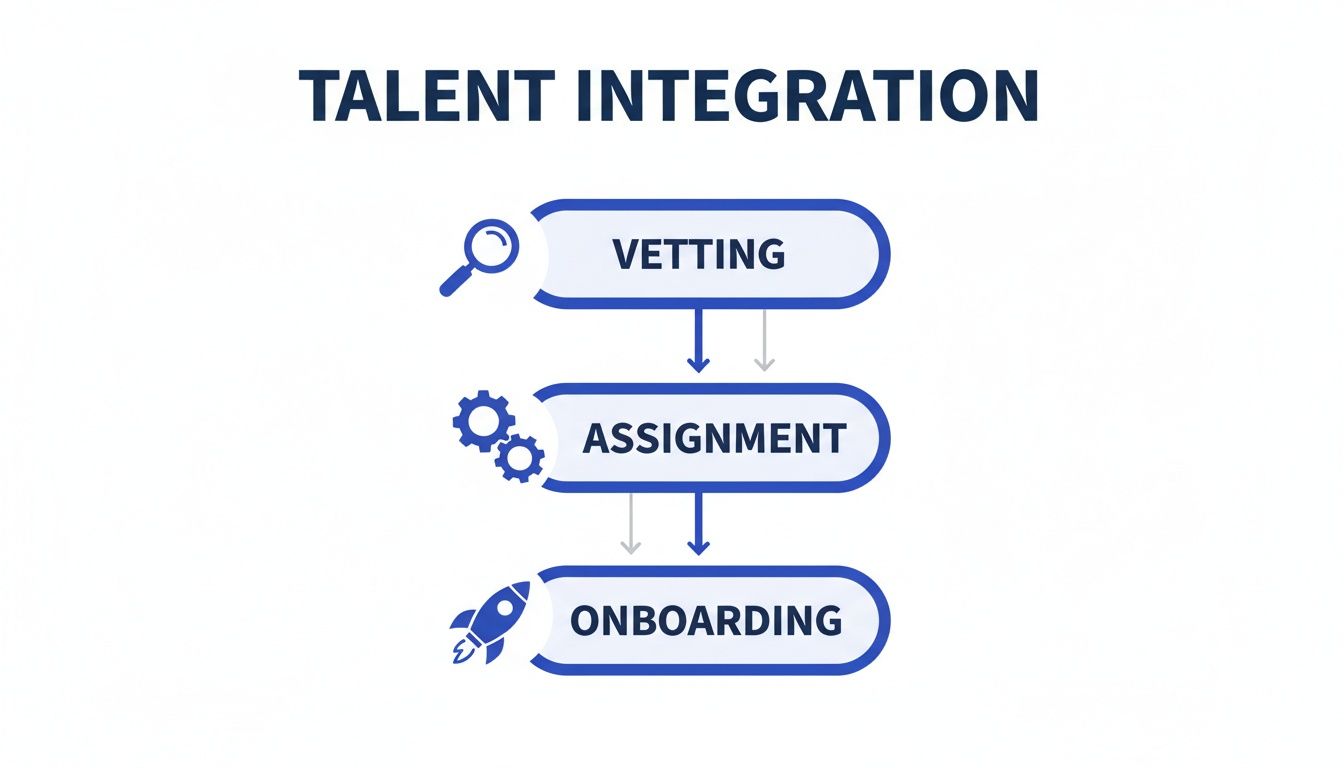
Alt Text: A flowchart titled 'TALENT INTEGRATION' with three steps: Vetting, Assignment, and Onboarding, each with an icon.
The Rituals That Drive Collaboration
Structure is only half the battle. High-performing teams are built on rituals. Data shows that companies investing in team-building see a 14% rise in team productivity and a 23% uplift in profitability. You can discover more team building statistics and their impact.
These three rituals are non-negotiable:
- Joint Planning Sessions: The entire team—engineers, PMs, and designers—maps out work together. An engineer’s technical insight can reshape the plan for the better, preventing downstream surprises.
- Weekly Metrics Review: A 30-minute meeting focused on a shared dashboard of technical (model latency) and business (user engagement) KPIs. This forces everyone to connect their work to business outcomes.
- Demo Days: Engineers demo what they built directly to business stakeholders. This builds empathy, provides unfiltered feedback, and creates a powerful sense of ownership.
Common Pitfalls and How to Fix Them
Even with the right structure, common anti-patterns can derail your team. Data shows diverse, collaborative teams are 1.9 times more likely to exceed financial targets. Spotting these pitfalls protects that advantage. You can find more data on how collaboration impacts decision quality.
- Fix: Mandate that engineers participate in customer interviews and demo their own work. This removes the PM as a bottleneck and builds crucial context.
- Fix: Set a single, shared business goal for the entire team for the quarter (e.g., "Increase new user activation by 15%"). This forces alignment on trade-offs.
- Fix: Implement pairing at key handoffs. Have the data scientist and ML engineer sit down together to containerize the model. This builds shared understanding and reduces rework.
Hiring and onboarding are foundational. A solid process for recruitment project management ensures you start off right, and strong methods to enhance employee onboarding integrate new hires effectively.
Checklist: Your Cross-Functional Team Building Playbook
Use this checklist to turn theory into action. This ensures nothing important falls through the cracks when building your AI team.
Phase 1: Role Definition
- Define the Business Problem First: Write down the specific business outcome this role will drive (e.g., "Reduce customer support ticket volume by 15%").
- Create a Responsibility Matrix: Clearly map out ownership for key tasks between roles like ML Engineer, Data Scientist, and Product Manager to prevent overlap.
- Write a Collaborative Job Description: Frame the role around team outcomes, not just a list of technical skills.
Phase 2: Vetting and Onboarding
- Ask Behavioral Questions: Use questions that probe past collaborative experiences (e.g., "Tell me about a time you disagreed with a PM on a feature's direction.").
- Use a Paired Take-Home Assignment: Have two candidates (e.g., Data Engineer and ML Engineer) work together on a small project to assess their collaboration skills.
- Implement a 30-Day Onboarding Sprint: Your goal for a new hire's first month is integration. Plan 1-on-1s, pair programming sessions, and have them ship one small, collaborative feature.
Phase 3: Structure and Measurement
- Choose Your Team Model: Intentionally decide between an "Embedded Squad" model for focus or a "Centralized Platform" model for scale and standardization.
- Establish Team Rituals: Implement joint planning sessions, weekly metric reviews, and engineer-led demo days to foster alignment.
- Track a Balanced Scorecard: Measure both engineering metrics (cycle time, deployment frequency) and business metrics (user adoption, revenue impact).
What to Do Next
- Download the Checklist: Get this entire playbook as a reusable Notion Template or PDF to use with your team today.
- Audit Your Current Team: Use the checklist to identify one area for improvement in your current team structure this quarter.
- Build Your Team Faster: If you need to hire elite AI talent now, ThirstySprout connects you with pre-vetted engineers and product experts who are ready to deliver.
Ready to build your AI team in weeks, not months? Start a Pilot with us.
References
- Proven strategies for building high-performance teams
- Team Building Statistics (High5)
- Why Diverse Teams Are Smarter (Forbes)
- Roles in Agile Software Development (ThirstySprout)
- Project Management Tools: Jira, Linear, Asana, Notion, Confluence
- Ready to accelerate your AI initiatives? ThirstySprout connects you with pre-vetted AI experts. Find your next hire with us.
Hire from the Top 1% Talent Network
Ready to accelerate your hiring or scale your company with our top-tier technical talent? Let's chat.