

You already have a model that works in a notebook. The team demoed it. Product likes it. Leadership is asking when users will see it.
Then the actual work starts.
The model needs clean data, repeatable training, deployment gates, rollback paths, monitoring, and someone on call when predictions go sideways in production. That gap between a promising experiment and a reliable feature is where machine learning operations either creates business value or kills momentum.
TL;DR
- MLOps is a business capability, not just a tooling choice. It helps you ship AI features faster, reduce production risk, and keep models useful after launch.
- Treat the lifecycle as continuous. Training, packaging, validating, deploying, monitoring, and retraining have to run as one operating loop, not as disconnected handoffs.
- Start with one production model. Build a minimum viable pipeline around it before you standardize across the company.
- Make build vs partner a leadership decision. The right answer depends on urgency, internal platform depth, and how much operational ownership your team can absorb.
- Use a 90-day pilot. Pick one high-value use case, automate the basics, instrument monitoring, and prove reliability before expanding.
If you own engineering or product strategy, this guide is for the moment when AI stops being a prototype conversation and becomes an execution problem.
What Is MLOps and Why It Matters Now
A lot of teams think they have an AI strategy when what they have is just a folder full of notebooks.
That sounds harsh, but it's common. A data scientist trains a model, shows strong offline results, and hands it to engineering. Then priorities collide. The feature needs APIs, testing, infrastructure, versioning, dashboards, and operating rules. Nobody owns the full path from experiment to daily production use, so the model stalls.
Machine learning operations, or MLOps, is the discipline that closes that gap. In practical terms, it unifies how teams build machine learning systems and how they run them in production.
Why leadership should care
A CTO shouldn't view MLOps as a niche platform concern. It directly affects three things leaders already care about:
- Speed to market: Can your team turn a model into a shipped product capability without months of custom glue work?
- Operational risk: Can you detect bad predictions, stale data, and broken pipelines before customers notice?
- Learning velocity: Can the team improve the model safely instead of treating every release like a one-off launch?
This matters now because companies aren't just experimenting with AI anymore. They're trying to operationalize it. The global MLOps market is projected to grow from USD 2.08 billion in 2023 to USD 4.09 billion in 2026, with a 37.8% CAGR, and is projected to reach USD 75.42 billion by 2033 according to the Global Machine Learning Operations market analysis. That scale of projected growth signals a shift in how serious companies treat production AI.
Practical rule: If a model affects customer decisions, pricing, fraud, support, search, or workflow automation, it needs an operating model. Not just a model file.
MLOps is where product value becomes real
The ultimate payoff isn't technical elegance. It's business execution.
A recommendation model that updates reliably can drive engagement. A fraud model that stays healthy protects revenue. A support triage model that degrades unnoticed creates service issues and trust problems. The difference is rarely the training notebook. It's the operating discipline around it.
This is also why MLOps should sit close to product thinking. If you're shaping AI features, the product team needs to understand what happens after launch, especially around iteration loops, user feedback, and release safety. That's one reason I like resources that connect technical delivery with AI-powered product management, because AI features only become strategic when the product and platform motions align.
The End-to-End MLOps Lifecycle Explained
Once you treat machine learning as a production system, the lifecycle becomes clear. It isn't a handoff from research to engineering. It's an operating loop.
Microsoft defines MLOps pipelines as an end-to-end lifecycle with six phases: training, packaging, validating, deploying, monitoring, and retraining, and notes that this structure matters because models degrade over time without automated retraining in a way static software code does not in the same way, as described in the Azure Kubernetes Service MLOps guidance.
A simple visual helps anchor that loop:
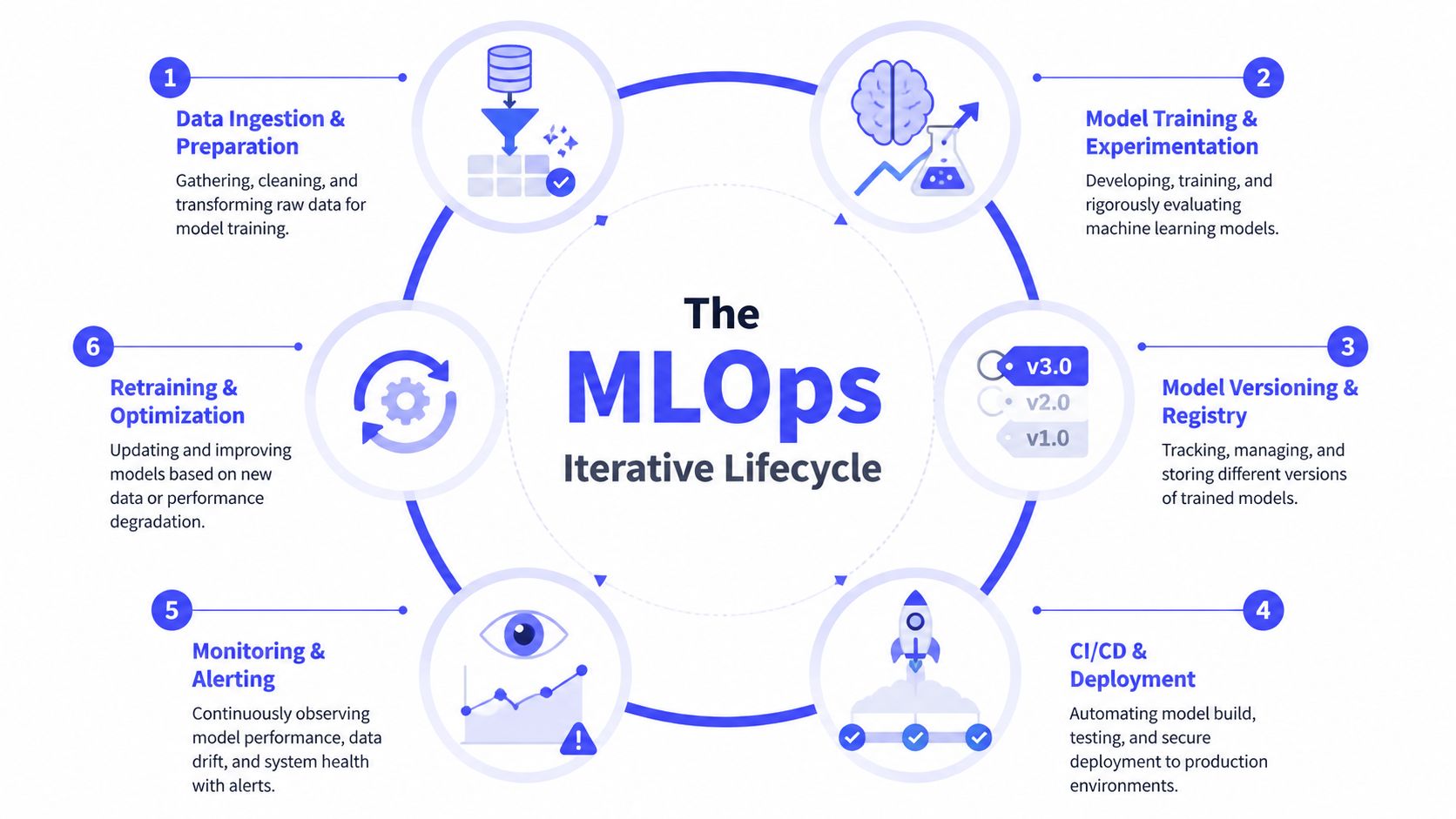
The six phases in plain English
Training
The team fits a model on prepared data and records the configuration, code version, and inputs used to create it.Packaging
Weak teams often cut corners in this area. Packaging isn't "save the pickle file." It's producing a deployable asset with everything needed to run consistently outside the notebook.Validating
You test whether the model meets acceptance criteria. That includes model behavior, input assumptions, and basic runtime expectations.Deploying
The model becomes a service, batch job, embedded component, or internal API. This step needs release controls, not heroics.Monitoring
Production starts here, not at deployment. You watch prediction quality, feature behavior, latency, failures, and changing input patterns.Retraining
You update the model when data changes, performance drifts, or the business problem evolves.
Why the loop matters
Software engineers sometimes underestimate the monitoring and retraining half of the system. That's a mistake. Static code can stay stable for long periods if dependencies don't change. Models don't get that luxury. User behavior shifts. Data pipelines drift. Labels arrive late. The environment moves.
A model that was correct at launch can become expensive, noisy, or misleading later, even when the service itself still returns a valid response.
That is why MLOps is operational by design. The loop never really ends.
A good walkthrough can make this more concrete if your team needs a second format for internal onboarding:
Mini example of the loop in action
Take a churn prediction service.
- The training step builds a model on subscription and support data.
- Packaging wraps the model and preprocessing logic into a service container.
- Validation checks that required columns exist and output ranges stay sane.
- Deployment exposes a prediction endpoint to the product backend.
- Monitoring watches for changing feature distributions after a pricing update.
- Retraining refreshes the model once the new pricing behavior appears in production data.
If you skip any of those, the system may still launch. It just won't stay trustworthy.
A Practical MLOps Reference Architecture
Most MLOps failures aren't caused by bad model ideas. They're caused by missing interfaces between teams and systems.
You need a reference architecture that separates concerns cleanly enough for different groups to move without stepping on each other. Azure's MLOps v2 pattern is useful here because it breaks the system into Data estate, Administration and setup, Model development, and Model deployment, and it explicitly distinguishes the inner loop of development from the outer loop of deployment in the Azure MLOps v2 architecture guide.
This layered view is a practical starting point:
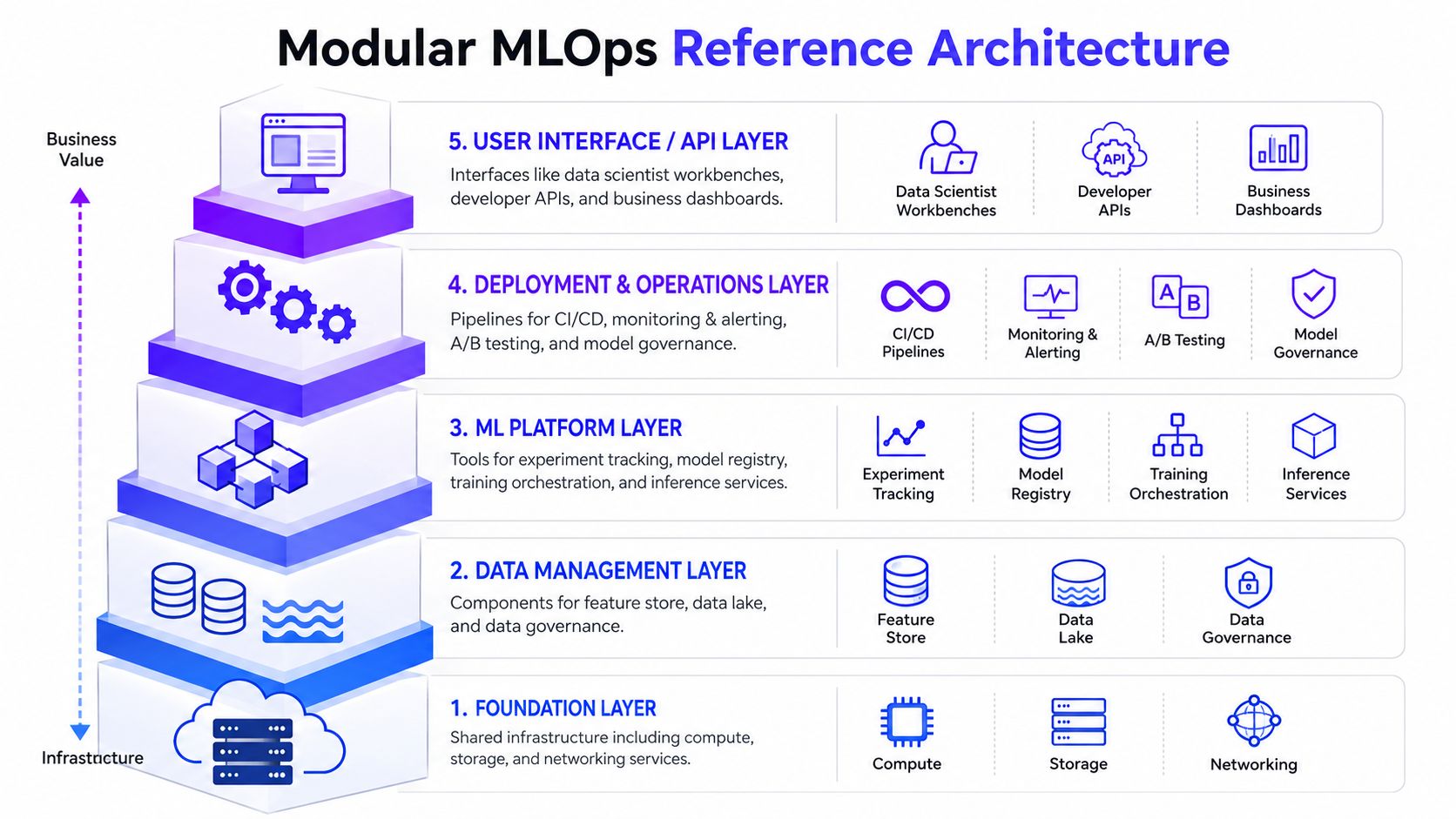
What belongs in the architecture
Here is the stack I want leadership teams to visualize before buying tools or hiring around the problem.
| Layer | What it does | Typical components |
|---|---|---|
| Foundation | Provides shared runtime and security boundaries | Compute, storage, networking, secrets, IAM |
| Data management | Makes data usable and governable | Data lake, feature pipelines, catalog, validation |
| ML platform | Supports model creation and tracking | Experiment tracking, training jobs, model registry |
| Deployment and operations | Moves models into production safely | CI/CD pipelines, serving layer, alerts, rollback |
| Interfaces | Exposes value to users and teams | APIs, dashboards, notebooks, workbenches |
Inner loop versus outer loop
The inner loop is where data scientists and ML engineers experiment. They train models, compare runs, inspect features, and iterate fast.
The outer loop is where platform and product engineering take over. The work becomes automation, approval rules, deployment policy, and service reliability.
That split matters because it tells you what to build and what to standardize. If the inner loop is too constrained, model teams slow down. If the outer loop is too loose, production gets brittle.
Architecture check: If the same person has to manually move artifacts, rewrite config, and recreate environments between experimentation and deployment, you don't have an MLOps system yet.
Mini case for a first implementation
A practical first setup for a mid-stage SaaS team often looks like this:
- Code and pipeline definitions in GitHub
- Training jobs triggered through a workflow runner
- Model registry holding approved versions
- CI/CD promoting only validated artifacts
- Inference service behind an internal API
- Monitoring dashboard for latency, failures, and model health
If you're comparing platform options, it's worth reviewing a grounded overview of machine learning model deployment tools before you commit to a stack. The right architecture usually mixes managed services with a small number of custom controls, rather than building every layer from scratch.
Core Practices and Key Metrics for Success
Tools matter less than operating habits. I've seen expensive platforms fail because the team never agreed on versioning, test gates, or monitoring ownership.
The three practices below are the minimum standard if you want machine learning operations to stay reliable after launch.
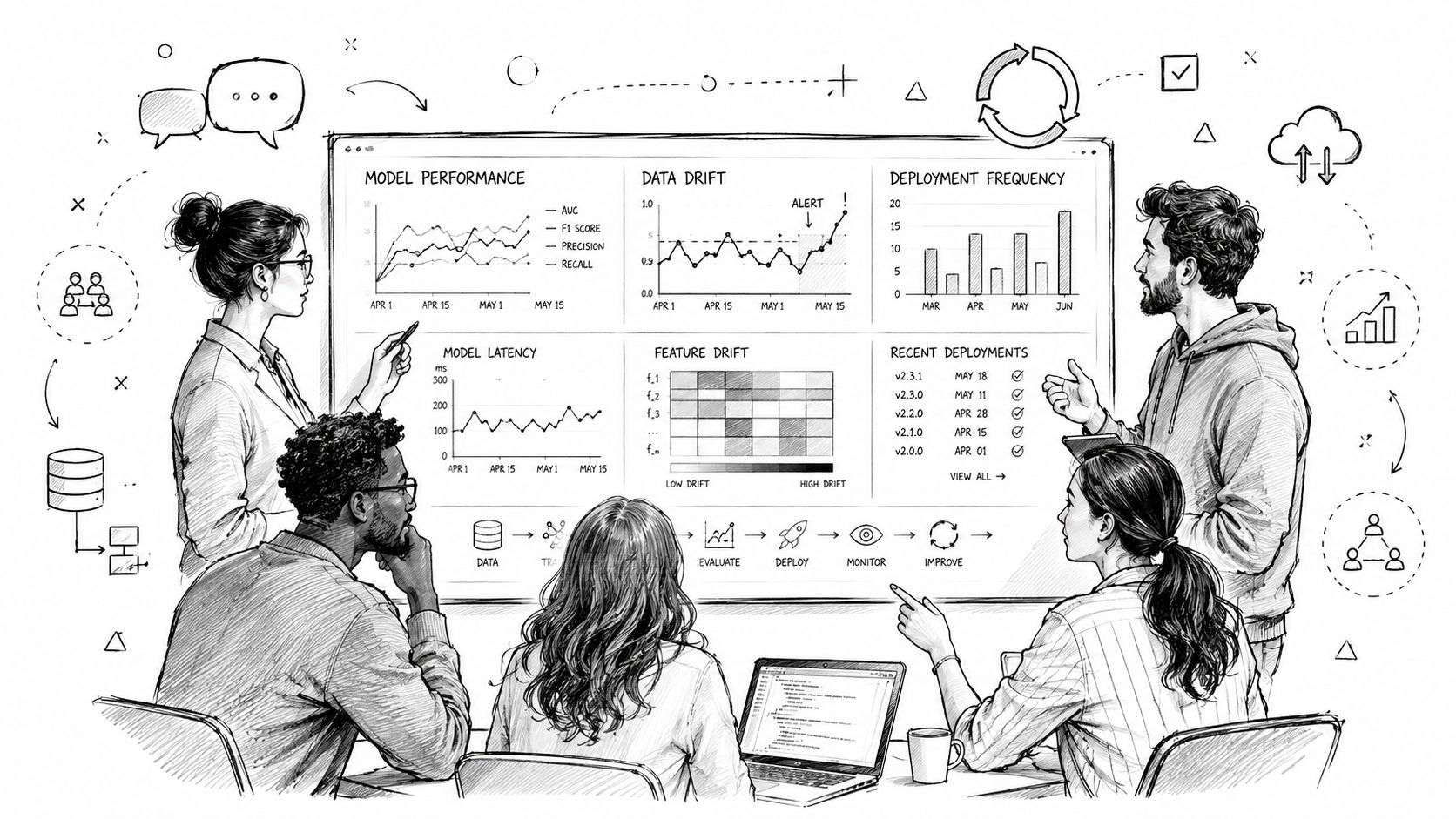
Version everything that can change
Versioning only the model file isn't enough. You need lineage across code, training data, feature logic, parameters, and deployment configuration.
Without that, every incident turns into archaeology. The team can't answer basic questions like which data snapshot produced the active model or what changed between the current release and the last good one.
Track these leadership metrics:
- Deployment frequency for models: How often can the team ship a safe update?
- Rollback readiness: Can you return to the last known good version cleanly?
- Reproducibility rate: When an issue appears, can the team recreate the training context?
Test more than model accuracy
Offline accuracy is not the release gate. A production model can pass an evaluation notebook and still fail in obvious ways once real inputs arrive.
Rigorous MLOps benchmarking requires protocols such as 5- or 10-fold cross-validation, along with separation between hyperparameter tuning and performance estimation. Failing to do that leads to irreproducible results, while significance testing supports evidence-based model selection in automated workflows, as outlined in the MLOps benchmarking guidance from UT Austin course materials.
A practical test suite usually includes:
- Data tests: Schema checks, missing value rules, distribution checks
- Model tests: Acceptance thresholds, calibration checks, bias review where relevant
- Service tests: Endpoint contract tests, dependency health, latency budgets
- Pipeline tests: Can training, registration, and deployment run end to end without manual fixes?
If your team is tightening release discipline around AI systems, this guide to mastering AI quality assurance is a useful complement to pure model evaluation thinking.
Monitor what users actually experience
Monitoring is where abstract MLOps theory becomes operational reality.
Typically, the first dashboard should answer four questions:
| Question | Why it matters |
|---|---|
| Is the service up? | Broken endpoints stop business workflows immediately |
| Are predictions arriving on time? | Slow responses make good models unusable |
| Has the input data changed? | Drift can quietly invalidate model assumptions |
| Is model behavior still acceptable? | Quality decay hurts trust before outages appear |
"If you only monitor infrastructure, you're watching the container stay healthy while the model gets worse."
A dedicated stack for observability helps once more than one model is in production. This overview of AI observability platforms is a practical place to compare how teams instrument model health beyond standard application logs.
Three Common MLOps Pitfalls to Avoid
The expensive mistakes in MLOps are rarely dramatic. They look reasonable at first. That's why teams repeat them.
The data science silo
A common failure mode starts with good intentions. The data science team builds the model, then hands it to platform or backend engineers "for productionization."
That handoff creates gaps immediately. The engineers receiving it often don't have the original assumptions, feature logic, or evaluation context. The model enters production as a software artifact, not as a living system with data dependencies.
The fix is structural. Put ML engineers, data scientists, and platform engineers in one delivery path with shared release criteria. Don't treat MLOps as the last mile.
Deployment-only thinking
Some teams celebrate the first production release and assume they've crossed the hard part. They haven't. They've only moved the risk.
In fraud scoring, for example, the pipeline must score every payment in milliseconds and return an action such as approve, verify, or block, as described in this production fraud scoring example. A notebook can prove the model concept. It can't satisfy that operational requirement by itself.
The model isn't done when it returns a prediction. It's done when it returns the right prediction fast enough, every time the business needs it.
When teams underinvest in monitoring, they discover problems from support tickets, chargebacks, or conversion drops. That's too late.
The wrong abstraction level
Leadership teams often swing to one of two extremes:
- Build too much yourself: You spend months creating internal tooling before proving one production use case.
- Buy a rigid platform: You inherit workflows that don't fit your team, data shape, or release process.
The practical answer usually sits in the middle. Buy commodity layers where your team gains little from custom development. Build only where the workflow creates differentiation, governance needs, or integration requirements specific to your product.
A simple decision test helps. If the capability is standard, boring, and hard to maintain well, prefer managed infrastructure. If it encodes business logic or approval flow unique to your company, own it.
How to Staff and Resource Your MLOps Team
The staffing question usually arrives before the architecture is fully settled. That's normal. Leadership needs to decide who owns the work before the pipeline exists.
The right team shape depends on urgency, internal maturity, and how much platform ownership you want to keep.
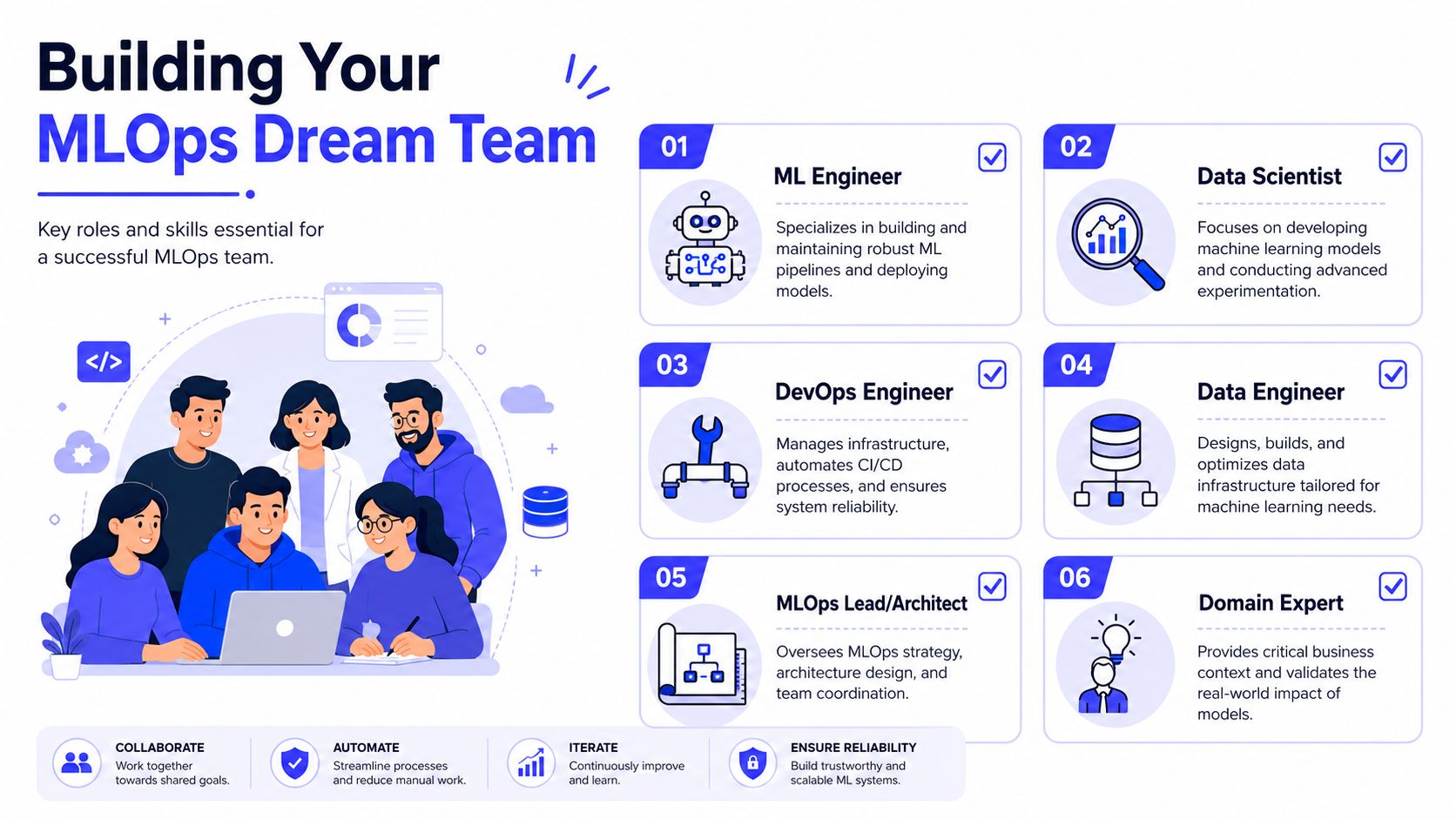
Three staffing models
| Model | Best fit | Strengths | Limits |
|---|---|---|---|
| Hire a dedicated MLOps engineer | You expect ongoing model operations across products | Clear ownership, durable systems knowledge | Hiring can be slow and the role is hard to scope well |
| Upskill an existing ML or DevOps engineer | You have one immediate use case and strong internal talent | Fastest path to starting, lower coordination overhead | The person may be stretched across conflicting priorities |
| Partner with a specialist team | You need execution speed and proven patterns quickly | Faster setup, less trial and error, good for first production rollout | You still need an internal owner for decisions and adoption |
A simple leadership scorecard
Use this checklist before you choose.
- Urgency is high: If you need a production pilot soon, upskilling or partnering usually beats a long hiring cycle.
- Platform complexity is rising: If multiple models, environments, and compliance needs are coming, a dedicated MLOps owner becomes more valuable.
- Internal bandwidth is thin: If your best engineers are already overloaded, "we'll just absorb it" usually fails.
- You need stack guidance: A broad review of the best machine learning tools can help frame the build-versus-buy conversation, but someone still has to make those tools work together in your environment.
What I would do for a first initiative
For most startup and scale-up teams, I wouldn't begin by hiring a large platform group. I'd assign one internal engineering owner, one model owner, and bring in senior implementation support if the team hasn't shipped machine learning infrastructure before.
If you're evaluating talent options, it's useful to review what strong machine learning engineers bring beyond model building. The best hires understand deployment constraints, monitoring, and the discipline needed to operate AI systems after launch.
Your MLOps 90-Day Plan and What to Do Next
A first MLOps initiative should be narrow, useful, and hard to argue with. Don't try to platform the entire company in one motion.
Days 1 through 30
Choose one model with clear business value and a real path to production use. Good candidates are fraud checks, lead scoring, churn risk, document classification, or support routing.
Define the minimum viable operating path:
- source-controlled training code
- reproducible packaging
- validation gates before release
- one deployment target
- one monitoring dashboard
- one owner for incidents and retraining decisions
Days 31 through 60
Automate the path end to end for that model. Remove manual artifact passing. Record model versions. Add basic alerts. Make rollback boring.
Run one release through the full path, even if the first version is internal only. The goal isn't elegance. It's repeatability.
Days 61 through 90
Measure what changed.
Look at deployment friction, incident visibility, release confidence, and how quickly the team can make a safe update. Then decide what should become shared platform capability and what should stay embedded in the product team.
Execution advice: Your first MLOps win should prove that one model can move from experiment to reliable operation without relying on tribal knowledge.
The next three steps are straightforward:
- Pick the first production model.
- Decide who owns the pipeline and runtime.
- Scope the pilot before buying a full platform.
If you want to move from planning to execution, ThirstySprout can help you Start a Pilot with senior AI and MLOps talent who've shipped production systems. If you need help scoping the right team shape first, See Sample Profiles and map the roles you need before you commit.
Hire from the Top 1% Talent Network
Ready to accelerate your hiring or scale your company with our top-tier technical talent? Let's chat.