

An AI trainer is a human who improves models by reviewing outputs, correcting mistakes, and creating feedback data for reinforcement learning from human feedback. It's also not one narrow job. It's an umbrella role that spans annotation, evaluation, and red-teaming, and by the end of 2025 one industry report said more than 70,000 people globally were already working in AI trainer roles across 600+ organizations, with 283% growth in cross-border hiring in a single year (independent market report on AI trainer hiring).
That scale matters because many teams still ask the wrong question. They ask, “What is an AI trainer?” as if there's one standard job description.
There isn't.
For a CTO, the useful question is narrower. What kind of AI trainer does your workflow need, what judgment do they apply, and how will you measure their consistency before you scale their output into a model?
What an AI Trainer Actually Does
At the simplest level, an AI trainer helps a model learn better behavior.
A coach doesn't play the sport for the athlete. The coach watches, points out mistakes, sets drills, and reinforces good patterns. An AI trainer does something similar for a model. They review outputs, judge quality, correct failures, and create examples that become training or evaluation data.
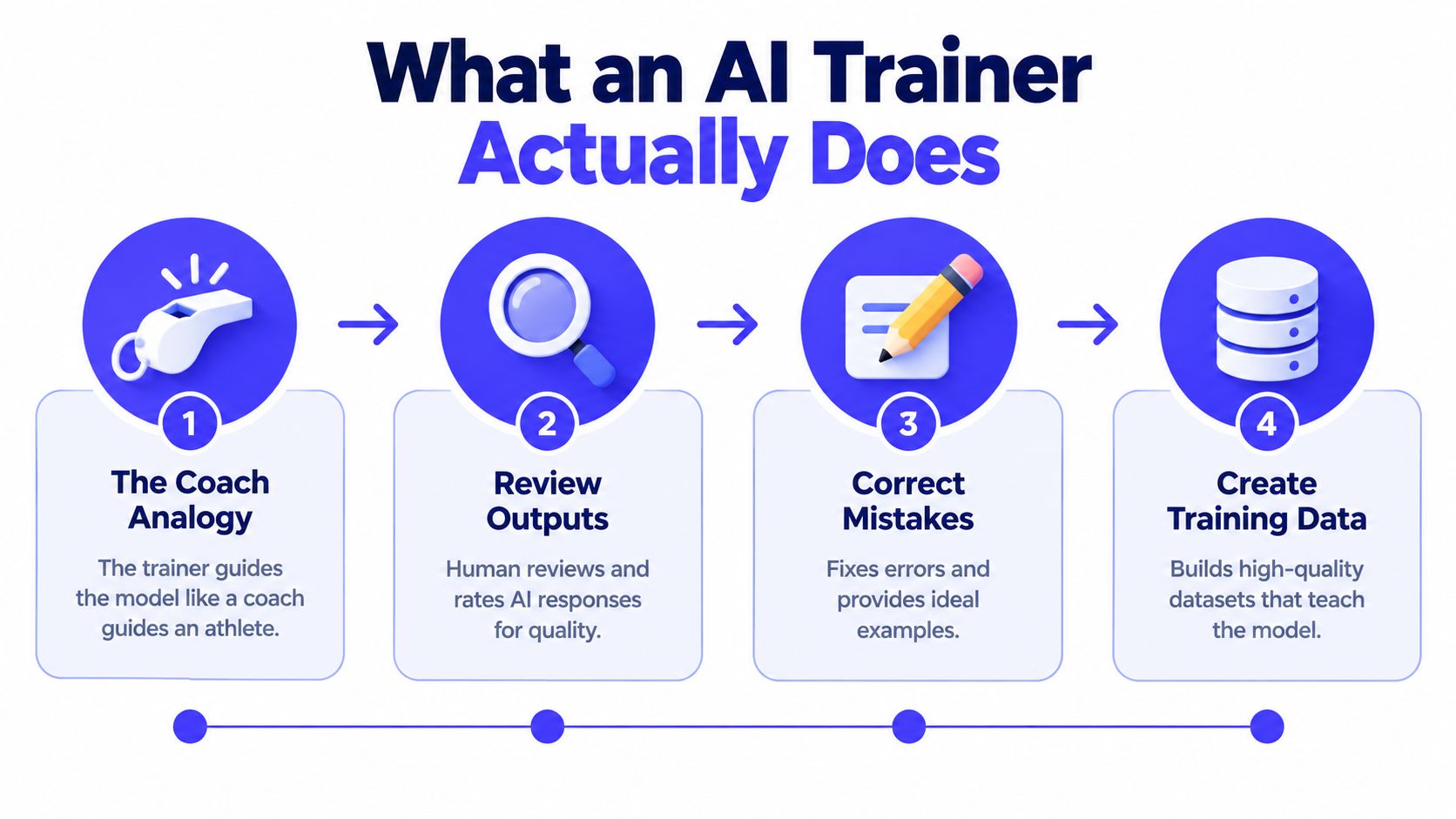
The short definition that actually helps
A practical definition is this: an AI trainer is a human who improves models through reviewing outputs, correcting mistakes, and creating examples or feedback data. That role became much more visible with large language models and reinforcement learning from human feedback, where human evaluators rank responses and guide model behavior (labor market guide to AI trainer roles).
That still sounds broad, because it is.
Some AI trainers label images. Some rank chatbot answers. Some test whether a model breaks policy. Some review support copilot answers against internal documentation. Some build benchmark sets that other raters use for calibration.
Practical rule: If the person's judgment will shape what the model learns, they're functioning as an AI trainer even if the title says rater, annotator, or evaluator.
Why the “teaches chatbots” description is too vague
The biggest hiring mistake is flattening this work into “someone who teaches chatbots.”
Industry guides describe AI trainer as an umbrella role across text, image, video, audio, and 3D sensor data, and the title varies by employer. You'll see AI rater, AI annotator, LLM trainer, chatbot trainer, and conversation designer used for related but different work (career guide covering AI trainer role variations).
That distinction changes your hiring plan.
If your model needs simple object labels, you need disciplined annotation. If your model needs nuanced helpfulness and safety ranking, you need people who can apply policy rubrics consistently. If your model answers legal or medical questions, you may need domain experts, not generalists.
A nearby role often confused with AI training is prompt engineering. If your team is still separating prompt design from supervised feedback work, this primer on what prompt engineering is helps draw that line cleanly.
Why human oversight exists at all
Human oversight isn't there to make the pipeline feel safer. It exists because teams need a way to reduce error risk and improve decision quality.
The OECD argues AI systems should include the capacity for human intervention and oversight so AI tools support humans rather than replace decision-making altogether (OECD guidance on human oversight in AI systems).
That's the operational reason AI trainers matter. They don't just “add labels.” They add judgment where model behavior is still ambiguous, brittle, or risky.
AI Trainer vs Related Roles You Might Hire Instead
If you're writing a job description, titles will mislead you fast.
Two candidates can both say they've done “AI training” while one mostly handled straightforward labeling and the other ran RLHF-style ranking against policy rubrics. Those are not interchangeable hires.
Which role do you actually need
| Role Title | Core Tasks | Judgment Level | Best For |
|---|---|---|---|
| AI Trainer | Reviews outputs, corrects mistakes, creates feedback data, may handle calibration and QA | Medium to high | Broad human-in-the-loop model improvement |
| AI Annotator | Applies predefined labels to data | Low to medium | Structured datasets with stable classes |
| AI Rater | Scores or ranks outputs against a rubric | Medium to high | LLM evaluation, preference data, safety reviews |
| Data Labeler | Tags raw examples for supervised learning | Low to medium | Volume labeling pipelines |
| LLM Trainer | Often focused on response ranking, red-teaming, and output refinement | High | Post-training for language models |
| Prompt Engineer | Designs prompts, workflows, and tool use patterns | Medium to high | Improving application behavior without retraining |
| ML Engineer | Builds training pipelines, models, and deployment systems | High, but technical not annotation-focused | Production model systems |
| Conversation Designer | Shapes dialogue flows, tone, and user interactions | Medium to high | Chatbot UX and structured conversational behavior |
Scope matters more than title
An AI annotator usually applies a known rubric to data. The task is often constrained. The main challenge is consistency and throughput.
An AI trainer may do that, but often goes further. They handle ambiguous outputs, compare model responses, write ideal answers, flag policy edge cases, and help refine the rubric itself.
An ML engineer sits in a different lane. They build the data pipeline, training jobs, evaluation harnesses, and production serving stack. They're not a substitute for the human judgment layer.
Don't hire an ML engineer when the bottleneck is rubric judgment. Don't hire a fleet of raters when the bottleneck is pipeline design.
A quick decision filter
Use this before you open a requisition:
- Choose data labelers when your categories are stable and examples are mostly objective.
- Choose AI raters or LLM trainers when outputs must be ranked for quality, safety, or policy compliance.
- Choose domain reviewers when correctness depends on expert knowledge, such as finance, healthcare, or legal operations.
- Choose prompt engineers when your fastest path is better application behavior, not new training data.
- Choose ML engineers when you already know what data you need and the issue is infrastructure.
A lot of budget waste comes from mixing these categories.
If the work is simple labeling, specialist rates are overkill. If the work requires nuanced judgment, cheap generalist labor can poison the dataset and cap model quality before your engineering team even notices.
How AI Training Workflows Run in Practice
AI training is often imagined as a single step. Collect labels, fine-tune the model, and move on.
That's not how the good programs work.
In practice, RLHF-style training behaves more like a managed quality pipeline with gates. One operational guide breaks the flow into spec, calibration, pilot, evaluation, and refresh, with weekly or release-based rubric updates rather than one-time instructions (RLHF data program workflow guide).
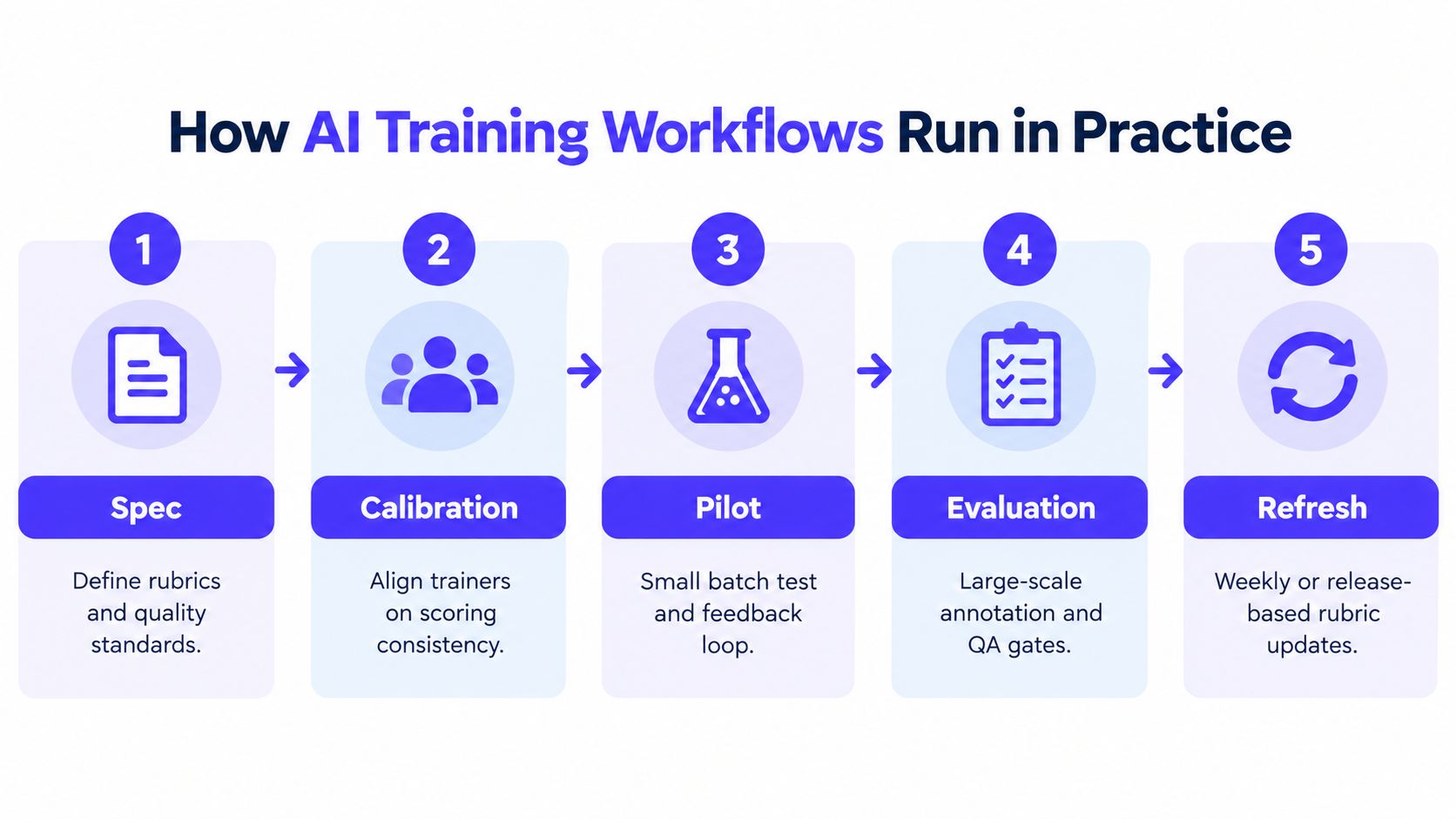
The five stages that keep data useful
Spec
Your team defines the task clearly. What are trainers judging. Helpfulness, truthfulness, policy adherence, tone, completeness, citation quality, or something else.Calibration
Trainers score the same examples and compare results. You discover whether the rubric is clear enough to survive scale.Pilot
Run a small batch first. Review disagreements, edge cases, and failure modes before sending more work downstream.Evaluation
Expand volume only after agreement is stable and QA catches systematic drift.Refresh
Update rubrics as model behavior, product requirements, or policy rules change.
Why RLHF changes the stakes
In reinforcement learning from human feedback, trainers often rank model outputs or score them against policy and helpfulness rubrics. Those judgments become preference data used for alignment. NIST describes RLHF as a form of model training where human involvement is indirectly used to fine-tune a model, and notes that it helps align large language models with human values and reduce unwanted behavior (NIST overview of RLHF in AI systems).
That means the annotation signal is not just metadata. It becomes the target.
If the judgment layer is sloppy, the model learns sloppy behavior.
Good AI training pipelines treat disagreement as a design signal, not just a worker problem.
A practical workflow example
Consider a support copilot that drafts account troubleshooting responses.
The spec might say:
- Primary objective: answer the user's issue correctly
- Secondary objective: follow internal support policy
- Fail conditions: invented steps, unsupported promises, unsafe account guidance
During calibration, trainers review the same responses and discuss edge cases like partial answers or correct answers with poor tone. The pilot exposes where policy wording is too fuzzy. Only then do you move into larger-scale scoring.
If you're deciding whether to rely on retrieval, fine-tuning, or both, this guide on fine-tuning an LLM is a useful counterpart because it helps place human feedback work in the broader post-training stack.
Some teams also need fast access to technical references while writing rubrics or review criteria. A practical option is Rivul AI scholarly index access, especially when reviewers need to pull source-backed material into evaluation workflows.
A short walkthrough can help make the workflow concrete:
Core Skills Tools and How to Measure Quality
Many teams get surprised. They assume the main quality metric is accuracy.
For AI trainer work, it usually isn't.
When multiple humans apply the same rubric to the same item, the useful question is whether they agree consistently. That's why supervised labeling and evaluation pipelines are typically measured with inter-annotator agreement, not raw accuracy. Common metrics include Cohen's Kappa and Krippendorff's Alpha. Kappa above 0.8 is usually treated as excellent, 0.6 to 0.8 as good, and below 0.6 is a warning that the guidelines or task design need revision (guide to agreement metrics in AI data labeling).
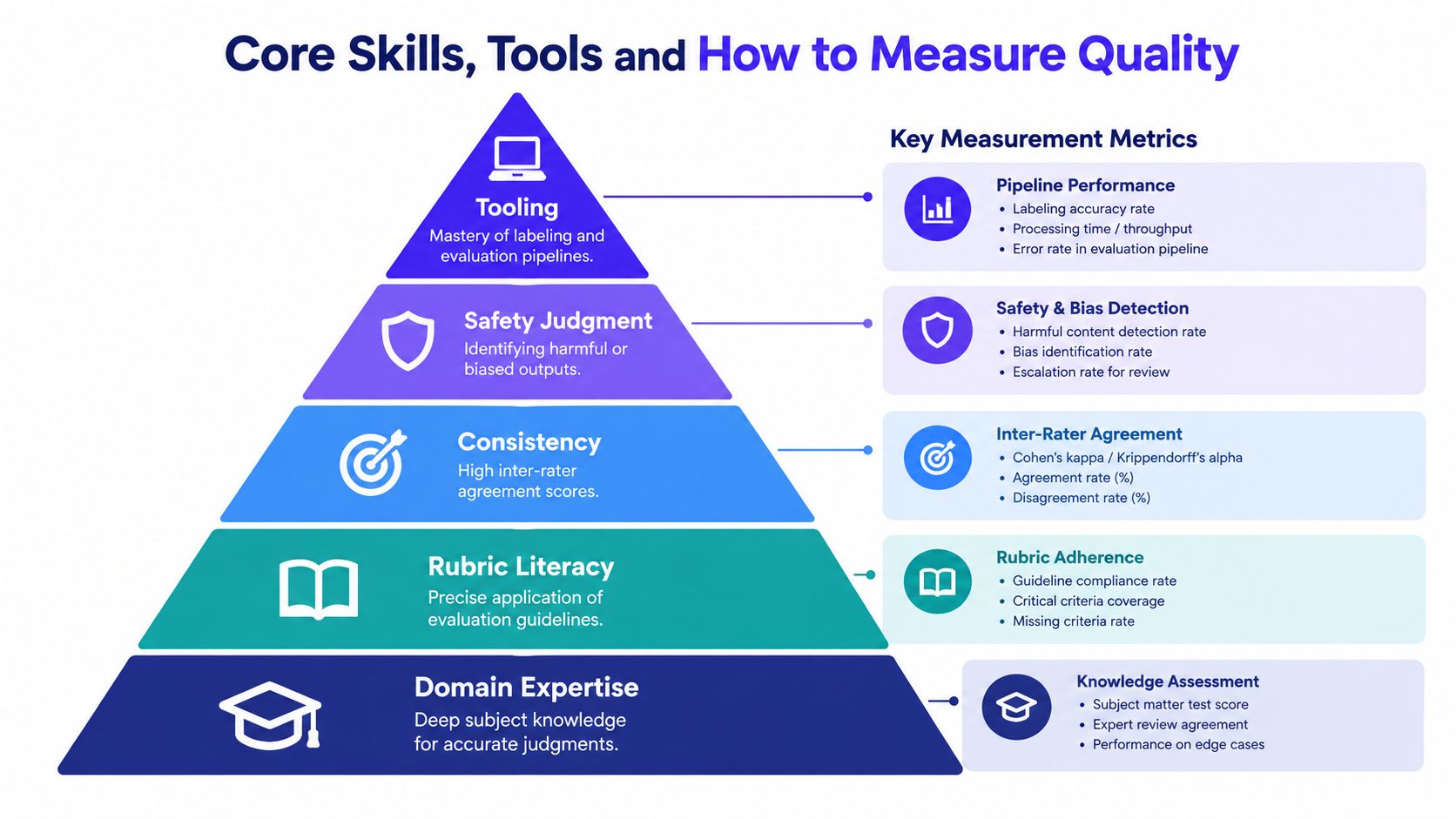
The skill matrix that actually matters
A strong AI trainer usually combines several abilities:
- Domain expertise: They know what a correct answer looks like in the context that matters to your business.
- Rubric literacy: They can apply the rule consistently, not just explain it back to you.
- Consistency under ambiguity: They keep their judgments stable across edge cases.
- Safety judgment: They can spot harmful, biased, or policy-breaking outputs.
- Tool fluency: They can work inside annotation, evaluation, and QA systems without creating process drag.
For many teams, the failure point isn't effort. It's rubric drift. Different reviewers apply different standards, and the model absorbs that conflict.
The measurement gates to set before scaling
For RLHF-style work, expert guidance recommends benchmark sets of roughly 100 to 500 verified items for annotator qualification, and production datasets often target agreement above 0.7 for moderately subjective tasks. Lower ranges may be workable only if adjudication and rubric refinement are already in place (practical guidance on annotating for RLHF and LLM evaluation).
That gives you a practical operating model:
| Quality Gate | What to Check | What It Tells You |
|---|---|---|
| Qualification set | Can reviewers match verified answers on a benchmark set | Whether they understand the task |
| Agreement check | Do reviewers score the same item similarly | Whether the rubric is stable |
| Adjudication review | Why do disagreements happen | Whether examples or policy wording need revision |
| Ongoing refresh | Are new edge cases emerging | Whether the dataset is drifting from production reality |
Hiring signal: Ask candidates to explain why two similar outputs should receive different scores. You're testing judgment, not speed.
Tools are secondary to rubric quality
Teams often over-focus on platforms.
The annotation UI matters. QA dashboards matter. Versioned rubrics matter. But no interface can rescue a vague task definition. If your reviewers can't tell whether “mostly correct” beats “fully correct but too verbose,” your data quality problem starts upstream.
That's why we like tying trainer work to a formal evaluation layer early. A useful companion is this AI agent evaluation framework, especially if your trainers are scoring outputs that later feed release decisions.
Real World Examples of AI Trainer Tasks and Outcomes
The easiest way to understand the role is to look at the work itself.
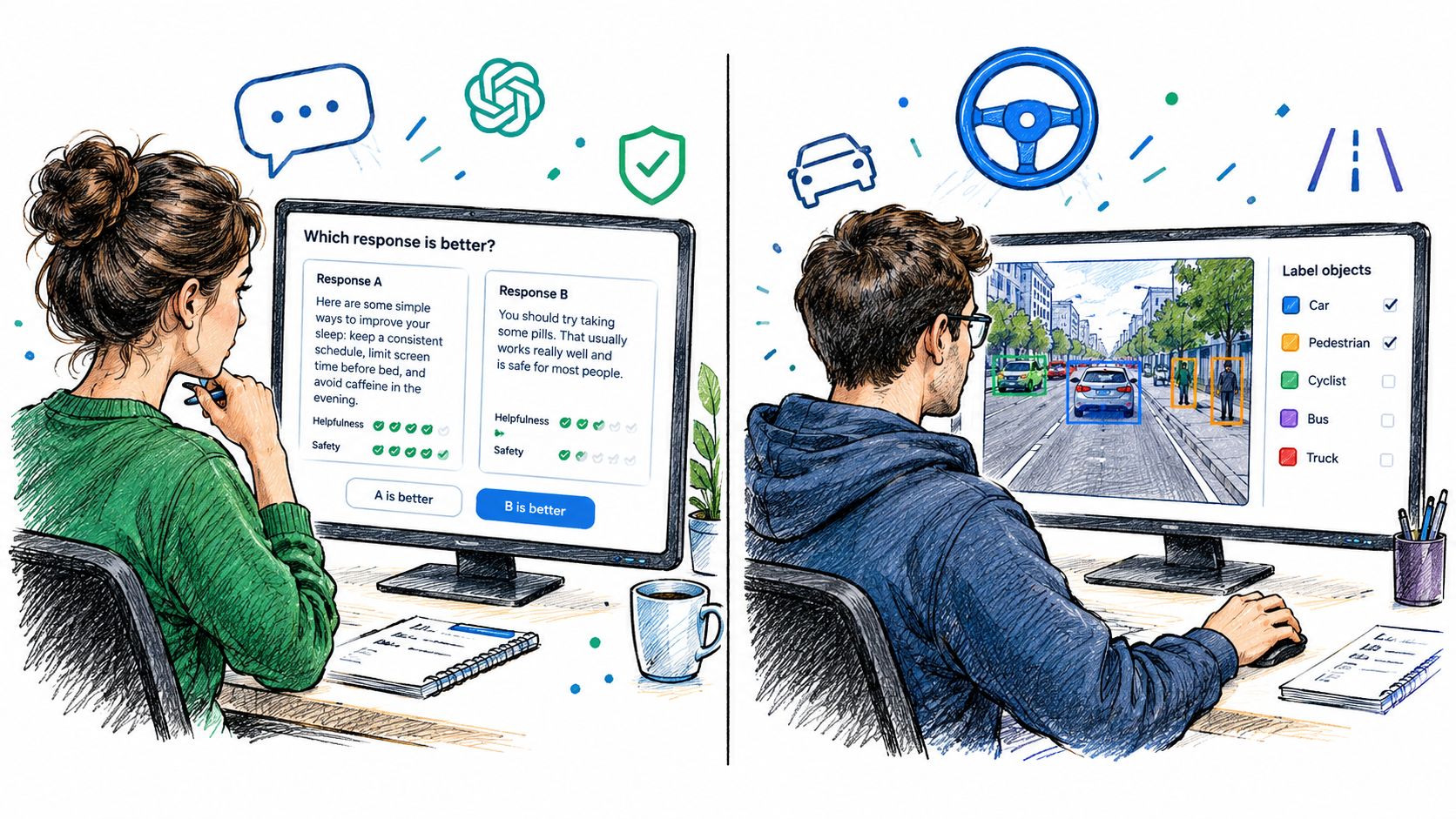
Example one: LLM helpfulness and safety evaluation
A product team is refining a general-purpose assistant.
They ask trainers to compare two model responses to the same prompt and rank which answer is better. The rubric includes helpfulness, factual restraint, policy compliance, and refusal quality for unsafe requests. Trainers also flag cases where both outputs fail.
A rubric snippet might look like this:
- Preferred answer: more helpful without violating policy
- Auto-fail: gives harmful instructions or presents uncertainty as fact
- Tie: both answers are equally safe and equally incomplete
The calibration challenge is subtle. One reviewer may reward warmth and detail. Another may prefer brevity. The team resolves that by scoring shared examples, discussing disagreements, and updating the rubric before they scale ranking work.
The outcome is not a magic number. The practical value is cleaner preference data for RLHF, fewer avoidable policy errors, and a clearer release gate for model behavior.
Example two: Support copilot quality review
A SaaS company deploys an internal support copilot connected to its help center and account policies.
Here, an AI trainer isn't just ranking outputs. They review drafted answers against source documents, correct unsupported claims, and write gold examples for tricky account scenarios. They may also label whether the answer should escalate to a human agent.
The fastest way to improve a support copilot is often not another model change. It's tightening the rubric for what counts as a usable answer.
A sample scorecard could include:
| Check | Pass Condition |
|---|---|
| Factual grounding | Response matches approved documentation |
| Actionability | User can follow the next step without guessing |
| Policy compliance | No promises outside support policy |
| Escalation judgment | Correctly hands off when issue is sensitive or unclear |
The business impact is straightforward. Better review data improves answer quality earlier, reduces time wasted on noisy labels, and gives support leaders a cleaner path to deciding what the assistant can safely automate.
These two cases look similar from a distance. Both involve “AI training.” In practice, one is preference ranking for model alignment and the other is domain-specific answer review tied to operational policy. You'd hire and manage those roles differently.
Hiring Playbook for AI Trainers
Hiring demand rose much faster than role clarity. One labor market guide notes that the U.S. Bureau of Labor Statistics does not yet track “AI trainer” as a standalone occupation, while industry estimates put global AI training roles at more than 300,000 people, up sharply from 2022, with a workforce spread across multiple countries (AI trainer labor market guide). For a CTO, that explains the confusion. “AI trainer” is often a bucket label for several different quality functions.
Start by deciding what kind of judgment your system is missing.
A useful way to frame the role is as a quality pipeline, not a single hire. Some teams need people who can apply a stable rubric at volume. Others need subject matter experts who can catch subtle errors, write better guidelines, and resolve disagreement. If you hire from the title alone, you often get the wrong shape of judgment.
Decide which trainer type you actually need
Use this simple matrix before you write a job description:
| If your workflow depends on... | Hire first | Why |
|---|---|---|
| High-volume labeling with clear rules | Generalist AI trainer | Good fit for repeatable annotation and standard QA |
| Ranking responses for helpfulness, safety, or style | RLHF or evaluator-style trainer | Better for preference judgments and edge-case comparison |
| Reviewing answers against policy or source docs | Domain QA trainer | Strong fit for grounded review and escalation decisions |
| Correctness in regulated or technical domains | Specialist reviewer | Needed where expert interpretation changes the label |
This saves time because each type should be screened differently. A generalist needs consistency and comfort with annotation tools. A specialist needs domain judgment plus discipline in following a rubric even when they disagree with it.
Interview for judgment, not just speed
A strong hiring loop tests three things.
Can they apply a rubric consistently?
Give two or three sample outputs and ask for a score with a short written reason.Can they handle ambiguity without making up rules?
Include one edge case where the guidance is incomplete. Good candidates flag the ambiguity, explain the risk, and suggest an escalation path.Can they improve the system?
Ask what in the rubric would cause disagreement between reviewers. That answer often matters more than raw labeling speed.
A short take-home works well here. Use a small gold set, an answer key, and one disputed item. You are testing whether the candidate can produce stable judgment that another trained reviewer would repeat.
Measure quality before you scale headcount
This is the part teams skip.
Do not judge trainers only by throughput. Judge them by agreement. If two qualified reviewers score the same item differently, the problem may be the person, the rubric, or the task design. Until you know which one, adding more reviewers only gives you more noisy data.
Use a basic scorecard during the pilot:
- Agreement with gold set: How often does the trainer match verified labels
- Inter-rater agreement: How often do trained reviewers agree on the same items
- Escalation rate: Are they spotting unclear cases or forcing low-confidence decisions
- Reason quality: Can another reviewer follow the written rationale
If agreement is weak, pause and fix the instructions. An AI training pipeline works like quality control on a factory line. If the gauge is off, producing more parts does not help.
Budget and sourcing reality
Pay varies because the work varies. Reporting on AI trainer job listings and pay ranges shows a wide spread, along with an international hiring base that already includes substantial remote participation (AI trainer pay and hiring market report).
That spread is useful. It tells you general annotation, preference evaluation, and expert review should not sit in the same budget bucket.
For sourcing, teams usually mix direct hiring, annotation vendors, independent expert networks, and talent partners. ThirstySprout is one option when trainer work needs to connect closely with engineering, ML, data, or evaluation hiring, especially for remote teams.
A practical onboarding plan for the first month
The first weeks should look more like calibration than production.
Week 1: teach the rubric, walk through gold examples, and explain why certain edge cases fail.
Week 2: assign overlapping work so leads can compare decisions across reviewers.
Week 3: review disagreements, tighten wording in the rubric, and remove labels that collapse multiple judgments into one.
Week 4: increase volume only if agreement is holding at an acceptable level for the use case.
A trainer who works fast but applies the wrong standard is expensive. A slower trainer with high agreement is often more valuable early, because they help you build a pipeline you can trust.
What to Do Next to Build Your Training Capability
If you came here asking what is an AI trainer, the short answer is now clear. It's a human quality role inside the model improvement loop. The more useful answer is that you probably don't need a generic “AI trainer.” You need the right trainer type for the kind of judgment your workflow depends on.
A simple three-step plan
Scope one use case clearly
Pick a narrow workflow first. Support answer review, safety ranking, retrieval answer checking, or domain QA.Run a calibrated pilot
Build a gold set of 100 to 500 verified items and qualify reviewers against it, using the benchmark guidance covered earlier in this article.Measure agreement before scale
Check whether raters are applying the rubric consistently. If agreement is weak, fix the task design before generating more data.
A lightweight checklist
- Task defined: Can a reviewer explain what a good answer is
- Rubric tested: Have multiple reviewers scored the same examples
- Gold set ready: Do you have verified items for qualification
- Escalation path set: Who resolves disagreement
- Refresh cycle planned: When will you update the rubric after release
Start with one workflow where better human judgment will clearly improve quality. That's usually enough to expose whether you need generalist labeling, expert review, or a full RLHF-style pipeline.
If you want a clean next step, build a one-page pilot brief. Include the task, rubric, gold examples, disagreement rules, and the business decision this data will support. That document will sharpen hiring, tooling, and budget decisions faster than another abstract AI strategy deck.
If you need help turning this into an operating plan, ThirstySprout helps companies assemble remote AI teams that can cover model evaluation, data workflows, and production engineering around the same use case. If you're scoping an AI trainer hire or a broader human-in-the-loop pipeline, start a pilot or see sample profiles so you can move from definition to execution within a few weeks.
Hire from the Top 1% Talent Network
Ready to accelerate your hiring or scale your company with our top-tier technical talent? Let's chat.