

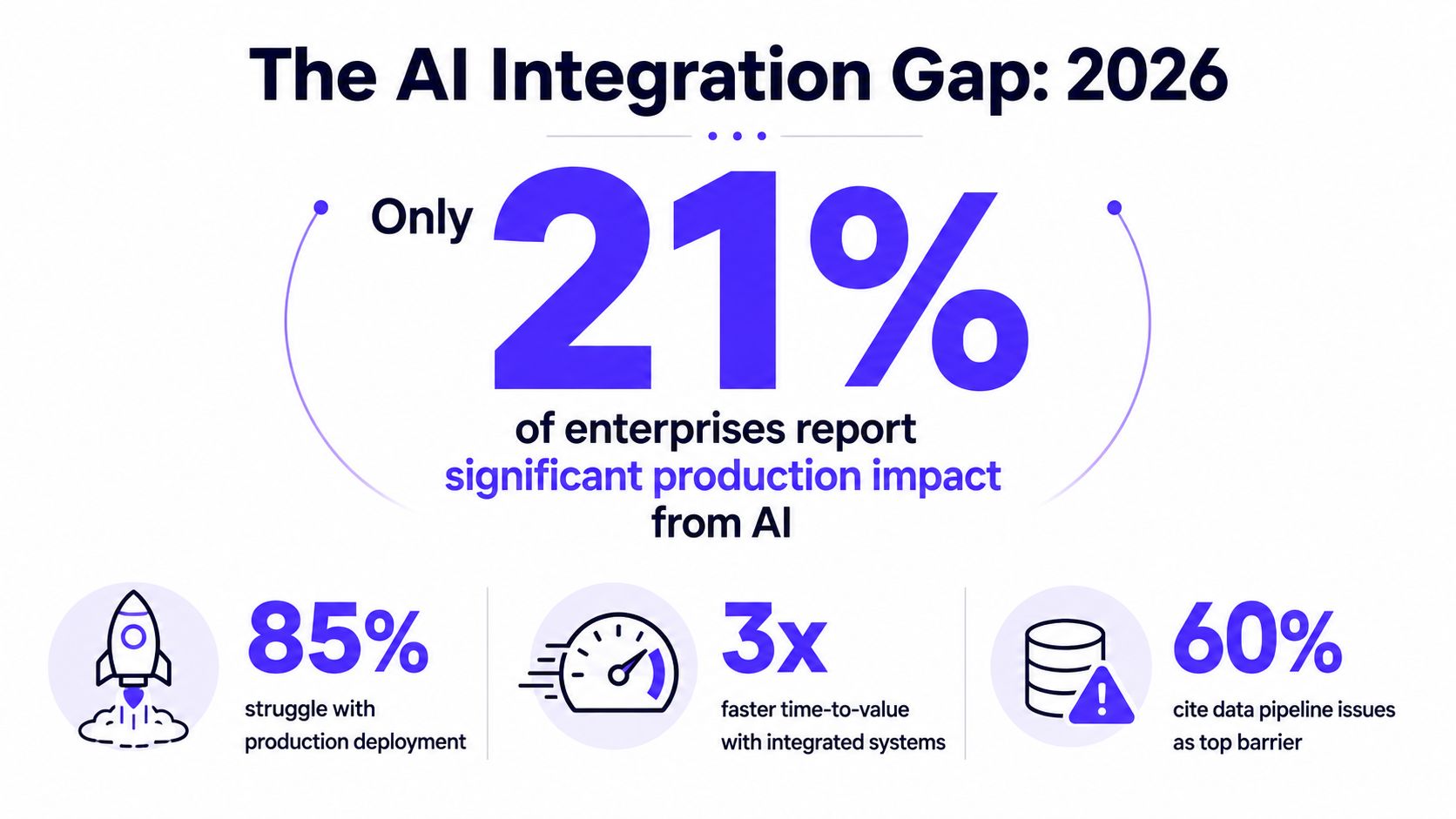
88% of organizations use AI in at least one business function, yet only 39% report enterprise-level EBIT impact. AI integration is the operational work that closes that gap by connecting models to data, software, governance, and the people responsible for outcomes.
That distinction matters because buying access to a model is easy. Shipping a dependable feature is not. A production system needs clean inputs, controlled permissions, reliable model serving, application logic, human review, monitoring, and an owner who can respond when quality or cost moves in the wrong direction.
This guide answers what is AI integration from a practitioner's perspective. It focuses on the architecture, patterns, team design, roadmap, and metrics required to move beyond an impressive demo.
What AI Integration Actually Means in 2026
AI adoption means people use an AI tool. AI development means a team trains, fine-tunes, evaluates, or selects a model. AI integration means embedding that model into a working business process so it can reliably produce a controlled outcome.
The distinction shows up in the data. McKinsey-reported survey results indicate that 88% of organizations use AI in at least one business function and 72% use generative AI, while only 25% report moving 40% or more of their AI experiments into production (State of Enterprise AI Adoption 2026). The same source reports that 23% are already scaling agentic systems, which points to a shift from one-off content generation toward repeated actions inside business workflows.
A separate McKinsey report places the business-value gap in sharper terms. Although 88% of organizations reported AI use, only 39% reported enterprise-level EBIT impact (McKinsey State of AI). Adoption tells you that a capability is available. Integration tells you whether that capability changes revenue, margin, productivity, service quality, or risk.
Ask yourself: If the model disappeared tomorrow, which business process would stop working, and who would notice first?
That question exposes weak integration. A chatbot that employees visit occasionally is an adopted tool. A support copilot that retrieves approved policy content, appears inside Zendesk, drafts a response, records confidence, routes uncertain cases to a person, and feeds quality data back into evaluation is an integrated system.
AI integration usually connects:
- Data pipelines, which collect, transform, authorize, and refresh information.
- Model services, which handle inference, versioning, fallbacks, and capacity.
- Business applications, which turn predictions or generations into user-visible actions.
- Governance controls, which manage privacy, permissions, review, auditability, and cost.
- Operating teams, which define quality thresholds and own incidents.
European and OECD data show why this operational discipline matters. In 2025, 19.95% of EU enterprises with 10 or more employees used at least one AI technology, compared with 13.48% in 2024, while OECD firms reporting AI use reached 20.2% in 2025 after starting at 8.7% in 2023 (Global AI Adoption Index 2026). EU large enterprises reported 55% AI use versus 17% for small enterprises, a difference connected to data maturity, skills, compliance capacity, and deployment discipline.
For a practical view of the transition from experimentation to connected agent workflows, the HappyRobot agent implementation guide is useful because it treats implementation as a workflow and systems problem rather than a model-selection exercise.
The Four Layers of an AI Integration Architecture
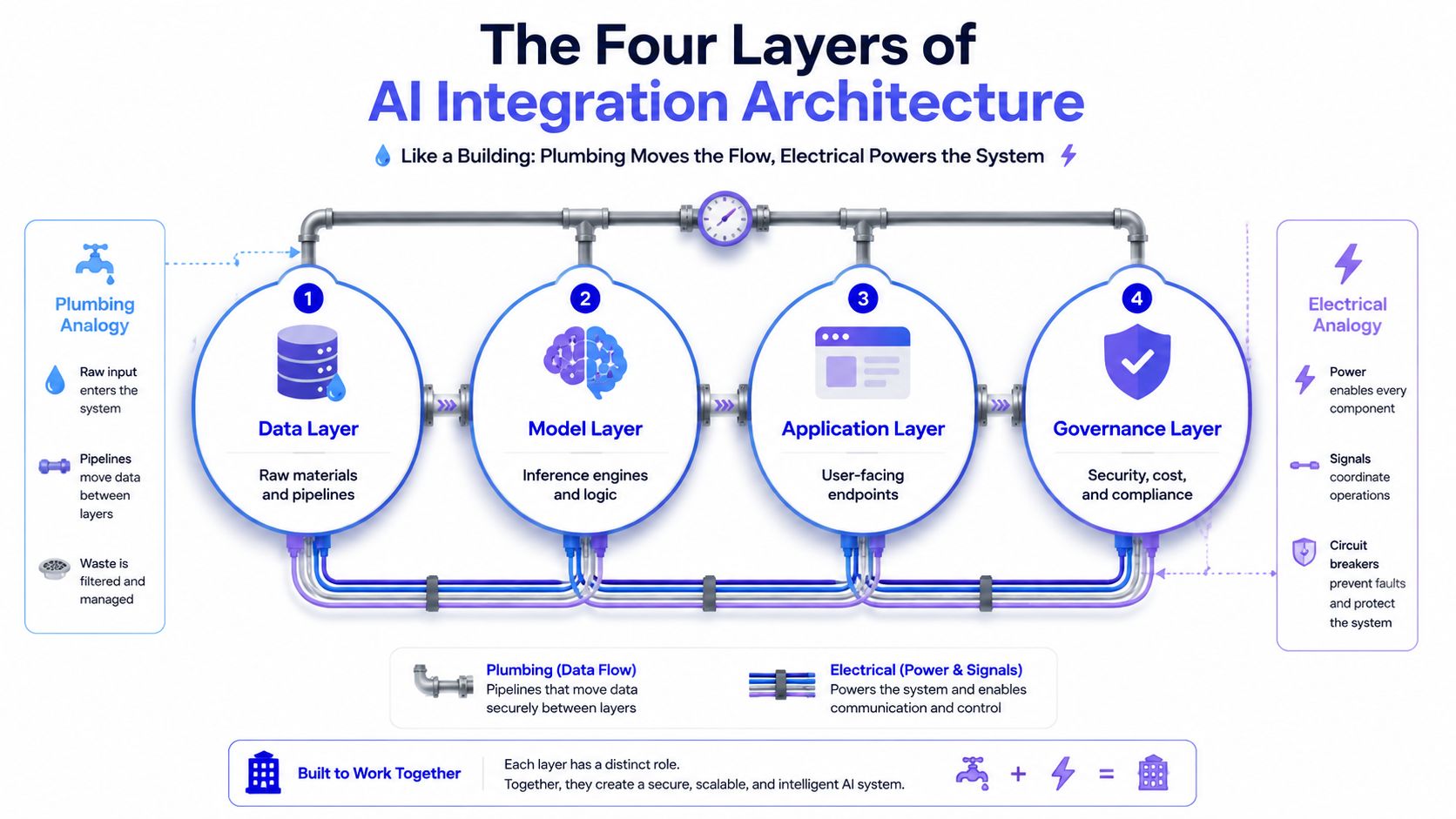
An effective AI integration rests on four layers: data, model service, application, and governance. Each layer has a separate operational responsibility, and a production failure in one can undermine the others.
The data foundation
The data layer handles ingestion, storage, transformation, access rules, freshness, and quality checks. It may include a warehouse, event stream, document store, feature store, or vector index.
Weak data handling gives the model stale, incomplete, duplicated, or unauthorized context. A retrieval-augmented generation system can produce a fluent answer that cites the wrong policy because its index was not refreshed or document permissions were not preserved.
The model service
The model layer handles inference through the selected model, prompt or feature contracts, versioning, routing, fallbacks, and evaluation hooks.
A team might call a hosted model through a REST API, deploy an open model behind an internal service, or run a smaller model near the device. The choice depends on sensitivity, latency, control, and operating capacity. A model that performs well in a notebook can fail in production when requests queue, a provider changes behavior, or an untracked version reduces output quality.
The application and API surface
The application layer converts model output into a business action. It defines endpoints, authentication, workflow rules, retries, user interfaces, approval steps, and downstream writes.
A recommendation can become a ticket draft, a forecast can become a billing adjustment, and an extraction result can populate a customer record. Application controls determine whether useful output reaches a workflow and whether a person must approve an action before it changes another system.
Governance and observability
The governance layer covers inventory, privacy, security, cost controls, evaluation, audit trails, and ongoing monitoring. The NIST AI Risk Management Framework guidance describes policies for AI system inventories, data quality and privacy controls, human-AI teaming configurations, and independent monitoring of pre-trained models over time.
Without these controls, an operating team cannot answer basic questions: which model produced an answer, what data it received, whether a person approved the action, or how much the workflow costs.
Architecture choices also affect ownership. Microservice-based serving gives multiple applications a shared inference boundary, centralized controls, and independent deployment. Embedded serving can reduce network calls and simplify a local or latency-sensitive feature, but it increases coupling and distributes responsibility for updates. Apply the same design discipline used elsewhere in software architecture best practices.
The complete guide to AI pipelines provides background on connecting data, model, and workflow steps.
Four Integration Patterns Every Team Should Know
Most production AI features use one of four integration shapes. Choosing the right one depends on the workflow, data, latency requirement, and consequence of an incorrect result, rather than model popularity. The pattern determines how much control the team retains and how much operational work it inherits.
Direct calls to hosted models
The application sends a prompt or structured request to a hosted model API and receives a response. This pattern fits summarization, classification, drafting, and extraction when the input can safely leave your environment and the application can tolerate provider dependency.
A recruiting platform might send a job description and candidate notes to a hosted model that produces a structured interview guide. Use this pattern when time to value matters more than model-level control. The team still needs request limits, failure handling, logging, and a review path for low-confidence outputs.
Embedded or on-device models
The model runs inside your infrastructure, service, desktop application, or device. This approach suits sensitive data, offline workflows, predictable latency, or environments where external calls create unacceptable exposure.
A manufacturing inspection device might run a compact vision model locally and send only approved events to a central system. The trade-off is operational ownership. Your team manages model packaging, hardware constraints, upgrades, and performance. Smaller models can reduce network dependence while making accuracy and maintenance more dependent on the deployment environment.
Retrieval-augmented generation pipelines
A retrieval-augmented generation, or RAG, pipeline retrieves relevant internal documents before asking a model to generate an answer. The flow usually looks like this:
- Ingest and normalize source documents.
- Split content into retrievable units.
- Create and store representations in a search system.
- Retrieve candidates for a user question.
- Generate an answer grounded in the retrieved context.
- Return citations, confidence signals, or a human-review route.
Use RAG when answers depend on changing private information and retraining would be too slow or inflexible. A support assistant connected to approved product documentation is a natural fit. Retrieval quality becomes part of application quality, so teams must handle stale documents, missing permissions, weak matches, and conflicting sources.
Agentic workflows with tool use
An agentic workflow lets a model choose among tools, maintain task state, and execute a sequence of actions. A collections assistant might inspect an account, check an approved policy, draft an outreach message, and request approval before sending it.
Choose this pattern when the task requires multiple steps or tools. Agents provide flexibility, but they also expand the permission surface, testing burden, and failure modes. A deterministic workflow with one model call is easier to control whenever it meets the requirement. Tool access should be narrow, observable, and reversible where possible.
| Pattern | Best for | Cost posture | Time to value |
|---|---|---|---|
| Hosted model API | Drafting, extraction, classification | Variable usage cost and provider dependency | Fast |
| Embedded model | Sensitive, offline, or latency-sensitive tasks | Higher platform ownership | Moderate |
| RAG pipeline | Private, changing knowledge | Search and indexing overhead plus inference cost | Moderate |
| Agentic workflow | Multi-step work across approved tools | Highest orchestration and governance burden | Slower |
Keep the boundaries explicit. The principles of pattern design apply here because a clear integration pattern reduces accidental coupling between business rules and model behavior.
Practical rule: Start with the least complex pattern that meets the workflow's needs. Add retrieval, tools, or autonomous planning only when a simpler design fails a defined requirement. Integration experience shows whether an engineer can make a model safe and useful inside a system other people depend on.
Two Production Mini-Cases Worth Studying
The following examples are illustrative production-shaped cases, not measured customer case studies. Their value is the decision logic: baseline, intervention, ownership, and a gate for moving beyond a pilot.
Case one, a support copilot inside Zendesk
A fintech support team handled customer questions in Zendesk and relied on internal policy documents spread across a knowledge base. The baseline problem was manual lookup and inconsistent drafting. Agents could find the answer, but the process depended heavily on individual familiarity with policy language.
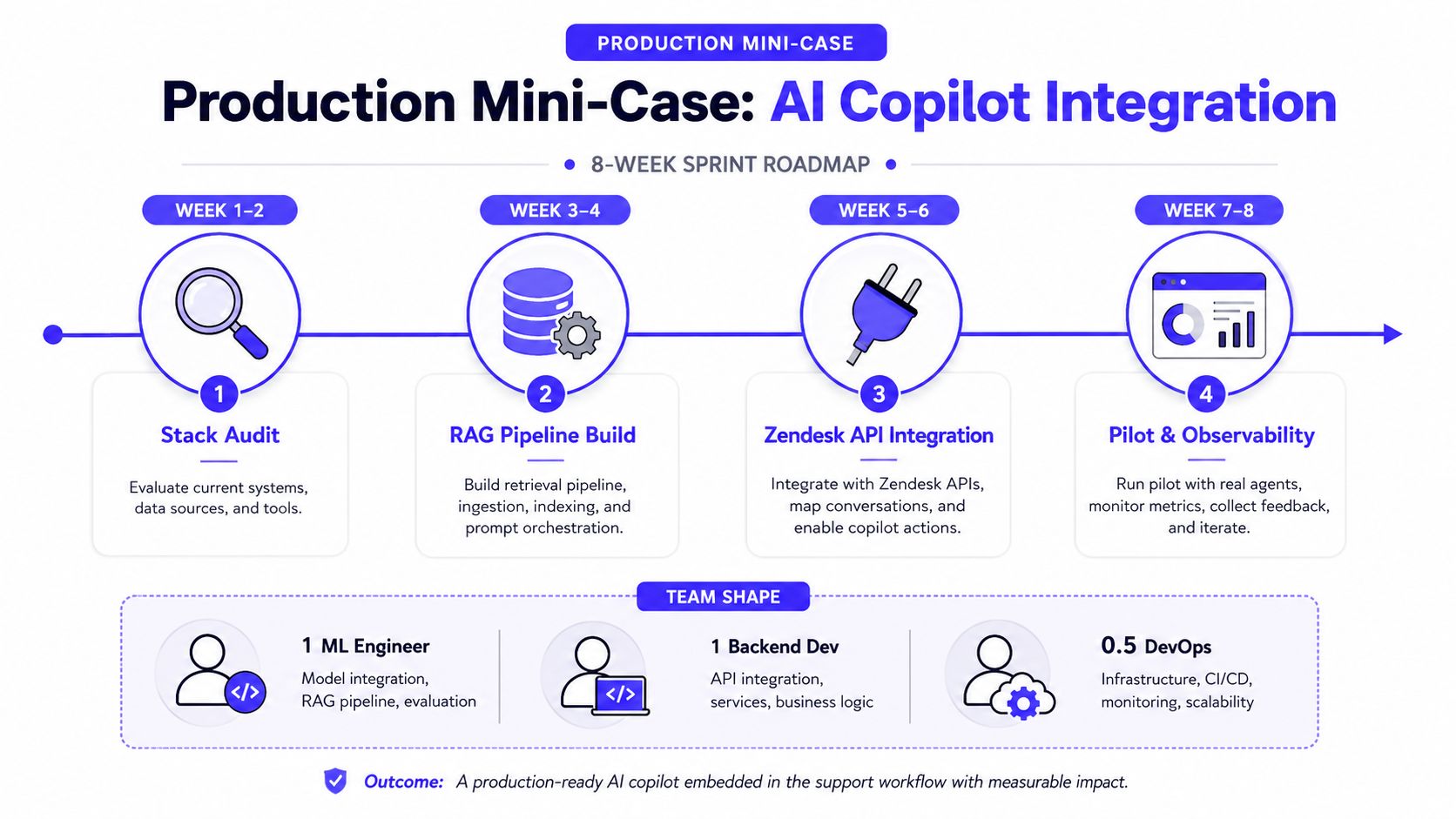
The team chose a RAG pipeline rather than fine-tuning. A backend engineer connected the Zendesk API, an ML engineer built document ingestion and retrieval, and a fractional DevOps contributor added deployment and monitoring. The pilot used an 8-week sequence:
- Weeks 1–2: Audit Zendesk fields, source documents, permissions, and unresolved ticket categories.
- Weeks 3–4: Build document normalization, retrieval, answer generation, and citation handling.
- Weeks 5–6: Add the Zendesk integration, draft-only behavior, feedback capture, and fallback paths.
- Weeks 7–8: Run a controlled pilot, review answers, and instrument quality and cost.
The team did not allow the assistant to send messages automatically. It drafted answers, displayed supporting documents, and routed uncertain cases to agents. The scale decision depended on answer quality, citation usefulness, agent acceptance, escalation behavior, and operating cost, not on the number of generated drafts.
Case two, forecasting inside a B2B billing system
A B2B SaaS company had a forecasting model that analysts ran separately from the billing system. The baseline issue wasn't merely prediction quality. Finance and revenue teams couldn't use the output consistently because the forecast lived outside the workflow that governed account activity.
The team introduced a feature store for reusable inputs and scheduled batch scoring. The billing system consumed versioned forecast outputs through an internal service, while a data engineer owned freshness checks and an ML engineer owned validation and drift review. The product manager defined how forecast changes would influence account planning rather than letting the model directly alter invoices.
The ROI review compared the old manual planning process with the integrated workflow across forecast usefulness, review time, exception handling, and downstream business decisions. The result was a go or no-go decision tied to operational adoption and decision quality, not a standalone model score.
Both cases share the same lesson: integration work becomes valuable when the output reaches the person or system responsible for the business result.
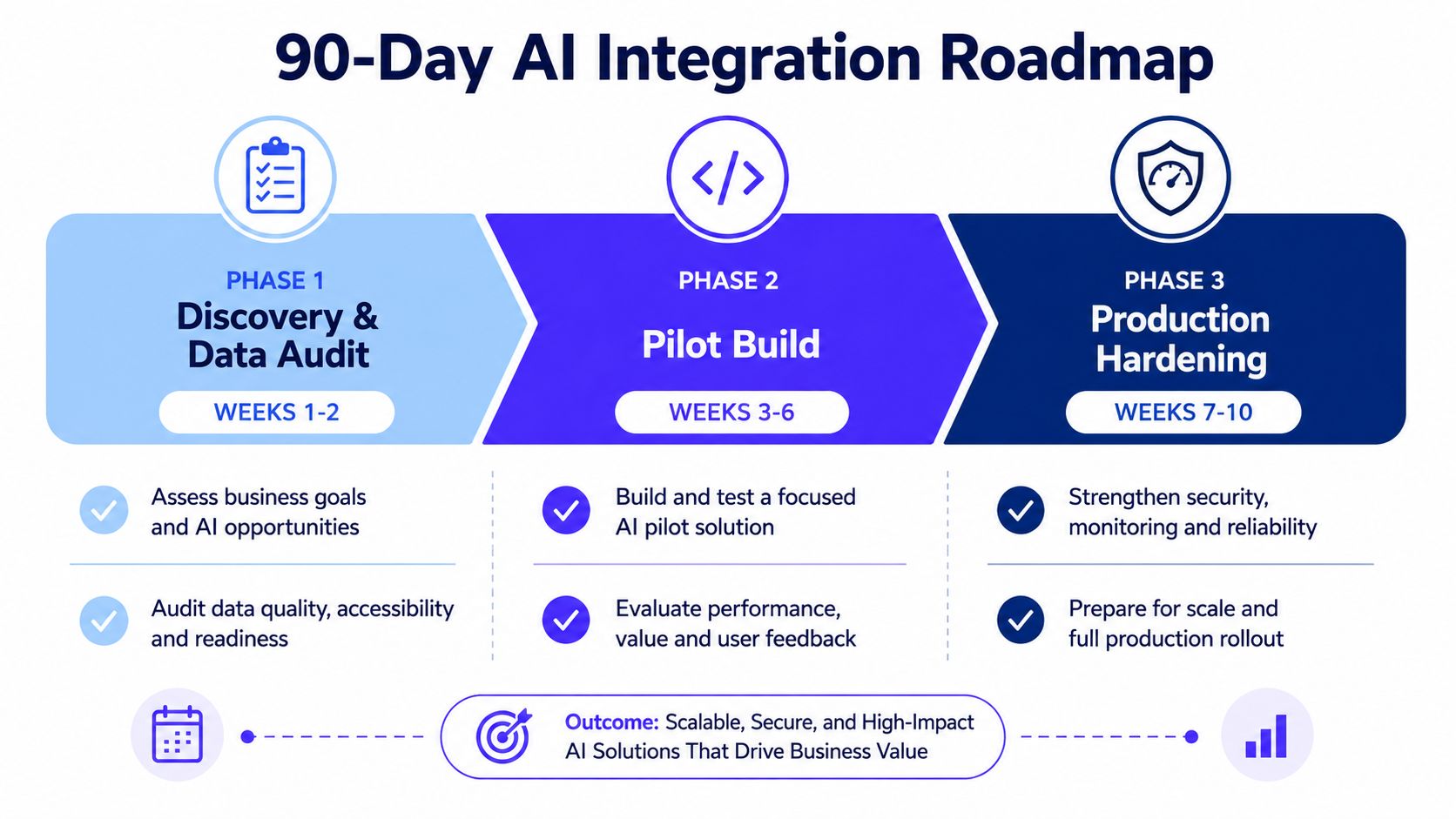
A 90-Day AI Integration Roadmap
A 90-day plan should produce a controlled production path, not a collection of experiments. Keep each phase tied to deliverables and an exit decision.
Weeks 1–2, discovery and data audit
Document the target workflow, current baseline, decision owner, data sources, permissions, and failure consequences. Inventory existing models, APIs, prompts, indexes, and manual review steps.
The output should include a one-page architecture sketch, a data-quality assessment, an initial risk register, and a success scorecard. Bring in a product owner, technical lead, data owner, and security or compliance reviewer as needed.
Exit when: the team can name the user, the business action, the source data, the fallback, and the metric that determines whether the feature deserves further investment.
Weeks 3–6, pilot build
Select one integration pattern and keep the scope narrow. Build the smallest end-to-end path from input to user or system action. Add structured logging, test fixtures, versioned prompts or features, and a human approval path before exposing the pilot to real work.
At this stage, hire or contract the missing implementation capability rather than creating a large permanent team prematurely. A senior ML engineer can often establish the evaluation and serving path while an existing backend engineer connects the business system.
Exit when: representative users can complete the target workflow, failures are visible, and the team has evidence about quality, latency, cost, and review effort.
Weeks 7–10, production hardening
Replace demo assumptions with operational controls. Add authentication, least-privilege permissions, rate handling, retries, fallback behavior, model and data versioning, monitoring, and incident ownership.
Run adversarial and edge-case tests. Review privacy boundaries and confirm that the system records enough context to reconstruct a questionable result. A production deployment guide, such as this YouTube Download API production deployment example, can help teams think through the difference between an API that works and an API that is operated.
Exit when: the service has an owner, an escalation path, observable failure states, and a rollback or disable mechanism.
Weeks 11–13, expansion and team planning
Review the scorecard with product, engineering, operations, and finance. Decide whether to expand the workflow, improve the current pattern, or stop. If the feature earns further investment, define the next data source, user group, or automation step.
Use the result to shape hiring. The next hire might be an MLOps engineer, data engineer, AI product manager, or application engineer, depending on the bottleneck rather than the model brand. The AI implementation roadmap provides another planning reference for sequencing this work.
Building the Team That Makes Integration Stick
The recurring bottleneck isn't access to a model. It's the ability to connect that model to reliable data, application logic, security controls, and a measurable workflow. Deloitte's 2026 enterprise AI report identifies the AI skills gap as the biggest barrier to integration, while the UK AI Labour Market Survey 2025 found that 97% of respondents identified at least one AI skills gap and 38% cited data management as a new key gap (Deloitte State of AI in the Enterprise).
Startup shape
A late-Seed startup usually needs a strong founding or senior software engineer who can own the application boundary, plus a fractional ML lead who can choose the pattern, define evaluation, and prevent a prototype from becoming an unmaintainable dependency.
A fractional specialist makes sense when the company has one clear pilot but lacks deep experience in model evaluation, retrieval, or deployment. Full-time hiring becomes more rational when multiple workflows share infrastructure and the team needs continuous ownership.
Series A and B shape
A scaling company often needs distinct ownership:
- ML engineer: model behavior, evaluation, inference logic, and feature quality.
- MLOps engineer: deployment, monitoring, automation, reliability, and model lifecycle controls.
- Data engineer: pipelines, contracts, lineage, freshness, and access boundaries.
- AI product manager: user problem, workflow adoption, quality thresholds, and business measurement.
Don't hire all four because an org chart says so. Hire against the constraint discovered during the pilot. If engineers spend most of their time repairing document ingestion, the first gap is data engineering. If releases are manual and failures are hard to detect, MLOps should come earlier.
Enterprise shape
Enterprises typically need a platform team that provides shared serving, evaluation, identity, observability, and governance capabilities. Product-aligned AI squads then build workflows against those capabilities, with domain owners accountable for business behavior.
A useful interview question is: “Tell me about an AI feature you shipped after the prototype. What broke in data, serving, permissions, or monitoring, and what did you change?” Strong candidates describe contracts, failure modes, ownership, and trade-offs. Candidates who only discuss prompts and benchmark quality haven't shown integration experience.
The hiring signal is not whether someone can call a model. It's whether they can make the model safe and useful inside a system other people depend on.
Remote teams need explicit handoffs between time zones, written runbooks, reproducible environments, and clear incident ownership. ThirstySprout connects companies with vetted AI engineers, ML, MLOps, data, and AI product specialists for full-time, contract, or fractional work. Treat that model as one staffing option alongside internal hiring and specialist consultancies.
Costs, Risks, and the Metrics That Prove It Works
Integration creates value, but it also creates operating costs. Hosted inference can make a pilot quick while introducing variable usage expense. Self-hosting can increase control while requiring more platform ownership. Agentic workflows can automate more steps while expanding permissions, testing needs, and the potential blast radius of a failure.
Scaling barriers reported in the World Quality Report 2025 include integration complexity at 64%, data privacy risks at 67%, and hallucination or reliability concerns at 60% (Capgemini generative AI research library). These risks are manageable only when teams connect controls to owners and measurements.
| Control | What to implement | Production metric |
|---|---|---|
| AI inventory | Record every model, workflow, provider, owner, data source, and permission scope | Inventory coverage and review status |
| Data quality and privacy | Validate freshness, schema, access, retention, and sensitive fields before inference | Data rejection rate and privacy incidents |
| Human-AI teaming | Define when a person must review, approve, edit, or override output | Human escalation rate and override rate |
| Model monitoring | Track quality, drift, latency, failures, and changes in pre-trained models | Drift rate and time to detect incidents |
| Cost control | Attribute inference, storage, retrieval, and review costs to the workflow | Cost per inference and cost per completed task |
| Reliability controls | Add fallbacks, retries, rate handling, and a disable mechanism | Successful completion rate and recovery time |
Start with a small scorecard. Measure whether the workflow completes, whether people trust the result enough to use it, whether reviewers catch unacceptable errors, and whether the cost fits the business case. Don't optimize token usage while users still abandon the feature or while source data remains untrustworthy.
Before launch, verify that you can answer these questions:
- Ownership: Who receives the alert and decides whether to disable the feature?
- Traceability: Can you identify the model, data, prompt, tool calls, and reviewer for a questionable result?
- Permissions: Can the system access only the records and actions required for its job?
- Fallback: Does the workflow degrade safely when the model, provider, index, or data pipeline fails?
- Value: Does the scorecard connect output quality to revenue, margin, productivity, service quality, or risk?
A useful operating cadence includes a technical review before release, a human quality review during early production, and a scheduled governance check as data, models, and permissions change. Refresh the implementation plan and hiring scorecard regularly, rather than assuming the first architecture will remain appropriate.
ThirstySprout helps startups and enterprises assemble senior remote AI engineers and ML teams for production integration, including full-time, contract, and fractional specialists. Visit ThirstySprout to start a pilot or see sample profiles, and bring a concrete workflow, data constraint, and success metric to the first conversation.
Hire from the Top 1% Talent Network
Ready to accelerate your hiring or scale your company with our top-tier technical talent? Let's chat.