

A talent network is a company-maintained pool of opt-in candidates engaged before a role opens, used to build a warm pipeline rather than wait for active applicants. An applicant tracking system, by contrast, manages people who've already applied, so it helps you process demand after the opening is public instead of creating interest ahead of time.
When a Series A founder loses a strong AI engineer to a competitor that already had warm relationships in place, the gap usually wasn't interviewing skill. It was pipeline. Job boards can still matter, but they're a bad way to start if you need hard-to-find AI talent on a deadline.
What Is a Talent Network and Why It Exists
A talent network starts to make sense when a founder has a role to fill, but the right people are not actively applying. Job boards feel like putting a sign on the door and waiting. A talent network works more like a standing guest list, where interested people have already said, “Keep me in the loop.”
A talent network is a company-maintained pool of people who've opted in to hear about opportunities, and it is often used alongside the idea of a talent community, although the network framing usually points to a lighter-touch relationship. The point is to build interest before a requisition opens, not after a job goes live. In practice, employers use it to collect contact details, sort people by function or interest, and send updates that keep the relationship warm over time.
That shift matters more in AI hiring than in general recruiting. AI startups often need specialists who are scarce, partially available, or already being courted by other teams, so the cost of waiting is high. In that setting, a talent network is part of building strong talent pipelines, because it gives you a pre-requisition path to people whose skills you may need later, even if the role is not open yet.
The logic behind the model is straightforward. Recruiting used to be mostly reactive, post a job, wait, sort, chase. Modern guidance frames talent networks as proactive pipeline building, and one VC-focused recruitment source says warm introductions through these networks can produce 60–80% response rates versus about 10% for cold outreach, while also reducing hiring timelines by 50–70% and external recruiting costs by 60–80% (Indeed). The same source also says effective networks often target 500–1,000 engaged members in the first year and aim to source 30–50% of portfolio hires through the network.
A useful mental model is this. Your ATS is the back office, your talent network is the front porch. One handles applications that already exist, the other helps create familiarity before the need becomes urgent.
Practical rule: if you only start building interest after the role is approved, you are already late.
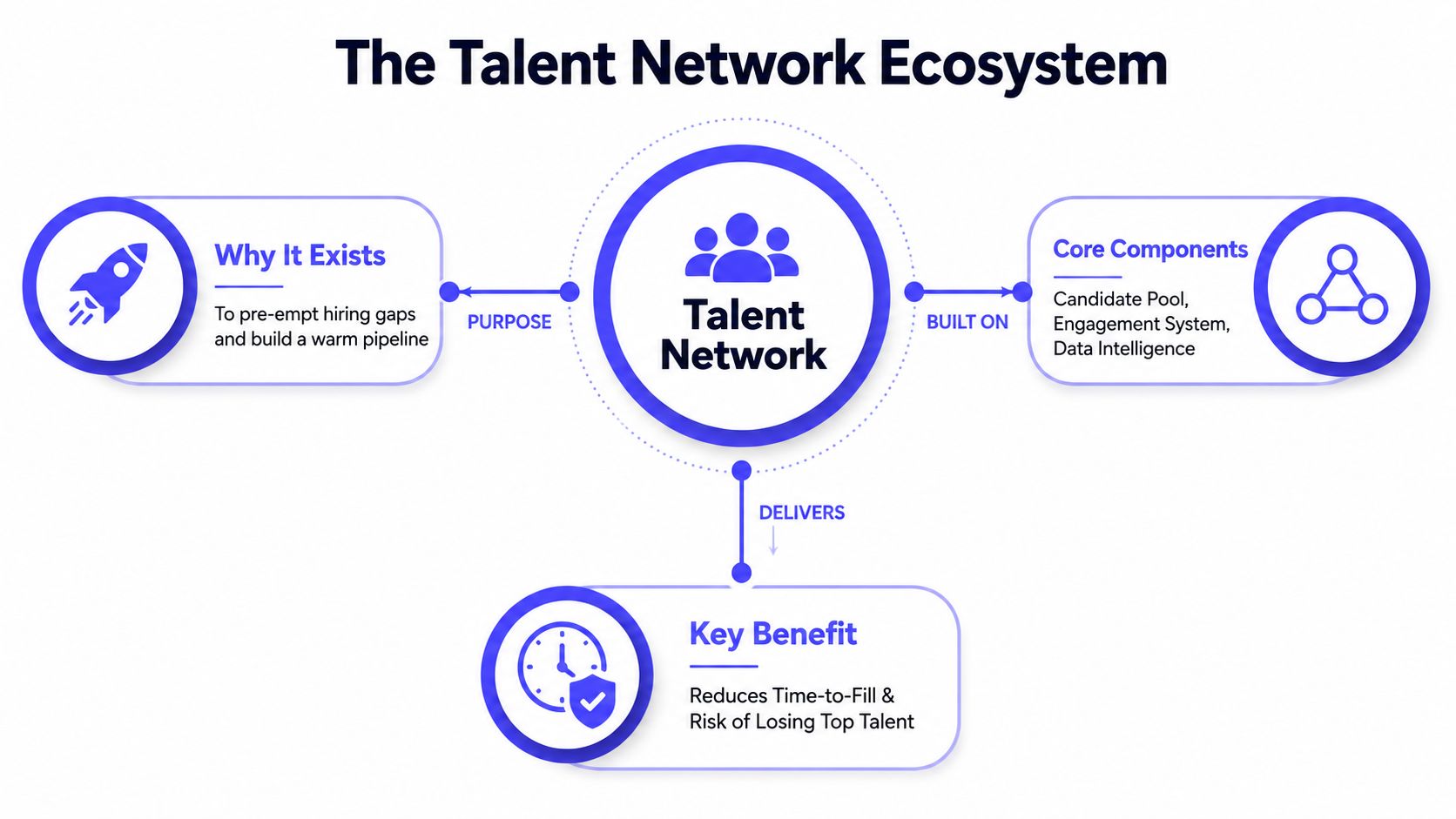
The structure stays fairly consistent in strong programs. First, people opt in and share contact data. Second, the team segments them by skill, function, seniority, or interest. Third, the company keeps sending useful updates so the relationship does not cool off.
That structure is especially useful when hiring gets technical. A Series B AI startup might build a network of LLM engineers, data engineers, and MLOps specialists, then separate them into groups like “prompt engineering,” “training pipelines,” and “inference optimization.” That lets the team send the right invite to the right person instead of sending every opening to everyone.
Government hiring uses the same basic pattern. USAJOBS runs talent networks for broad recruitment, and job seekers share their name, email, and profile so agencies can reach out before specific roles open. The process is simple, but the timing changes everything, because the relationship begins before the posting exists (USAJOBS).
AI hiring software can support that work, but only if the network itself is clear about who it serves and how people move through it. Tools from companies like ThirstySprout's guide to AI recruiting software can help with segmentation and outreach, yet the underlying idea stays the same. A talent network is infrastructure you build before you need it, not a list you scramble to assemble when a role opens.
Talent Network vs ATS vs Talent Pool vs Talent Marketplace
These four models look alike, but they sit at different points in the hiring process. If you mix them up, you end up using the wrong tool for the job and measuring the wrong outcome.
| Model | Purpose | Who It Serves | Time Horizon | Owned By |
|---|---|---|---|---|
| Talent Network | Build an opt-in pipeline before a role opens | Employer and interested candidates | Medium to long term | Employer |
| ATS | Track and process active applicants | Recruiters, hiring managers, applicants | Immediate hiring cycle | Employer |
| Talent Pool | Keep a recruiter's candidate stash | Recruiter or recruiting team | Short to medium term | Recruiter or employer |
| Talent Marketplace | Match candidates and open roles on demand | Candidates and employers | Immediate or near-term | Platform |
An ATS handles active applications. It tracks resumes, stages, feedback, and compliance after someone has already applied. A talent pool is usually a recruiter-held list, often informal, and often built from past conversations, referrals, or candidates who were close but not selected. A talent marketplace sits on the other side of the market, matching open roles with available people on demand, which works best when speed matters more than relationship depth.
A talent network sits earlier than all of that. It is the employer-owned, opt-in community you keep warm before the role exists, more like a pre-requisition pipeline than a job board replacement. That is why people sometimes group it with talent community, but the network framing usually points to lighter-touch engagement and ongoing contact, not a one-time capture of names. As noted earlier, the point is not just collecting profiles. It is keeping the relationship active enough that a future role does not start cold.
For a broader lens on pipeline design, building strong talent pipelines is a useful adjacent read. It helps connect the network concept to the rest of your recruiting system without pretending every source works the same way.
A simple rule helps here. If you need someone next quarter, a marketplace may be the faster path. If you need someone next year, build a network now. If the candidate has already applied, the ATS is the right system to use.
The difference becomes obvious in technical hiring. A recruiter at a 500-person fintech can keep posting into an ATS and still miss niche AI talent, because the ATS only organizes people who have already raised their hand. A Series A founder who built a 300-person AI specialist network 18 months before the first ML hire starts with names, context, and trust.
The same logic matters for tools. This guide to AI recruiting software is useful because it forces a better question, whether the software helps you manage applicants or maintain relationships before hiring opens. The wrong category can make a polished database look like a strategy.
The trap is treating the ATS as the hiring plan. It is only the system of record for applications.
Who Talent Networks Are Really For in 2026
Most explainers still describe talent networks as employer branding tools for general recruiting. That misses the people who need them most now. Founders hiring their first ML engineer, CTOs scaling from 5 to 50 AI specialists, and Heads of Talent running AI hiring mandates all need a different kind of pipeline.

The underused angle is internal mobility. Some sources describe talent networks as including internal employees, former employees, and external professionals, and they emphasize internal mobility and redeployment by capturing skills at sign-up (Qualee). That matters because a network can do more than source applicants. It can match people to projects, new roles, returnships, or contract work.
Think about the economics. A network built around a skill graph and project readiness can route a person to the right opportunity without waiting for a generic job alert. It can also surface alumni, contractors, and specialists in the exact stack you need, like LLMs, MLOps, or data engineering.
A Director of Data Science might structure a 400-person network by stack and seniority, then segment people across PyTorch, JAX, and Ray, with junior, senior, and staff tags. When a new requisition opens, the first 10 sourced candidates already resemble the JD instead of needing broad screening.
The most valuable networks in 2026 are not soft applicant pools. They're structured, project-ready communities.
Some teams use talent networks for internal redeployment. Others use them to stay close to alumni who might boomerang later. Specialized firms use them to build candidate moats around rare roles, especially where AI hiring depends on warm relationships and specific domain experience.
If you're hiring in AI, this is the key shift. A talent network is no longer just a softer version of an applicant list. It's a structured community around skills, readiness, and future work.
How to Build and Evaluate a Talent Network
Start by deciding whether you want to buy software, build in-house, or do both. The market includes systems like LinkedIn Talent Insights and Eightfold, plus recruiting platforms such as Beamery, and specialist models like ThirstySprout that focus on pre-vetted technical talent. Each choice changes your operating burden, not just your tooling.

A lean build usually needs five parts. A landing page, an opt-in form, segmentation tags, a CRM layer, and a content cadence. If you skip any one of those, the network turns into a dead list.
When you're setting up the form, don't overcomplicate it. Ask for the basics, then add the skill fields that help you segment later. If you need help collecting contact data from a professional profile, email finding techniques for LinkedIn is a practical reference for how teams often bridge discovery and outreach.
Evaluate the network with five measures:
- Sourcing ratio. What share of hires come from the network.
- Warm response rate. How often engaged members reply.
- Time to first touch. How fast your team reaches out after interest is shown.
- Cost per hire through the network. What it costs relative to agencies or repeated outbound.
- Active member rate. How many people are interacting, not just subscribed.
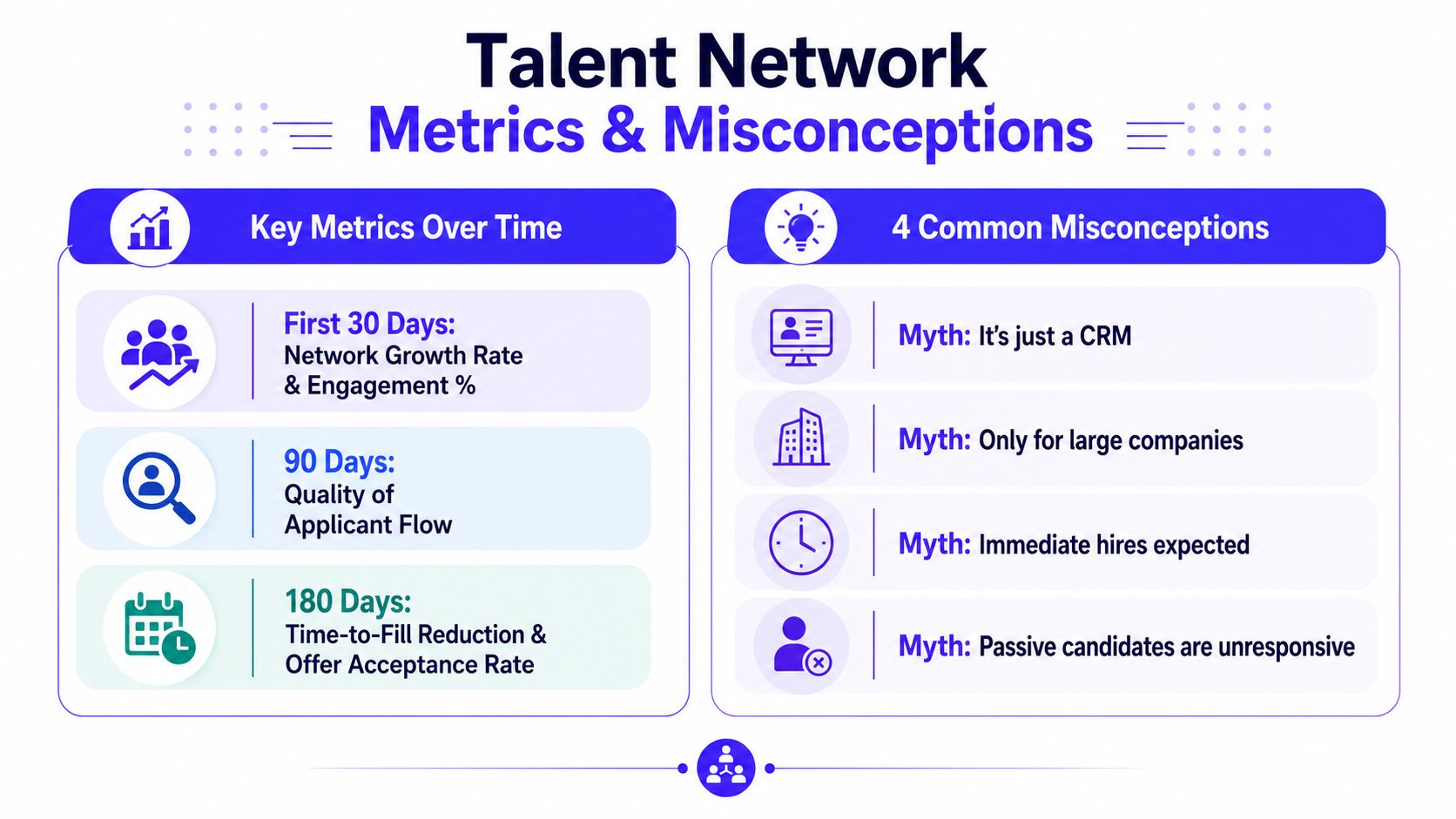
A simple scorecard keeps this honest. In month 1, focus on opt-in conversion and whether the audience is defined correctly. By day 90, look at quality of applicant flow and whether the right people are raising their hands. By day 180, check whether the network is shortening time to fill and improving offer acceptance relative to other channels.
A CTO at a Series B fintech could pilot this over 6 months, target 500 engaged members, and review weekly content engagement before deciding whether to expand or pivot. That's the right cadence for an AI hiring pipeline, because it tells you whether the audience is warm enough to justify more effort.
Common mistake: teams buy the platform before they can describe the audience in one paragraph.
The failure modes are predictable. Some teams treat the network like a newsletter list. Others staff it like a side project with no owner. The most common mistake is assuming a vendor will create the community for you. It won't.
Practical Examples for AI and ML Hiring
A startup hiring LLM specialists can make this work fast if it commits to a narrow audience. One team built a network of 250 vetted LLM engineers over 4 months by using open-source contributions, paper-reading groups, and a quarterly newsletter. When they posted a senior prompt engineer role, they filled it in 11 days from the network.
The structure mattered more than the volume. They tracked who opened the newsletter, who attended the reading group, and who replied to technical prompts. They also kept the cadence steady, which made the network feel like a real community instead of a campaign.
A better practical case is a healthcare company hiring AI and ML talent for systems that touch regulated data. A hospital group or health-tech team can keep a pre-requisition network of data scientists, applied ML engineers, and MLOps specialists who have already shown interest in privacy, model monitoring, and clinical workflows. That gives the hiring team a warmer starting point than a fresh job post, because the relationship begins before a req opens. A similar setup works for manufacturing companies that need computer vision engineers, robotics specialists, or edge ML talent for plant operations. The network helps them keep a short list of people who already understand the constraints of production environments.
For teams building that kind of pipeline, how to hire AI engineers is a useful reference because the network only matters if it connects to real roles. The point is not to collect names. It is to create a pre-requisition bench of people whose skills, interests, and timing line up with the jobs you expect to open.
A second example is internal mobility. A mid-sized enterprise can layer a network on top of an ATS so data engineers who want to move into ML roles are matched before external requisitions open. That changes the search from “who can we find?” to “who already has adjacent skills and wants the next step?”
The failed version looks very different. A company builds a talent network for employer branding, never segments it, and ends up with a 40,000-person list that barely gets responses. Size alone doesn't create value. Engagement, relevance, and follow-up do.
A strong AI network usually has three things in common. It speaks to a narrow audience, it sends useful content, and it has someone responsible for maintaining the relationship. Without that, the network becomes a mailing list with a nicer name.
Metrics, Best Practices, and Common Misconceptions
The first metric to watch is whether people opt in. If your landing page doesn't convert, the rest of the system can't recover. After that, look at weekly engagement, source of hire, time to fill for network-sourced roles, and cost per hire compared with agencies.
A simple operating rhythm works best. You need a named owner, a weekly content cadence, and segmentation by stack and seniority. You also need a feedback loop from candidates who decline, because their reasons usually tell you whether the message, role, or timing was off.
One clean way to audit the network is with a short checklist.
- Audience clarity. Can you describe the exact person you want in one paragraph.
- Opt-in flow. Is it easy to join and easy to update a profile.
- Segmentation. Can you separate by skill, function, and seniority.
- Content rhythm. Are members hearing from you on a predictable schedule.
- Ownership. Is one person accountable for community health.
- Measurement. Are you tracking engagement and source of hire, not just list size.
Three misconceptions cause the most damage. First, a network is not the same as a CRM. A CRM stores relationships, but the network is the relationship strategy. Second, size doesn't matter more than engagement. A large cold list is usually worse than a smaller active one. Third, the network does not replace the ATS. It feeds the ATS. Fourth, you can't solve AI hiring by blasting generic job alerts at passive candidates and hoping for the best.
For a deeper lens on recruiting speed, time to hire metrics is the right companion read because it helps you connect network health to actual hiring flow.
The honest limit is this. A talent network works best when you're willing to invest in community management over months, not weeks. If nobody owns it, it fades.
Your Next Steps and How to Get Started
The first decision is whether you want to build or buy. The second is whether your network is meant for internal mobility, external sourcing, or both. The third is whether you need a generalist community or a specialized one for AI, ML, MLOps, or data engineering.
A solid 30-day starter plan is straightforward. Define the audience in one sentence. Choose the platform. Set up a landing page. Draft a 90-day content calendar. Pick 2 metrics, one for engagement and one for hiring impact.
If you're moving quickly, don't start with everything at once. Start with one role family, one community owner, and one clear reason for candidates to stay in touch. That keeps the work manageable and gives you a real signal instead of a messy pile of contacts.
Use this as your decision filter:
- Build first if you already know the exact talent profile.
- Buy first if you need infrastructure and reporting fast.
- Internal first if you have adjacent talent already inside the company.
- External first if you're still building your employer story in the market.
The right network is focused, maintained, and tied to real hiring plans. It's not a silver bullet, and it won't fix weak roles or slow interview loops. It works when your team is ready to treat community as part of recruiting, not an afterthought.
If you want help turning this into a real hiring pipeline, ThirstySprout can help you scope the audience, structure the network, and connect it to AI roles that need filling. Visit ThirstySprout to start a pilot or review sample profiles for senior AI, ML, and MLOps talent.
Hire from the Top 1% Talent Network
Ready to accelerate your hiring or scale your company with our top-tier technical talent? Let's chat.