

TL;DR
- Time to Hire vs. Time to Fill: Time to Hire measures the candidate's journey (application to offer accept), showing pipeline speed. Time to Fill measures the internal process (requisition open to offer accept), showing organizational efficiency.
- The Cost of Delay: A slow hiring process (over 45 days for senior AI roles) leads to losing top candidates, team burnout, and delayed product roadmaps, directly impacting revenue.
- Fix the Bottlenecks: The most common delays are vague role definitions, disorganized interview scheduling, and slow feedback.
- Actionable Framework: Implement a standardized process with defined interview panels, structured scorecards, and a strict 24-hour feedback Service Level Agreement (SLA) to cut your Time to Hire by 50% or more.
- Recommended Action: Audit your current hiring stages to find the biggest time sink. Implement one fix, like a 24-hour feedback rule, this week.
Who This is For
- CTO / Head of Engineering: You need to hire senior AI/ML engineers quickly to hit your product roadmap, but your hiring process is slow and unpredictable.
- Founder / Product Lead: You're scoping new AI features and need to understand the real timeline and cost of building the required team.
- Talent Ops / TA Lead: You're responsible for the hiring process and need a framework to measure performance and convince engineering leaders to adopt best practices.
Framework: How to Measure and Reduce Hiring Latency
A slow hiring process is a tax on your engineering team. To fix it, you need to measure it accurately, identify the specific bottlenecks, and implement a standardized system.
This three-step framework helps you move from slow and reactive to fast and decisive.
- Measure Accurately with Two Key Metrics: Differentiate between Time to Hire and Time to Fill. Use your Applicant Tracking System (ATS) as the single source of truth, tracking key dates from requisition approval to offer acceptance.
- Identify Bottlenecks by Analyzing Stage Duration: Calculate the time candidates spend in each stage (e.g., screening, technical interview, final round). This pinpoints exactly where your process is breaking down, whether it's slow feedback or scheduling chaos.
- Standardize the Process to Eliminate Drag: Create a repeatable hiring plan for each role with defined interview panels, structured scorecards, and a mandatory 24-hour feedback SLA. This removes ambiguity and forces a faster, more consistent pace.
Practical Examples of Time to Hire in Action
Theory is good, but practical application is better. Here are two real-world examples of how to put these concepts to work.
Example 1: The Weighted Scorecard for a Senior AI Engineer
A well-designed scorecard is your best tool against slow, subjective decision-making. It forces alignment among interviewers and turns vague "gut feelings" into comparable data points.
This template helps you create a clear, weighted evaluation rubric for a senior AI role, ensuring everyone is assessing against the same priorities.
Business Impact: Using a scorecard like this prevents endless debate in debriefs. It focuses the conversation on the most critical skills, leading to faster, higher-quality decisions and a shorter time to hire.
Example 2: Case Study—Cutting ML Engineer Hire Time from 60 to 25 Days
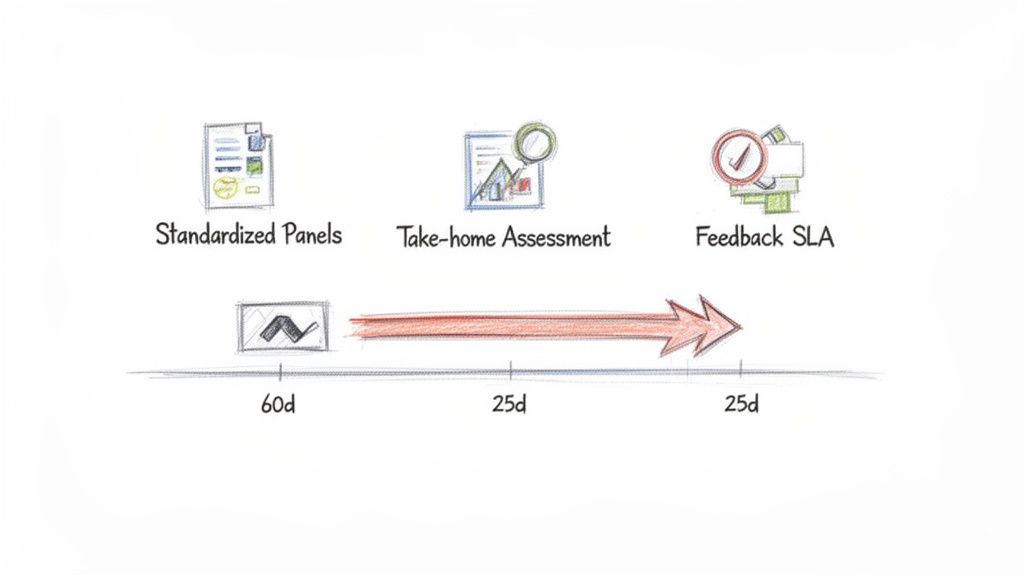
A Series B fintech startup was struggling to hire Senior Machine Learning Engineers. Their average time-to-hire was 60 days, causing them to lose top candidates and fall behind on their AI product roadmap.
The problem was a chaotic process: inconsistent interview panels, varied take-home projects, and feedback that lagged for a week or more.
We implemented a three-part fix:
- Standardized Panels and Scorecards: We defined a dedicated interview panel for the ML role and implemented a structured scorecard in their ATS.
- A Single, Timed Take-Home: We replaced multiple assignments with one well-defined project that could be completed in 3–4 hours.
- A Strict 24-Hour Feedback SLA: We made it a hard rule that all interview feedback must be submitted within 24 hours. No exceptions.
The Result: The company slashed their average time-to-hire for Senior ML Engineers from 60 days to just 25 days. This allowed them to secure the talent needed to ship their new features a full quarter ahead of the old schedule. This shows that reducing time-to-hire isn't about cutting corners—it's about ruthlessly eliminating process inefficiency.
Deep Dive: The True Cost of a Slow Hiring Process
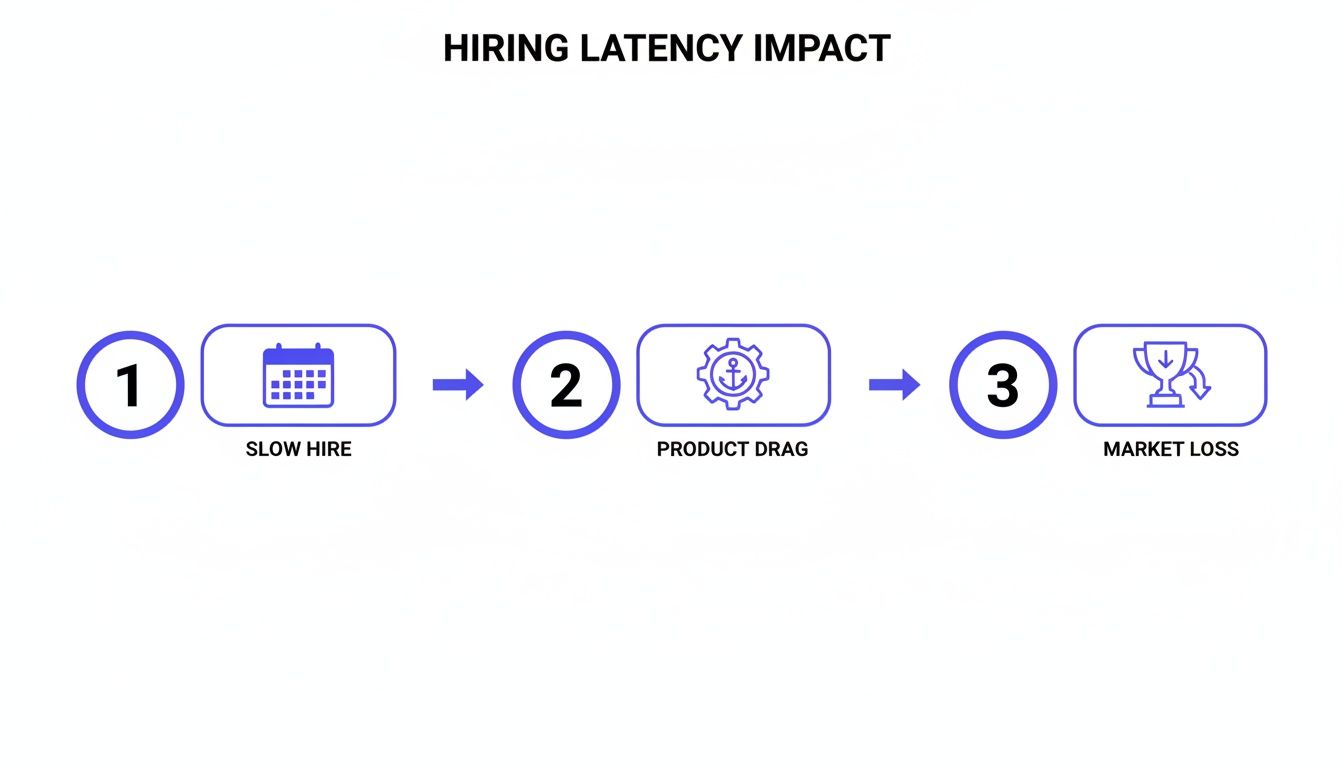
For technical leaders, a slow hiring process isn't an HR issue; it's a direct threat to the product roadmap. Think of it as hiring latency. Just like network latency grinds an application to a halt, hiring latency puts a massive drag on your entire engineering organization.
Every day a critical AI role sits empty, you accumulate organizational debt. Your product velocity slows, innovation stalls, and you risk missing narrow market windows. If a competitor can hire a senior ML engineer in 25 days while you're still in process at day 60, they gain a monumental execution advantage.
Core Hiring Velocity Metrics: A Quick Reference
To diagnose latency, you must first measure it correctly. Two core metrics provide visibility into your hiring engine: Time to Hire and Time to Fill.
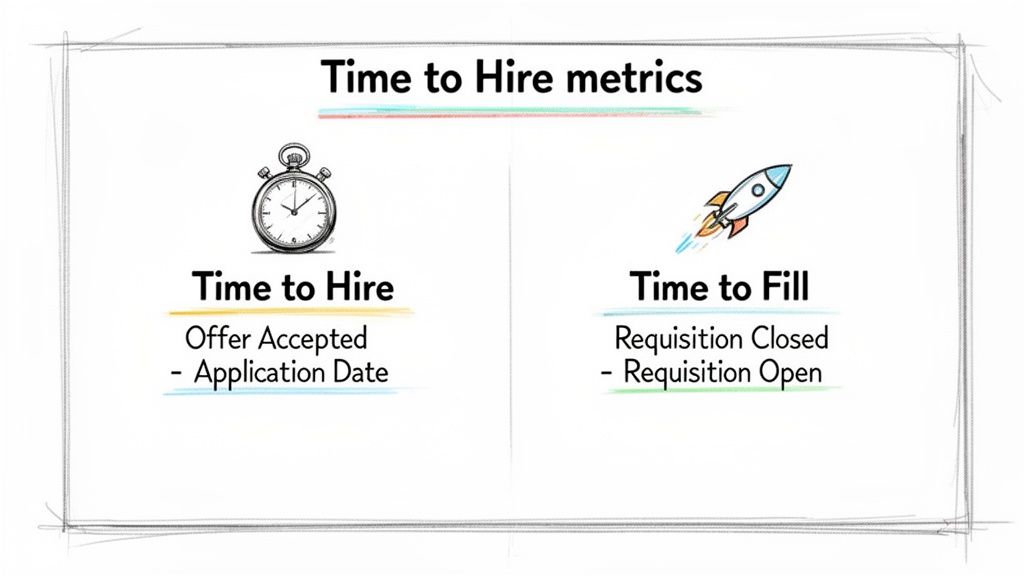
It’s easy to confuse them, but they measure different parts of the journey.
- Time to Hire tracks the candidate's experience. It starts the moment they apply and stops when they accept your offer. It answers, "How fast can we move a great person through our pipeline?"
- Time to Fill tracks your internal process. It starts when a job requisition is approved and stops when the new hire is confirmed. It answers, "How long does it take us as a company to close a headcount?"
A long Time to Fill often signals internal friction like slow approvals. A long Time to Hire points to pipeline problems like scheduling delays or too many interview rounds.
Benchmarking Your Hiring Latency
So, how slow is too slow? Recent global benchmarks put the average time‑to‑hire at 44 days, with engineering roles often open for a staggering 62 days. For a startup building AI capabilities, a 44‑day delay means losing an entire product cycle waiting for one engineer. You can see how you compare with these recruitment time-to-fill benchmarks.
Connecting Hiring Speed to Business Outcomes
To get buy-in from leadership, you must connect these metrics to business impact.
Scenario: A Senior MLOps Engineer role took 68 days to fill.
- Weak Reporting: "Our Time to Fill for the MLOps role was 68 days."
- Strong Reporting: "The 68-day hiring timeline for our Senior MLOps Engineer delayed the deployment of our new RAG model by one quarter. This pushed a projected $250k in Q3 revenue to Q4 and cost the team an estimated 320 hours in duplicated manual work."
This approach reframes the metric from an HR stat into an urgent business problem. Speed isn’t everything; it must be balanced with another vital metric, which we break down in our guide to measuring quality of hire metrics.
Checklist: A System for Tracking Hiring Metrics
To get a real handle on your time-to-hire, you need a trusted system to collect and analyze hiring data. Your Applicant Tracking System (ATS) must be your single source of truth.
Without clean data, any reports you pull will be flawed.
Core Data Points Checklist
Ensure your team consistently tracks these non-negotiable timestamps in your ATS for every role:
- Requisition Open Date: The day the job is officially approved.
- Application Date: The moment a candidate hits "submit."
- Stage Entry/Exit Dates: Timestamps for each step (e.g., Recruiter Screen to Hiring Manager Interview).
- Offer Extended Date: The day you send the formal offer.
- Offer Accepted Date: The moment the candidate signs.
Getting recruiters and hiring managers to update these fields in real-time is critical. A few days' delay in logging an action can hide the real bottlenecks.
Automating Calculations with SQL
Automate your reporting by querying your ATS database directly. This provides live insights that can scale.
Here’s a conceptual SQL snippet you can adapt for platforms like Greenhouse or Lever to calculate Time to Fill and Time to Hire.
SELECTrequisition_id,job_title,-- Calculates Time to Fill in daysDATEDIFF(day, requisition_open_date, offer_accepted_date) AS time_to_fill_days,-- Calculates Time to Hire in daysDATEDIFF(day, application_date, offer_accepted_date) AS time_to_hire_daysFROMhires_data_viewWHEREoffer_accepted_date IS NOT NULL;This simple query grabs the key dates for every successful hire and instantly calculates the duration, giving you clean, automated metrics for your dashboard. For effective recruitment project management, automation is key.
Common Pitfalls (And How to Fix Them)
Even well-intentioned teams watch their hiring timelines stretch from weeks into months. It’s rarely one big failure but a series of small inefficiencies that sabotage your speed.
1. Vague Role Definitions and Scorecards
A search without a clear definition of the role is doomed to be slow. Interviewers use inconsistent questions, and debriefs become subjective arguments.
This creates friction at every stage:
- Misfired Sourcing: Recruiters waste time chasing the wrong profiles.
- Confused Interviews: Each panelist uses their own mental model to judge candidates.
- Aimless Debriefs: Feedback becomes unhelpful ("I just got a good feeling").
How to Fix It: Before posting a role, the recruiter and hiring manager must build a detailed scorecard. This document locks in the top 3–5 core skills, key questions to assess them, and what great answers look like.
2. Disorganized Interview Panels and Scheduling
Last-minute reschedules, interviewers who haven't read the resume, and endless email tag to find a time slot create a terrible candidate experience.
Surveys show that 75% of job seekers say the interview process shapes their decision to accept an offer. A sloppy process is a direct threat to your ability to hire. You can find more hiring trend insights on talentmsh.com.
How to Fix It: Define a dedicated interview panel for each role. Use a tool like Calendly to streamline scheduling and present a professional, organized front.
3. Slow Feedback Loops
The single biggest villain of bloated hiring timelines is a slow feedback loop. When a hiring manager takes three days to submit notes, you lose all momentum.
This delay pushes back the next round, gives competitors time to make an offer, and signals to the candidate that they aren't a priority.
How to Fix It:
- The 24-Hour Rule: Mandate that all interview feedback must be submitted in your ATS within 24 hours. No exceptions.
- The Immediate Debrief: As soon as the final interview ends, hold a 15-minute call with the panel to force a decision while impressions are fresh. If you want to go deeper on this, check out this ultimate guide to hiring top AI engineers.
What to Do Next
Getting a handle on your time-to-hire metrics is a great start, but progress comes from action. Here are three practical steps you can take now.
Step 1: Audit Your Current Process (This Week)
You can't fix a bottleneck you can't see. Dig into your ATS data and calculate the average time spent at each stage. Pinpoint the single biggest slowdown—is it the time between application and first contact, or between the final interview and the offer?
Step 2: Implement One High-Impact Change (Next Week)
Don't try to fix everything at once. Focus on the biggest chokepoint you found.
- If scheduling is the problem: Use a tool like Calendly and implement a strict 24-hour feedback SLA.
- If decision-making drags on: Build a standardized scorecard and schedule a mandatory 15-minute debrief immediately after the final interview.
For teams that need to scale quickly, staff augmentation services can be a game-changer.
Step 3: Engage a Specialized Talent Partner (For Critical Roles)
For highly competitive AI roles, your internal process might not be enough. A specialized partner like ThirstySprout bypasses the traditional sourcing funnel entirely. We connect you directly to our pre-vetted network of senior AI experts, slashing your time-to-hire from months to just 2–4 weeks. You can find more insights in a comprehensive guide to recruiting software developers.
Ready to stop losing top candidates to faster competitors?
- Start a Pilot
- See Sample Profiles
References
- Recruitment Time-to-Fill Benchmarks by iSmartRecruit
- Hiring Trend Insights on TalentLMS
- What Is an Applicant Tracking System (ATS)? by BambooHR
- Quality of Hire Metrics by ThirstySprout
- Recruitment Project Management by ThirstySprout
- Staff Augmentation Services by ThirstySprout
At ThirstySprout, our model is built to collapse this timeline. We connect you directly with our exclusive, pre-vetted network of senior AI and ML engineers. Start a pilot and you can hire your next expert in weeks, not months.
Hire from the Top 1% Talent Network
Ready to accelerate your hiring or scale your company with our top-tier technical talent? Let's chat.