

TL;DR
- When to use it: Staff augmentation is ideal when you need to fill a specific skill gap (like MLOps or RAG experts) within 1–2 weeks and want to maintain direct project control. It’s a faster, more flexible alternative to a 2–3 month direct hiring cycle.
- Key benefits: Gain access to pre-vetted, global AI talent, reduce total hiring costs by 20–30% by eliminating recruiting fees and benefits overhead, and scale your team up or down based on project needs.
- How it works: You select specialized engineers from a partner's talent pool. They integrate directly into your team, report to your managers, and work within your existing tools and workflows (Jira, Slack, GitHub).
- Actionable first step: Identify a critical, short-term project (e.g., building a prototype or clearing a backlog) and run a 2-week pilot with one augmented engineer to test the model's effectiveness for your team.
Who This Guide Is For
- CTOs & Heads of Engineering: You need to accelerate your AI roadmap and fill critical skill gaps without getting stuck in a 3-month hiring process.
- Founders & Product Leads: You're scoping an AI feature and need to de-risk the project by bringing in specialized expertise quickly and within budget.
- Talent & Procurement Leaders: You are evaluating vendors and need a clear framework for assessing the ROI and risks of flexible talent models.
A Quick Framework for Choosing a Hiring Model
The core value of staff augmentation is speed and control. You get pre-vetted specialists who integrate directly into your team in days, not months. You bypass the long recruitment cycle and high overhead of a full-time hire while maintaining complete authority over your project.
This isn't project outsourcing, where you hand over the reins. It's about adding specific capabilities to your existing team for a defined period. The decision tree below helps clarify when to use staff augmentation versus other models.
alt text: A flowchart titled 'Hiring Model Decision Guide' shows that when direct project control and specialized skills are needed for a specific duration, staff augmentation is the optimal choice over managed services or project outsourcing.
If you need high control over the talent and fast integration for a short-to-mid-term project, staff augmentation services are your most direct and efficient solution.
Hiring Model Comparison Table
To make the best decision, compare staff augmentation against other common talent models. The right choice depends entirely on your project's specific goals.
Practical Examples of Staff Augmentation
Seeing how staff augmentation works in the real world makes its value clear. The model excels when used to solve a specific, high-stakes problem by embedding specialized expertise exactly where it's needed.
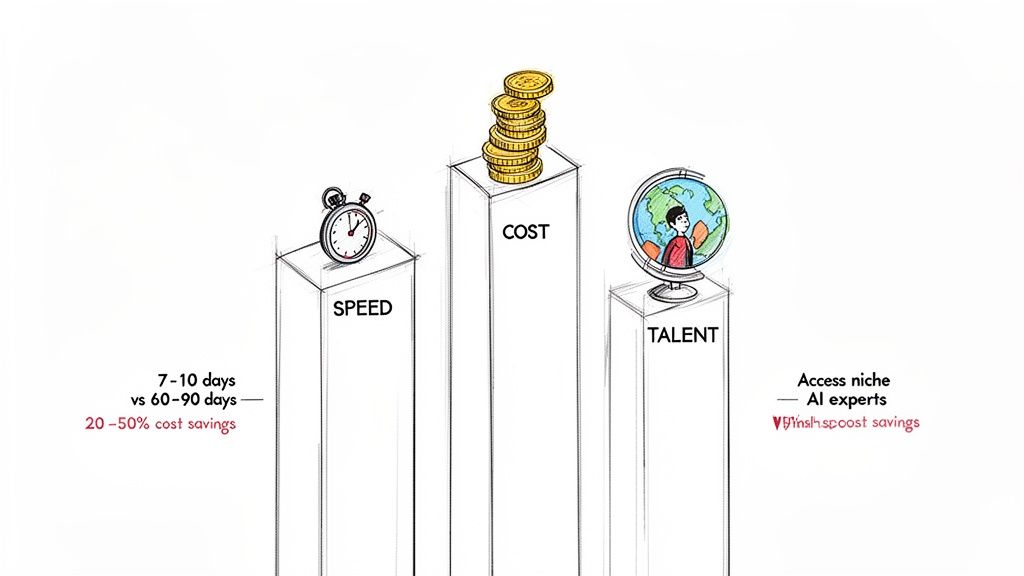
alt text: Three pillars illustrate the key benefits of staff augmentation services: speed (faster project delivery), talent (access to niche AI experts), and cost (significant savings on recruitment and overhead).
Example 1: Fintech Startup Builds a RAG Prototype in 8 Weeks
A Series A fintech company wanted to reduce customer support costs by building a Retrieval-Augmented Generation (RAG) system for their agents. Their in-house team was skilled in backend development but lacked experience building and evaluating modern AI applications.
- The Problem: High support ticket volume and slow agent response times. They needed to validate if an internal AI tool could accurately pull answers from their knowledge base.
- The Augmented Team: They onboarded two senior AI engineers with hands-on experience building RAG pipelines using LangChain and measuring model performance.
- The Result: The augmented engineers integrated with the core team and delivered a working prototype in eight weeks. The prototype successfully answered 75% of test queries, proving the concept and securing internal buy-in for a full-scale production build.
- Business Impact: The company de-risked its AI strategy and validated a solution to reduce operational costs without the 3-month delay and high expense of hiring a full-time AI team.
Example 2: Enterprise Overhauls its MLOps Pipeline
A large enterprise struggled with a slow and unreliable Machine Learning Operations (MLOps) pipeline. Deploying new models was a manual, error-prone process that created a significant bottleneck for their data science team.
- The Problem: A slow time-to-market for new models and frequent production failures. Their platform team lacked the specialized CI/CD for Machine Learning (ML) expertise needed.
- The Augmented Team: They added a single, senior MLOps engineer to lead the pipeline overhaul and mentor the internal team on best practices.
- The Result: In 12 weeks, the specialist redesigned the deployment workflow, automated testing, and implemented robust monitoring. The new pipeline reduced model deployment failures by 40% and accelerated the deployment cadence from monthly to weekly.
- Business Impact: Faster delivery of ML models directly translated to quicker business value and a more effective data science function.
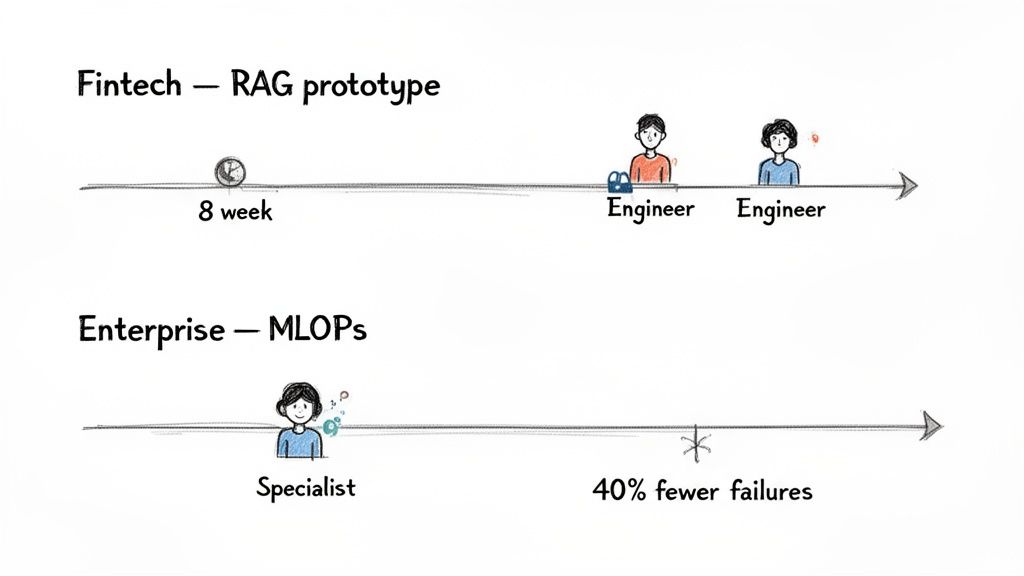
alt text: A diagram showing a fintech using augmented AI engineers to build a RAG prototype, contrasted with an enterprise using an augmented MLOps engineer to achieve 40% fewer deployment failures.
Deep Dive: Trade-offs, Alternatives, and Pitfalls
Staff augmentation offers clear benefits in speed, cost, and access to talent. However, it's not a silver bullet. Being aware of the trade-offs and potential pitfalls is crucial for success.
When Staff Augmentation is the Wrong Choice
This model is less effective for:
- Core, long-term functions: If a role is central to your company's identity and long-term strategy (e.g., Head of AI), a direct, full-time hire is a better investment.
- Poorly defined projects: Augmentation works best when you have a clear goal and can direct the talent effectively. If the scope is ambiguous, you may struggle to manage the engagement.
- Teams without management capacity: Augmented staff are not self-managing. They require direction, feedback, and integration from your existing managers. If your leads are already overextended, adding more direct reports can create problems.
Common Pitfalls to Avoid
- Treating them like outsiders: The biggest mistake is failing to fully integrate augmented staff. If they are excluded from team rituals, key meetings, or communication channels, their effectiveness and morale will plummet. They must be treated as part of the team.
- Skipping a structured onboarding: Throwing an engineer into a project without proper introductions, access to tools, or a clear overview of the architecture is a recipe for a slow start and frustration.
- Choosing a partner based only on price: The lowest hourly rate can be tempting, but it often correlates with poor vetting, communication barriers, or a lack of specialized skills. A bad hire costs far more in lost time and rework than a slightly higher rate for a top-tier engineer. According to research from Forbes, a key trend is the move toward quality and specialized skills over pure cost savings.
Checklist: How to Choose the Right Augmentation Partner
Selecting a partner for staff augmentation services is a critical decision. Use this checklist to cut through sales pitches and evaluate potential partners on what truly matters.
[ ] 1. Vetting Process & Technical Depth
- Do they have a multi-stage technical screening process? (e.g., coding challenge, systems design interview, live practical assessment).
- Do they test for specific AI/ML frameworks (PyTorch, TensorFlow) and cloud platforms (AWS SageMaker, Google Vertex AI)?
- Is their vetting process conducted by senior engineers?
- Red Flag: Vague claims like "we only hire the top 1%" without a transparent, verifiable process.
[ ] 2. Talent Pool & Specialization
- Do they specialize in AI and ML talent, or are they a generalist IT staffing firm?
- Can they provide anonymized profiles of engineers with the specific skills you need (e.g., computer vision, NLP, MLOps)?
- What is their typical time-to-present for qualified candidates? (Should be 2–5 days).
- Red Flag: Inability to share specific numbers or case studies relevant to your niche.
[ ] 3. Operational Model & Flexibility
- Do they offer a trial period (e.g., 2 weeks) to ensure a good fit with minimal risk?
- Are contracts flexible, allowing you to scale the engagement up or down?
- Do they provide structured support for onboarding and integration?
- Red Flag: Rigid, long-term contracts with no trial period or easy off-ramping clause.
A strong partner acts as an extension of your talent team. ThirstySprout’s candidate vetting engine is an example of a system designed specifically to address these criteria for AI roles.
What to Do Next
Putting this into action is straightforward. Use these three steps to determine if staff augmentation fits your immediate needs.
- Map Your 6-Month Roadmap to Your Team's Skills: Identify the key projects for the next two quarters. Against each project, list the required technical skills. This will immediately highlight your most critical gaps.
- Calculate Your True Time-to-Hire: Review your last three senior technical hires. How long did it take from posting the job description to the engineer’s first day? Compare that timeline to the 1–2 week benchmark for augmentation.
- Define a Pilot Project: Choose one well-defined, critical project from your backlog that has been stalled due to a lack of specific expertise. This is your ideal candidate for a low-risk, high-impact pilot.
This pragmatic approach allows you to test the staff augmentation model and see firsthand how it can accelerate your roadmap.
References
- Key trends in staff augmentation - Forbes Advisor
- The growing market and its key drivers - N-iX
- Managing remote teams effectively - Firacard
- How to hire AI engineers - ThirstySprout
- Postiv.ai for AI Engineer Staffing
At ThirstySprout, we help you build world-class AI teams without the friction of traditional hiring. Start a pilot project and have a vetted AI expert integrated with your team in days, not months.
Hire from the Top 1% Talent Network
Ready to accelerate your hiring or scale your company with our top-tier technical talent? Let's chat.