

A familiar architecture debate starts like this. One team wants to keep everything portable with standard SQL. Another wants to use T-SQL stored procedures, control flow, and SQL Server-specific features to move faster now. Both sides are right, and that's why the decision matters.
If you're a CTO, VP Engineering, or staff-level data lead choosing a database approach for a new product, Transact-SQL vs SQL isn't a syntax debate first. It's a staffing, maintenance, and platform strategy decision. The wrong choice won't usually break your first release. It shows up later, when you need to hire, migrate, split services, or support a second cloud.
SQL vs T-SQL What's at Stake for Your Team
A team launches on SQL Server because it matches the current stack, the Microsoft tooling is familiar, and T-SQL lets engineers ship stored procedures and operational reports quickly. Two years later, the company wants a second cloud option, a PostgreSQL-based analytics path, or a broader hiring pipeline. That is usually when the original choice starts showing its full cost.
TL;DR
- SQL is the cross-vendor relational standard. T-SQL is Microsoft's extension for SQL Server, not a separate database product, and SQL Server application development commonly relies on it, as summarized in this T-SQL vs SQL reference.
- Choose T-SQL when SQL Server is a clear long-term platform decision and database-side logic will materially improve delivery or operations.
- Choose standard SQL-first when portability, hiring flexibility, and future database options carry more weight.
- Long-term cost usually comes from how much proprietary logic ends up in the database layer, because that logic affects migration effort, testing patterns, and who you can hire to maintain it.
T-SQL grew into the default language for server-side database logic across Microsoft environments. Standard SQL remained the common baseline across database vendors. That split still matters, but the important impact is rarely syntax alone. It changes where business rules live, how teams debug production issues, and how tightly the application becomes tied to one platform.
A .NET team building an internal system on SQL Server may get clear gains from T-SQL. Stored procedures, error handling, transactions, and SQL Server-specific features can shorten the path to a stable release. The trade-off is architectural. Each T-SQL-specific decision increases the amount of code that has to be rewritten, retested, or rethought if the company changes databases later.
Practical rule: Treat every T-SQL-specific feature as a platform commitment with staffing and migration consequences.
Leaders often underestimate the second-order effects:
- Hiring pool: Strong SQL developers are easier to find than engineers with deep experience in T-SQL, SQL Server internals, and long-lived procedural database code.
- Team velocity: T-SQL can speed delivery for data-heavy workflows, especially when validation, batching, and transaction control fit naturally in the database.
- Maintenance cost: Stored procedures and triggers can become a parallel application layer with weaker testing discipline and fewer engineers willing to own it.
- Architectural risk: The more business logic depends on T-SQL-specific behavior, the harder it becomes to split services, adopt another database, or support mixed-platform environments.
For a CTO or data lead, transact sql vs sql is a decision about operating model as much as language choice. It affects team shape, delivery speed, vendor dependence, and how expensive change becomes once the system is in production.
A Quick Decision Framework for Choosing Your SQL Dialect
Use this scorecard in an architecture review. If most answers land on the left, standard SQL should be your default. If most land on the right, T-SQL is probably the better operational fit.
| Decision area | Lean toward SQL | Lean toward T-SQL |
|---|---|---|
| Platform | You want flexibility across vendors | You're committed to SQL Server |
| Team profile | Your engineers are generalists across multiple databases | Your team already works deeply in Microsoft data stacks |
| Application logic | Most business rules belong in services | Many rules fit naturally in database procedures |
| Performance approach | You prefer portable query patterns | You want SQL Server-specific optimization options |
| Hiring plan | You want the broadest candidate pool | You can recruit for SQL Server specialists |
| Future migration risk | Vendor flexibility matters | Platform lock-in is acceptable |
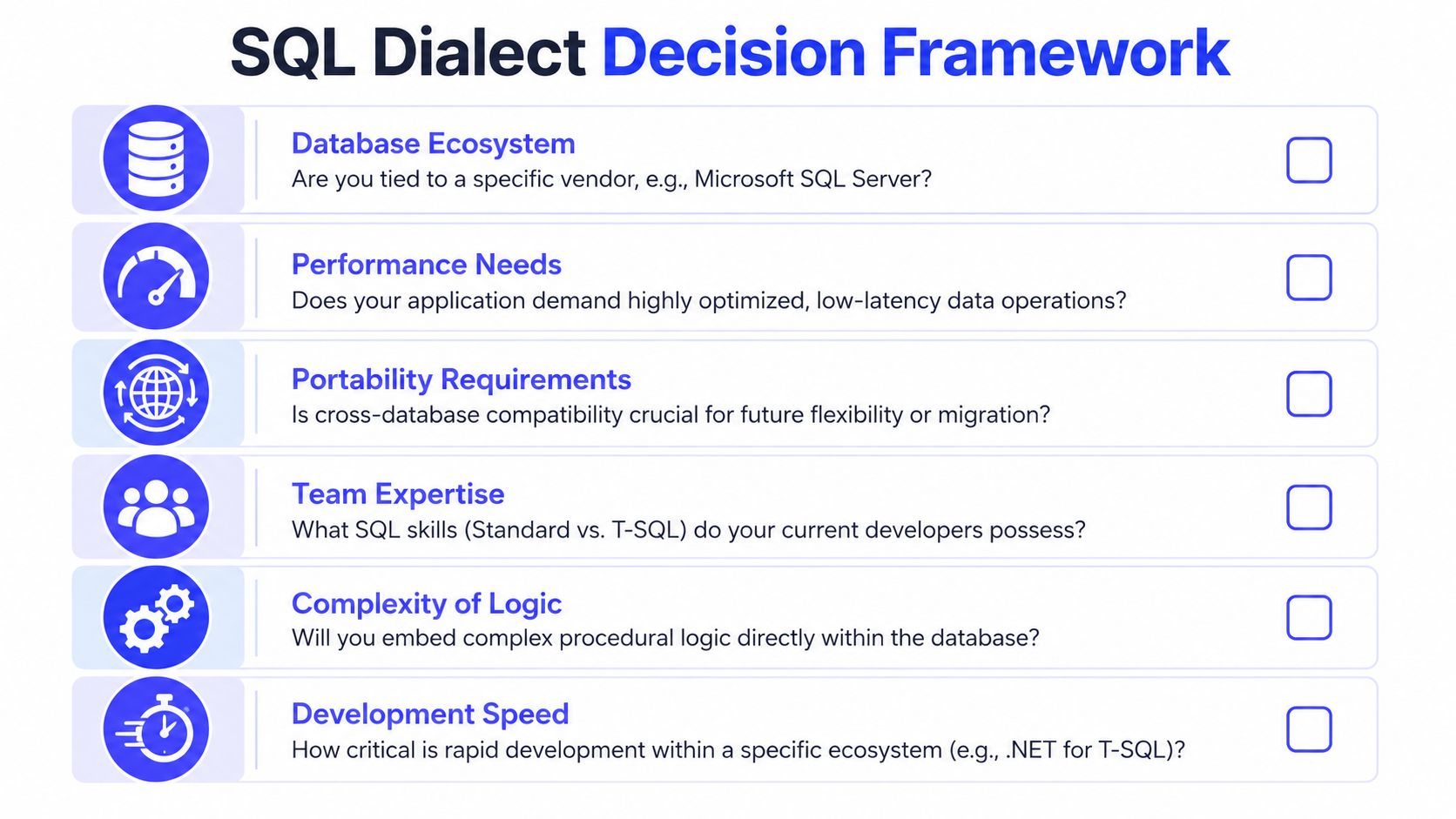
A fast way to decide
Ask these six questions in order:
Where will the system run?
If the answer is SQL Server and likely stays there, T-SQL becomes a stronger option.How much logic belongs near the data?
If you need validations, transformations, and transaction-heavy workflows close to the database, T-SQL helps.Will you support another database later?
If yes, keep the SQL layer narrow and portable.Who will maintain this code in two years?
A platform decision is also a staffing decision.Does your application already own the domain logic?
If your services are the system of record for business rules, duplicating logic in T-SQL creates drift.What fails more painfully. Slower delivery now, or costly rewrites later?
That answer usually clarifies the right trade-off.
Two common recommendations
Recommendation one. Standard SQL-first with selective exceptions
This works well when:
- you expect product changes fast
- you may add PostgreSQL or another engine later
- your team is strongest in application code
In that model, use standard SQL for queries and keep most orchestration in the service layer.
Recommendation two. T-SQL as a first-class platform choice
This works when:
- SQL Server is a deliberate standard
- you need rich database automation
- your team can support stored procedures, triggers, and SQL Server operations well
If you can't explain your database portability plan in one paragraph, you're not ready to standardize on a proprietary dialect.
Key Syntax and Feature Differences with Code Examples
The practical differences cause friction in small places first. A query that works in SQL Server doesn't run elsewhere. A null-handling function behaves differently. A date expression has to be rewritten during migration.
Here's a practical comparison table for the differences engineers run into most often.
T-SQL vs ANSI SQL Syntax Comparison
| Feature | T-SQL Example | ANSI SQL Equivalent | Note |
|---|---|---|---|
| Limit rows | SELECT TOP 10 * FROM orders; | SELECT * FROM orders FETCH FIRST 10 ROWS ONLY; | TOP is common in T-SQL. ANSI-style row limiting is more portable. |
| Null handling | SELECT ISNULL(discount, 0) FROM orders; | SELECT COALESCE(discount, 0) FROM orders; | COALESCE is the safer cross-database habit. |
| String concatenation | SELECT first_name + ' ' + last_name FROM users; | `SELECT first_name | |
| Current date and time | SELECT GETDATE(); | SELECT CURRENT_TIMESTAMP; | SQL Server uses GETDATE(). ANSI uses CURRENT_TIMESTAMP. |
| Variables | DECLARE @x INT = 1; | Varies by vendor or procedural extension | Variable syntax is a strong signal that you're beyond portable SQL. |
Example one: limiting result sets
T-SQL
SELECT TOP 5 customer_id, total_amountFROM invoicesORDER BY total_amount DESC;More portable SQL
SELECT customer_id, total_amountFROM invoicesORDER BY total_amount DESCFETCH FIRST 5 ROWS ONLY;If your analysts also work across finance tooling, the habit of writing portable query patterns pays off. A simple example is this guide on SQL for FinOps data analysis, where reusable grouping and aggregation patterns matter more than vendor-specific syntax.
Example two: null handling
T-SQL
SELECT ISNULL(phone_number, 'unknown')FROM customers;Portable version
SELECT COALESCE(phone_number, 'unknown')FROM customers;This is a small choice with a large maintenance effect. Teams that default to COALESCE create fewer rewrites later.
Example three: date and time functions
T-SQL
SELECT GETDATE() AS current_time;Portable version
SELECT CURRENT_TIMESTAMP AS current_time;Date functions are one of the fastest ways to discover how “portable” your SQL really is.
Example four: string concatenation
T-SQL
SELECT first_name + ' ' + last_name AS full_nameFROM employees;Portable pattern
SELECT first_name || ' ' || last_name AS full_nameFROM employees;Some engines support additional alternatives, but the key point is operational. When developers say “it's just SQL,” these are the details that break build pipelines, reporting jobs, and migrations.
For a broader database comparison mindset, this look at RDBMS choices in Oracle environments is useful because it forces the same question from another angle. Which parts of your stack are standards-based, and which are vendor commitments?
The expensive rewrite usually isn't the big reporting query. It's the hundreds of small assumptions baked into everyday SQL.
Procedural Logic Where T-SQL Extends Beyond Queries
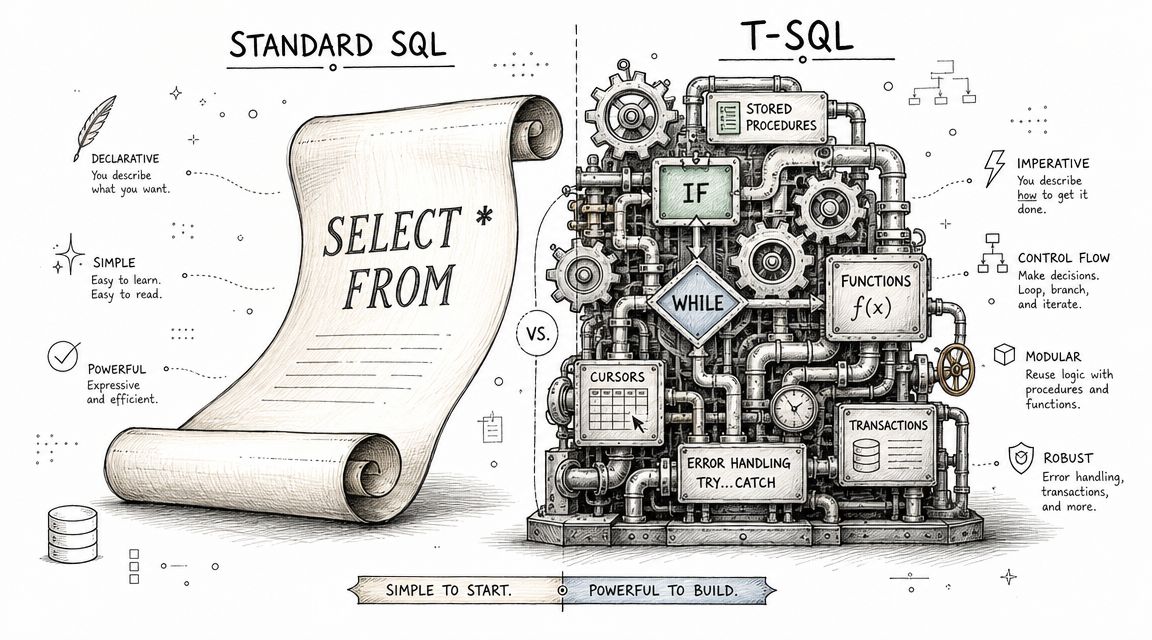
Standard SQL is mainly declarative. You describe the data you want. T-SQL goes further by letting you define variables, use control flow, and handle errors inside the database. That changes the shape of your application.
In SQL Server environments, teams often choose T-SQL for enterprise workloads because it combines language features with engine capabilities such as complex query optimization, parallel processing, and In-Memory OLTP, as described in Bytebase's SQL Server comparison. The same source also notes an important deployment caveat. Azure SQL Database supports most T-SQL features, but excludes certain instance-level and OS-dependent options, including server-level triggers (ALL SERVER).
What that means in practice
Here's a common workflow: validate an order, check inventory, write an audit row, and return a business-friendly error if any step fails.
With T-SQL, that can live in one stored procedure:
CREATE PROCEDURE ProcessOrder@OrderId INTASBEGINBEGIN TRYDECLARE @Stock INT;SELECT @Stock = quantityFROM inventoryWHERE product_id = (SELECT product_id FROM orders WHERE order_id = @OrderId);IF @Stock IS NULL OR @Stock <= 0BEGINRAISERROR ('Item unavailable', 16, 1);RETURN;ENDUPDATE inventorySET quantity = quantity - 1WHERE product_id = (SELECT product_id FROM orders WHERE order_id = @OrderId);INSERT INTO order_audit(order_id, status)VALUES (@OrderId, 'processed');END TRYBEGIN CATCHINSERT INTO order_audit(order_id, status)VALUES (@OrderId, 'failed');THROW;END CATCHEND;The application-layer alternative
If you stay close to standard SQL, the same workflow usually spreads across service code:
- fetch stock
- branch in application logic
- issue update
- issue audit insert
- map database errors back to business errors
That isn't automatically worse. In many systems it's better, because the service layer is easier to test, version, and move across platforms. But it usually means more orchestration outside the database.
Where T-SQL is a clear win
T-SQL works especially well when:
- Transactions are tight: You want validation and state changes close together.
- Rules are data-centric: The database already has the context needed to decide.
- Round trips matter: Pushing logic closer to the data can cut chatter between app and database.
Keep business rules in T-SQL only when the database is the natural owner of those rules, not just the nearest place to put them.
Where teams get into trouble is pushing too much orchestration into stored procedures, then discovering that debugging, CI, and portability all became harder at once.
The Real Cost Platform Performance vs Portability Risk
The strongest argument for T-SQL isn't that it's more expressive. It's that inside the Microsoft stack, it can be the fastest route to a stable production system. The strongest argument against it is that every proprietary feature narrows your future options.
Microsoft states that most core T-SQL features work in both SQL Server and Azure SQL Database, but there are still DDL and DML differences and only partial support for some statements, which creates a narrower portability envelope than ANSI SQL, according to Microsoft's T-SQL differences guidance for Azure SQL. That matters even if you never leave the Microsoft ecosystem, because “SQL Server compatible” doesn't always mean “runs unchanged everywhere Microsoft runs SQL.”
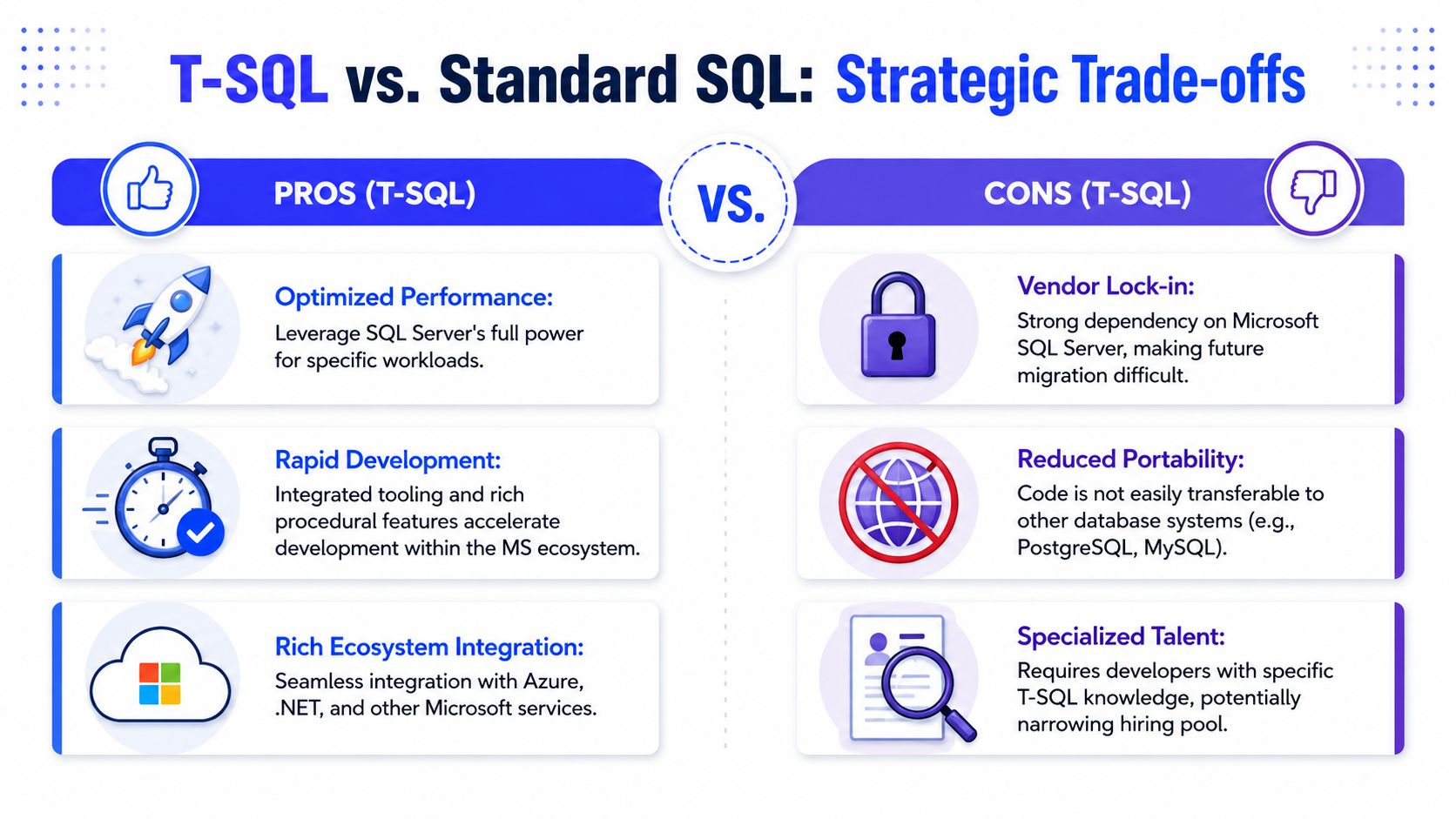
Think in terms of portability envelope
A portability envelope is the range of platforms where your database code can move with limited rewrite. Standard SQL keeps that envelope wider. T-SQL narrows it each time you rely on:
- stored procedure-heavy workflows
- trigger-based automation
- SQL Server-specific functions
- vendor-specific DDL patterns
- proprietary operational assumptions
That doesn't mean you should avoid T-SQL. It means you should price the lock-in accurately.
Mini-case for architecture reviews
Consider a SaaS company that launches on SQL Server because the internal team already knows Microsoft tooling. Early on, they move quickly with T-SQL procedures for billing adjustments, validation rules, and scheduled cleanup jobs.
Two years later, platform leadership wants optional support for PostgreSQL in a new deployment model. The data model can move. The hard part is everything around it:
- procedures need rewrites
- trigger behavior has to be rethought
- app services now duplicate old database logic during transition
- testing expands because two behavior models must match
No disaster happened. But the migration stopped being a database project. It became an application re-architecture.
A similar trade-off appears in broader database choices like Oracle vs PostgreSQL. The syntax differences are manageable. The hidden cost lives in the proprietary surface area you adopted over time.
What works well
Use T-SQL extensively when SQL Server is a durable platform decision and the database is part of your execution strategy.
Stay close to standard SQL when your business strategy includes acquisition flexibility, multi-cloud options, or uncertain future platform needs.
Portability debt behaves like any other architecture debt. It stays quiet until the business changes direction.
How Your Choice Impacts Hiring and Team Skills
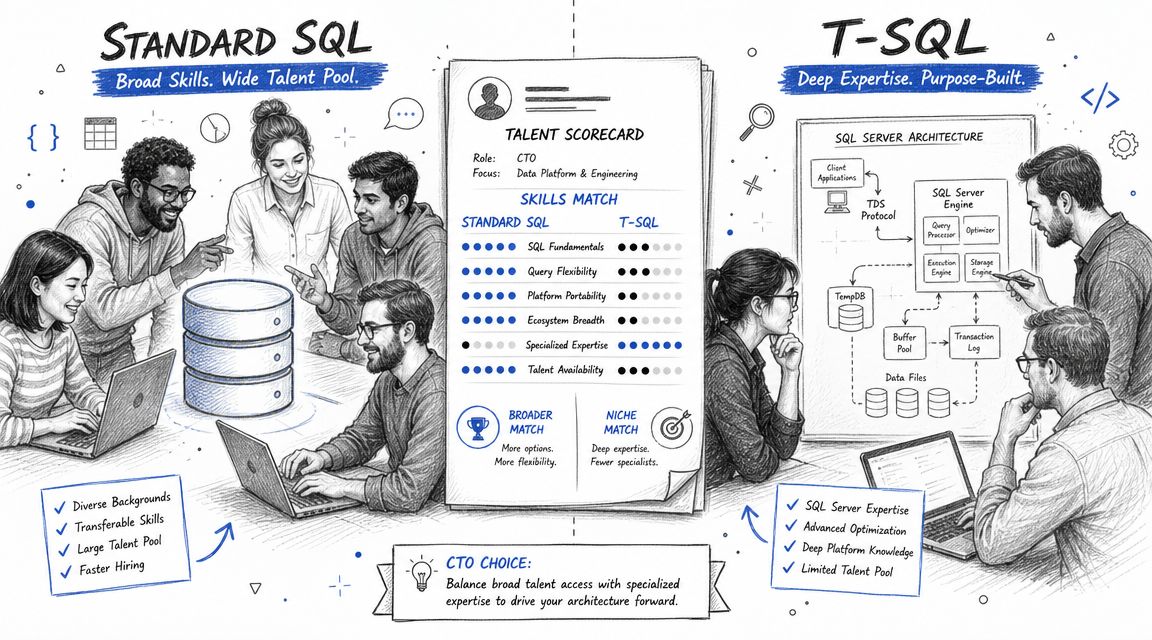
Your database language becomes part of your hiring spec, whether you write it down or not.
A standard SQL-first architecture usually gives you a broader recruiting lane. Data engineers, backend developers, analytics engineers, and DBAs from different backgrounds can contribute faster because the query layer looks familiar. A T-SQL-heavy stack asks for something narrower: engineers who understand SQL Server behavior, procedural database code, and often the surrounding Microsoft tooling.
What to screen for in interviews
If you choose T-SQL, don't just ask whether a candidate knows stored procedures. Ask whether they know when not to use them.
Useful interview prompts:
- Portability judgment: “How would you write this query so it works across SQL Server and another relational engine?”
- Operational maturity: “Tell me about a time database-side logic helped delivery, and a time it made maintenance harder.”
- Architecture reasoning: “When should validation live in the database versus in the application service?”
- Migration awareness: “Which T-SQL constructs would you flag first in a platform migration review?”
A practical team design rule
Match the architecture to the team you can build.
If your recruiting motion favors broad data and backend talent, keep the SQL layer more portable. If you have a stable SQL Server practice and dedicated ownership for database code, T-SQL can be a strength instead of a liability.
For leaders building those teams, working with specialists in data analytics recruiting can help clarify whether your hiring market supports a proprietary database strategy or whether a more portable approach is safer.
The best candidates won't only know syntax. They'll understand the business cost of putting logic in one layer instead of another.
Checklist and What to Do Next
Use this in your next architecture review.
- Confirm platform intent: Are you standardizing on SQL Server, or keeping future database options open?
- Map logic ownership: Which rules belong in the database, and which belong in services?
- Audit portability needs: Could this product need multi-cloud, acquisition integration, or database diversification?
- Assess team fit: Do you already have people who can maintain T-SQL procedures, triggers, and SQL Server operations?
- Set coding boundaries: Define which SQL constructs are allowed everywhere and which require explicit approval.
- Review deployment targets: If Azure SQL Database is in scope, verify T-SQL feature support early.
Three next steps usually work best:
- Run a short architecture review with engineering and data leads using the checklist above.
- Choose a default policy such as “portable SQL unless justified” or “T-SQL by design inside SQL Server services.”
- Align hiring with the decision before the codebase hardens around the wrong assumptions.
If you need senior engineers who can make these trade-offs well, not just write queries, ThirstySprout helps startups and enterprises hire vetted AI, data, and platform talent fast. Whether you need a SQL Server specialist, a portable data architecture lead, or a full remote team to build the system cleanly from day one, you can Start a Pilot or See Sample Profiles and scope the right team for your stack.
Hire from the Top 1% Talent Network
Ready to accelerate your hiring or scale your company with our top-tier technical talent? Let's chat.