

You're reviewing a support automation project. The team has labeled messages, a delivery target, and pressure to ship quickly. One engineer recommends support vector machines (SVMs) with term frequency-inverse document frequency features. Another argues for fine-tuned BERT. Both may be right, because the best text classification method depends less on novelty than on your labels, error costs, latency needs, and ability to maintain the system.
TLDR and Audience Overview
A text-classification project often starts with a practical constraint: route messages accurately without creating a system that becomes expensive to retrain or difficult to explain. Naive Bayes, logistic regression, and SVMs make strong baselines for sparse bag-of-words or TF-IDF features. They train quickly, require little inference overhead, and give a team a clear reference point. A 2023 survey of 118 papers found SVMs in 59% of studies and Naive Bayes in 46%, showing their continued practical role (survey of machine-learning text classification methods).
CNN and recurrent neural network approaches learn patterns that manual features may miss. Their added training, serving, and monitoring requirements make them a better fit when word order matters and the team can support neural model operations.
Transformer methods such as BERT are candidates when context, labeled data, and the value of better predictions justify their cost. They may improve quality, but the decision should include latency, hardware, evaluation, and ongoing maintenance rather than benchmark performance alone.
Production readiness also depends on the labels. A classifier trained for fixed categories can become unreliable when a new class appears or an existing definition changes. Teams need ownership for reviewing uncertain cases, tracking label drift, and deciding when retraining is justified. Open-world classification research addresses this problem directly.
Start with a measurable baseline. Upgrade only when it misses a defined business requirement, such as routing accuracy, response time, or review workload. Every increase in model complexity can bring more data preparation, infrastructure, testing, and maintenance work.
This guide is for CTOs and staff engineers comparing architectures, founders and product leads planning an AI feature, and procurement or talent teams assessing vendor risk. Remote AI teams can also use it to scope a working pilot within weeks instead of spending months optimizing a benchmark.
The practical question is: Which method reaches the required quality with acceptable cost, latency, explainability, and maintenance?
Core Concepts of Text Classification Methods
Text classification maps an input document to one or more predefined categories. A support ticket might receive an intent label such as billing question, bug report, or feature request. It might also receive a priority label such as low, medium, high, or critical. Those are separate classification tasks unless you deliberately model them together.
The mail-sorting analogy makes the workflow easier to see. Incoming text is the envelope. Class labels are folders. Features are the clues a clerk uses, such as words, phrases, sender information, or message length. The model learns how combinations of those clues correspond to folders.
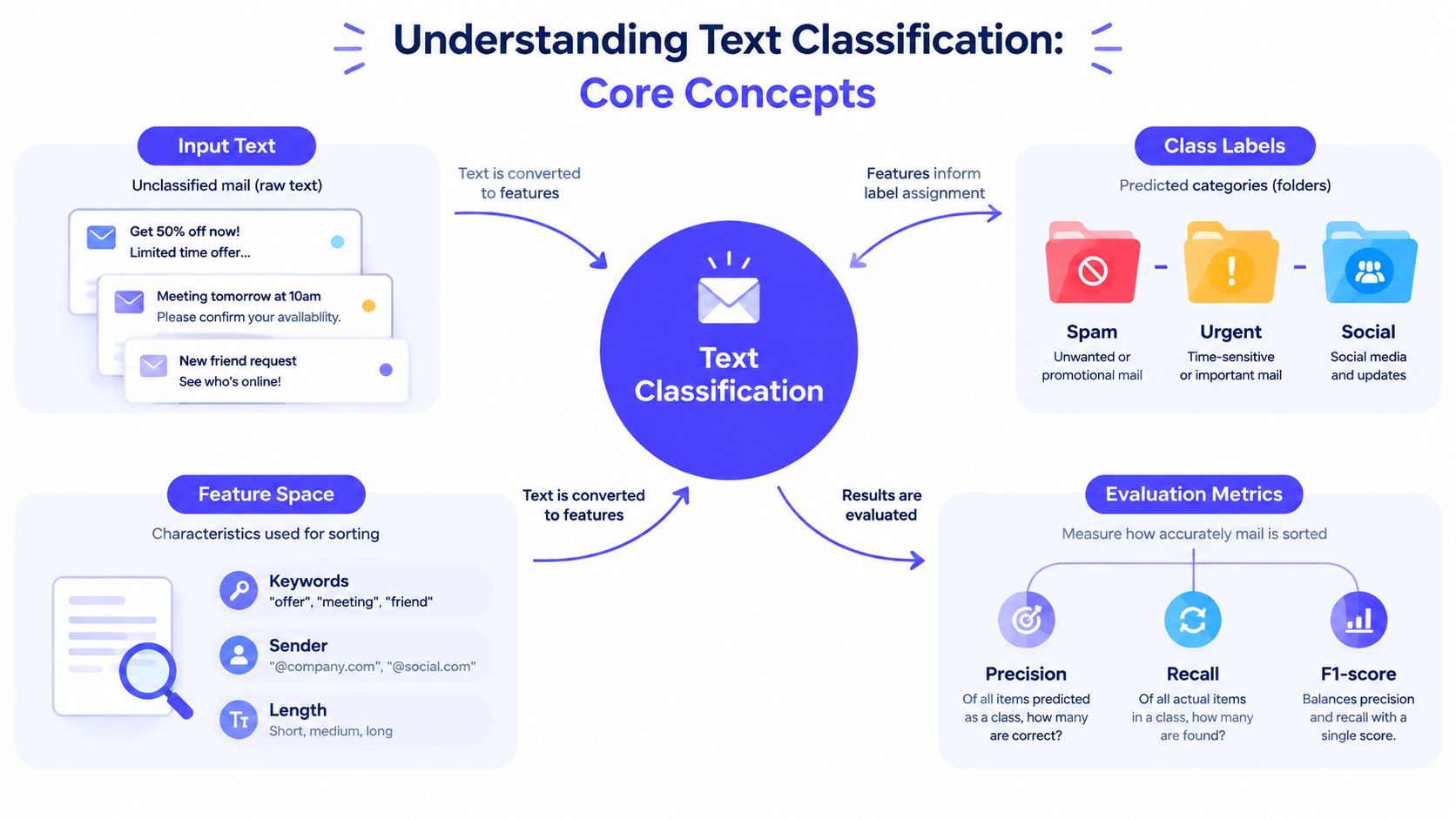
This diagram visually explains text classification by comparing it to sorting mail. It highlights key components: input text, class labels (folders), feature space (sorting criteria), and evaluation metrics (how accurately mail is sorted).
From raw text to a prediction
A typical pipeline has four steps:
- Define labels. Write a precise description for every class. “Urgent” should have an operational meaning, not just an emotional one.
- Represent the text. Traditional systems turn documents into sparse vectors using word counts, TF-IDF weights, or n-grams. Neural systems learn dense representations, often called embeddings.
- Train a decision rule. The model estimates which label best fits the representation. Some classifiers learn a separating boundary, while others estimate class probabilities or compare examples.
- Evaluate errors. Compare predictions with trusted labels, then inspect mistakes by class and by business consequence.
Accuracy can be useful when classes are balanced and errors have similar consequences. It can mislead when a common class dominates. Precision asks how often predicted positives are correct. Recall asks how many actual positives the system finds. F1-score combines both, making it useful when you need a balance between missed cases and false alarms.
Practical rule: Choose metrics from the workflow's risk. A missed fraud-related message and an incorrectly routed general inquiry shouldn't automatically carry the same cost.
The field's history explains why shared evaluation remains important. Text classification grew from early statistical language processing into a benchmark-driven research area by the 2000s, with publications increasing more than tenfold between 2000 and 2020. Reuters-21578, containing 21,578 newswire articles, became a classic test collection for comparing systems (historical survey of text classification). For broader context, see this introduction to natural language processing.
A closed-set classifier assumes the possible folders are known. An evolving-label system must cope with new folders, retired categories, and changing definitions. That difference affects your data pipeline, confidence thresholds, human review process, and release strategy.
Traditional Machine Learning and Feature Engineering
客服訊息若要分成退款、登入或配送問題,傳統方法會先把文字轉成模型可處理的特徵。Bag of Words 記錄詞語是否出現,或計算出現次數。TF-IDF 提高能區分文件的詞語權重,降低廣泛出現詞語的影響。N-grams 保留短語序,例如「password reset」或「not delivered」,讓模型看見單一詞語可能遺漏的意圖。
模型接著處理高維度、以稀疏值為主的矩陣。這類流程通常訓練成本較低,也容易檢查。團隊可以查看影響預測的詞語、移除雜訊特徵,並用產品或合規團隊能理解的語言解釋結果。對需要快速上線、資源有限的專案,這種可觀察性也能降低維護成本。
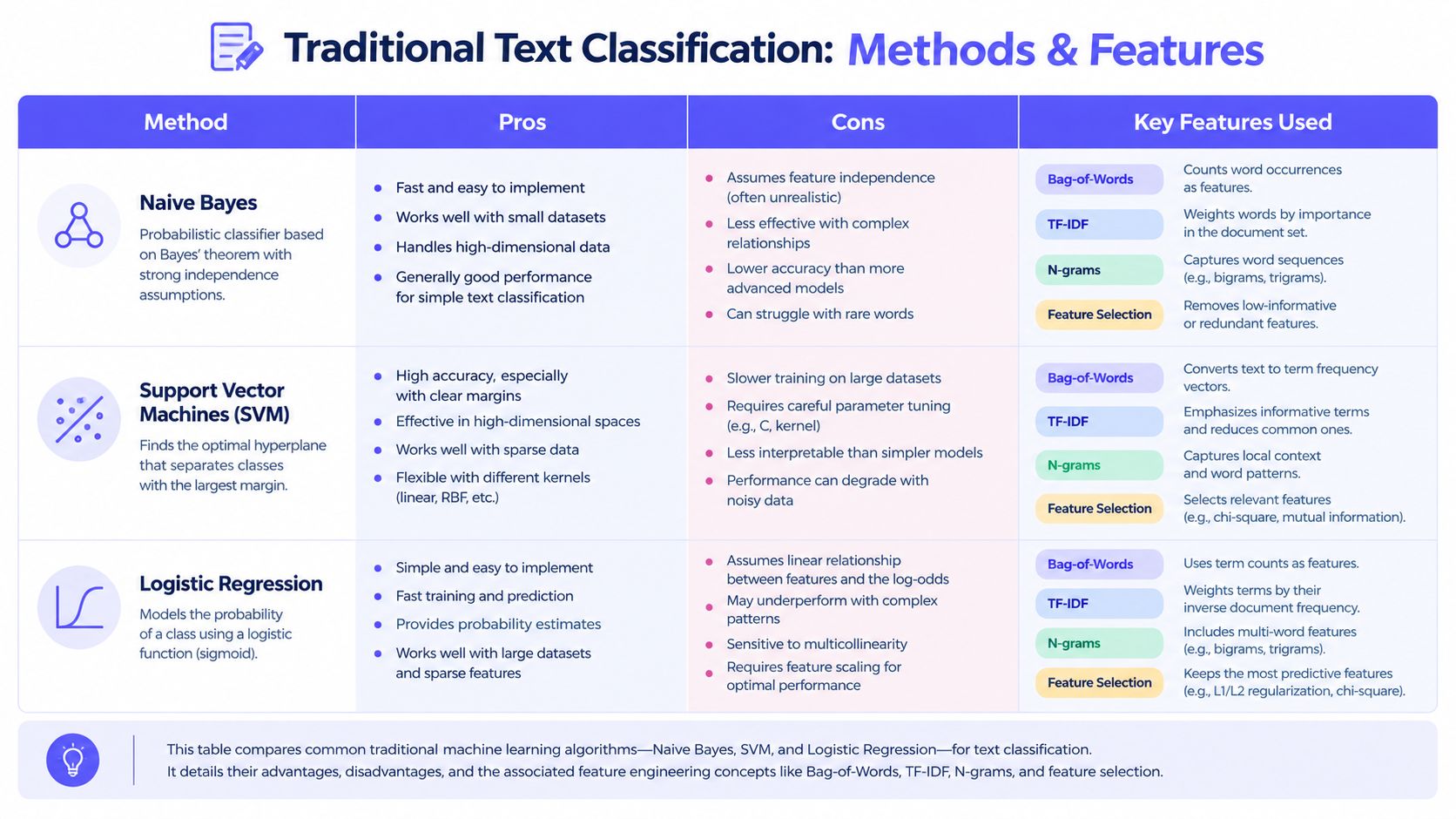
This table compares common traditional machine learning algorithms, Naive Bayes, SVM, and Logistic Regression, for text classification. It details their advantages, disadvantages, and the associated feature engineering concepts like Bag-of-Words, TF-IDF, N-grams, and feature selection.
What each classic model contributes
Naive Bayes 估計不同類別下詞語出現的可能性。它假設詞語彼此獨立,這並不符合自然語言,但在短篇、領域用語一致的文件上仍可能有良好表現。它適合作為第一個分類器,因為訓練快速、實作直接,也容易建立基準。若標籤定義或用語持續改變,團隊仍需定期重訓與檢查錯誤。
SVM 尋找能分隔類別、同時保留較大邊界的決策線。文字資料常形成高維度稀疏特徵空間,因此線性 SVM 往往適合這種輸入。一項以 20 Newsgroups 資料集進行的比較研究,報告 SVM 的 F1-macro 為 0.82,人工神經網路為 0.79,Naive Bayes 為 0.78(comparative text classification study)。
Logistic regression 根據特徵加權組合估計類別機率。這些機率可用於調整門檻、排列處理佇列,以及決定哪些案件交由人工覆核。它也能作為透明的診斷模型,讓團隊在投入更複雜架構前,先了解特徵和標籤是否真的提供足夠訊號。
Feature choices change the economics
特徵工程同時影響分類品質與運行成本。詞語 unigram 提供廣泛涵蓋,bigram 和 trigram 能捕捉意圖,卻會擴大特徵空間並增加記憶體需求。特徵選擇則可移除低頻詞、洩漏標籤資訊的詞,或反映不穩定用語的詞。對生產系統而言,這些選擇也決定新產品名稱、活動用語或客戶措辭改變後,模型需要多少維護工作。
可固定模型,只改變文字表示方式,建立一組容易重現的基準實驗:
| Experiment | What it tests | Production question |
|---|---|---|
| Word counts | Basic term presence | Is the task mostly keyword-driven? |
| TF-IDF | Discriminative wording | Do rare terms separate categories? |
| Word n-grams | Short phrase meaning | Do phrases define intent? |
| Character n-grams | Misspellings and variants | Is user-generated text noisy? |
| Feature selection | Signal versus noise | Can you reduce memory and review burden? |
傳統模型不代表品質一定較低。在所引用的 BBC 資料集比較中,SVM 和 Naive Bayes 都達到 F1-macro 0.97,人工神經網路則為 0.96。結果仍取決於資料集、標籤設計、前處理方式與評估切分。上線前也應監測標籤漂移,否則原本有效的特徵可能逐漸失去意義。
對初級團隊而言,先建立可重現的 SVM 或 logistic regression 基準,再評估更高成本的方法。若要了解其中的機率模型,可參考這份 Naive Bayes algorithm 教學。
Deep Learning and Transformer Based Methods
Neural methods reduce the amount of manual feature design. Instead of asking engineers to decide which terms or phrases matter, the model learns representations during training. TextCNN detects local patterns, such as short phrases. Long short-term memory networks, or LSTMs, process sequences while retaining information across tokens. Transformers use attention to relate words across a broader context.
That contextual behavior matters because the same word can signal different classes in different sentences. “Charge” may refer to billing in one message and battery behavior in another. A contextual embedding can represent the token differently based on surrounding language, while a basic bag-of-words representation treats the word more independently.
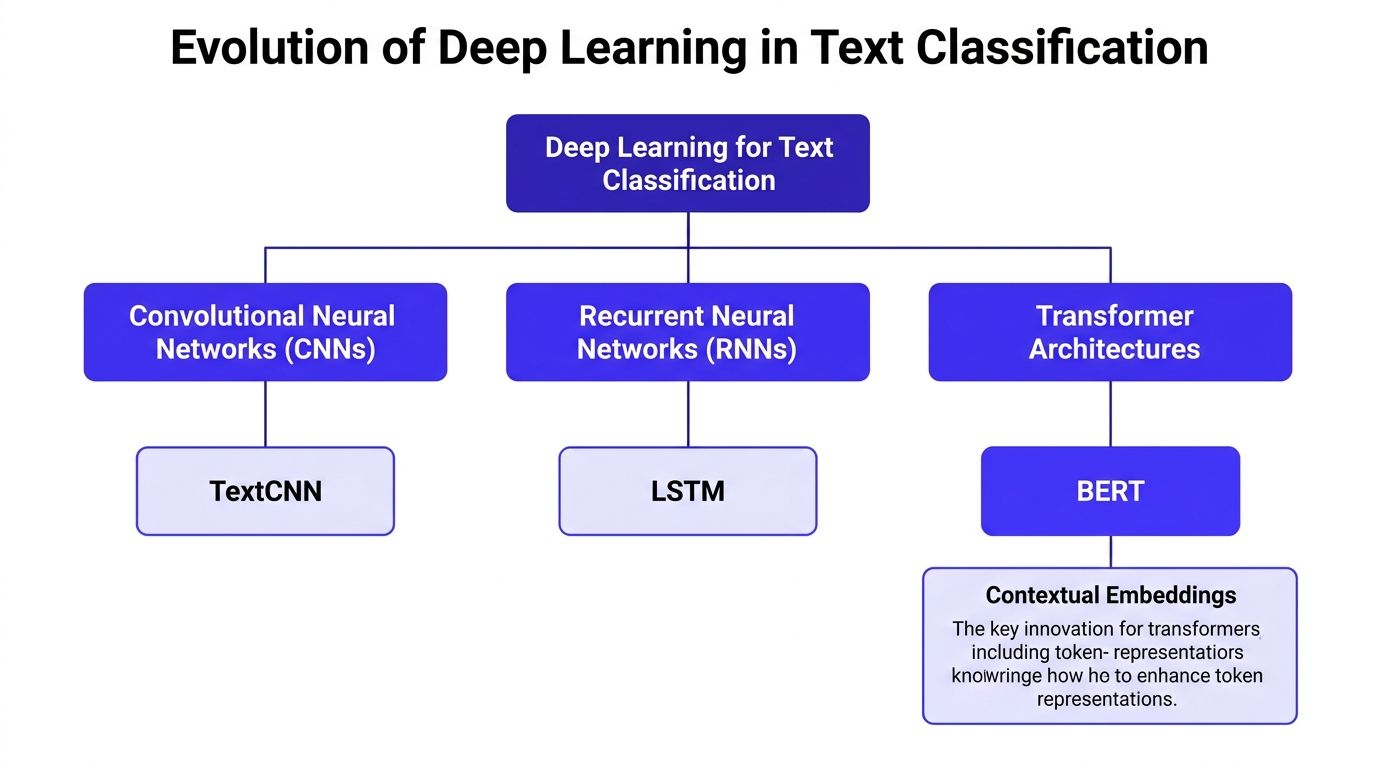
This hierarchy diagram showcases the advancement of deep learning methods for text classification, starting from specialized CNNs, TextCNN, and recurrent models, LSTM, to transformer architectures, BERT, emphasizing how contextual embeddings transform token representations.
Where BERT earns its complexity
BERT is an encoder-only transformer that can be fine-tuned for classification. Fine-tuning adapts pretrained language representations to your labels, rather than training every language pattern from scratch. That can help when class boundaries depend on context, wording variation, and domain language.
A benchmark for news classification reported 0.81 accuracy for headline-only BERT, ahead of the tested alternatives. Another reported 0.83 accuracy for BERT compared with 0.58 for TextCNN, demonstrating the potential advantage of contextual representations (news text classification benchmark).
The business value depends on the decision downstream. Better sentiment routing may help a support team prioritize escalation. Better ticket intent detection may reduce manual sorting. But a benchmark improvement only matters if it survives production conditions, including new phrasing, class imbalance, long documents, and changing policies.
For foundational terminology, this overview of large language models provides useful context. A classifier based on BERT isn't the same as a general-purpose conversational system, even though both may use transformer technology.
The hidden operating bill
Transformers require more planning than linear models. Your team must manage tokenization, sequence length, model packaging, accelerator or CPU capacity, batch behavior, inference latency, and regression testing. Fine-tuning also requires clean labels and repeatable experiments.
Pretrained models reduce the need to learn language from scratch, but they don't remove operational work. You still need versioned datasets, a stable validation protocol, confidence thresholds, and monitoring that tells you when incoming text no longer resembles training data.
Use a transformer when its contextual gains address a real error pattern. Don't choose it merely because it's newer.
Framework for Choosing the Right Method
Select the method by working through the workflow in order. This prevents a common failure mode, where a team chooses an architecture before defining labels, error costs, or service constraints.
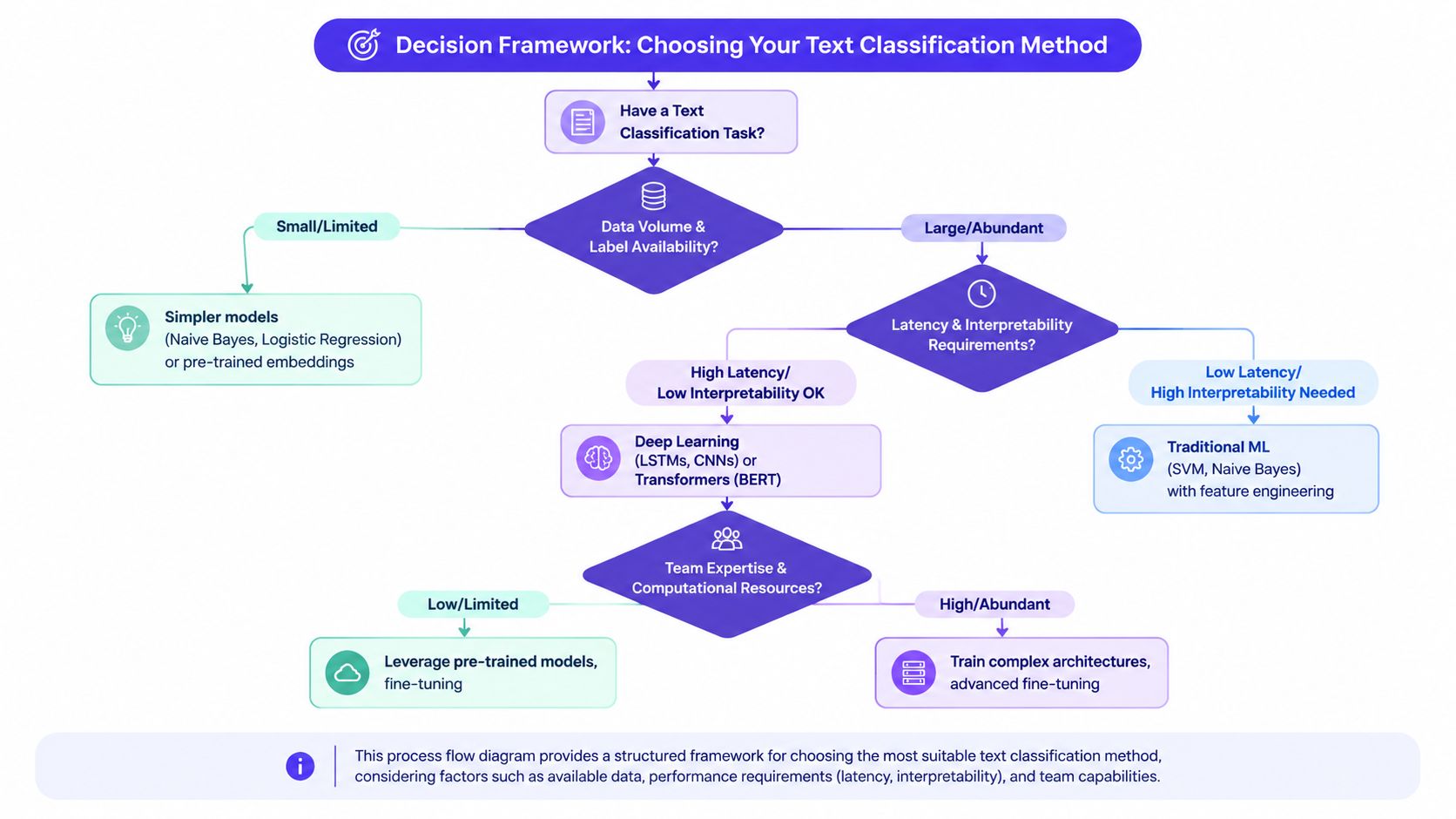
This process flow diagram provides a structured framework for choosing the most suitable text classification method, considering available data, performance requirements, latency, interpretability, and team capabilities.
Step one defines the decision
Write the action that follows a prediction. “Assign a category” is incomplete. “Send billing messages to the billing queue, while routing uncertain cases to a human” is testable.
Then document:
- Label meaning: What qualifies for each class, and what doesn't?
- Error cost: Which mistake creates more operational or customer risk?
- Review path: What happens when confidence is low?
- Success metric: Which class-level precision, recall, or F1 target matters?
Step two checks data and labels
If labeled data is limited, start with a simpler model or pretrained embeddings. Naive Bayes and logistic regression can establish a useful reference point without requiring a large neural training effort.
If you have abundant, representative labels, compare a linear baseline with a transformer. Keep the same train, validation, and test definitions so the comparison measures the method rather than a data split.
Step three applies production constraints
High interpretability and low latency favor traditional models. A sparse linear classifier can be easier to inspect, package, and scale. It also gives operators a clearer explanation when a prediction needs review.
If latency and interpretability constraints are looser, TextCNN, LSTM, or BERT may be appropriate. Your team should still measure actual serving behavior, not infer it from model size alone.
Step four prices maintenance
Count more than training compute. Include labeling, retraining, feature updates, model registry work, monitoring, incident response, and human review. A method with slightly better offline quality may have a weaker business case if it requires a much heavier release process.
A survey of text classification research notes that newer graph-based and large language model techniques don't consistently displace strong baselines. Encoder-only models such as BERT remain strong on many benchmarks, while logistic regression and trigram SVMs can outperform newer approaches on some datasets (survey of deep learning methods for text classification).
| Situation | First method to test | Why |
|---|---|---|
| Limited labels and clear wording | Naive Bayes or logistic regression | Fast baseline and simple iteration |
| Sparse, high-dimensional text | Linear SVM | Strong margin-based decision boundary |
| Stable taxonomy and contextual ambiguity | Fine-tuned BERT | Learns meaning from surrounding text |
| New labels or changing categories | Retrieval, review, or open-world design | Reduces dependence on a frozen label set |
| Strict explanation requirements | Linear model with inspected features | Easier to audit and communicate |
Use the simplest method that meets the decision requirement. Escalate after an error analysis shows exactly where the baseline fails.
Real World Examples in Production
A helpdesk classifier often has a modest task hidden inside a large message stream. Suppose a team receives a 100,000-message archive and wants to route tickets by intent. The right first move is not automatically a transformer. It's to inspect label quality, duplicate messages, class overlap, and the cost of misrouting.
Example one with SVM and TF-IDF
A practical baseline could use this representative configuration:
- Input: normalized subject and body text
- Representation: word and phrase TF-IDF features
- Classifier: linear SVM
- Fallback: human review below a selected confidence threshold
- Monitoring: class distribution, review rate, and sampled errors
The data pipeline should separate historical training messages from a later validation period when possible. That makes the test more realistic than randomly mixing messages from the same operational period.
The team would measure precision, recall, and F1 by intent, then review false positives and false negatives with support managers. If “billing question” and “payment failure” overlap, the problem may be taxonomy design rather than model selection.
Example two with fine-tuned BERT
A social media team may face shorter, more varied messages where context and tone matter. A fine-tuned BERT classifier can be a candidate when the team has trusted sentiment labels and needs to distinguish subtle positive, neutral, and negative language.
A representative serving flow looks like this:
- Ingest post text and metadata permitted by the product policy.
- Apply the same tokenizer used during training.
- Run the classifier and store label probabilities.
- Send low-confidence or policy-sensitive cases to human review.
- Sample predictions over time for relabeling and drift analysis.
The team should compare this system with the SVM baseline on the same holdout data. It should also test latency under realistic traffic, because a quality gain that delays moderation or routing may create a different business problem.
Production lesson: Offline scores select candidates. Error review and service measurements decide what ships.
For research-heavy teams, Tools for document analysis and research can help organize source material and compare documentation while you define labels and review edge cases. Treat such tools as support for the workflow, not as substitutes for labeled evaluation.
Neither example proves that one method always wins. The helpdesk may favor a transparent linear model. The sentiment system may justify BERT because contextual ambiguity drives costly errors. In both cases, the team needs a fallback, a validation set, and an owner for label changes.
Implementation Checklist and Next Steps
Use this checklist as a production handoff for the machine learning team:
- Define labels: Set inclusion and exclusion rules for each class, with examples of ambiguous cases.
- Sample data: Confirm that training examples reflect current traffic, document lengths, and difficult edge cases.
- Review annotation: Ask a subject matter expert to inspect disagreements and unclear samples.
- Build a baseline: Train Naive Bayes, logistic regression, or SVM before testing a heavier architecture.
- Validate by class: Track precision, recall, and F1 for each class, not only aggregate accuracy.
- Test latency: Measure end-to-end response time under realistic concurrency.
- Set a fallback: Send uncertain predictions to human reviewers or a safe default.
- Monitor drift: Watch label frequencies, vocabulary, confidence patterns, and review outcomes.
- Plan new classes: Define how operators propose, test, and release labels absent from the original training data.
- Control cost: Reuse features, batch inference where appropriate, and retrain only when error analysis supports it.
- Run a pilot: Evaluate a production-like workflow over 2–4 weeks, with a named technical owner and business reviewer.
- Evaluate vendors: Check model versioning, data isolation, export options, audit logs, monitoring, and support for changing taxonomies.
Production readiness includes ownership after launch. Label drift can make yesterday's classifier misclassify today's messages, while new classes may require annotation rules, retraining, and regression tests. Assign responsibility for reviewing errors, approving taxonomy changes, and deciding when maintenance cost exceeds the benefit of a more complex model.
A practical pilot should compare quality, latency, infrastructure use, review workload, and failure handling. A model that improves F1 but requires expensive inference or frequent relabeling may be a poor business choice. Keep a simple baseline so the team can measure whether added complexity continues to pay for itself.
If you're comparing an internal build with external support, ThirstySprout can connect you with remote AI engineers and machine learning teams experienced in classification, evaluation, and production MLOps. Visit ThirstySprout to start a focused scope conversation, review suitable profiles, and plan a pilot around your labels and operational constraints.
Hire from the Top 1% Talent Network
Ready to accelerate your hiring or scale your company with our top-tier technical talent? Let's chat.