

You're hiring a new analytics team, and the first real fight shows up before the first model ships. Your senior econometrician wants Stata because it's predictable, auditable, and familiar to the people who will review the work. Your newer data scientists want R because they need flexibility, modern modeling packages, and a path to production without buying another seat every time the team grows.
If you're the CTO, that's not a tooling argument, it's a cost, hiring, and operating-model decision. Standardize the wrong way and you pay for it in slower onboarding, weaker collaboration, and a stack the next team doesn't want to touch. Standardize the right way and you make recruiting easier, keep workflows reproducible, and avoid paying twice for the same analysis.
| Decision factor | Stata | R |
|---|---|---|
| Best fit | Traditional statistical analysis, econometrics, social science workflows | Custom analytics, machine learning, production data science |
| Access model | Proprietary, paid licensing | Free and open-source under GNU GPL |
| Ecosystem | Smaller, more curated extension set | 20,000+ CRAN packages plus Bioconductor |
| Team profile | Analysts who value point-and-click workflows and standardized routines | Programmers, data scientists, and teams building software-like analytics |
| Business trade-off | Lower training friction in some research teams, but licensing overhead | Lower software access cost, but more engineering discipline required |
Stata vs R The Strategic Choice for Your Team
A startup team usually doesn't choose between Stata and R in the abstract. It chooses between the tool your legacy advisor trusts and the tool your new hires already expect to use. That's why this decision lands in procurement, hiring, and delivery speed, not just in methodology.
My recommendation is simple. If your team's output is mostly publishable research, policy analysis, or regulated statistical reporting, standardize on Stata. If your team needs to build custom analytics, production models, or software-adjacent data products, standardize on R. The split isn't academic, it's operational.
A useful way to think about it is through ownership. R is open source and free, while Stata is proprietary and licensed commercially. NYU's statistical software guide notes that R first appeared publicly in 1993, and that this free access lowers adoption barriers across universities, nonprofits, and startups, while proprietary licensing often fits standardized institutional workflows better (NYU statistical software guide). That difference shapes who joins your team, how fast they ramp, and what your recurring software bill looks like.
If you need a hiring benchmark to sanity-check compensation strategy, a practical place to start is the guide to data scientist salaries in LATAM. It won't decide the software for you, but it helps frame what the broader R-native talent market tends to look like when you're building a distributed team.
Practical rule: Pick the tool that matches your operating model, not the tool that one senior hire prefers.
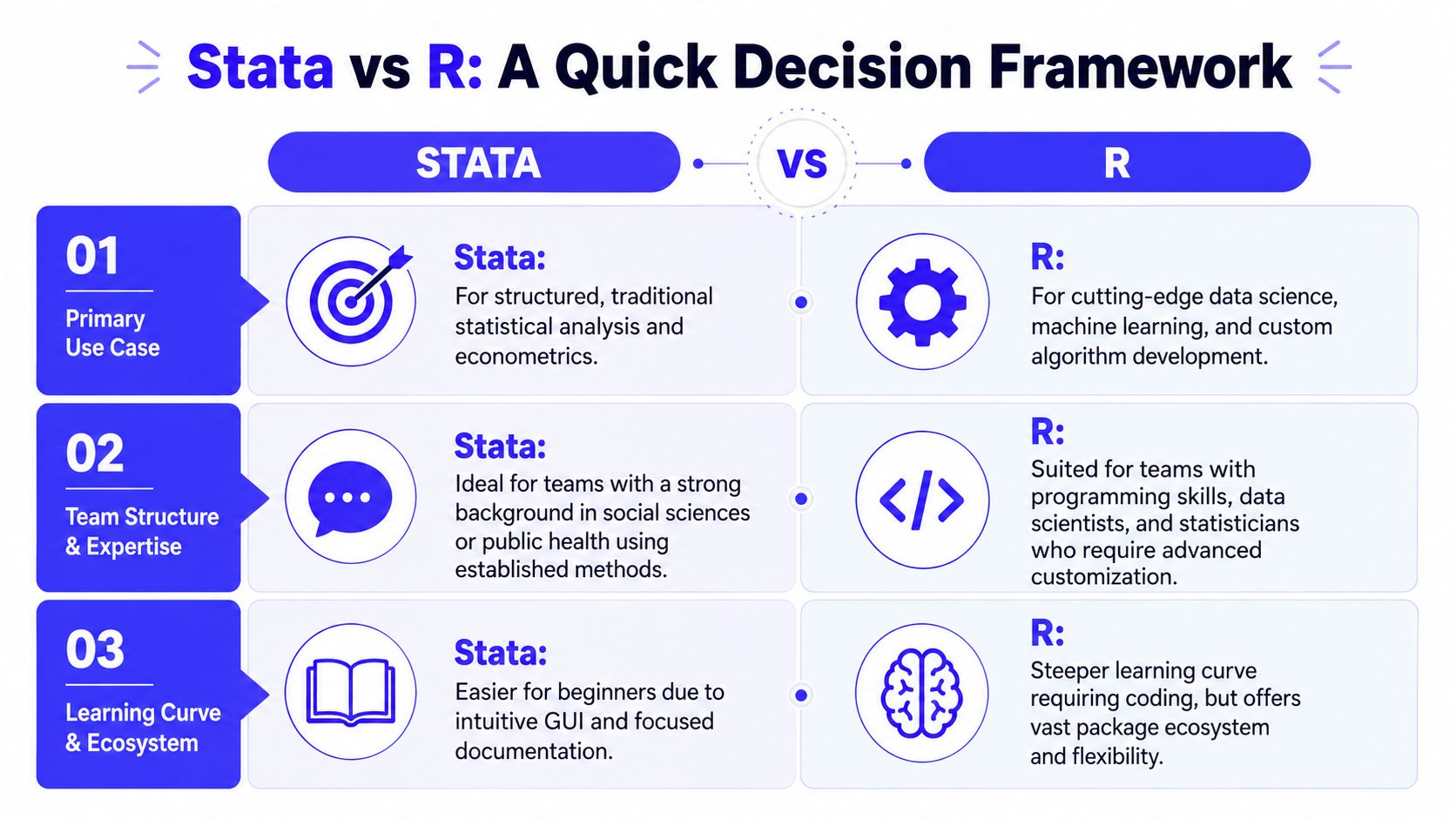
A Quick Decision Framework for Choosing
Start with what your team must ship, and standardize from there. If the deliverable is a paper, a policy memo, a thesis, or a replicable academic analysis, Stata is the safer default. If the deliverable is a model, an internal analytics service, or a pipeline that has to connect cleanly with other software, R is the stronger choice.
Use case first
Stata has a durable niche in econometrics and social-science research because teams value validated routines, consistent syntax, and disciplined workflows. R is broader and more extensible, especially when the work moves into visualization, machine learning, and custom modeling. That split is why many comparisons describe R as the wider platform, while Stata remains concentrated in specific research domains.
Team structure second
If your team is built around economists, public-health researchers, or analysts who rely on familiar statistical procedures, Stata cuts down friction. If you are hiring data scientists, ML engineers, or analysts who need to write code, integrate APIs, and maintain reusable packages, R fits better. The key question is not which interface looks nicer, it is which talent profile you can hire repeatedly without retraining every new person from scratch.
For a concrete look at how R shows up in practice, the R programming language examples page is a useful reference point.
Budget third
Stata's licensing model creates recurring cost and procurement overhead. R removes software licensing from the equation, but it does not remove engineering discipline, package management, or support needs. That trade-off matters most when you are scaling a team and every extra seat or renewal goes through finance.
Decision shortcut: If the work must be reproducible in a research setting, choose Stata. If the work must be extensible in a product stack, choose R.
Two Real-World Examples Stata and R in Action

A university public health department and a fintech startup can both be “doing statistics,” but they don't need the same tool.
Academic workflow that rewards Stata
The public health team is analyzing survey data for a paper on healthcare access. They care about documented methodology, auditability, and a workflow that the department can review without improvising. Stata fits that environment because its statistical routines are well established, its syntax is familiar in academic settings, and the team can keep its work aligned with field standards.
That same team also cares about consistency across multiple researchers. Stata's closed workflow can be a feature here, not a limitation, because it reduces variation in how analyses get run and reported.
Product workflow that rewards R
A fintech startup is building churn prediction into its customer platform. The team needs to move from exploration to a deployed API quickly, and it needs a codebase that other engineers can maintain. R fits that path because it supports custom modeling, package-driven workflows, and production interfaces in ways that map better to modern software teams.
If you want a concrete feel for how R gets used in practice, the internal R programming language examples page is a useful companion. It shows the kind of coding patterns your team will maintain if you choose the more extensible route.
The important distinction is this. Stata helps a team produce trusted statistical output fast. R helps a team turn statistical work into software.
A Deep Dive on Technical Capabilities
Core statistics and model breadth
Stata's advantage is not that it can do statistics and R cannot. It's that many of Stata's core commands are packaged as validated, ready-to-run routines that fit common econometric and social-science work. That reduces decision fatigue for teams who want a stable workflow instead of a coding sandbox.
R's strength is the opposite. It gives you breadth, especially when your use cases move beyond standard regression into specialized machine learning, custom algorithms, and advanced visualization. If your team expects to discover new methods, not just repeat known ones, R gives you room to grow.
Ecosystem and extensibility
R's package ecosystem is one of its biggest business advantages. CASRAI notes 20,000+ CRAN packages plus Bioconductor, while Stata has a much smaller user-written extension archive (CASRAI comparison). That matters because ecosystem size translates into faster experimentation, more reusable tooling, and less time spent rebuilding common functionality.
Stata's smaller ecosystem can still be an advantage when your team values curation over sprawl. Fewer moving parts often means fewer choices to police. That's useful in organizations where consistency matters more than experimentation.
Performance and workflow
For estimation-heavy workloads, Stata often has the edge in raw runtime because many core commands are compiled. One comparative benchmark reported Stata was 5–8 times faster than R on several generalized linear and ordinal models, including multinomial logit at 9.06 seconds in Stata versus 50.59 seconds in base R's multinom (speed benchmark). That doesn't make Stata universally faster, but it does matter if your team spends all day fitting the same class of models.
R can also be fast when you use optimized libraries. A benchmark guide covering datasets from 100 MB to 5 GB reports that data.table and dplyr are generally about an order of magnitude faster than Stata for routine data manipulation tasks, which makes R a strong choice when the bottleneck is data wrangling rather than model fitting (Statalist benchmark discussion).
Reproducibility and day-to-day collaboration
Stata's do-files and log files suit teams that want a clear record of what ran and what changed. R's workflow is more naturally tied to version control, dynamic reports, and code-first collaboration. If your engineers already live in Git and ship code through review, R tends to fit the rest of the stack more cleanly.
You'll also feel the difference in interface choice. The internal R GUI vs RStudio guide is relevant if you're deciding how much training overhead you're willing to absorb for new hires. GUI-heavy comfort can help early adoption, but code-centric workflows age better in product organizations.
Business Impact Cost Hiring and Integration
Total cost of ownership
A software choice that looks cheap on paper can get expensive fast once you add onboarding, maintenance, and handoffs between analysts and engineers. Stata makes the direct license cost obvious. R shifts more of the spend into implementation quality, package upkeep, and internal support. Ultimately, the question is not which tool has the lower sticker price, it is which one gives you the better outcome for every fully loaded team hour you spend.
For a small research group, Stata can be the lower-friction option because it shortens onboarding and keeps the workflow steady. For a growing data team, R usually makes more sense because it avoids per-seat licensing and fits a larger mix of analysts, engineers, and model builders without turning every new hire into a procurement decision.
Hiring market reality
Stata hiring is concentrated in narrow domains. A market overview reports usage across 1,007 companies, about 0.4% market share in the Analytics category, with 57% of users in the United States, 13% in Italy, and 33% in Higher Education (Statssy market overview). That points to a real labor pool, but a limited one. If you standardize on Stata, you narrow your recruiting funnel.
The broader signal is relevance, not hype. Public discussion still asks whether Stata remains relevant, and that discussion is mostly community chatter rather than current labor-market evidence (Reddit discussion on Stata relevance). For a CTO, that is enough to make R the safer default. It maps better to modern analytics engineering teams and gives you a wider base of candidates who already work in code-first environments. The analytics engineering guide is useful here because it aligns more closely with the cross-functional profiles that tend to pair well with R.
Integration with modern stacks
If your team needs to connect analytics work to cloud warehouses, CI/CD pipelines, or microservices, standardize on R. Its package-driven workflow fits production systems and code review culture better. Stata can handle controlled research work very well, but it is not the first choice for a team that needs to ship analytics into operational systems.
Hiring and stack design should match. The internal hire a data scientist guide is useful as a recruiting reference, because the software you choose shapes the profile you should hire. If you ask for one tool while your stack runs on another, you force new hires to translate constantly, and that slows the team from day one.
Your Stata vs R Decision Checklist
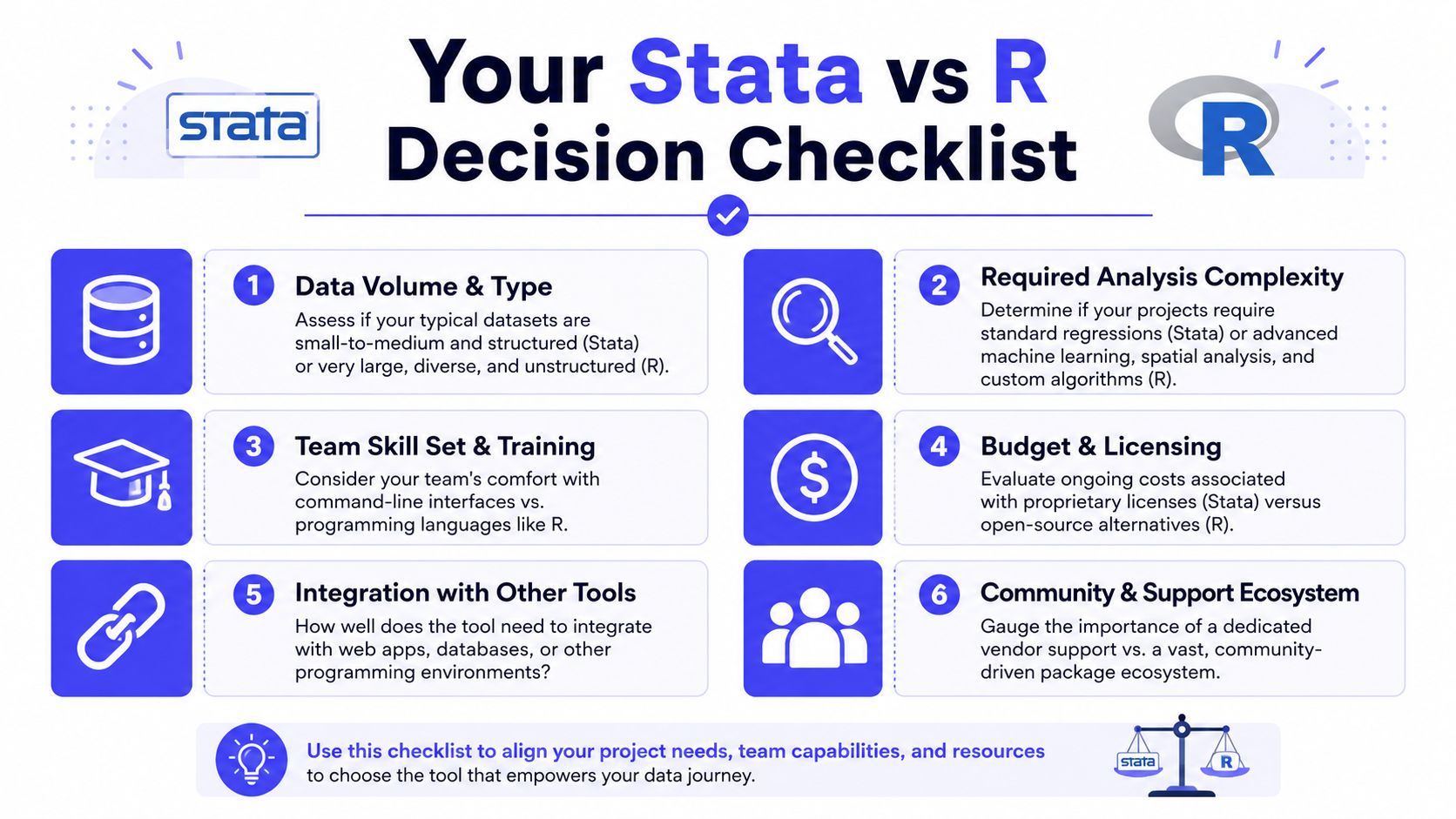
Use this checklist in your planning meeting and score each item objectively.
1. Primary workflow
- Research-first: Choose Stata if your output is mostly publishable analysis, policy work, or academic reporting.
- Production-first: Choose R if the output needs to plug into applications, APIs, or automated pipelines.
2. Team skills
- Economists and statisticians: Stata fits teams that already think in established statistical routines.
- Programmers and ML engineers: R fits teams that write and review code as part of daily work.
3. Budget model
- License-heavy environment: Stata may fit if your organization already budgets for proprietary software and support.
- Scale-efficient environment: R usually wins when you want to avoid per-seat software cost.
4. Technical stack
- Closed analysis workflow: Stata works well when the analysis stays inside a controlled environment.
- Integrated software stack: R fits better when analytics must share data and code with the rest of the engineering system.
5. Scalability and complexity
- Standard models, standard outputs: Stata is strong when the models are familiar and repeatable.
- Custom models, custom product logic: R is stronger when you need to extend methods or automate them.
Final scoring rule: If 3 or more items lean toward production, integration, and extensibility, pick R. If 3 or more lean toward validated research workflows, pick Stata.
How to Build Your High-Performing Data Team
Choosing the tool does not solve the staffing problem. It changes the hiring profile. Standardize on R if you want people who write clean code, document their work, and can support analytics that grow into products. Standardize on Stata if you want people who are strongest in statistical rigor, repeatable analysis, and consistent reporting.
A primary risk is a mismatch between the stack and the team. A group can choose Stata and later need software-style analytics, or choose R and then find that nobody is prepared to own code quality, testing, or shared conventions. The right hire profile follows the tool choice, not the other way around. For a practical hiring lens, the internal hire a data scientist page is the next step, and if you are comparing team structures more broadly, the analytics engineering guide gives a useful view of adjacent roles.
For CTOs building fast, tool standardization should follow talent access and total cost of ownership. If your team needs specialists who can plug into an existing stack without a long ramp, ThirstySprout connects companies with senior data and AI talent that can start a pilot in 2 to 4 weeks. Book a 20-minute scope call, define the work, and put the right expert in motion instead of letting the decision drag on for months.
Hire from the Top 1% Talent Network
Ready to accelerate your hiring or scale your company with our top-tier technical talent? Let's chat.