

TL;DR
- Choose a Framework: Use Scrum for complex products needing iterative feedback and Kanban for continuous workflows like MLOps or support.
- Structure for Speed: Build cross-functional teams with a Product Manager (the "why"), Tech Lead (the "how"), and Engineering Manager (the "who") to maximize autonomy and reduce hand-offs.
- Measure Impact, Not Activity: Track DORA metrics—Cycle Time, Lead Time, Change Failure Rate, and Mean Time to Recovery (MTTR)—to measure team velocity and stability. Avoid individual metrics like lines of code.
- Automate Everything: Implement a CI/CD pipeline to automate testing, security scans, and deployment. This reduces human error and frees up engineers to solve high-value problems.
Who this is for
- CTOs & Heads of Engineering who need a reliable system for shipping high-quality software predictably, especially when managing remote or AI-focused teams.
- Founders & Product Leads responsible for scoping projects, defining team structures, and connecting engineering output to business goals.
- New Engineering Managers looking for a practical playbook to build a high-performing team from the ground up.
The Blueprint for Engineering Success
Software development management is the system that turns ideas into high-quality, functional software. It’s the art of balancing scope, budget, and deadlines while keeping your team productive and aligned with business goals.
Without a solid management framework, development becomes chaotic. Deadlines slip, code quality drops, and developer burnout becomes a serious risk. A strong structure transforms that chaos into an efficient, scalable process that connects engineering work directly to business impact.
Four Core Pillars
To build a high-performing team—especially one that is remote or building AI products—you need to master four essential pillars. Get these right, and you're on your way.
- Proven Methodologies: Frameworks like Agile, Scrum, and Kanban are playbooks for how your team gets work done. They provide a structured system for planning, executing, and shipping software predictably.
- High-Impact Team Structures: Organizing your people correctly clarifies roles, streamlines collaboration, and empowers engineers to own their work.
- Essential Performance Metrics: You can't improve what you don't measure. Key Performance Indicators (KPIs) like Cycle Time and Change Failure Rate provide an objective, data-driven view of your team's speed, quality, and efficiency.
- Modern Tool Stacks: The right tools act as force multipliers. Project management platforms and automated CI/CD pipelines eliminate manual work, freeing up engineers to focus on creative problem-solving.
This guide dives into each pillar with practical frameworks and real-world examples to help you build a resilient development process.
Core Pillars of Software Development Management
Each pillar supports the others, creating a stable foundation that allows engineering teams to deliver meaningful business value consistently.
Choosing Your Development Framework
The way you build software is just as important as what you’re building. Your development framework sets the rhythm for your team—defining how you communicate, plan, and adapt to change.
A nimble AI startup racing to market needs speed and flexibility, making a framework like Scrum a good fit. In contrast, a large financial institution migrating a core system needs predictability and thorough documentation, where a more traditional approach might be necessary.
This is where you map out your journey. Your methodology, team structure, and metrics are interconnected.
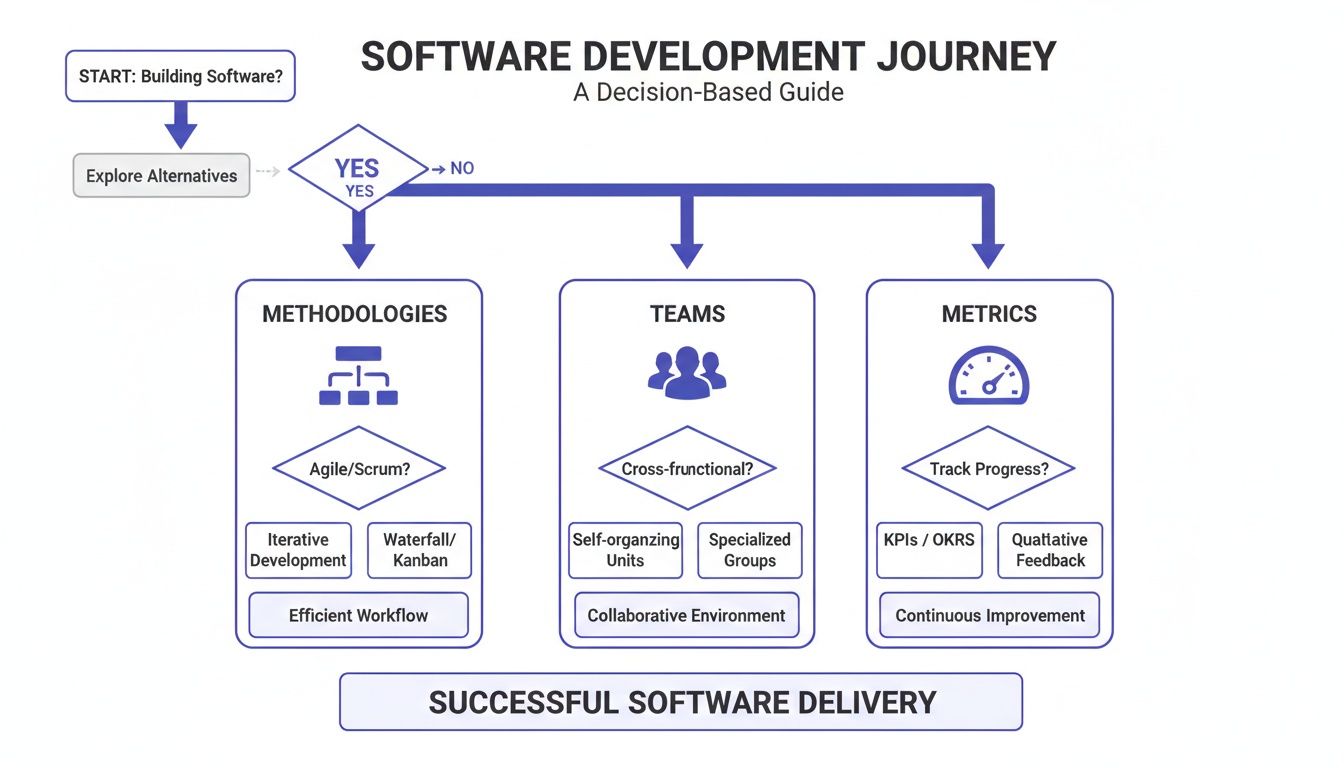
The framework you choose directly influences who you need on your team and which KPIs matter most.
Agile and Its Flavors: Scrum and Kanban
Most modern software teams operate under the Agile umbrella, a philosophy built on shipping in small increments and adapting to customer feedback. Teams typically use specific frameworks like Scrum or Kanban to put these principles into practice.
Scrum: Best for complex projects where requirements are not fully known upfront. Work is broken into fixed-length cycles called sprints (usually 2–4 weeks), with the goal of delivering a working piece of the product at the end of each. This is ideal for product development where you need to release a feature, get user feedback, and adjust.
Kanban: This framework focuses on visualizing workflow and maintaining a smooth, continuous flow of work. It’s perfect for teams managing a constant stream of tasks, like a support engineering or MLOps team. There are no sprints; the team pulls the next highest-priority task from the backlog as soon as they have capacity.
A simple way to decide? If your work arrives in planned batches, start with Scrum. If it's a continuous, unpredictable stream, Kanban will likely be a better fit.
The Waterfall Model: When Predictability Is Paramount
The Waterfall model is a linear approach where you must complete one phase (requirements, design, coding, testing) before starting the next. While often seen as rigid, it is the right choice in specific situations.
Waterfall excels in environments where requirements are clear, fixed, and unlikely to change. This is common in projects where safety and compliance are critical, such as developing software for medical devices or aerospace. The heavy upfront investment in planning and documentation is a feature, not a bug, as it drastically reduces risk in these high-stakes fields.
A Practical Decision Framework
Choosing a framework isn’t a permanent commitment. The best managers are pragmatic, often mixing elements to create hybrid models that fit their team's needs.
Here’s a quick scorecard to guide your decision:
The goal is to find a system that removes friction. Start with the framework that best fits your current reality, and don't be afraid to adapt it as your team and projects evolve.
Structuring High-Performing Engineering Teams
Effective software development management requires building the right team structure. A good structure creates an environment of autonomy and clear ownership, while a poor one leads to confusion and delays, regardless of your methodology.
The goal is to form teams that are aligned with business needs and empowered to determine how to achieve them. This starts with defining roles clearly and establishing predictable collaboration patterns.
Core Roles And Responsibilities
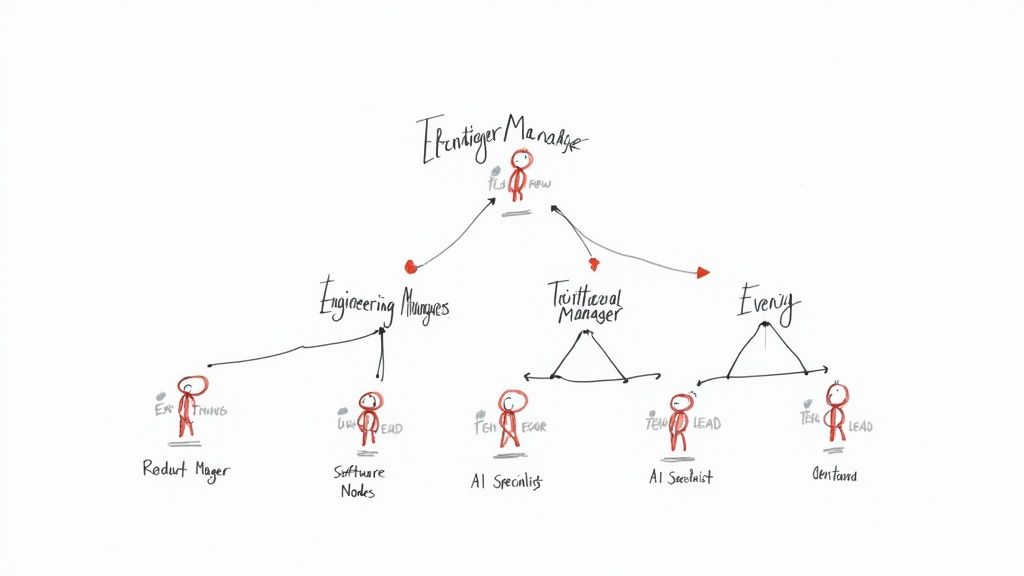
Most modern software teams are led by a collaborative trio, each balancing a vital part of the equation.
- Product Manager (PM): The PM is the voice of the customer and the business, owning the "what" and the "why." They manage the product vision and prioritize the backlog to ensure the team builds something valuable.
- Engineering Manager (EM): The EM focuses on the people—the "who" and "how." They are responsible for hiring, career growth, performance management, and removing roadblocks to cultivate a healthy engineering culture.
- Tech Lead (TL): The TL owns the technical execution. They guide architectural decisions, uphold code quality, and mentor other engineers on the team.
When a team is effective, these three roles operate in a state of healthy tension. The PM pushes for more features, the TL advocates for technical quality, and the EM ensures the team has the skills and capacity to deliver.
Choosing Your Team Organizational Model
The two most common models for grouping engineers involve a trade-off between specialization and speed.
Functional Teams: Engineers are grouped by expertise (e.g., frontend team, backend team). This model fosters deep domain knowledge and consistent standards but can create communication silos and hand-off delays.
Cross-Functional Teams: All necessary skills (frontend, backend, QA, design) are combined into a single unit. This structure is built for speed and autonomy, eliminating most external dependencies. For a deep dive, see our guide on https://www.thirstysprout.com/post/cross-functional-team-building.
For most modern product development, especially in remote settings, the cross-functional model is superior. It aligns well with Agile principles by empowering small, focused teams. Effectively managing a distributed team is also simpler with this structure.
Practical Example: RAG Project Team Composition
Let's make this real. Imagine you are building a new internal support tool powered by Retrieval-Augmented Generation (RAG) with a 3-month timeline. An effective cross-functional team might look like this:
- 1 AI Product Manager: Defines use cases and success metrics.
- 1 Staff ML Engineer (acting as Tech Lead): Architects the RAG pipeline.
- 2 Python/Backend Engineers: Build data ingestion, vectorization, and API layers.
- 1 Frontend Engineer: Creates the user interface for support agents.
- 1 MLOps Engineer (part-time): Sets up the CI/CD pipeline for updating models and prompts.
This structure puts all the necessary skills in one place, enabling the team to move quickly and solve problems without external dependencies.
Measuring What Matters with Engineering KPIs
You can't improve what you don't measure. Gut feelings are not enough to build a high-performing software team. The key is to focus on a few Key Performance Indicators (KPIs) that provide an honest look at your engineering health.
The right metrics create a common language between engineering and the business, translating technical work into tangible outcomes like speed, quality, and predictability. This helps you identify problems early and celebrate wins with hard data.
Delivery and Velocity Metrics
These metrics measure the speed and rhythm of your development pipeline, from the first line of code to deployment.
- Cycle Time: The time it takes for a task to go from "in progress" to "done." A short cycle time (ideally under 3 days) indicates an efficient workflow without bottlenecks.
- Lead Time: The total time from when an idea is logged in the backlog to when it’s live for users. Lead Time measures your overall responsiveness to new requests.
If your Cycle Time is short but Lead Time is long, your team builds fast, but work is sitting idle in the backlog. This signals a prioritization problem, not a development one.
Avoid vanity metrics like "story points per sprint." Teams often game these by inflating estimates. Cycle Time and Lead Time are more honest because they measure the actual flow of value.
Quality and Stability Metrics
Moving fast is meaningless if you are constantly shipping bugs. Quality metrics, often called the DORA metrics, measure the stability of your production environment.
- Change Failure Rate (CFR): The percentage of deployments that cause a production failure. Elite teams keep their CFR below 15%. A high rate indicates issues in your testing or deployment process.
- Mean Time to Recovery (MTTR): When an issue occurs, how quickly can you fix it? MTTR measures the average time from detection to resolution. Top teams often achieve an MTTR of under one hour.
A low CFR and a low MTTR are hallmarks of a mature engineering team that can move quickly without sacrificing stability.
Efficiency and Business Impact Metrics
Finally, connect engineering activity to business value. These metrics help you understand your team's efficiency and impact.
- Code Churn: How often is new code heavily modified or deleted shortly after being committed? High churn suggests wasted effort, likely due to unclear requirements or technical debt.
- Time-to-Value (TTV): The time from the initial feature request to the moment customers gain value from it. TTV directly ties your development process to business outcomes.
Ultimately, you are building a team that delivers great results repeatedly. Measuring the quality of hire metrics helps ensure you are hiring engineers who can consistently meet these performance standards.
Putting Modern Tools and Automation to Work
The right tech stack acts as a force multiplier for your team. Good management practices are essential, but the right tools and automation can turn a good team into an exceptional one.
Automating repetitive, error-prone tasks frees up your engineers to focus on solving complex business problems. This is a strategic move to increase speed, improve quality, and reduce cognitive load.
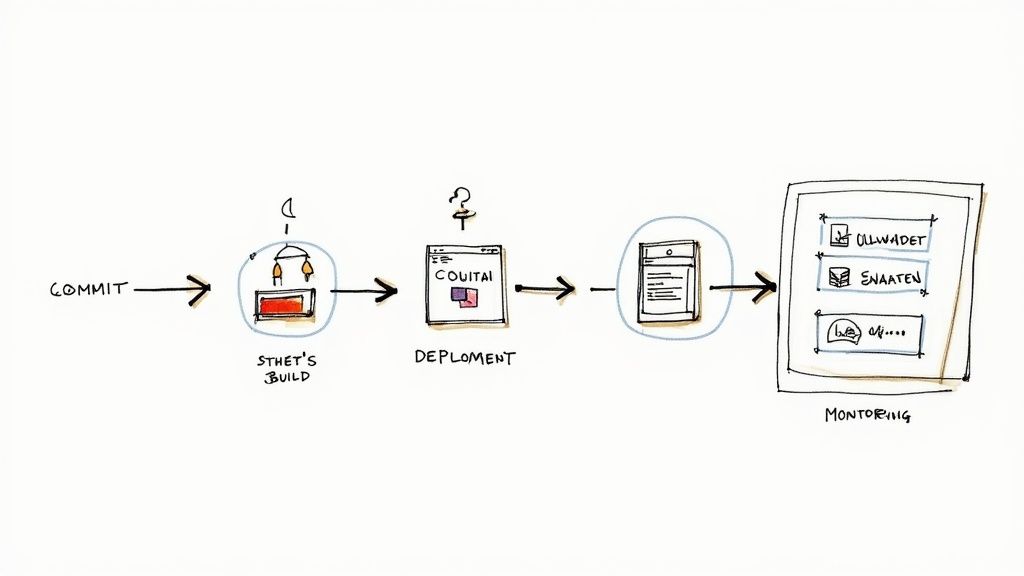
The core of modern automation is the CI/CD pipeline (Continuous Integration/Continuous Deployment). A well-designed pipeline automates everything from code compilation and testing to security scans and deployment, creating a reliable path to production.
The Low-Code and No-Code Revolution
Low-code and no-code platforms allow teams to build and launch applications with little to no coding. These tools are perfect for creating internal tools, admin dashboards, or rapid prototypes.
Gartner predicts that by 2025, 70% of new applications will be developed using these technologies. This enables non-technical team members to build solutions, freeing up senior engineers for more complex architectural work. This approach can save significant time and engineering costs, especially when building your startup's backend with no-code solutions.
A Real-World Example: An AI Model CI/CD Pipeline
Let's make this concrete. Here is an automated workflow for deploying a new AI model:
- Commit: A data scientist pushes a change to a training script in a Git repository.
- Trigger: The push automatically kicks off a CI pipeline in a tool like GitHub Actions.
- Build & Test: The pipeline runs tests to validate the code, data, and model performance against the current version.
- Train & Evaluate: If tests pass, the pipeline retrains the model and checks its performance metrics against a predefined quality bar.
- Register: A successful new model is versioned and saved in a model registry like MLflow or Vertex AI.
- Deploy to Staging: The CD part of the pipeline deploys the model to a staging environment for further testing.
- Rollout to Production: Once approved, the model is carefully rolled out to production, often using a canary release to a small percentage of users, with continuous monitoring.
This entire process, from code commit to a monitored production model, happens almost entirely automatically. It is a system that validates and safely deploys every update—the foundation of modern software and MLOps management.
This level of automation is essential for any team that needs to move fast without breaking things. To learn more, read our guide on what is AI automation and its business implications.
Your 90-Day Implementation Playbook
Knowing the theory is one thing, but putting it into practice is where real change happens. This 90-day playbook is a step-by-step guide to implementing a solid software development management system.
It provides a practical roadmap for leaders tasked with bringing structure and efficiency to their engineering teams, from foundational goal-setting to running your first structured sprint.
Phase 1: Assess and Align (Days 1–30)
The first month is about discovery and planning. You must understand the current landscape before building a new system. This phase is dedicated to auditing existing processes, interviewing your team, and defining success.
Your primary goal is to establish a clear baseline by identifying the biggest points of friction in your current development lifecycle.
Key actions for this phase include:
- Conduct Stakeholder Interviews: Talk to engineers, product managers, designers, and business leaders to understand their pain points.
- Audit Existing Tools and Workflows: Map your current process from idea to deployment, documenting every tool and manual handoff.
- Define Initial KPIs: Select 2–3 core metrics to track, such as Cycle Time and Change Failure Rate, to create an objective starting point.
- Draft a Vision Document: Write a short, clear document outlining the problems you are solving and your vision for the future to get leadership buy-in.
A common mistake is skipping this discovery phase. Imposing a new process without understanding the underlying issues is a recipe for resistance. Listen and diagnose before prescribing solutions.
Phase 2: Design and Deploy (Days 31–60)
With a clear understanding of your challenges, month two is for building the core components of your new system. Here, you will choose a methodology, define team roles, and introduce tools to support your new workflow.
This phase is about creating structure and clarity. Your team should know exactly how work gets done, who is responsible for what, and how progress is measured.
For instance, a startup might choose a lightweight Kanban system with a project board in GitHub, while a larger company might implement Scrum with more formal ceremonies using a tool like Jira.
Actions for this phase include:
- Select a Methodology: Choose Scrum or Kanban as your starting point and communicate the process clearly.
- Clarify Roles and Responsibilities: Formally define the roles of Product Manager, Engineering Manager, and Tech Lead.
- Implement Core Tooling: Set up your chosen project management tool (e.g., Jira, Linear, or GitHub Projects) and integrate it with your version control system.
- Run a Low-Stakes Pilot: Test the new process with a single small project to gather feedback and make adjustments.
Phase 3: Execute and Iterate (Days 61–90)
The final month is about putting your new system into motion and establishing a rhythm of continuous improvement. The team runs its first official work cycle within the new framework, focusing on execution and learning.
Your role shifts from designer to coach, helping the team navigate the new workflow and using your KPIs to guide retrospectives. This creates a powerful feedback loop that strengthens your system over time.
By the end of this period, the system should feel like the natural way the team operates. This is the foundation of effective software development management.
90-Day Software Management Implementation Plan
Here’s a consolidated checklist to track your progress as you implement a more formal software development management process.
This plan is a guideline; adapt the timeline and actions to fit your company's needs. The goal is steady progress, not perfection.
Frequently Asked Questions
Here are quick answers to common questions about software development management.
What's the Biggest Mistake New Engineering Managers Make?
The most common mistake is remaining too focused on writing code. New managers promoted from individual contributor (IC) roles often forget their job has shifted from shipping features to building a team that can ship features sustainably.
Another pitfall is micromanaging developers or imposing a rigid process without team input. A better approach is to set clear goals, provide support, and empower the team to determine how to achieve them. Your role is to be a coach, not a director.
How Should I Manage Development for AI and ML Projects?
Managing AI and machine learning (ML) projects requires embracing uncertainty. These projects are experimental, and your plans will change as you learn.
Key differences from traditional software projects include:
- Data is Your Biggest Dependency: You must manage data pipelines, quality, and labeling, as model performance depends on it.
- Rigorous Experiment Tracking is Essential: You need to track every experiment, model version, and performance metric to understand what works.
- Specialized Roles are Required: You will need roles like MLOps Engineers to manage the entire model lifecycle, from training to production.
Success is measured not just by model accuracy but by its impact on business goals.
How Do I Choose the Right Project Management Tool?
The best tool is the one your team will actually use. For Scrum or Kanban, tools like Jira or Trello are standard. If your team is code-centric, GitHub Projects may be a better fit.
Pick a tool that simplifies work, not one that adds administrative overhead. Start simple and get your team's buy-in before committing.
Should I Measure Individual Developer Productivity?
No. Measuring individual output with metrics like "lines of code" or "number of commits" is counterproductive. It encourages gaming the system and optimizing for busywork instead of impact, leading to low-quality code and a competitive, rather than collaborative, team environment.
Instead, focus on team-level metrics that reflect shared success:
- Cycle Time: How quickly does an idea reach users?
- Change Failure Rate: How often do deployments cause issues?
- Deployment Frequency: How often are we successfully shipping to production?
These metrics promote teamwork and keep everyone focused on delivering stable value.
Ready to build a high-performing AI team? ThirstySprout connects you with top-tier, vetted AI and software engineering talent to accelerate your product roadmap. Start a Pilot and see how quickly you can scale.
Hire from the Top 1% Talent Network
Ready to accelerate your hiring or scale your company with our top-tier technical talent? Let's chat.