

TL;DR
- Who this is for: CTOs, engineering leads, and product managers who need to ship reliable, scalable APIs without slowing down development.
- Quick Answer: A robust RESTful API testing strategy layers multiple test types. Start with fast contract and integration tests in your CI/CD pipeline for every commit. Reserve slower, full end-to-end (E2E) and performance tests for nightly builds or pre-deployment checks to balance speed with coverage.
- Framework: Use our 4-stage testing framework: Contract Testing (pre-build), Integration Testing (post-commit), Performance Testing (pre-release), and Security Testing (continuously).
- Next Steps: Identify your 3-5 most critical API endpoints and build a basic "happy path" test suite in Postman. Then, integrate it into your CI/CD pipeline for immediate feedback.
Why API Testing Matters for Business Outcomes
In modern software, APIs are the glue connecting microservices, mobile frontends, and third-party integrations. A single API bug doesn't just create technical debt; it directly impacts business outcomes. It can cause data corruption, security breaches, or service outages that erode customer trust and revenue.
Effective RESTful API testing is a quality gate that prevents these issues before they affect users. It's a proactive strategy that lowers business risk, reduces the cost of fixing bugs, and accelerates time-to-market for new features.
With 93% of organizations using REST APIs, effective testing is no longer a niche skill but a core engineering competency. For a deeper look at industry trends, explore the latest research on API lifecycle management.
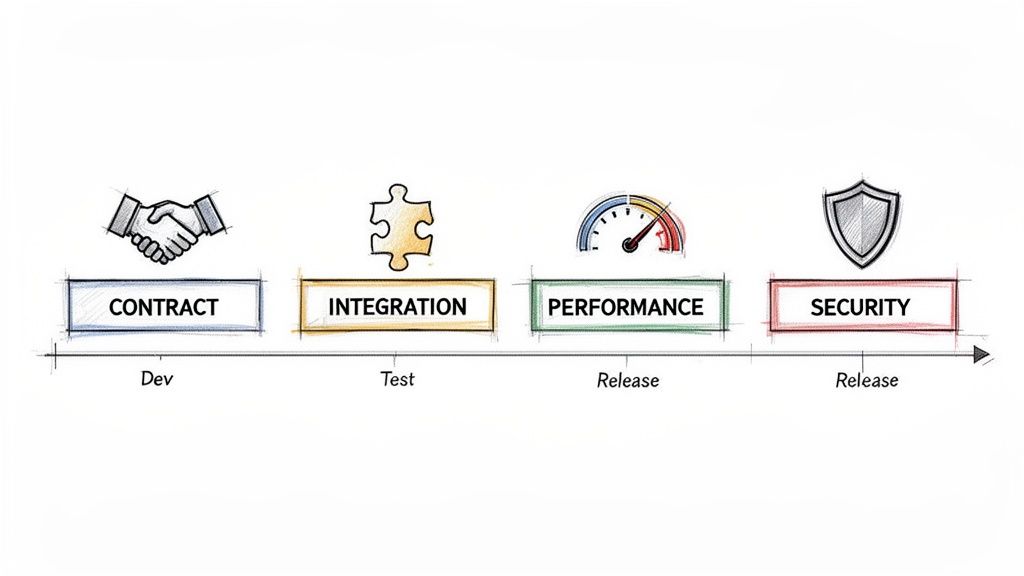
Alt text: An illustration of a development process timeline, showing contract, integration, performance, and security stages.
A 4-Stage Framework for RESTful API Testing
A solid testing strategy layers different approaches to catch specific problems at each stage of development. Think of it like building a house: you inspect the foundation (unit tests), the plumbing (integration tests), and the final structure (E2E tests). Each validates a critical layer.
This framework helps you decide which tests to run and when, ensuring complete coverage from initial build to final release.
Building Your Foundation in API Concepts
Before you can test an API, you must understand its core principles. Unlike a user interface, an API's components are invisible, governed by rules that define how systems communicate.
REST (Representational State Transfer) is an architectural style for building predictable and scalable web services. The most critical principle is statelessness: every request from a client to the server must contain all the information needed to process it. The server holds no session state, which simplifies scaling.
In REST, everything is a "resource" (e.g., a user, an order) identified by a Uniform Resource Identifier (URI), like /users/123. You interact with these resources using standard HTTP methods.
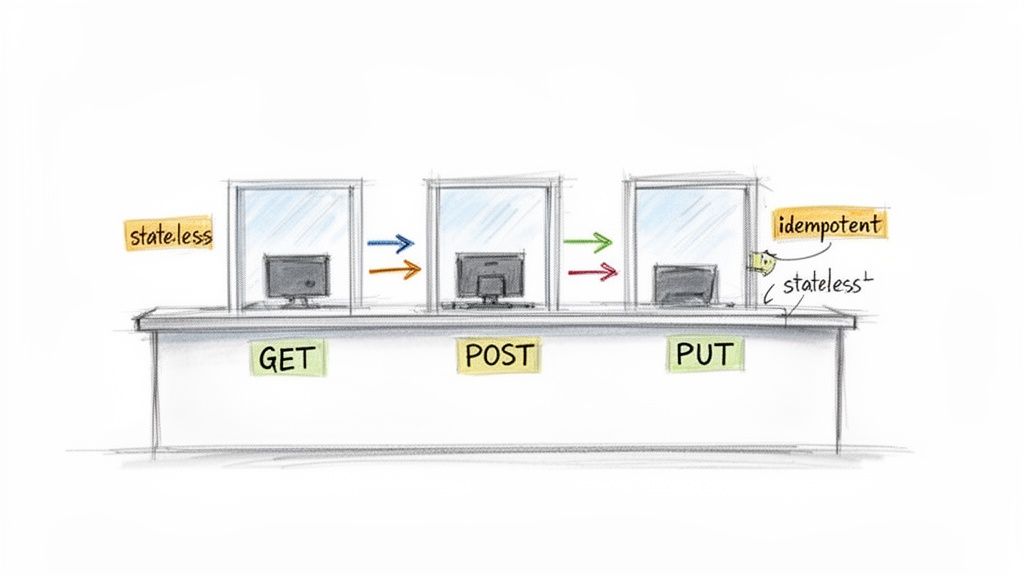
Alt text: Illustration depicting REST API methods GET, POST, and PUT, highlighting stateless and idempotent properties.
HTTP Methods: The Verbs of Your API
HTTP methods are the actions you perform on a resource. Your testing will primarily focus on these four:
- GET: Fetches data. It's a "safe" and idempotent operation, meaning calling it multiple times has the same effect as calling it once.
- POST: Creates a new resource. This is not idempotent; calling it twice creates two resources.
- PUT: Updates an existing resource. It is idempotent.
- DELETE: Removes a resource.
Understanding these is fundamental. A test for a GET endpoint validates the response data. A test for a POST must first create a resource, then use a GET to confirm its existence. This request-response model differs significantly from alternatives like GraphQL. To see how they compare, read our guide on GraphQL vs REST.
The API testing market is projected to hit USD 1.69 billion in 2026, signaling how critical this function is to modern business operations.
Practical Examples of API Test Types
A layered testing strategy is more effective than relying on a single method. Different tests answer different questions about your API's health.
A common mistake is over-relying on slow, brittle E2E tests. A better approach is to use fast contract and integration tests for most scenarios, reserving E2E tests for only the most critical user workflows. This improves feedback speed and reduces maintenance overhead.
Example 1: Contract Testing in a Microservices Architecture
Scenario: An e-commerce platform has a UserService and an OrderService. The OrderService calls the UserService to get customer details when an order is placed.
Problem: The UserService team renames the emailAddress field to email in the GET /users/{id} response. Without contract testing, this change would break the OrderService in production.
Solution: Using a tool like Pact, the services agree on a "contract." If the UserService team makes a change that violates this contract, their build fails instantly within the CI/CD pipeline. The problem is caught and fixed in minutes, preventing a production incident.
Example 2: Performance Testing for a Product Launch
Scenario: A fintech startup expects 10,000 concurrent users for a new feature launch.
Problem: How can they ensure the API can handle the traffic without crashing or becoming unacceptably slow?
Solution: The team uses a tool like k6 or JMeter to simulate the load against a staging environment. The script mimics a real user journey:
- Login:
POST /auth/login - Load dashboard:
GET /dashboard - Make a transaction:
POST /transactions
The test reveals that while login is fast (under 200ms), the /transactions endpoint takes 3 seconds under load due to a database bottleneck. By identifying this before launch, the team optimizes the query, adds a cache, and reruns the test to confirm they meet their Service Level Objective (SLO) of sub-500ms response times. This proactive work prevents a failed launch and protects revenue.
Choosing Your API Testing Toolkit
Selecting the right tool depends on your team's skills, project complexity, and automation goals. A QA analyst needs a different tool than an engineer embedding tests in the codebase.
Let's compare three industry leaders: Postman, REST Assured, and Pact.
- Postman: Famous for its user-friendly interface, it excels at exploratory testing and building automated test suites without deep coding knowledge.
- REST Assured: A Java library that enables clean, readable API tests using a BDD-style syntax, perfect for teams in the Java ecosystem.
- Pact: A dedicated contract testing tool that prevents integration failures in microservices architectures.

Alt text: Postman logo.
A Practical Tool Comparison
High-performing teams often use a combination: Postman for ad-hoc testing, REST Assured for service-level integration tests, and Pact to guarantee microservice compatibility. To explore more options, see our definitive guide to API testing tools.
Integrating API Tests into Your CI/CD Pipeline
Effective RESTful API testing must be automated. Integrating tests into your Continuous Integration/Continuous Deployment (CI/CD) pipeline creates a quality gate that catches bugs automatically with every code change.
This creates a fast feedback loop, allowing developers to fix breaking changes in minutes, not days. This aligns with modern software test automation practices.
A Phased Approach to CI/CD Test Integration
Run different tests at different stages to balance speed and confidence.
- On Every Commit (Pre-Merge): Run lightweight contract tests and critical integration tests. These should complete in under 5 minutes to provide rapid feedback.
- After Merging to Main: Run a broader suite of integration and component-level tests in a shared environment.
- Nightly or Scheduled: Execute the full E2E regression suite. This is ideal for complex workflows that are too slow for the main pipeline. Learn more about automating regression testing.
- Pre-Deployment: Run smoke tests, security scans, and performance tests against a production-like staging environment.
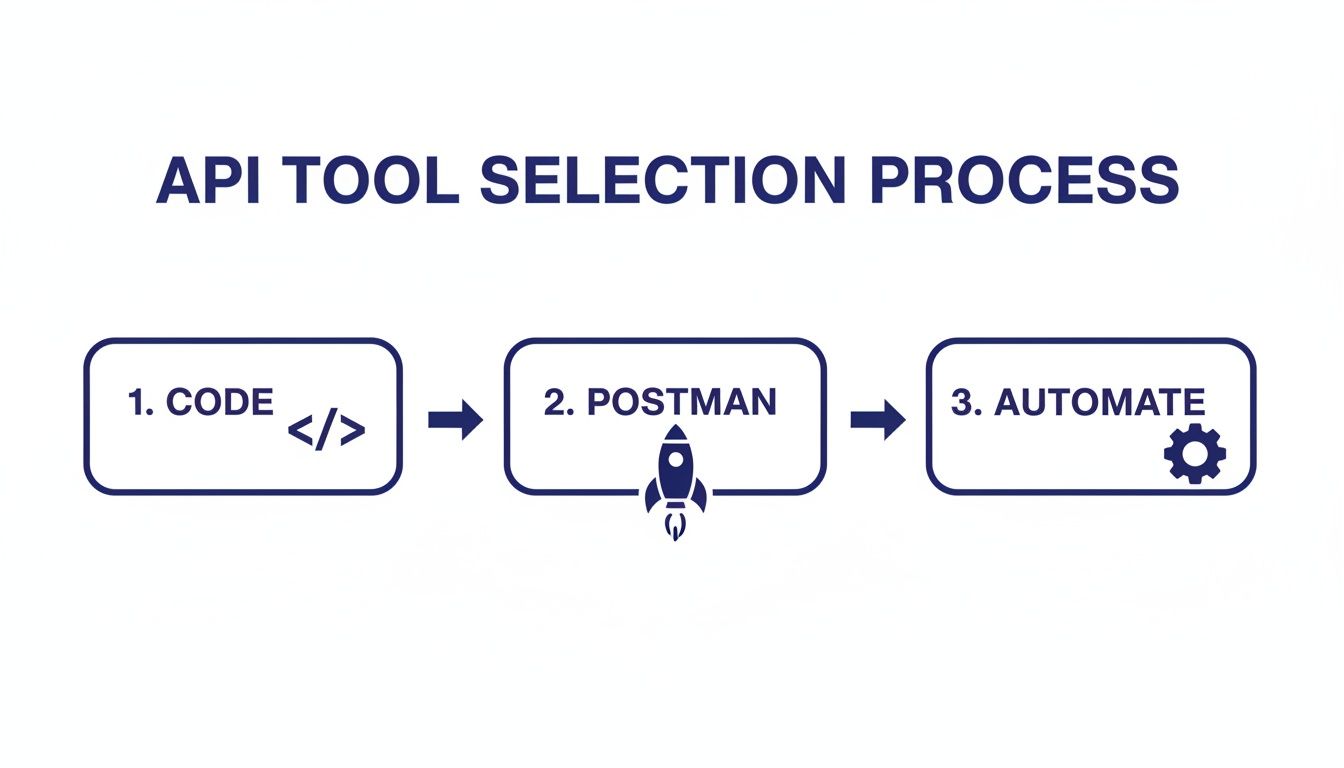
Alt text: A process diagram illustrates the API tool selection workflow: Code, Postman, and Automate.
Example: GitHub Actions Configuration Snippet
This YAML configuration for GitHub Actions runs a Postman test suite using Newman (Postman's command-line runner) every time code is pushed to the main branch.
# .github/workflows/api-tests.ymlname: API Integration Testson:push:branches: [ main ]jobs:run-api-tests:runs-on: ubuntu-lateststeps:- name: Checkout codeuses: actions/checkout@v3- name: Install Node.jsuses: actions/setup-node@v3with:node-version: '18'- name: Install Newmanrun: npm install -g newman- name: Run Postman collectionrun: |# Runs the Postman collection against the staging environment# and exports results in a CI-friendly format.newman run "My API Tests.postman_collection.json" \--environment "Staging.postman_environment.json" \--reporters cli,junit \--reporter-junit-export results/api-test-results.xmlThis script automates the entire process, providing immediate pass/fail feedback directly within your development workflow.
Implementing Smart Test Data Management
Unreliable test data is a primary cause of flaky tests and wasted engineering time. Effective test data management ensures your tests are predictable, isolated, and repeatable. Stop relying on fragile, shared development databases and start controlling your test environment.
Generating Realistic and Isolated Data
Instead of testing against hardcoded data, generate it dynamically for each test run.
- Data Generation Libraries: Use tools like Faker.js (JavaScript) or Faker (Python) to create realistic data on the fly.
- Seeding Scripts: Before a test suite runs, execute a script to populate your test database with a consistent baseline of data.
This approach makes tests more resilient and helps you secure big data by avoiding the use of sensitive production information in test environments.
Decoupling From Unstable Dependencies
Your API tests should not fail because a partner's staging environment is down. Service virtualization isolates your application by creating "stunt doubles" for external dependencies.
Tools like WireMock or Mountebank let you spin up mock servers that mimic external APIs. This is essential for testing failure scenarios, like payment gateway timeouts, which are nearly impossible to replicate with live services.
API Health Scorecard (Template)
Not all endpoints are created equal. An API Health Scorecard helps you focus testing effort on endpoints that carry the most business risk.
This scorecard aligns your testing strategy with business impact, shifting the conversation from "did tests pass?" to "how confident are we in our most critical business workflows?"
What to Do Next: Your 30-Day Action Plan
Turn theory into action with this checklist to improve your RESTful API testing strategy over the next month. Our recommendation: start small with one critical workflow to build momentum and demonstrate value.
Weeks 1–2: Foundation and Quick Wins
- Identify Critical Endpoints: With your team, select the 3–5 most important API endpoints tied to revenue or core user actions.
- Build a Basic Test Suite: Use a tool like Postman to create a collection of "happy path" tests for those endpoints.
- Integrate with CI/CD: Configure your CI server (e.g., GitHub Actions) to run this suite on every commit to
main. This is your first safety net.
Weeks 3–4: Expand Coverage and Add Sophistication
- Add Negative Test Cases: Expand your suite to cover error conditions, such as invalid input or authentication failure.
- Implement a Contract Test: Introduce a consumer-driven contract test for a key integration point between two services.
- Establish Performance Baselines: Run an initial performance test on one critical endpoint to establish a baseline for response time and error rate.
Following this roadmap will produce a measurable improvement in your API quality and team velocity in just one month.
At ThirstySprout, we help you hire and manage world-class remote AI and engineering teams. If you need to scale with experts who can implement robust testing strategies from day one, we can help you build your team in weeks, not months.
Hire from the Top 1% Talent Network
Ready to accelerate your hiring or scale your company with our top-tier technical talent? Let's chat.