

TL;DR
- Choose REST for public APIs, simple CRUD apps, or internal microservices where predictability and standard caching are critical. It's faster to market if your team knows HTTP well.
- Choose GraphQL for complex mobile or web UIs that pull data from multiple sources. It minimizes network requests, saving bandwidth and improving user experience.
- For migrating, don't rewrite. Use GraphQL as a facade over existing REST APIs (Strangler Fig Pattern) to get flexibility without disrupting old clients.
- Security isn't inherent. REST security is endpoint-based (simpler). GraphQL requires application-layer defenses against complex queries (depth limiting, cost analysis).
- Recommended Action: Run a 3-day proof-of-concept. Build one critical feature with both REST and GraphQL to get real data on performance and developer effort for your specific use case.
Who This Guide Is For
This guide is for technical and product leaders at high-growth companies who need to make a strategic API decision that balances speed, scale, and cost.
- CTO / Head of Engineering / Staff Engineer: You need a clear framework to choose an architecture that fits your team's skills, accelerates development, and won't create technical debt in 6 months.
- Founder / Product Lead: You need to understand how this choice impacts feature velocity, user experience on mobile, and the overall cost of development.
- Talent Ops / Procurement: You need to know the hiring implications. Choosing GraphQL may require sourcing engineers with a more specialized (and potentially expensive) skillset.
Your Quick Decision Framework
Choosing an API architecture is a foundational decision. Get it right, and you accelerate development. Get it wrong, and you end up with slow performance, wasted bandwidth, and frustrated developers. Your choice hinges on a simple trade-off: REST's standardized simplicity versus GraphQL's query flexibility.
This framework helps you move past theory and make a practical choice for your project. For a wider view on how this fits into your overall strategy, it’s worth reading a comprehensive guide on how to choose a tech stack for your SaaS product.
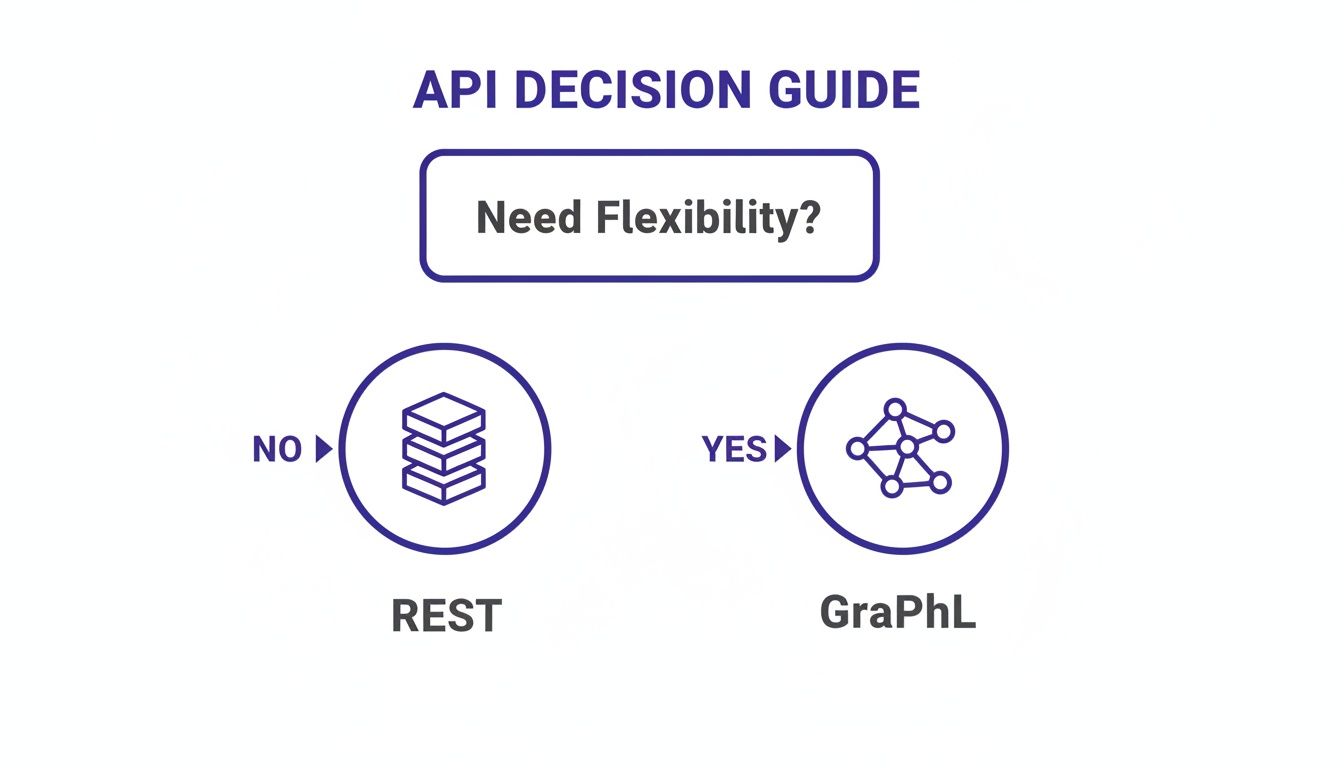
GraphQL vs REST Quick Decision Matrix
This matrix provides a granular breakdown to help you weigh the critical factors that come up in real-world projects—the kind of practical guidance we build into our cloud application development services.
Practical Examples: Where Each API Style Wins
Theory is useful, but seeing these architectures in action provides clarity. Here are two common scenarios engineering leaders face.
Example 1: Public API for an AI Service (REST Wins)
Scenario: You're building a public API for an AI-powered image recognition service. Your customers are other developers who need a predictable, stable, and well-documented way to send an image and get back an analysis.
Why REST is the right choice:
- Standardization: Developers know
POST /v1/imagesuploads a file andGET /v1/images/{id}pulls results. This near-zero learning curve is crucial for adoption. - Caching: Analysis results for a specific image are static. REST works perfectly with HTTP caching, so repeat requests can be served from a CDN, reducing server load.
- Security: It’s simpler to secure. You can apply rate limits to resource-intensive endpoints like
/imagesto prevent abuse, which is easier than calculating the cost of a complex GraphQL query on the fly.
A public REST API is a clear contract. It tells developers what to expect, building trust and making integration easy. For most third-party consumers, predictability is more valuable than query flexibility.
Example 2: The Mobile E-commerce App (GraphQL Wins)
Scenario: You're building the product detail screen for a mobile shopping app. This single view needs to show:
- Product details (name, price).
- The three latest user reviews.
- Real-time stock level from an inventory service.
- The logged-in user's rating for that product.
With REST, this would require at least three, maybe four, separate network requests. On a weak mobile signal, that's a slow, frustrating experience. GraphQL consolidates this into one query.
query ProductDetailScreen($productId: ID!, $userId: ID!) {product(id: $productId) {namepricestockLevelreviews(last: 3) {ratingcomment}userRating(userId: $userId) {rating}}}Why GraphQL is the clear winner here:
- Fewer Network Calls: One roundtrip instead of four makes the app feel much faster.
- No Over-fetching: The mobile client gets only the fields it needs, saving bandwidth for users on limited data plans.
- Frontend Autonomy: The frontend team can change the query to add or remove data fields without waiting for the backend team to create a new endpoint. This speeds up development cycles.
Deep Dive: Key Architectural Differences
REST and GraphQL have fundamentally different philosophies. REST is built on the idea of resources, where every piece of data has its own URL. GraphQL operates from a schema and a single endpoint, treating your entire API as one interconnected data graph.
This distinction drives major differences in performance and developer experience.
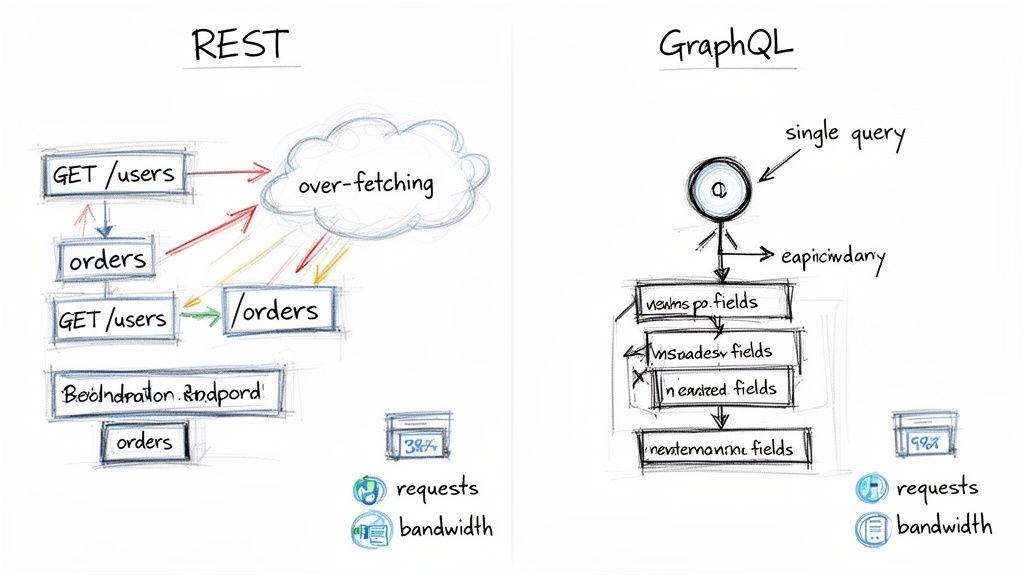
Caption: REST often requires multiple requests, leading to over-fetching, while GraphQL allows a single, precise query for all needed data.
Data Fetching and Network Performance
REST’s resource-based model is straightforward but rigid, often causing two problems: over-fetching (getting more data than you need) and under-fetching (not getting enough, forcing more calls).
If your UI needs a user's name and their last three blog post titles:
- With REST: You first
GET /api/users/123, which returns the name but also email, address, etc. (over-fetching). Then youGET /api/users/123/poststo get all posts and filter on the client (more over-fetching). This is inefficient. - With GraphQL: You send one precise query and get exactly what you asked for. This surgical precision is GraphQL’s main advantage, giving frontend developers control. This approach is central to modern software architecture best practices.
For simple, cacheable lookups, REST can handle ~20,000 requests per second. But for complex data aggregation, GraphQL shines, fulfilling intricate queries in as little as 180ms while cutting data transfer by 30–50%. You can find detailed API performance comparisons that break this down further.
When REST is the Pragmatic Choice
REST remains dominant for a reason. Its simplicity, standardization, and mature ecosystem let you ship features fast. Looking at 2026 projections, 93% of development teams will continue to rely on REST. For startups building AI-driven SaaS or fintech products—like the kind of companies ThirstySprout works with, including Mailchimp and Intuit—REST's stateless nature is often the default choice.
As you discover more insights about these API trends, it’s clear why CTOs stick with it: a faster development cycle is a huge business advantage. A well-defined REST API can often be implemented 2–3x faster than a full GraphQL schema.
When GraphQL Delivers a Competitive Edge
Enterprise adoption of GraphQL has spiked by 340% since 2023, with nearly half of new API projects using it. For complex data aggregation, GraphQL can slash API calls by up to 60% and cut mobile bandwidth use by 30-50%. As detailed in these AI API performance tests, that efficiency can take screen rendering times from five seconds down to one or two.
This is a game-changer for sophisticated single-page applications (SPAs) and real-time dashboards. GraphQL’s Subscriptions feature uses WebSockets to push data to the client the moment it's available, eliminating inefficient polling. This client-side agility is a core principle in modern cloud-native development strategies.
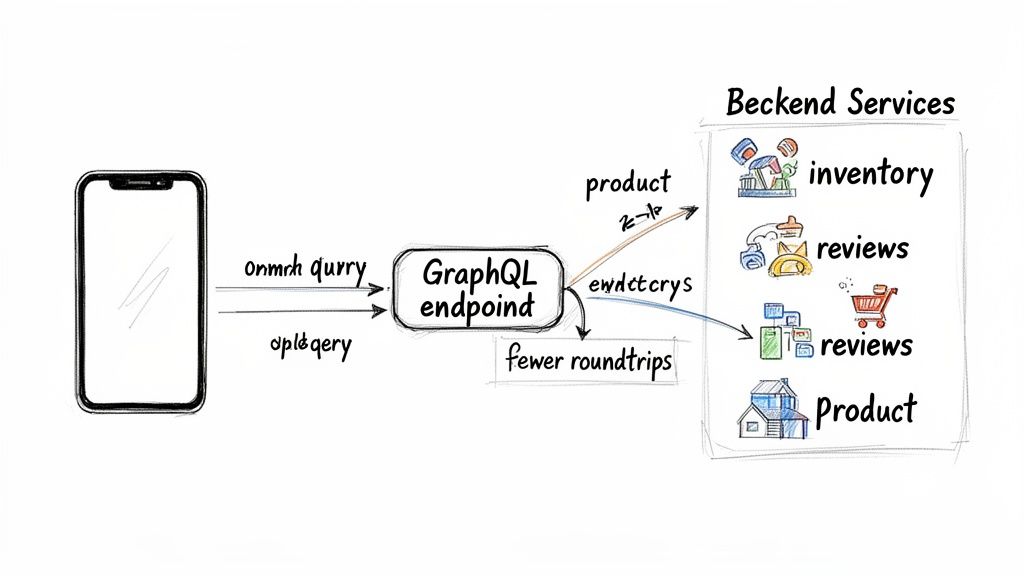
Caption: A GraphQL gateway can act as a single entry point for a mobile app to efficiently query multiple downstream microservices.
Checklist: Your API Decision Rubric
Use these questions to move from debate to a data-driven decision. Answering them honestly will build a solid business case for either REST or GraphQL.
[ ] Client & Data Needs
- How many different clients will use this API (e.g., mobile, web, IoT)? (3+ clients favors GraphQL's flexibility).
- Does your UI need to display data from multiple sources on a single screen? (Yes strongly favors GraphQL).
- How interconnected is your data? (Highly relational data is a natural fit for GraphQL's graph model).
[ ] Team & Ecosystem Factors
- What is your team's current skill set? (Deep REST knowledge means faster time-to-market with REST).
- Do you rely heavily on third-party tools and public APIs? (The REST ecosystem is larger and more mature).
- Is HTTP caching your primary performance strategy? (REST has a significant out-of-the-box advantage here).
[ ] Business & Operational Impact
- What is your time-to-market priority for the next 6 months? (REST is often faster for an initial MVP).
- Is frontend developer velocity a key bottleneck? (GraphQL empowers frontend teams to iterate faster without backend changes).
- What is your risk tolerance for new technology? (REST is a proven, lower-risk choice; GraphQL has a steeper learning curve).
What To Do Next
- Run a Time-boxed Prototype (3-5 days): Assign a small team to build one critical feature using both REST and GraphQL. Measure developer effort, query performance, and payload size. This real-world data is more valuable than any article. This is a core part of how we approach developing in the cloud.
- Map Talent to Your Decision: The best architecture is useless without the right engineers. If your choice exposes a skill gap, plan for it. Consider bringing in a vetted remote engineer to lead the pilot and upskill your team.
- Book a 60-Minute Scoping Session: Use the checklist above as your agenda with engineering and product leads. Finalize the decision based on your prototype data and strategic priorities.
Making the GraphQL vs. REST decision is foundational. By using a structured process, you can confidently set your product on the right path for scale.
Frequently Asked Questions
Which is better for security, GraphQL or REST?
Neither is inherently more secure; security depends on implementation. REST security is simpler to reason about because it's endpoint-based, making it a safer default for public APIs. GraphQL requires a proactive approach to defend against complex query attacks using depth limiting, query cost analysis, and strict timeouts.
How does caching work differently in GraphQL vs REST?
REST works seamlessly with standard HTTP caching because each resource has a unique URL (GET /api/users/123). GraphQL uses a single /graphql endpoint with POST requests, which are not cached by default. Caching in GraphQL relies on client-side libraries like Apollo Client or Relay and server-side strategies like persisted queries.
Can I migrate from REST to GraphQL without a full rewrite?
Yes, and you should. The best practice is the "strangler fig pattern." You introduce a GraphQL layer that sits in front of your existing REST APIs. The GraphQL resolvers simply call your old REST endpoints. This allows new clients to use GraphQL immediately while old clients continue working, letting you migrate services incrementally without a high-risk "big bang" rewrite.
Ready to build your next-gen application but need the expert talent to execute your API strategy? ThirstySprout connects you with senior AI and software engineers who have deep experience building scalable systems with both GraphQL and REST. Start your pilot in under a week.
Hire from the Top 1% Talent Network
Ready to accelerate your hiring or scale your company with our top-tier technical talent? Let's chat.