

TL;DR: Building a remote software engineering team isn't optional for AI-focused companies; it's a strategic necessity.
- Who this is for: CTOs, Heads of Engineering, and Founders who need to hire specialized AI/ML talent that isn't available locally.
- The problem: Forcing a return-to-office model cuts you off from the global talent pool, slows hiring, and increases attrition. A 2024 poll showed 21% of engineers would quit if forced back full-time.
- The framework: Adopt an asynchronous-first model. Structure your team (fully distributed, hub-and-spoke, or hybrid), build a modern tool stack, and create a hiring process designed for remote talent.
- Actionable next steps: Start by defining core collaboration hours, auditing your current tool stack for async readiness, and scheduling a pilot with 1-2 remote engineers to test your new processes.
Who This Is For
This guide is for technical leaders who must build and scale high-performing software engineering teams to ship AI products.
You're likely a CTO, Head of Engineering, or a Founder at a fast-growing company. Your primary challenge is finding and retaining the niche, senior-level talent required for AI/ML, MLOps, or data engineering roles. You've realized that the best engineers for the job probably don't live within a 30-mile radius of your office, and you need a practical playbook for building a world-class remote team.
The Remote Engineering Framework: A 3-Step Plan
Building a remote engineering team is about much more than just allowing people to work from home. It's a strategic shift that requires a deliberate approach to structure, tooling, and talent management. We use a three-step framework to guide this transition, ensuring it drives business impact—faster hiring, reduced costs, and higher productivity.
- Choose the Right Model: Decide between a fully distributed, hub-and-spoke, or hybrid-first structure based on your company stage and talent needs. The goal is to maximize access to talent without creating operational drag.
- Implement an Async-First Stack: Equip your team with tools for asynchronous communication, collaborative development, and transparent project management. Your stack should reduce the need for synchronous meetings, not just facilitate them.
- Redesign Your Talent Lifecycle: Overhaul your hiring, onboarding, and performance management processes for a remote context. This means sourcing from global talent pools, running practical interviews, and measuring outcomes, not hours online.
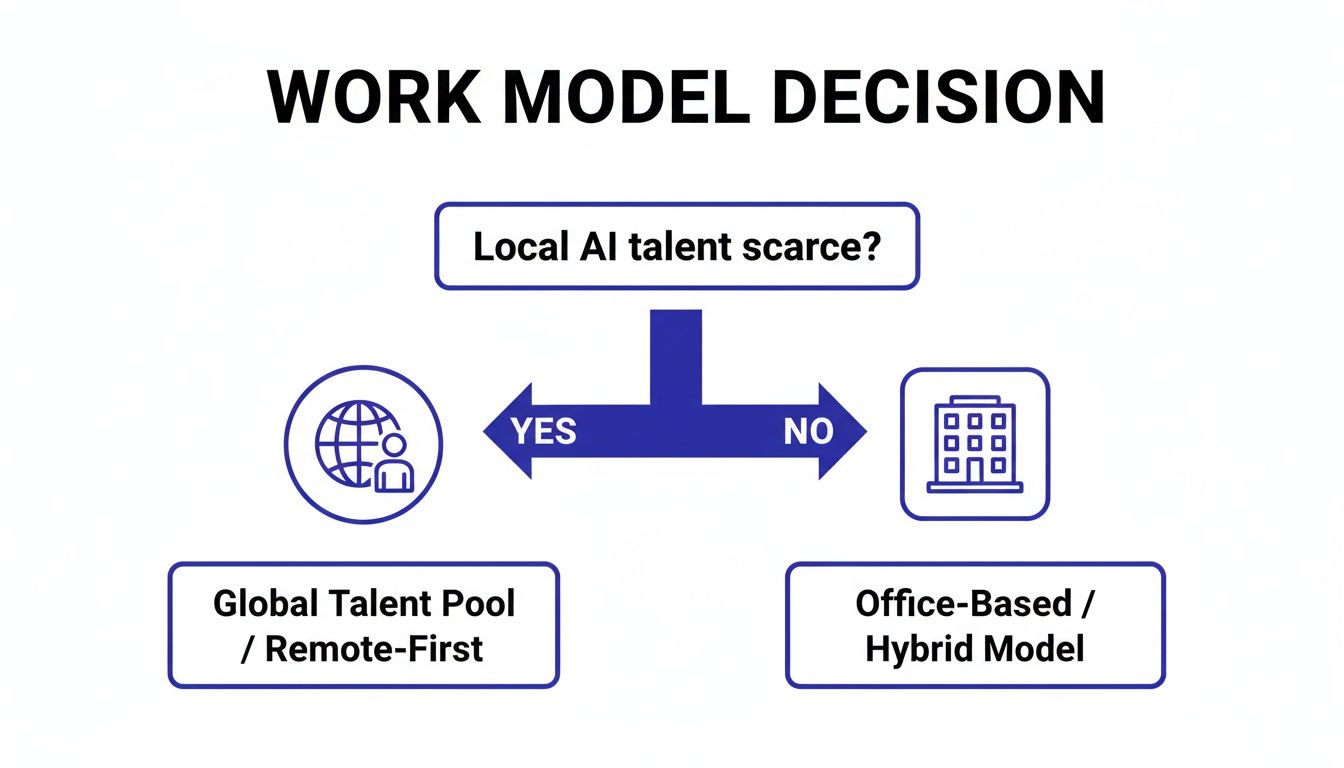
This flowchart shows the core decision: if you can't find specialized AI engineers locally, a remote-first model is the only logical path.
The rest of this guide provides practical examples and checklists for each step of this framework.
Practical Examples of Remote Engineering in Action
Theory is good, but real-world application is better. Here are two examples of how to apply these principles.
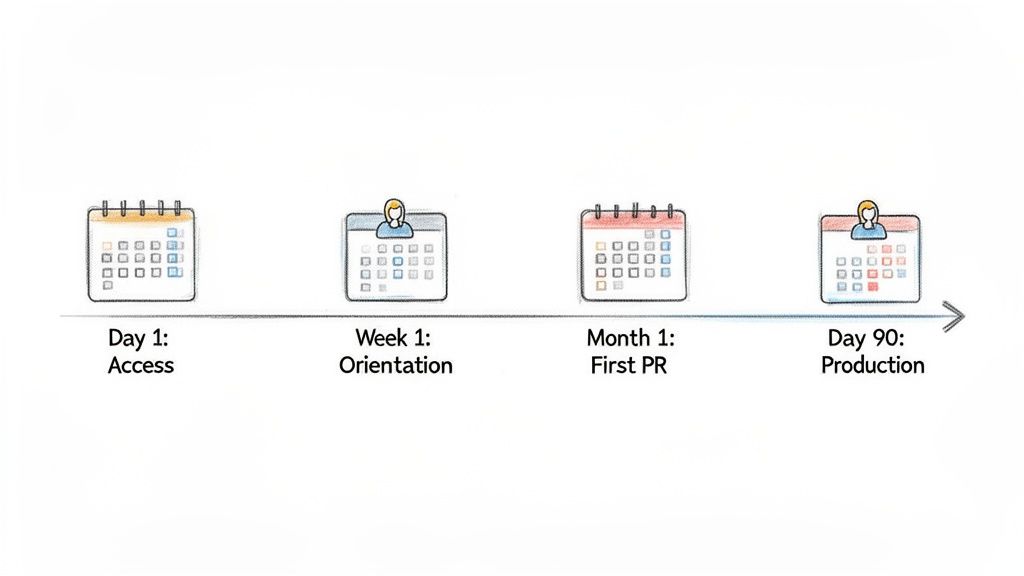
Example 1: 90-Day Onboarding Checklist for a Remote ML Engineer
A structured onboarding process is critical for setting up a new remote engineer for success. Without a clear plan, new hires feel isolated and struggle to contribute. This checklist creates a path from Day 1 to full productivity.
| Milestone | Key Actions & Goals |
|---|---|
| Day 1: Access & Setup | - Goal: Zero IT friction. - Provision all accounts (GitHub, Slack, AWS, etc.) before start date. - Assign a dedicated "onboarding buddy" for informal questions. |
| Week 1: Immersion & First PR | - Goal: A quick, tangible win. - Assign a small, well-scoped starter task (e.g., fix a bug, add a test). - Guide them through their first pull request (PR) to teach team standards. |
| Month 1: First Feature | - Goal: Build ownership. - Assign a small, self-contained feature to own from spec to deployment. - Have them demo their work to the team to build visibility and confidence. |
| Day 90: Full Contributor | - Goal: Independent productivity. - The engineer is comfortable picking up new tickets, contributing to technical discussions, and shipping code to production with minimal supervision. |
Example 2: Performance Review Rubric for a Remote Engineer
In a remote setting, performance management must focus on outcomes, not activity. This rubric provides a clear and fair way to evaluate a mid-level engineer's contribution, balancing technical output with the crucial skills of remote collaboration.
| Category | Needs Improvement (1-2) | Meets Expectations (3-4) | Exceeds Expectations (5) |
|---|---|---|---|
| Technical Output | Delivers code with frequent bugs or architectural flaws. | Consistently delivers high-quality, well-tested code for assigned tasks. | Proactively improves code quality and system architecture beyond their tasks. |
| Cycle Time | Frequently misses estimates; work often gets blocked or delayed. | Delivers features within estimated timelines; effectively unblocks self. | Consistently delivers ahead of schedule; helps unblock other team members. |
| Async Communication | Documentation is unclear or incomplete; relies on synchronous meetings. | Clearly documents work in PRs and project management tools like Jira. | Creates excellent documentation that improves team knowledge and reduces meetings. |
| Collaboration | Works in a silo; feedback is often not constructive. | Provides thoughtful, constructive feedback in code reviews; collaborates well. | Actively mentors junior engineers; elevates the team's technical standards. |
Deep Dive: Trade-offs, Pitfalls, and Best Practices
The Business Case for Going Remote
Building a remote engineering team drives measurable results, primarily through talent, cost, and productivity.
- Access to a Global Talent Pool: When you aren't constrained by a 30-mile radius around an office, you can hire the best person for the job. This is a game-changer for niche AI roles.
- Cost and Scaling Advantages: A remote-first model lets you grow your team without your real estate bill growing alongside it. It also enables smarter compensation strategies that are more sustainable than outbidding competitors in expensive tech hubs.
- Productivity and Focus: A well-run remote team reports more time for deep, focused work. An async-first culture cuts down on interruptions and lets your team build.
Choosing Your Remote Team Model
There are three proven models to consider. Each comes with trade-offs around cost, collaboration, and access to talent.
- The Fully Distributed Model: No central office. The company operates asynchronously by default. This model offers maximum talent access but requires extreme discipline in documentation and communication.
- The Hub-and-Spoke Model: A central HQ (the hub) combined with smaller, regional offices (the spokes). This model offers a balance but risks creating an "HQ vs. remote" culture where remote employees feel like second-class citizens. For more on global hiring, see our guide to nearshore vs. offshore team building.
- The Hybrid-First Model: A physical office exists but is treated as a tool for specific events (e.g., project kickoffs, design sprints), not a daily requirement. The biggest risk is proximity bias, where managers subconsciously favor employees they see in person. You must mitigate this with outcome-based performance metrics.
The Modern Stack for Remote Engineering Success
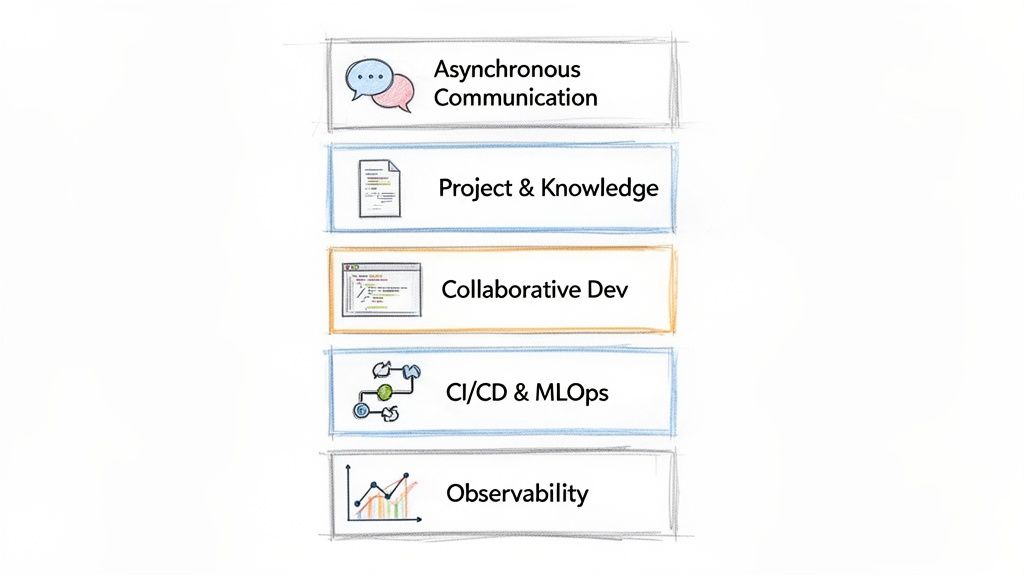
Your tech stack should be built to minimize dependencies and empower your engineers to do deep, focused work, no matter their time zone. A well-designed remote stack creates a single source of truth that lets any engineer get context and start contributing without waiting for a meeting.
Every high-performing remote stack covers five key areas:
- Asynchronous Communication: Tools that favor threaded, searchable conversations like Slack or Twist.
- Project & Knowledge Management: A central brain for project status and documentation, like Linear for issue tracking and Notion for an internal wiki.
- Collaborative Development: Cloud-based environments like GitHub Codespaces or Replit to standardize the developer experience.
- CI/CD & MLOps: Automated pipelines for building, testing, and deploying code and models using tools like GitLab, GitHub Actions, or Kubeflow.
- Observability & Monitoring: Tools like Datadog or Honeycomb to see exactly what your distributed systems are doing.
How to Hire and Interview Remote AI Engineers
Finding elite remote AI engineers is one of the toughest challenges for any tech leader. You need a dedicated plan to find and attract experts who can make a real impact.
- Source Talent Beyond Job Boards: Go where top engineers are. Get active in niche communities (e.g., MLOps.community), use specialized talent networks like ThirstySprout, or do targeted outreach to contributors of relevant open-source projects.
- Craft a Compelling Role Description: Frame the role around the mission and the problems to be solved. Instead of "Must have 5+ years of Python," try "You will build the core retrieval pipeline for our next-gen AI-powered search engine."
- Screen (30 mins): Align on role scope and culture fit.
- Technical Deep Dive (60 mins): A senior engineer discusses past projects and technical decisions.
- Practical Take-Home (3–4 hours): A small, real-world project that mirrors the job. This is the best way to assess coding habits and problem-solving skills.
- Values & Impact Interview (45 mins): A final conversation with the CTO or Head of Engineering to discuss motivation and long-term contribution.
- Global Hiring Models: EOR vs. Contractor: For long-term, core roles, use an Employer of Record (EOR) service. They handle local compliance, payroll, and benefits, reducing your risk. Use contractors for short-term projects or highly specialized, autonomous work.
- Taming Time Zones with Core Hours: Define a 2-4 hour window each day when everyone agrees to be online for real-time collaboration. For a US-Europe team, this might be 10 AM to 1 PM EST. This protects deep-work time while keeping the team connected.
- Global vs. Local Pay Rates: Pay a competitive local market rate. Research the salary benchmarks for a senior engineer in their location (e.g., Lisbon) and pay at or above the 75th percentile for that market. This approach attracts top regional talent while managing cash burn effectively. Some companies like GitLab use a single pay scale adjusted for location, but a local market rate model is simpler and more direct for most companies.
- We have chosen a remote model (Fully Distributed, Hub-and-Spoke, or Hybrid-First).
- We have defined core collaboration hours to manage time zone differences.
- We have a clear policy on compensation (e.g., local market rates).
- Our communication stack favors asynchronous, threaded conversations (Slack, Twist).
- We have a central knowledge base for documentation (Notion).
- Our project management tool is transparent and engineer-friendly (Linear).
- Our CI/CD and MLOps pipelines are fully automated.
- Our interview process includes a practical, take-home assessment.
- We have a documented 90-day onboarding plan for new hires.
- Our performance reviews are based on outcomes, not hours worked.
- We use an EOR for compliant international hiring.
- Audit Your Current Processes: Use the checklist above to identify the biggest gaps in your remote readiness. Is your documentation a mess? Is your interview process too slow? Start there.
- Define Your Pilot: Select one upcoming role to hire remotely. Use this hire to test your new sourcing, interviewing, and onboarding processes end-to-end.
- Book a Scoping Call: If you need to hire senior AI/ML engineers in the next 3-6 months, let us help. We can connect you with vetted, production-ready talent from our network in days.
- Nearshore vs. Offshore Team Building (ThirstySprout)
- How to Manage Remote Teams Effectively (ThirstySprout)
- AI Engineer Interview Questions (ThirstySprout)
- Software Development Industry Statistics (Itransition)
- Software Engineering Trends and Their Impact on Hiring (Example.com)
- Essential Tools for Remote Teams (YayRemote)
- Tips for Hiring Remote Software Developers (RemoteSparks)
For more, see our guide on AI engineer interview questions.
Global Hiring Logistics: Compliance, Time Zones, and Pay
Before you can tap into the global talent pool, you must handle the legal and logistical side of international employment.
Remote Engineering Checklist
Use this checklist to audit your readiness for building a high-performing remote software engineering team.
Structure & Strategy
Tooling & Process
Talent Lifecycle
What to Do Next
Ready to hire elite, production-ready AI talent for your remote team? ThirstySprout connects you with vetted senior engineers in AI, MLOps, and data who can start contributing in days, not months.
References
Hire from the Top 1% Talent Network
Ready to accelerate your hiring or scale your company with our top-tier technical talent? Let's chat.