

TL;DR: Your Quick Guide to Nearshore vs. Offshore AI Talent
- Choose Nearshore for complex, fast-moving AI projects like building a novel RAG system or developing proprietary models. The minimal 0–3 hour time zone difference is critical for the required daily collaboration and rapid iteration.
- Choose Offshore for large-scale, well-defined tasks where cost is the primary driver. Think data annotation, QA testing, or maintaining legacy systems. The work is asynchronous and benefits from lower hourly rates.
- Nearshore optimizes for Total Cost of Ownership (TCO), factoring in lower management overhead and reduced rework costs. Offshore optimizes for the lowest hourly rate but can have hidden costs.
- Action Plan: Use our decision checklist to score your project's complexity and collaboration needs. For complex AI work, start a low-risk, two-week pilot with vetted nearshore engineers to validate the model.
Who This Guide Is For
This guide is for technology and business leaders who need to make a strategic decision about sourcing remote AI talent within the next quarter.
- CTO / Head of Engineering: You need to decide on the right sourcing model to accelerate AI feature development without compromising quality or team velocity.
- Founder / Product Lead: You're scoping new AI initiatives and need to balance budget constraints with the need for speed-to-market and deep collaboration.
- Talent Ops / Procurement: You are evaluating vendors and need a clear framework to assess the risks and true costs associated with nearshore and offshore partners.
Quick Answer: A Framework for Choosing Your AI Sourcing Model
The choice between nearshore and offshore talent is a strategic trade-off between real-time collaboration and cost efficiency. Nearshore acts as a high-bandwidth extension of your core team, while offshore functions as a scalable resource for well-defined tasks.
Use this decision tree for your initial assessment.
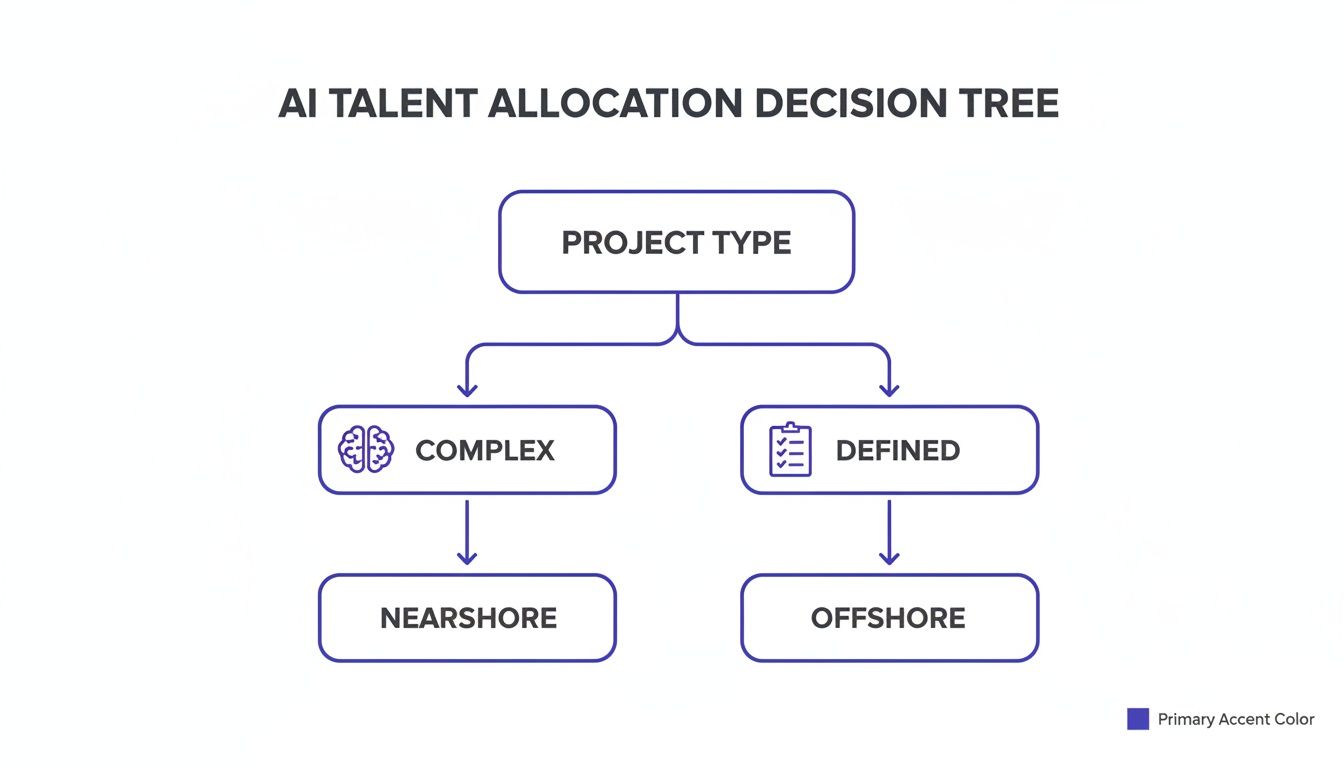
alt text: An AI talent allocation decision tree showing complex projects lead to nearshore and defined projects to offshore.
The project's nature—exploratory vs. standardized—is your primary filter. To go deeper, use this table to connect your project needs to the right model. For a complete breakdown, see our guide on nearshore software development.
Practical Examples: Two Real-World AI Sourcing Scenarios
Theory is useful, but seeing the models in action makes the choice clear. Let's analyze two common AI projects to see where each strategy excels.
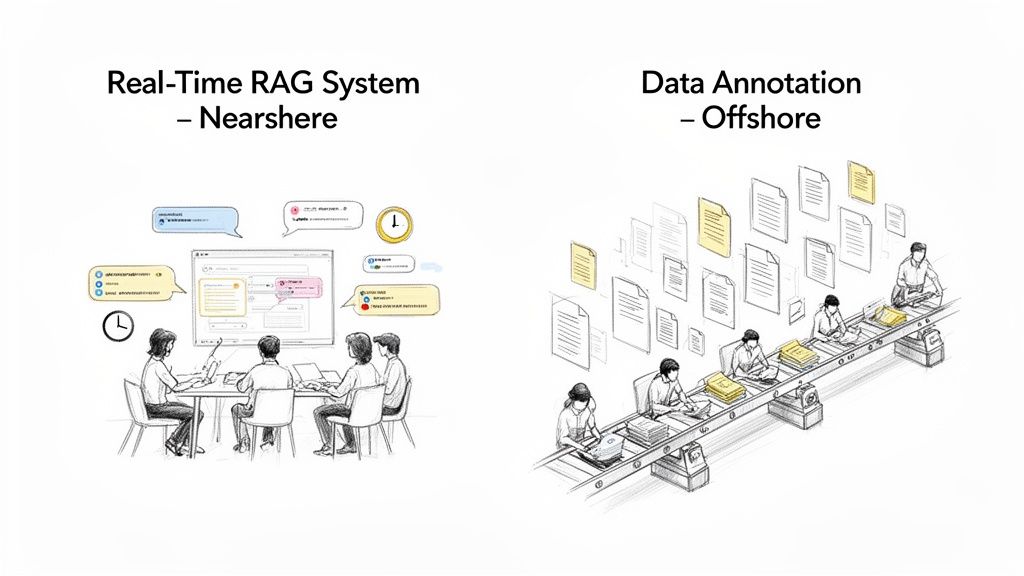
alt text: Illustration contrasting a real-time RAG system with nearshore collaboration and offshore data annotation on a production line.
Example 1: Building a Real-Time RAG System
Your goal is to build a Retrieval-Augmented Generation (RAG) system for your customer support team. The system must pull real-time data to deliver accurate, up-to-the-minute answers. The requirements are evolving, and you expect to iterate constantly.
Verdict: Nearshore is the clear winner.
Success for this project depends on tight feedback loops. The minimal time zone difference with a nearshore team (0–3 hours) makes daily stand-ups, pair programming, and spontaneous troubleshooting easy. You cannot afford a 12-hour communication lag when an LLM hallucinates or a critical data pipeline breaks.
Sample RAG Project Team (Nearshore):
- 1 Senior AI/ML Engineer: Leads model selection and retrieval strategy.
- 1 Data Engineer: Builds real-time data ingestion pipelines.
- 1 Backend Engineer: Develops the API and integrates components.
Sample 90-Day Timeline:
- Days 1–30: Focus on core data ingestion and vector database setup. Daily syncs are critical to nail down chunking and embedding strategies.
- Days 31–60: Develop retrieval and generation logic. This requires intensive, real-time collaboration to fine-tune prompts and evaluate outputs.
- Days 61–90: Deploy a V1 to a small user group, gather feedback, and iterate quickly. The ability to jump on a call immediately is what makes the project successful.
Example 2: Scaling a Data Annotation Team
Your computer vision model needs 500,000 images labeled with bounding boxes. The annotation rules are well-documented, the work is repetitive, and the primary goal is high throughput at a target quality bar.
Verdict: Offshore is the ideal model.
This is a textbook case for an offshore team. The work is highly structured and can be done asynchronously, making it a perfect fit for a large, cost-effective workforce. The significant time zone difference enables a "follow-the-sun" model: your U.S. team submits a batch of images at the end of their day and finds the labeled data waiting the next morning.
Key Decision Metrics for This Scenario:
- Cost per Annotation: This is your primary metric. Offshore models deliver a significant cost advantage at this scale.
- Annotation Accuracy: Quality is maintained through clear guidelines, regular audits, and a small in-house QA team.
- Scalability: Offshore partners can scale the team size up or down based on data volume, which is difficult with specialized nearshore talent.
The biggest pitfall here is failing to create crystal-clear documentation. Our guide to hiring offshore developers dives deeper into setting up the robust processes this model requires.
Deep Dive: Trade-Offs, Risks, and Key Considerations
Choosing between nearshore and offshore requires looking beyond hourly rates. The right decision hinges on a clear-eyed analysis of how each model affects operations, timelines, and product quality.
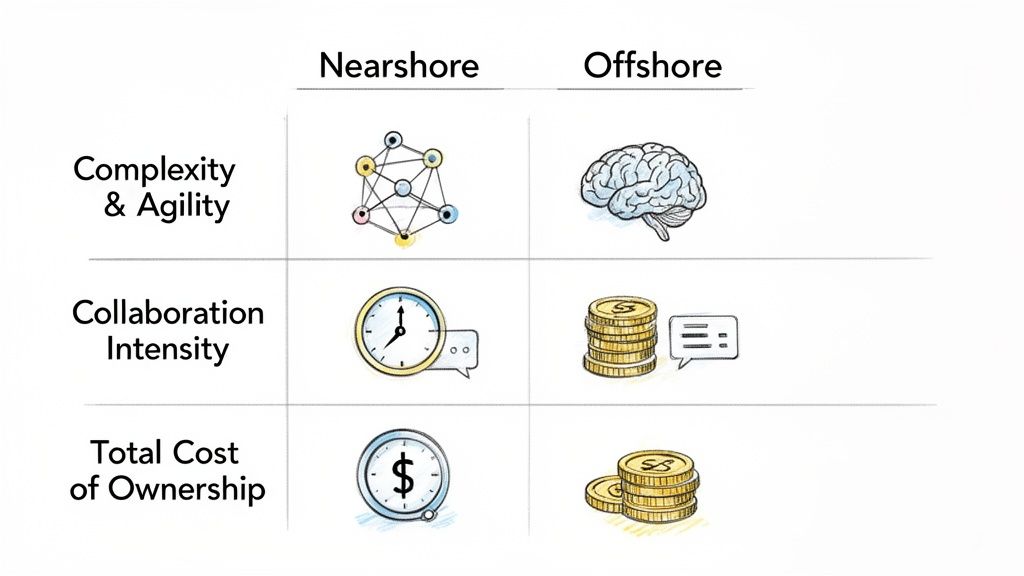
alt text: A diagram comparing nearshore and offshore strategies across complexity, collaboration intensity, and total cost of ownership.
Total Cost of Ownership: Looking Beyond the Hourly Rate
A common mistake is fixating on the hourly rate. Offshore rates often come with hidden costs that bloat the Total Cost of Ownership (TCO).
Account for these expenses:
- Heavier Management Load: Managing teams across large time zones demands more project managers and painstakingly detailed documentation, slowing down progress.
- High Cost of Rework: Miscommunication from cultural or language gaps leads to errors. Fixing them can inflate project budgets by 27% to 45%.
- Travel and Onboarding Overheads: Getting face-time with an offshore team involves significant travel costs. The same trips to a nearshore partner are a fraction of the cost.
Nearshore developers in Latin America and Eastern Europe average $4,000–$7,000 per month. Offshore rates in the Philippines are around $3,500–$5,500, with India at $2,800–$4,500. While offshore is 20–40% cheaper upfront, the gap is shrinking, and many founders find nearshore delivers a better return on investment.
Time Zone Alignment and Team Workflow
For complex AI projects, real-time collaboration is essential.
- Nearshore: With a 0–3 hour time difference, nearshore teams can join daily stand-ups, participate in pair programming, and solve problems instantly. This is ideal for Agile workflows.
- Offshore: A 9–13 hour time difference forces an asynchronous rhythm. This works for well-defined tasks but creates friction for iterative development.
Knowing how to measure developer productivity is crucial. You'll often find that the high productivity in nearshore teams comes directly from seamless, real-time teamwork.
Depth and Specialization of the AI Talent Pool
Both regions have large talent pools, but the skill sets differ.
Offshore hubs like India have a high volume of developers, making them a great fit for scaling large teams for data annotation or maintaining legacy code.
Nearshore regions in Latin America and Eastern Europe have a strong reputation for specialized expertise in:
- Machine Learning Operations (MLOps)
- Large Language Model (LLM) integration
- Computer Vision
- Advanced Data Engineering
If you're building sophisticated AI features, the concentrated expertise in nearshore markets is a decisive edge.

alt text: A horizontal diagram illustrating 5 key business considerations: TCO, time zone, talent depth, legal, and culture.
Legal Frameworks and IP Protection
Protecting your intellectual property is non-negotiable.
Nearshore countries, especially in Eastern Europe, often have legal systems that mirror those in the US and EU, including strong, GDPR-compliant data protection laws. This simplifies contracts and provides stronger legal footing.
Offshore regions may operate under different legal standards. Navigating a foreign legal system can add complexity and risk, requiring more due diligence from your legal team.
Culture and Communication Nuances
Clear communication is critical for project success.
Nearshore teams often share more cultural touchstones with companies in North America and Western Europe. This translates to more direct communication and smoother integration.
Offshore teams can have different communication styles. This is manageable but typically requires a longer ramp-up period and more explicit instructions. This is a key factor when choosing an engagement model, as we cover in our breakdown of managed services vs staff augmentation.
Checklist: Your Step-by-Step Decision Framework
Use this structured checklist to systematically evaluate your project needs and make a data-backed decision.
[ ] Step 1: Define Your Project and Methodology
- Agile/Scrum Projects: If you rely on daily stand-ups and quick iterations, a nearshore model is almost a prerequisite due to the minimal time difference.
- Waterfall Projects: For projects with a fixed, linear plan, an offshore model can be effective as asynchronous communication is less of a barrier.
[ ] Step 2: Assess Collaboration Needs
- High-Touch: If your teams need to pair program, brainstorm, and solve complex problems together daily, choose nearshore.
- Low-Touch: If tasks can be neatly packaged and handed off with clear written instructions, offshore is a viable option.
[ ] Step 3: Calculate the True Total Cost of Ownership (TCO)
- Direct Labor Costs: Compare hourly or monthly rates.
- Management Overhead: Factor in extra PM time or documentation costs for bridging time zones (add 10-15% to offshore project management budget).
- Rework Costs: Budget a 15–30% buffer for fixing miscommunications, which is more common in asynchronous offshore models.
- Travel Expenses: Include the cost of any in-person visits for kickoffs or planning sessions.
While US-based developers command $180K–$250K annually and offshore talent might be $25K–$55K, nearshore provides senior AI/ML engineers for $65K–$95K, delivering major savings without sacrificing quality. More data on the rise of nearshore development on dbbsoftware.com.
[ ] Step 4: Evaluate Security and Compliance Risks
- Sensitive Data: If your project involves PII, financial records, or proprietary algorithms, legal alignment is critical. Nearshore partners in Latin America and Eastern Europe often have legal frameworks aligned with US and EU standards (like GDPR), reducing risk.
- Low-Sensitivity Data: For less sensitive projects, offshore can work, but requires thorough vendor vetting and robust security protocols.
[ ] Step 5: Vet Potential Talent Partners
- Request case studies that mirror your project's challenges.
- Insist on speaking directly with the engineers who would join your team.
- Ask about their communication protocols, project management tools, and how they handle escalations.
What to Do Next
You've analyzed the models and have a decision framework. Now, turn your strategy into action with these three steps.
- Score Your Project Needs: Use the checklist above to build a data-backed case for your choice. A clear score will point you firmly toward nearshore for complex AI work or confirm offshore for scalable, defined tasks.
- Validate with an Expert: Book a 20-minute call to pressure-test your assumptions. A quick external check can save you months of friction by confirming talent availability and realistic timelines. A good consultation should include reviewing anonymous, pre-vetted AI talent profiles.
- Launch a Low-Risk Pilot: Run a controlled, two-week pilot to experience the workflow and collaboration dynamics firsthand. This gives you direct insight into the communication style and technical skills of vetted nearshore engineers, allowing you to move forward with confidence.
Frequently Asked Questions
How does intellectual property protection differ?
Nearshore locations in Latin America and Eastern Europe typically have legal systems similar to the US and EU, with strong copyright laws and data privacy regulations like GDPR. This simplifies contracts and makes them easier to enforce. Offshore jurisdictions can have different legal standards, requiring more due diligence. The key difference isn't just the law itself, but how easily you can enforce it.
What is the typical onboarding time?
A nearshore AI engineer can often be fully integrated in one to two weeks. The small time zone difference allows for real-time training and quick Q&A. In an offshore setup, onboarding usually takes two to four weeks due to the reliance on asynchronous communication.
Can we use a hybrid sourcing model?
Yes. A hybrid model is often the smartest approach for larger organizations. You can use a nearshore team for core product development that requires real-time collaboration and an offshore team for large-scale, asynchronous tasks like data annotation or QA testing. This strategy optimizes for both speed and cost.
Ready to build your remote AI team with confidence? At ThirstySprout, we specialize in connecting you with elite, pre-vetted nearshore AI and ML engineers who can integrate seamlessly with your team.
Hire from the Top 1% Talent Network
Ready to accelerate your hiring or scale your company with our top-tier technical talent? Let's chat.