

TL;DR
- Staff Augmentation is for control and speed. Use it to add specialized AI/ML engineers directly to your team for a critical project, like building a RAG copilot. You manage them daily, and you own 100% of the IP.
- Managed Services is for offloading a function. Use it for well-defined, non-core tasks like 24/7 security monitoring or cloud infrastructure management. You pay a fixed price for a specific outcome defined by an SLA.
- The key difference is ownership. With staff augmentation, you own the process and the people. With managed services, you own the outcome, but the vendor owns the process.
- For core AI development, default to Staff Augmentation. AI/ML projects require tight integration and rapid iteration, making direct team control essential.
- Action: Use the decision checklist below to determine which model fits your immediate need. For core product work, start vetting staff augmentation partners.
Who This Guide Is For
This guide is for technical leaders who need to build and scale high-performing AI teams now. It's a practical playbook for operators making critical resourcing decisions within weeks, not months.
This is for you if you're a:
- CTO or Head of Engineering: You have an aggressive AI product roadmap but can't find the specialized talent you need locally. You need to embed experts without derailing your team.
- Founder or Product Lead: You're scoping new AI features and need a realistic budget, timeline, and team composition. You're weighing the trade-offs between owning the process vs. outsourcing the outcome.
- Talent Ops or Procurement Leader: You're evaluating vendors and the risks of different engagement models. You need a clear framework to vet partners for both short-term projects and long-term functions.
We skip the fluff and provide a clear framework to help you decide between managed services and staff augmentation based on what actually matters: control, business impact, and cost.
Quick Decision Framework
The choice between staff augmentation and managed services boils down to a single question: Are you trying to augment your team to build something, or are you trying to outsource a function to be managed for you?
One gives you direct control over talent integrated into your daily sprints; the other offers a hands-off service where a vendor delivers a specific result for a fixed price.
This decision tree helps frame the central question:
alt text: Decision guide flowchart for tech talent, exploring options like staff augmentation and managed services.
Here’s a quick comparison of the two models across factors that matter most to technical leaders.
Ultimately, it comes down to control versus convenience. If your project demands tight collaboration and constant iteration—which is almost always the case in AI development—staff augmentation is the clear choice.
Practical Examples: When to Use Each Model
Theory is one thing, but execution is another. Let's walk through two common scenarios to see how the right model directly impacts your project's outcome, speed, and focus.
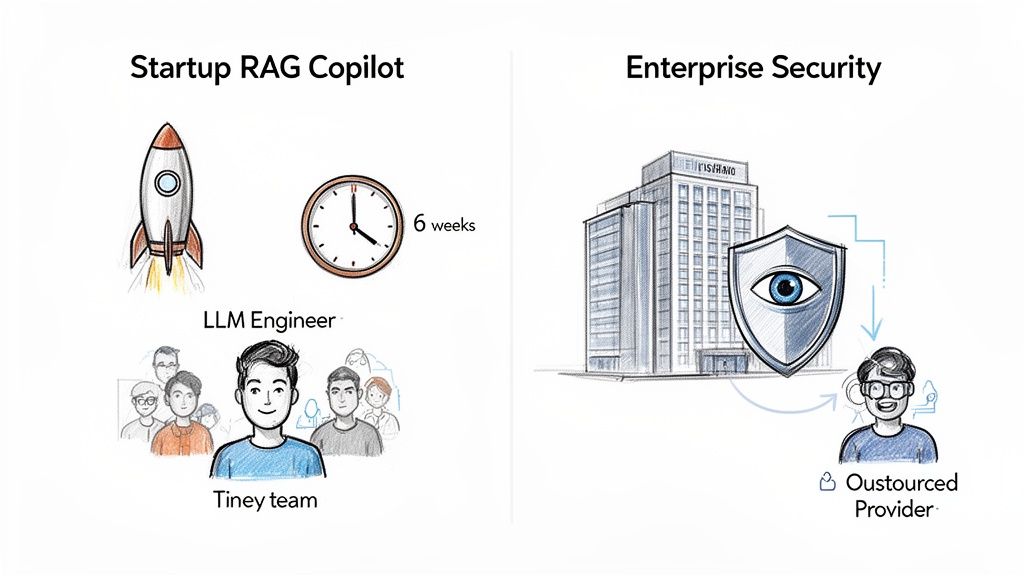
alt text: Illustrative comparison showing a startup team building a RAG copilot and an outsourced provider handling enterprise security.
Example 1: Staff Augmentation for a High-Stakes AI Product Launch
- The Situation: A Series A SaaS startup is racing to build a Retrieval-Augmented Generation (RAG) support copilot. Their goal: ship a beta in 6 weeks to beat a competitor. Their in-house team is strong but lacks production-grade Large Language Model (LLM) application experience.
- The Challenge: A traditional search for a senior LLM engineer would take 2–3 months, killing their market opportunity. This copilot is core IP, so they must maintain full control over its architecture.
- The Solution: Staff Augmentation. The CTO brings in two specialists on a 3-month contract: a Senior LLM Engineer and an AI Product Manager.
How It Plays Out:
- Rapid Onboarding: The experts are onboarded in under a week, gaining access to Slack, Jira, and GitHub. They are immediately embedded in the core product team.
- Seamless Integration: The LLM engineer works with the startup’s backend team, guiding decisions on vector databases and chunking strategies. The AI PM defines user stories with the existing product lead.
- Total IP Ownership: The startup’s CTO retains complete authority. All code is committed to their private repositories. The startup owns 100% of the IP.
- Knowledge Transfer: Through daily stand-ups and pair programming, the augmented staff mentor the full-time team. When the contract ends, the in-house engineers can maintain and iterate on the system.
Business Impact: The startup launches its beta in seven weeks, hitting its market window. They retained full control of their core IP, cut months from their roadmap, and upskilled their internal team. This is the textbook win for staff augmentation: speed, control, and targeted expertise.
Example 2: Managed Services for Enterprise-Grade Security Monitoring
- The Situation: A Series C fintech company is preparing for a SOC 2 audit. Their platform engineering team is elite at building MLOps infrastructure but is drowning in the 24/7 grind of cybersecurity monitoring and incident response.
- The Challenge: Cybersecurity is critical but not their core business. Building an in-house Security Operations Center (SOC) is too expensive and would distract engineers from revenue-generating work. They need a guaranteed outcome: ironclad security and compliance.
- The Solution: Managed Services. The Head of Engineering partners with a managed security service provider (MSSP) on a one-year contract with a strict SLA.
How It Plays Out:
- Clear Hand-Off: The MSSP takes complete ownership of monitoring the cloud environment, managing firewalls, and handling security alerts.
- Predictable Costs: The company pays a fixed monthly fee, simplifying budgeting and covering all tools and 24/7 expert coverage.
- Outcome-Based Accountability: The SLA guarantees results, like <15 minute response time for critical alerts and detailed monthly reports for auditors.
- Restored Focus: The internal platform team is now free to improve the MLOps infrastructure that ships new AI models faster. To learn more about this kind of strategic delegation, see our guide on IT services outsourcing.
Business Impact: The fintech company passes its SOC 2 audit easily. The MSSP delivers a reliable, expert security function for a predictable cost, freeing the core engineering team to focus on innovation. This is where managed services excel: offloading a critical, non-core function to a specialist.
Deep Dive: Control, Cost, and IP Trade-Offs
Choosing a model is a strategic call that determines who controls the project, how your budget behaves, and who owns the intellectual property.
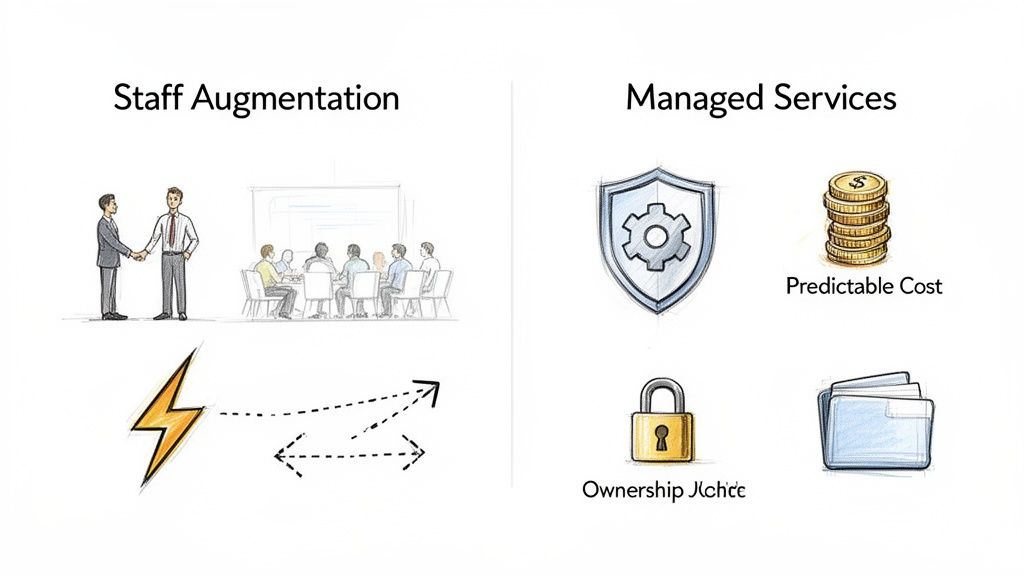
alt text: Infographic comparing staff augmentation and managed services, highlighting benefits like predictable cost and flexibility.
Direct vs. Delegated Control
With staff augmentation, you are in full control. Engineers slot directly into your team, report to your managers, and join your daily stand-ups. Your internal leads assign work and set deadlines. This is essential for developing your core product, especially in fast-moving fields like AI where tight collaboration is non-negotiable.
With managed services, you delegate control. The provider manages their own team to deliver an outcome. Your focus shifts from daily tasks to ensuring they meet the benchmarks in your SLA. This is a great fit for standardized functions where the process is repeatable, like IT helpdesk support.
Variable vs. Fixed Cost Structures
Staff augmentation uses a variable, time-and-materials cost model (e.g., a monthly retainer per engineer). This aligns perfectly with agile development, allowing you to scale your team up or down based on sprint needs without carrying fixed headcount costs.
Managed services operate on a fixed-fee structure. You pay a predictable monthly subscription based on the agreed scope. This offers budget predictability, which is ideal for stable operational functions.
Intellectual Property and Knowledge Transfer
In a staff augmentation engagement, you own 100% of the IP. The work is done in your codebase and contributed to your repositories. Knowledge transfer is organic, as augmented staff work alongside your team, sharing insights and improving documentation. For a deeper look into these long-term impacts, review our guide on the build vs buy software decision.
With managed services, ownership is more complex. The provider owns their proprietary processes and tools. Your contract must explicitly define ownership of any custom work. Because the provider's team operates separately, there is little knowledge transfer, creating a risk of vendor lock-in.
Management Overhead
Staff augmentation requires active, hands-on management from your team leads. You are responsible for onboarding, task assignment, and performance management. This ensures work aligns with your vision but requires leadership bandwidth.
Managed services are designed to minimize your management burden. The provider is responsible for quality assurance and managing their staff. Your involvement is limited to high-level governance and reviewing SLA reports, freeing up your leaders for strategic work.
Decision Checklist
Use this checklist to make a clear, defensible decision. Check the box that best describes your situation.
Scoring Your Checklist:
- Mostly Staff Augmentation: Your project is strategic and requires tight control. Focus on finding a partner who can provide deeply vetted, high-quality talent that can integrate seamlessly.
- Mostly Managed Services: Your need is operational. Focus on finding a provider with a proven track record and a crystal-clear SLA that protects your business.
- A Mix of Both: Consider a hybrid approach. Use managed services for stable, non-core functions (like cloud infrastructure) and staff augmentation for high-impact product development.
What to Do Next
- Finalize your model. Use the checklist above to make a final call on staff augmentation vs. managed services for your immediate need.
- Define your requirements. Document the specific skills you need (for staff augmentation) or the exact outcomes and metrics you require (for a managed services SLA).
- Start a pilot. The best way to vet a partner is to start with a small, low-risk pilot project. You can evaluate talent quality and integration fit before committing to a larger engagement.
Ready to accelerate your AI roadmap with vetted, senior talent? With ThirstySprout, you can hire remote AI and ML experts in days, not months. Start a Pilot.
Hire from the Top 1% Talent Network
Ready to accelerate your hiring or scale your company with our top-tier technical talent? Let's chat.