

TL;DR: Your Quick Guide to Outsourcing
- When to Outsource: Outsource when you need to scale faster than you can hire, access specialized skills (like MLOps or platform engineering), or free up your core team from operational tasks.
- Choosing a Model: Use an offshore or nearshore dedicated team for long-term, cost-effective development. Opt for onshore, time-and-materials engagements for complex projects needing tight collaboration.
- Key Risks: The biggest risks are IP leaks, poor communication, and low-quality work. Mitigate these with strong contracts (NDAs, IP clauses), security audits (SOC 2), and clear, measurable Service Level Agreements (SLAs).
- Top Action: Start with a 2-4 week pilot project. This is the fastest way to test a vendor's technical skill, communication, and overall fit before committing to a long-term contract.
Who This Is For
This guide is for technical leaders who need to make smart outsourcing decisions in the next 1-3 months:
- CTOs / Heads of Engineering: You need to scale your team or add specialized AI/MLOps capabilities without derailing your roadmap.
- Founders / Product Leads: You're scoping the budget and team for a new feature and need to decide whether to build in-house or find a partner.
- Talent Ops / Procurement: You're evaluating vendors and need a practical framework to assess risk, cost, and technical competence.
A 4-Step Framework for IT Outsourcing Decisions
Figuring out whether to outsource your IT is a major decision. It’s about making a smart choice to let your team focus on your core business while a partner handles specialized tech work. This framework helps you move from idea to execution methodically.
- Identify the Trigger: Pinpoint your exact pain point. Are you facing scaling challenges, a critical skills gap (e.g., MLOps), a need for cost optimization, or a desire to refocus your best engineers on product innovation? A clear "why" is essential.
- For specialized skills or long-term needs, consider a Dedicated Team.
- For well-defined, short-term projects, a Fixed Price model works.
- For projects with evolving requirements, use Time & Materials (T&M).
- Vet Vendors Systematically: Use a scorecard to evaluate 3-5 potential partners. Assess their technical skills, communication processes, security certifications (SOC 2, ISO 27001), and client references. Never skip reference checks.
- Define Success with an SLA: Create a Service Level Agreement (SLA) with clear, numeric targets for uptime (e.g., 99.95%), response times (<15 mins for P1 incidents), and other key metrics. This turns vague promises into accountable results.
- Situation: A fast-growing SaaS startup’s engineering team was spending nearly 50% of its time on manual deployments and infrastructure maintenance, slowing down new feature releases to a crawl.
- Action: They outsourced their platform engineering to a specialized offshore team. The goal was to build a fully automated CI/CD (Continuous Integration/Continuous Deployment) pipeline and offload day-to-day infrastructure management.
- Result: The partner implemented a CI/CD pipeline using Jenkins and ArgoCD, enabling multiple automated deployments per day. This freed the in-house team to focus entirely on product development.
- Business Impact: Time-to-market for new features was cut by 80%, developer productivity soared, and platform stability improved significantly.
- Situation: A large financial services firm built a powerful Retrieval-Augmented Generation (RAG) model but lacked the in-house MLOps expertise to run it reliably in production. They faced challenges with model monitoring, data pipeline latency, and model drift.
- Action: Instead of a slow and expensive hiring process, they partnered with a nearshore vendor specializing in production AI. They used a vendor scorecard to make a data-driven decision.
- Result: Here’s a simplified version of their scorecard, which helped them choose a vendor based on operational excellence, not just price.
- Business Impact: This objective approach allowed them to select a partner who could guarantee performance and reliability, de-risking their significant investment in AI.
- Software Development: The classic use case. Augment your team to build new apps or features faster.
- MLOps & AI: Access specialized talent to build, deploy, and monitor machine learning models without the high cost and long timeline of hiring in-house.
- Platform Engineering: Outsource management of your cloud infrastructure, CI/CD pipelines, and container orchestration to free your engineers to focus on product.
- Managed Services: Hand over full responsibility for an IT function, like 24/7 security monitoring or database administration, with performance guaranteed by an SLA. Understanding the difference between staff augmentation vs managed services is key here.
- Intellectual Property (IP) Leaks: Your contract must have ironclad NDA and IP ownership clauses stating everything built for you belongs to you. Verify vendor security certifications like SOC 2 or ISO 27001.
- Communication Breakdowns: Time zones and cultural differences can cause friction. Establish a clear communication protocol from day one: daily stand-ups, a shared Slack channel, and weekly syncs.
- Poor Quality Work: Define "done" with clear acceptance criteria for every task. Mandate code reviews and integrate automated testing into the CI/CD pipeline. Don't just hope for quality; build a process that demands it.
- Pinpoint the exact problem: Are you trying to cut time-to-market, access AI talent, or reduce operational load?
- Create a clear project brief detailing technical requirements and business goals.
- Establish a realistic budget range to guide your vendor search.
- Choose your location model: onshore, nearshore, or offshore. Balance your need for real-time collaboration against cost savings.
- Choose your pricing model: Fixed Price for defined projects, Time & Materials for evolving scopes, or Dedicated Team for long-term needs.
- Identify 3–5 potential partners with proven experience in your specific niche (e.g., MLOps, platform engineering).
- Use our Vendor Selection Checklist to evaluate technical skills, communication processes, and security protocols.
- Insist on speaking with at least two current or former clients. This is non-negotiable. For more on this, read our key vendor management best practices.
- Draft a detailed Statement of Work (SOW) that leaves no ambiguity on deliverables and timelines.
- Define measurable SLAs with numeric targets for uptime, response time, and other key metrics.
- Ensure your contract clearly states that all intellectual property developed belongs to you.
- Set up the new team on your company’s communication and project management tools like Microsoft Teams, JIRA, or Asana.
- Hold a formal kickoff meeting to align everyone on goals and processes.
- Establish a regular reporting cadence (e.g., daily stand-ups, weekly performance reviews).
- Scope Your Needs: Book a free 20-minute scope call with our team. We'll help you map your technical requirements to the right talent.
- Review Sample Profiles: See the caliber of expertise available by requesting sample profiles of our pre-vetted AI and MLOps engineers.
- Start Your Search: Download our comprehensive Vendor Selection Checklist to begin vetting partners with a proven framework.
- Automation vs. Outsourcing - Osher
- Staff Augmentation vs. Managed Services - ThirstySprout
- Software Development Outsourcing Guide - ThirstySprout
- Vendor Management Best Practices - MakeAutomation
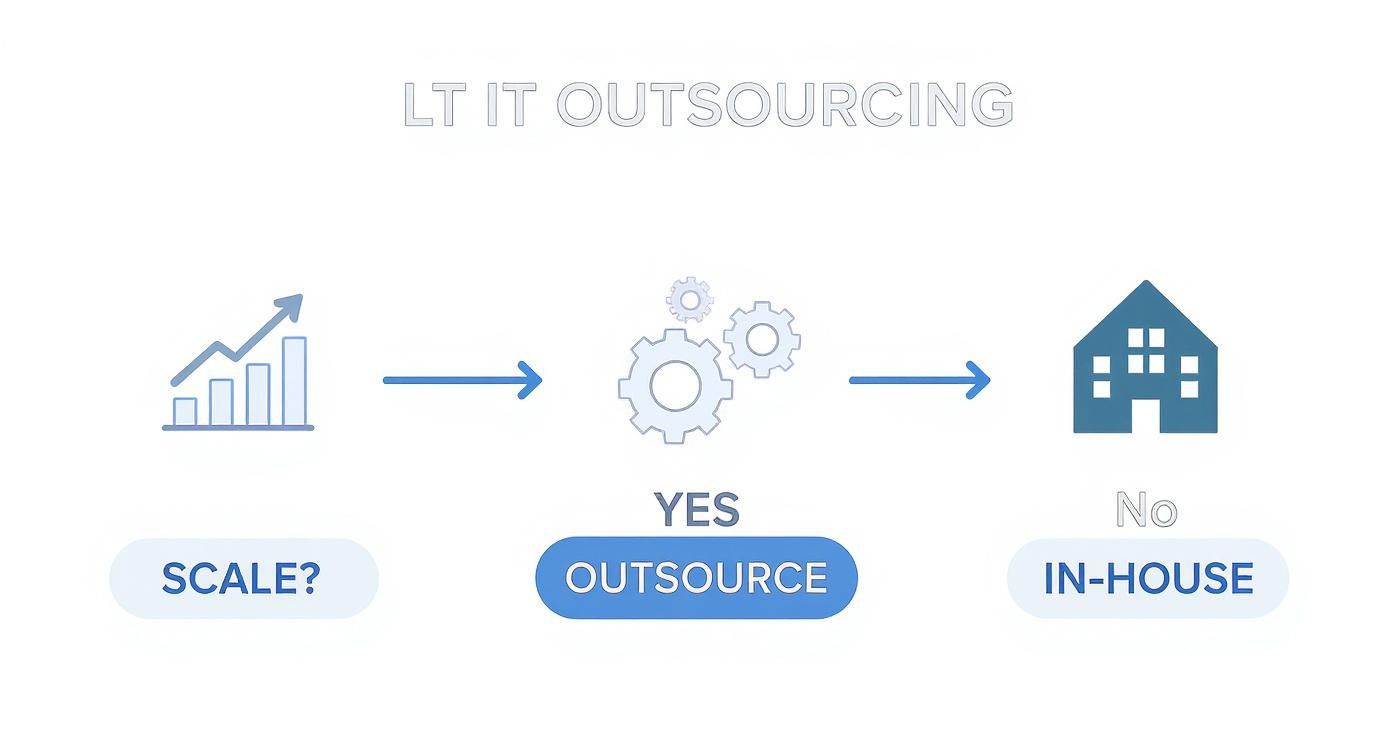
The primary driver is almost always growth. Once you decide an external partner is the right path, the next step is choosing the right engagement model.
Practical Examples: How Outsourcing Delivers Results
Let's move past the theory. Here are two real-world examples of how companies used IT services outsourcing to gain a competitive edge.
Example 1: SaaS Startup Slashes Time-to-Market by 80%
The Takeaway: Smart outsourcing augments your team, it doesn't just replace them. Offloading a critical but non-core function frees your most valuable talent to create real business value. For more, see our guide on software development outsourcing strategies.
Example 2: Enterprise De-Risks AI Project with MLOps Partner
Deep Dive: Choosing Your Model and Managing Risk
Deciding to outsource is one thing; making it work is another. Your success depends on picking the right model, anticipating risks, and choosing a trustworthy partner.
Which Outsourcing Model is Right for You?
Think of it like building a house. You could hire a local architect who's always available (Onshore), a well-known firm from a nearby country (Nearshore), or a world-class specialist from another continent (Offshore). Each has trade-offs in cost, communication, and collaboration.

The model you choose must align with your project’s needs. For complex AI projects requiring constant collaboration, the minimal time zone difference of nearshore or onshore might be worth the higher cost. For more defined, long-term work, offshore often provides the best value.
Common IT Services You Can Outsource
Facing Risks Head-On
Outsourcing has huge upsides, but it comes with risks. The key is to plan for them.
Another strategic choice is between outsourcing a task and automating it internally. Reviewing a direct comparison of Automation vs. Outsourcing can clarify the best path for your specific process.
Checklist: A 5-Step Plan for Implementation
This action plan breaks down the entire journey, from internal assessment to kicking off with your new partner.

[ ] 1. Define Scope and Build the Business Case
[ ] 2. Select the Right Outsourcing and Pricing Model
[ ] 3. Shortlist and Vet Potential Vendors
[ ] 4. Finalize the Contract and SLAs
[ ] 5. Onboard and Integrate the Team
What to Do Next
References
Ready to accelerate your AI and MLOps initiatives with elite, pre-vetted talent? ThirstySprout connects you with the top-tier engineers you need to build, deploy, and scale with confidence. Start a Pilot today.
Hire from the Top 1% Talent Network
Ready to accelerate your hiring or scale your company with our top-tier technical talent? Let's chat.