

TL;DR:
- Hiring offshore is a strategic move for accessing specialized AI/ML talent, not just for cutting costs.
- The best engagement model for most tech companies is Staff Augmentation, offering a balance of control and flexibility.
- Replace generic coding tests with a practical, 3–5 hour take-home assignment (e.g., building a mini RAG component) to assess real-world skills.
- Implement a structured 90-day onboarding plan with a dedicated buddy to get new hires to 85% productivity within 3–4 months.
- Calculate the Total Cost of Ownership (TCO), not just the hourly rate, by factoring in partner fees, management overhead, and a contingency buffer.
Who this is for:
- CTOs / Heads of Engineering who need to scale their teams with specialized AI or software talent without getting stuck in a local hiring bottleneck.
- Founders / Product Leads who are scoping roles and budgets for new product features and need to find the right engineers quickly.
- Talent Ops / Procurement managers evaluating vendors and trying to de-risk the process of hiring international contractors.
The Quick Framework: When and How to Hire Offshore Developers
Hiring offshore developers used to be about saving money. Now, it's a strategic play to tap into specialized AI and software engineering talent pools you can't find at home. Success isn't about finding the cheapest talent; it's about building a rock-solid vetting process and a structured onboarding plan to sidestep common pitfalls.
This playbook gives you a clear roadmap for scoping roles, setting realistic budgets, and managing the risks of hiring offshore AI and software engineers.
Here is the step-by-step process we recommend:
- Define the Need & Engagement Model: Is this for a short-term project (Staff Augmentation) or a long-term core team member (Direct Hire)? For most AI projects, Staff Augmentation provides the fastest path to value.
- Select a Region: Choose a location based on a trade-off between timezone overlap and talent specialization. Latin America for real-time collaboration (high overlap), Eastern Europe for deep systems expertise (partial overlap).
- Implement High-Signal Vetting: Design a practical take-home assignment that mirrors a real work task. Follow up with a structured technical interview and a consistent scorecard.
- Calculate Total Cost of Ownership (TCO): Budget for the developer's rate plus partner fees (
18-25%), internal management overhead (15-20%), and a contingency buffer (~10%). - Execute a 90-Day Onboarding Plan: Get your new hire to their first code commit within 3–5 days and full productivity within one quarter using a structured plan with clear KPIs.
Our First-Party Insight: We've analyzed over 200 offshore engineering placements. Teams that use a structured 90-day onboarding plan with clear KPIs (like time-to-first-commit) see their offshore developers integrate 40% faster and reach full productivity in 10 weeks, compared to 16+ weeks for teams with an ad-hoc approach.
Practical Examples of Offshore Hiring in Action
Theory is one thing, but execution is another. Here are two real-world examples that show how these principles work in practice.
Example 1: FinTech Startup Accelerates Fraud Detection
We worked with a Series B fintech company building a machine learning-based fraud detection engine. Their goal was to reduce chargebacks and protect users. The original plan was to hire three senior ML engineers in San Francisco.
- The Onshore Reality: After three months, they had hired only one engineer. The local talent pool was thin, and salary demands were breaking their budget, putting the project at risk.
- The Offshore Solution: The CTO decided to explore hiring offshore developers. We connected them with a team of three ML engineers in Eastern Europe who had specific, hands-on experience building real-time fraud detection systems.
- The Business Impact: The offshore team was fully ramped up and shipping code in three weeks. They built and deployed the entire fraud detection engine in five months. This strategic shift cut their development timeline by an estimated 40% and allowed them to launch a key competitive feature months ahead of schedule.
Example 2: The Vetting Rubric for a Senior MLOps Engineer
Gut feelings lead to bad hires. A simple scorecard forces you to evaluate candidates on the criteria that predict success in an offshore role. It’s a structured way to capture feedback and make data-informed decisions.
Here’s a simplified scorecard we use for MLOps roles. We score each category on a 1-5 scale.
This rubric changes the conversation from "Did they solve the puzzle?" to "How did they solve the problem, and how well did they communicate it?" Those process-oriented signals are far more predictive when hiring offshore developers.
Deep Dive: Engagement Models, Locations, and Vetting
Before you write a job description, you have two critical decisions to make: how you'll work with offshore talent and where you'll find them.
Picking the Right Engagement Model
You have three main paths for structuring your relationship with offshore developers.
- Direct Hire: You hire an employee who lives in another country. You're responsible for recruitment, payroll, local compliance, and benefits. This offers the tightest integration but has the heaviest administrative burden. Best for long-term core team members when you have international HR capabilities.
- Staff Augmentation: You partner with a firm that provides pre-vetted engineers who join your existing teams. You manage their daily work; the partner handles HR and payroll. This is a great balance of control and flexibility, perfect for adding specialized skills quickly.
- Project-Based Outsourcing: You hand off an entire project to an external agency. You define the scope, and they manage delivery. This requires the least day-to-day involvement but gives you the least control. Best for well-defined, non-core projects.
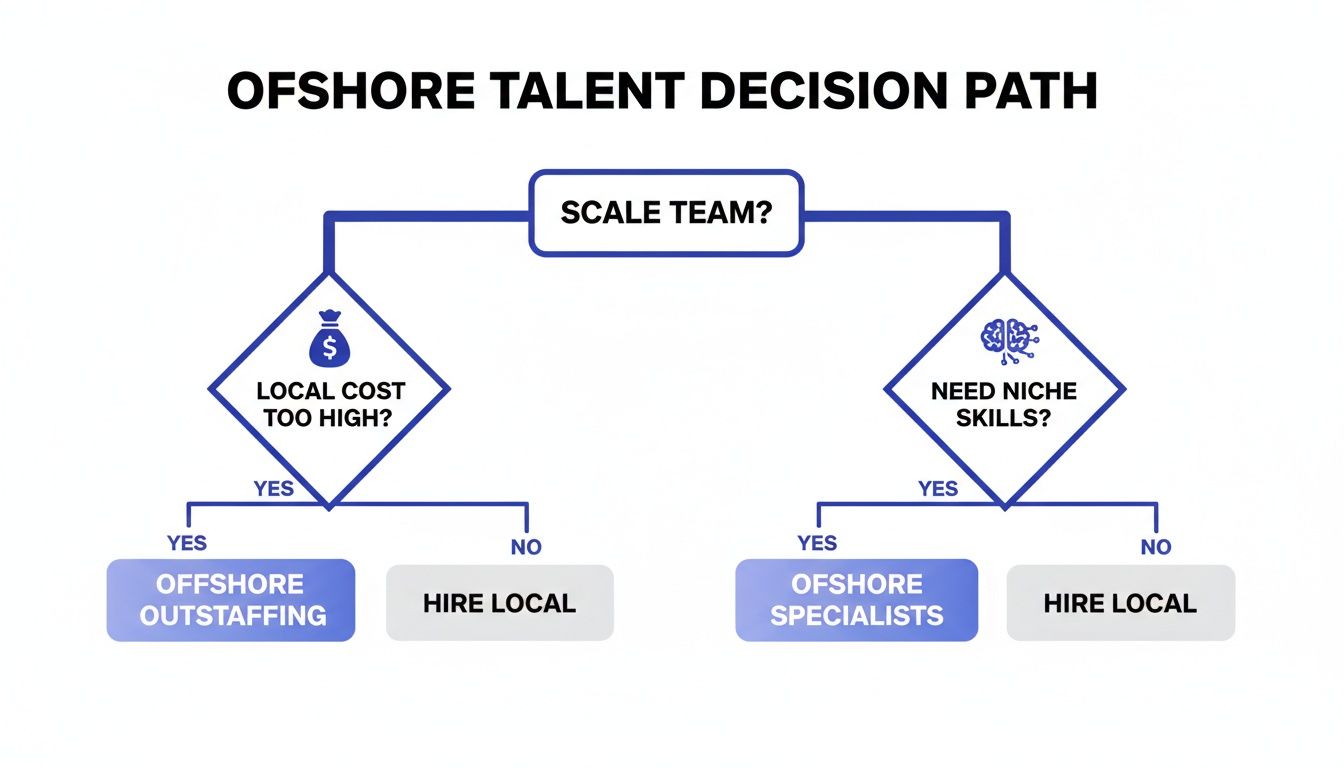
For most tech companies building complex AI/ML products, staff augmentation hits the sweet spot. It gives you direct oversight of your technical direction and lets you embed talent into your agile workflow without the logistical nightmare of international employment law.
The decision often comes down to a trade-off between cost and the need for niche skills.
Top Offshore Hubs for AI and Software Talent
Once you've chosen a model, the next question is geography. Different regions offer unique advantages in talent, cost, and timezone overlap.
Your choice depends on your team's specific needs and work style. For deeper analysis, see our guide on nearshore vs. offshore outsourcing. Understanding the legal and business structures in different hubs can also be useful, as detailed in resources like this Offshore Company Dubai: A Complete Setup Guide.
The Playbook for Vetting and Interviewing
Your success boils down to a process that tests what matters: technical skill, clear communication, and the discipline to thrive asynchronously.
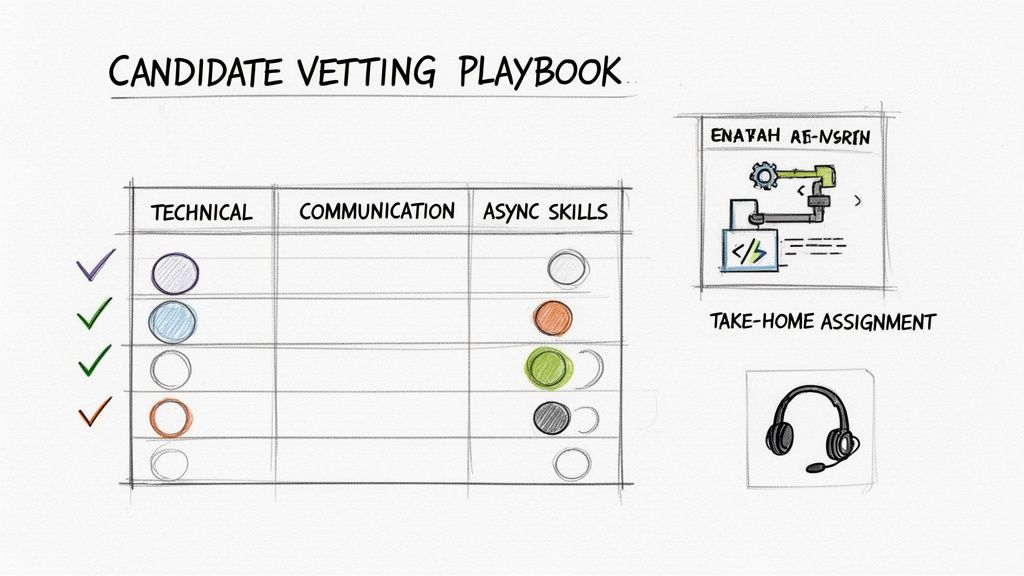
1. Design a Practical Take-Home Assignment
The most effective tool is a small, 3–5 hour project that simulates a real task.
- Example Task (AI Engineer): Give them 10–20 text files. Ask them to write a script to chunk the text, create embeddings with a pre-trained model, and load them into a simple vector store like FAISS or ChromaDB.
- What It Tests: This shows hands-on skills with the core LLM stack and, more importantly, how well they document their work for a remote team.
2. Use a Structured Interview Kit
Dig deeper into their production experience and system design thinking. For more ideas, check our guide to technical interview questions for engineers.
- Production Experience: "Tell me about a time a system you built went down. What was the root cause, and how did you prevent it from happening again?"
- System Design: "Sketch a high-level architecture for a service that analyzes 1 million customer reviews daily. What are the major trade-offs?"
A great candidate talks about trade-offs, monitoring, and asks clarifying questions—signs of real-world experience.
The 90-Day Onboarding Checklist for Offshore Developers
You’ve hired a great developer. The work starts now. The first 90 days determine whether they become a core team member or fizzle out. A structured plan is non-negotiable.
The goal is to provide a clear path to an early win through smooth technical setup, cultural integration, and clear expectations.
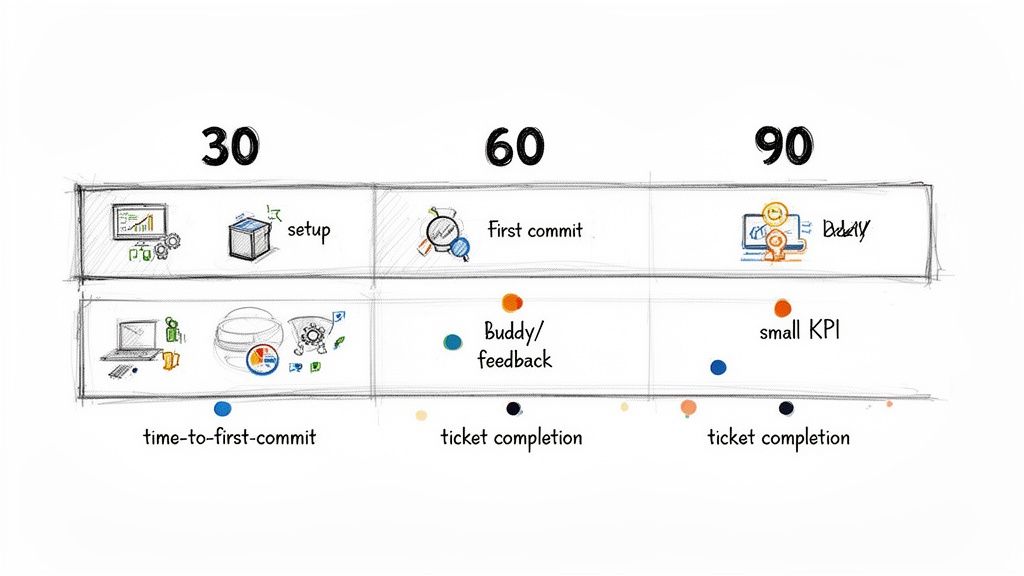
[ ] Days 1–30: Setup and First Commit
- Assign a Buddy: Pair them with a dedicated onshore teammate for daily check-ins. This is their go-to for questions about the codebase and team rituals.
- Day One Access: Grant immediate access to Git, project boards (Jira or Linear), and communication tools (Slack/Teams).
- First Task: Assign a well-defined, low-risk bug fix to help them learn the workflow.
- KPI: Time-to-First-Commit (aim for <5 days).
[ ] Days 31–60: Gaining Autonomy
- Bigger Work Chunks: Move them from single bug fixes to small, self-contained features.
- System Deep Dives: Schedule virtual whiteboard sessions with senior engineers to walk through the architecture.
- KPI: Ticket Completion Rate (should increase week-over-week).
[ ] Days 61–90: Driving Impact
- Feature Ownership: Give them ownership of a small-to-medium feature, from scoping to deployment.
- Become a Reviewer: Encourage them to review pull requests from teammates to deepen their codebase knowledge.
- KPI: Code Contribution Volume and Quality. Their output should approach that of an established team member.
Calculating Costs and Managing Compliance
Focusing only on the hourly rate is a rookie mistake. You must calculate the Total Cost of Ownership (TCO) for a realistic budget.
What's the Real Number?
TCO includes:
- Developer Rate: The base salary or hourly rate.
- Partner Fees: The margin for the staff augmentation firm (typically 18-25%).
- Management Overhead: Your onshore managers' time spent on oversight (budget an extra 15-20% of labor cost).
- Compliance & Legal: Costs for drafting international contracts.
For a deeper look, see our guide to offshore software development costs.
Crafting an Ironclad Contractor Agreement
Your contract is your primary tool for managing risk. Ensure it includes these five clauses:
- Intellectual Property (IP) Rights: All work product created belongs solely to your company.
- Confidentiality (NDA): A robust non-disclosure agreement to protect trade secrets.
- Termination Clause: Clear conditions and notice period for ending the agreement.
- Payment Terms: Specify rates, invoicing schedule, and payment methods.
- Governing Law: Designate which jurisdiction’s laws apply (typically your company's home state).
What to Do Next
- Assess Your Needs: Identify the specific skills you need and determine if Staff Augmentation is the right model to fill the gap quickly.
- Download the Onboarding Checklist: Use our 90-day plan to structure your onboarding process and set your next hire up for success.
- Book a Scoping Call: If you're ready to find pre-vetted AI/ML talent, let's talk. We can help you define the role and start the search.
Ready to build your offshore AI team without the guesswork? At ThirstySprout, we connect you with pre-vetted senior AI and ML engineers who can contribute from day one.
Start a Pilot.
References
Hire from the Top 1% Talent Network
Ready to accelerate your hiring or scale your company with our top-tier technical talent? Let's chat.