

TL;DR
- Move beyond algorithms: Focus on system design, MLOps, and practical LLM implementation questions to assess real-world skills.
- Assess business impact: Ask how technical choices (e.g., model accuracy vs. latency) affect business KPIs like cost or user retention. Don't hire engineers who can't connect code to outcomes.
- Use a structured rubric: Evaluate candidates consistently with a scorecard that covers code quality, system design trade-offs, and communication. This reduces bias and improves hiring accuracy.
- Actionable next step: Standardize your interview kits for your top 1–2 roles today using the questions in this guide to ensure every interviewer assesses candidates from a consistent baseline.
Who this is for
- CTO / Head of Engineering / Staff Engineer: You need a reliable framework to vet senior AI, ML, and MLOps engineers who can design and ship production systems.
- Founder / Product Lead: You are scoping new AI features and need to hire engineers who understand the practical trade-offs between cost, performance, and user experience.
- Talent Ops / Hiring Manager: You need to standardize your technical interview process to hire faster and reduce the risk of making a bad hire.
A Better Framework for Technical Interviews
Hiring elite engineers requires more than testing their ability to solve abstract algorithm puzzles. A generic LeetCode-style question might show if a candidate understands Big O notation, but it won't tell you if they can design a scalable API or debug a failing CI/CD pipeline for a machine learning model. This outdated approach filters out practical engineers while optimizing for candidates who are good at passing tests.
To hire talent capable of delivering real business impact, you need a modern framework. This guide provides a battle-tested bank of technical interview questions for engineers, broken down by critical skill categories. We focus on assessing the skills that directly correlate with on-the-job performance for roles in AI, machine learning, and MLOps.
1. Machine Learning & Model Development
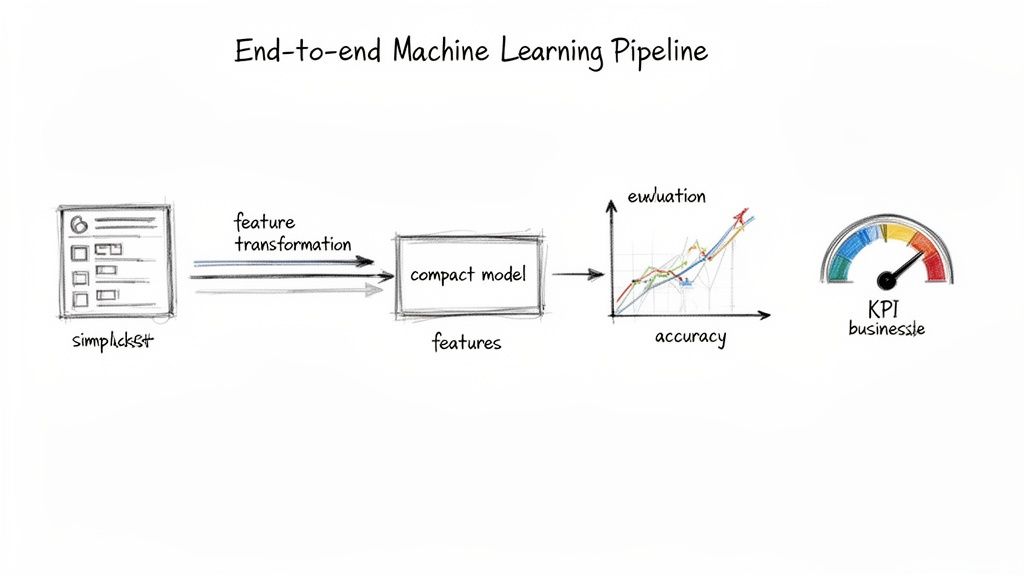
This category assesses a candidate's practical ability to design, build, and optimize machine learning (ML) models. It evaluates hands-on skills in feature engineering, algorithm selection, and model validation—critical for any team building production AI systems.
Why It's a Priority
Hiring managers use these questions to identify engineers who connect ML models to business outcomes. A candidate who only discusses model accuracy is a red flag. An excellent candidate discusses the entire lifecycle, from handling concept drift in production to measuring the model's impact on Key Performance Indicators (KPIs) like user retention.
Practical Interview Questions
- Project Walkthrough: "Walk me through a recent ML project you shipped. What trade-offs did you make between latency and accuracy, and how did you measure the business impact?"
- Real-World Scenario: "Your new fraud detection model has 99% accuracy, but the business isn't seeing a reduction in fraud losses. What do you investigate first?"
- Framework Choice: "Why would you choose XGBoost over a neural network for a tabular data problem? What are the practical trade-offs?"
2. Data Structures & Algorithms
This fundamental category evaluates a candidate's core problem-solving abilities. It tests their capacity to select appropriate data structures and implement efficient algorithms. This skill is the bedrock of performant software.
Why It's a Priority
These questions gauge computational thinking. A candidate who only finds a brute-force solution is a red flag. A strong engineer analyzes time and space complexity (Big O notation) and writes clean, maintainable code. This remains a non-negotiable baseline for most software engineering roles.
Practical Interview Questions
- Optimization Challenge: "You've written a script to process user activity logs that's too slow. It uses a nested loop. How would you refactor it using a hash map to improve its time complexity?"
- Real-World Application: "We need to build a 'recently viewed items' feature. Which data structure would you choose to store the last 10 items for each user, and why is it more efficient than a simple array?"
- Thought Process: (After they solve a problem) "Walk me through your choice of data structure. What are the trade-offs of this approach if memory were our primary constraint instead of speed?"
3. System Design & Architecture
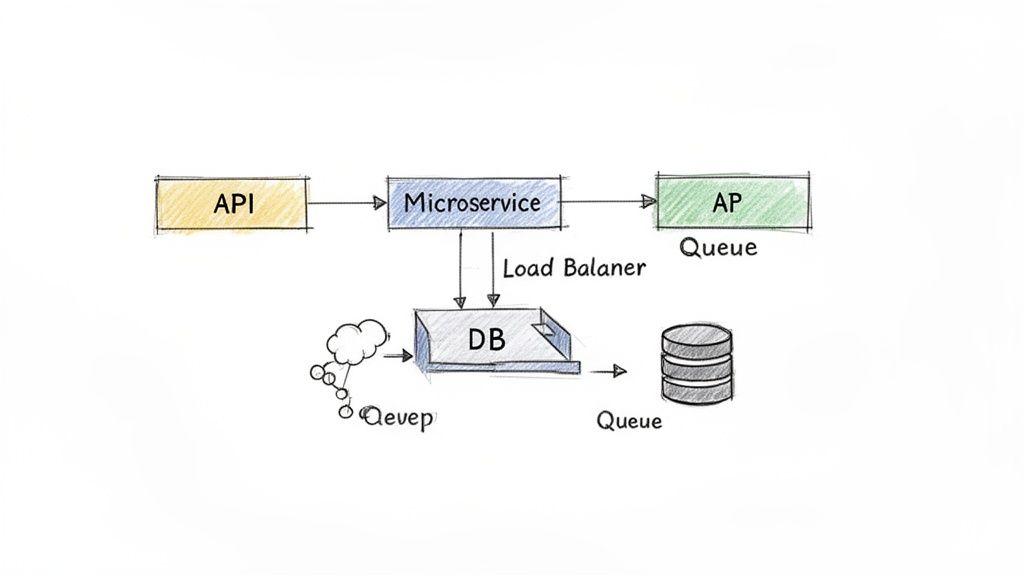
This category evaluates a candidate's ability to design large-scale, resilient systems. It moves beyond isolated algorithms to assess thinking on distributed systems, data flows, and infrastructure trade-offs, which is critical for senior and lead engineers.
Why It's a Priority
Hiring managers use system design questions to identify architectural maturity. A junior candidate might suggest a specific technology, while a senior candidate will start by clarifying requirements like latency, data consistency, and scale. This focus on trade-offs is a key differentiator.
Practical Interview Questions
- Open-Ended Design: "Design the backend for a ride-sharing app. Start by listing the functional and non-functional requirements you'd need to clarify."
- Probe on Trade-offs: "You've chosen a microservices architecture. Why not a monolith for this use case? What are the operational costs and risks your team would take on?"
- Introduce Bottlenecks: "Your design works for 10,000 users. What breaks when it needs to handle 10 million? Where are the bottlenecks, and how would you resolve them?"
4. LLM & Generative AI Implementation
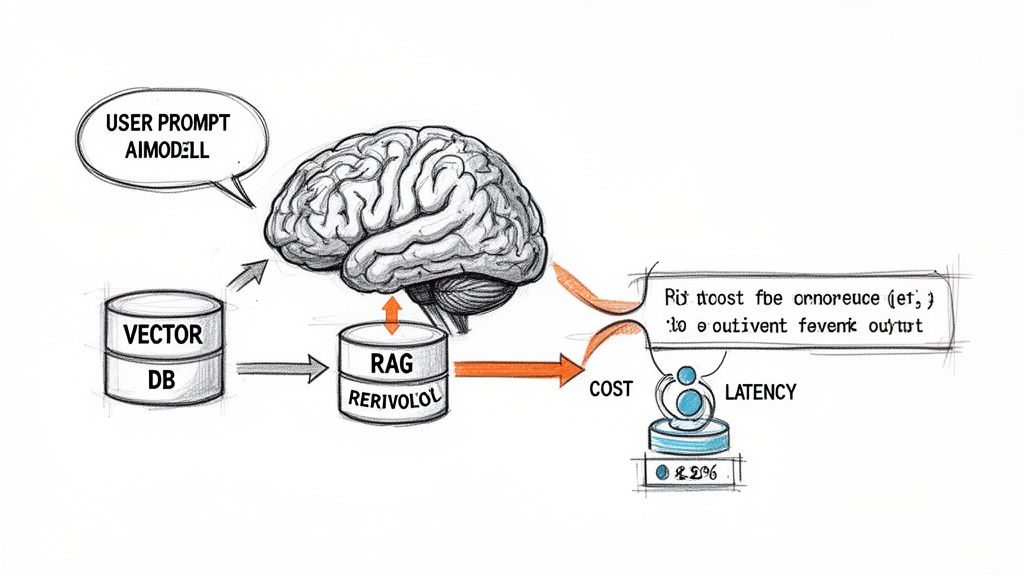
This emerging category evaluates the ability to build production applications using Large Language Models (LLMs). It assesses practical skills in prompt engineering, fine-tuning, and Retrieval-Augmented Generation (RAG).
Why It's a Priority
These questions identify engineers who can navigate the entire LLM application lifecycle. A strong candidate understands the trade-offs between models, how to evaluate subjective outputs, manage costs tied to token usage, and mitigate risks like hallucinations.
Practical Interview Questions
- System Design: "Design a RAG pipeline for our internal documentation. Which vector database would you choose and why? How would you handle document updates?"
- Cost Management: "Your AI agent's API costs are too high. What are the first three things you investigate to reduce them without significantly degrading quality?"
- Failure Modes: "Describe a time an LLM application failed in production. What caused it, and what guardrails did you implement to prevent it from happening again?"
5. Software Engineering Fundamentals & Code Quality
This category evaluates a candidate's grasp of core development practices beyond algorithms, including design patterns, testing, version control, and code review. These skills are fundamental for building production-grade systems.
Why It's a Priority
These questions identify engineers who think about the long-term health of a codebase. A strong candidate demonstrates how their code will be maintained, tested, and understood by others. This is a direct indicator of engineering maturity and ability to reduce technical debt.
Practical Interview Questions
- Live Refactoring: (Provide a messy code snippet) "Refactor this code to make it more readable and testable. Explain the principles behind your changes."
- Testing Philosophy: "How do you decide what to test and when to stop writing tests? Describe your approach to unit, integration, and end-to-end testing."
- Code Review Simulation: "You see a pull request that is functionally correct but difficult to read. How do you phrase your feedback? What if the author disagrees?" You can review 10 Code Review Best Practices here.
6. MLOps, Production ML Infrastructure & Cloud Platforms
This category evaluates the ability to operationalize machine learning. It focuses on skills needed to deploy, monitor, and maintain ML models in production, covering CI/CD for ML, container orchestration, and infrastructure as code (IaC).
Why It's a Priority
MLOps questions find engineers who bridge the gap between data science and production engineering. A great candidate details how they ensure a model remains performant, secure, and cost-effective once deployed. This "Day 2" operational mindset separates hobby projects from enterprise-grade AI.
Practical Interview Questions
- End-to-End Design: "Architect an MLOps pipeline for a recommendation engine. Which tools would you use for experiment tracking, data versioning, and model serving?"
- Production Failure: "A deployed model's prediction latency has suddenly tripled. How do you diagnose and fix this? Walk me through your debugging process."
- Cost Optimization: "Design an inference service to handle spiky traffic while controlling cloud costs. What are the trade-offs between serverless, containers, and dedicated VMs?" For a deeper dive, review these MLOps best practices.
7. Natural Language Processing & Computer Vision
This specialized category evaluates domain expertise in Natural Language Processing (NLP) or Computer Vision (CV). Questions probe understanding of specific architectures (Transformers, CNNs) and data preprocessing techniques.
Why It's a Priority
These questions identify engineers who have successfully shipped products using NLP or CV. A strong candidate can articulate the entire project lifecycle, from data annotation strategies to deploying a model and monitoring for performance degradation on messy, real-world data.
Practical Interview Questions
- Project Deep-Dive: "Walk me through an NLP project you shipped. Why did you choose a DistilBERT model over a larger one? How did you measure business impact?"
- Domain Trade-offs: "You have a small, domain-specific dataset for image classification. Would you fine-tune an existing model or train one from scratch? Justify your choice."
- Data and Tooling: "How have you handled data quality issues or annotation inconsistencies in past projects? Which tools (e.g., Labelbox, Hugging Face) did you use?"
8. API Design & Backend Development
This category evaluates skill in designing and building robust backend services. It assesses understanding of API design principles (REST, GraphQL), authentication, and error handling—foundational for any backend or full-stack engineer.
Why It's a Priority
These questions gauge a candidate's ability to create APIs that are scalable, secure, and easy for others to consume. A senior engineer will discuss versioning, rate limiting, and choosing appropriate HTTP status codes for clear error communication.
Practical Interview Questions
- Scenario-Based Design: "Design a REST API for a social media feed. What would your main endpoints be, what data would they return, and which HTTP methods would you use?"
- Trade-off Discussion: "When would you choose GraphQL over REST for a new service? What are the trade-offs for the backend team and the client-side developers?"
- Security and Scalability: "How would you secure a public-facing API that provides sensitive user data? What measures would you take to prevent abuse?"
9. Data Engineering & SQL
This category evaluates the ability to design and optimize data systems at scale. It tests expertise in SQL optimization, data modeling, and Extract-Transform-Load (ETL) pipeline construction.
Why It's a Priority
Data is the bedrock of any analytics or AI product. A top-tier candidate will discuss the trade-offs of different data models, explain how to partition tables for performance, and describe their process for ensuring data quality. This skill set is non-negotiable for teams relying on data.
Practical Interview Questions
- Query Optimization: (Provide a slow, complex SQL query) "Walk me through how you would diagnose the bottleneck and rewrite this query for efficiency. What would you look for in the execution plan?"
- Data Modeling: "We need to build a real-time dashboard for user activity. Design the underlying data model. Justify your choices for tables, keys, and any denormalization."
- Tooling Philosophy: "When would you use dbt versus a custom Python script for data transformation? What are the trade-offs?"
10. Communication, Problem-Solving & Collaboration
This category evaluates the crucial soft skills that enable technical talent to thrive, especially in remote teams. It assesses the ability to articulate complex concepts, solve ambiguous problems, and collaborate effectively.
Why It's a Priority
An engineer who writes brilliant code but cannot document their work or explain trade-offs becomes a bottleneck. Google's Project Aristotle found that psychological safety, built on clear communication, is the foundation of effective teams.
Practical Interview Questions
- Explaining Complexity: "Explain a complex system you've built as if you were speaking to a new, non-technical product manager."
- Conflict Resolution: "Tell me about a time you had a technical disagreement with a colleague. How did you handle it, and what was the outcome?" For more examples, see these common behavioral interview questions.
- Asynchronous Work: "How do you ensure alignment and communicate progress in a remote or asynchronous environment? Describe your experience with documentation like Architecture Decision Records (ADRs)."
What to do next: Your Action Plan
Having the right questions is the first step. To translate this framework into a streamlined hiring workflow, take these actions today.
- Standardize Your Interview Kits: Select the most relevant questions from this guide for your top 1–2 priority roles. Build a standardized interview kit in Notion or Google Docs with questions, an evaluation rubric, and sample "good" vs. "bad" answer notes.
- Conduct a Mock Interview: Run an internal mock interview using your new kit. This is the fastest way to identify confusing questions and calibrate what a top-tier answer sounds like before you risk losing a great external candidate.
- Define a "Go/No-Go" Scorecard: Create a simple scorecard for each stage with 3–5 core competencies and a clear decision rubric (e.g., "Strong Hire," "Hire," "No Hire"). This forces a decisive outcome and accelerates your time-to-hire.
Key Insight: The biggest bottleneck in building an elite AI team isn't finding interview questions; it's gaining access to a pool of pre-vetted talent who can confidently answer them. Mastering these technical interview questions for engineers is your internal lever for quality control.
Ready to skip the sourcing headache and interview only the best? The engineers in the ThirstySprout network are already vetted against the rigorous standards outlined in this guide. Start your pilot and connect with the top 1% of remote AI and MLOps talent in days, not months.
Hire from the Top 1% Talent Network
Ready to accelerate your hiring or scale your company with our top-tier technical talent? Let's chat.