

TL;DR
- When to Hire: Hire a remote Machine Learning Engineer when you need to move a model prototype from a Jupyter notebook to a scalable, production-ready system that delivers real business value.
- What to Look For: Prioritize strong software engineering skills over pure ML theory. Candidates must have hands-on experience with Python, a major cloud platform (AWS, GCP), containerization (Docker, Kubernetes), and MLOps tools (MLflow).
- How to Vet: Use a 4-stage process: 1) a 30-min screening call, 2) a 60-min technical deep dive, 3) a 3-4 hour practical take-home assignment (e.g., containerizing an API), and 4) a final system design interview.
- Budget: For a mid-level remote ML engineer in the US market, budget a base salary of around $145,000. Senior and specialized roles command significantly more.
- Next Step: Use our skill matrix and take-home assignment template below to standardize your interview process and avoid costly mis-hires.
Who This Guide Is For
This guide is for technical leaders who need to hire an ML engineer to ship an AI feature within the next 1-3 months.
- CTO / Head of Engineering: You're responsible for turning a promising model prototype into a reliable, scalable product feature and need to hire the right engineering talent to build it.
- Founder / Product Lead: You're scoping the budget, timeline, and team needed to launch a core AI capability and need to understand the role's responsibilities and cost.
- Hiring Manager / Staff Engineer: You're leading the interview process and need a structured framework to vet candidates for production-grade skills, not just theoretical knowledge.
A Quick Framework: When to Hire an ML Engineer vs. Other AI Roles
It's easy to get AI roles mixed up. Choosing the wrong one costs time and money. Use this decision framework to clarify who you need right now.
If your goal is to bridge the gap between a prototype and a live product, the ML Engineer is your answer.
Practical Examples of an ML Engineer's Impact
A remote Machine Learning (ML) Engineer's job is to answer one question: "This model works on my laptop. How do we make it serve 100,000 users per minute with 99.9% uptime?" Answering that requires a software engineering brain.
Here are two real-world examples.
Example 1: Building a Real-Time Fraud Detection API
A fintech startup has a model that spots fraudulent transactions. It works on historical data but now needs to screen thousands of live transactions per second.
- ML Engineer's Role: The engineer builds a low-latency REST API for the model. They containerize it using Docker, deploy it on AWS SageMaker with auto-scaling, and set up a monitoring dashboard to track accuracy and p99 latency. They also implement an alerting system for model drift.
- Business Impact: The company blocks fraud in real-time, reducing financial losses by a projected 15% in the first quarter and protecting customer trust. The system's scalability directly supports business growth.
Example 2: Automating a SaaS Recommendation Engine
A B2B SaaS company wants to recommend articles to users. The prototype is promising, but retraining it is a manual, weekly task that's becoming a bottleneck.
- ML Engineer's Role: The engineer designs and builds an automated retraining pipeline using Apache Airflow to pull fresh user data, trigger a training job, and version the new model with MLflow. The new model is automatically A/B tested and deployed as a microservice without downtime.
- Business Impact: User engagement with recommended content increases by 40%. The automated pipeline frees up 10 hours of data science time per week, allowing the team to focus on developing new models instead of maintaining old ones.
The Deep Dive: Core Responsibilities & Key Skills
A remote ML Engineer operates in a continuous cycle: Design, Deploy, and Monitor. This isn't a one-off handoff; it’s a full-lifecycle ownership that demands a unique blend of architectural foresight and operational discipline.
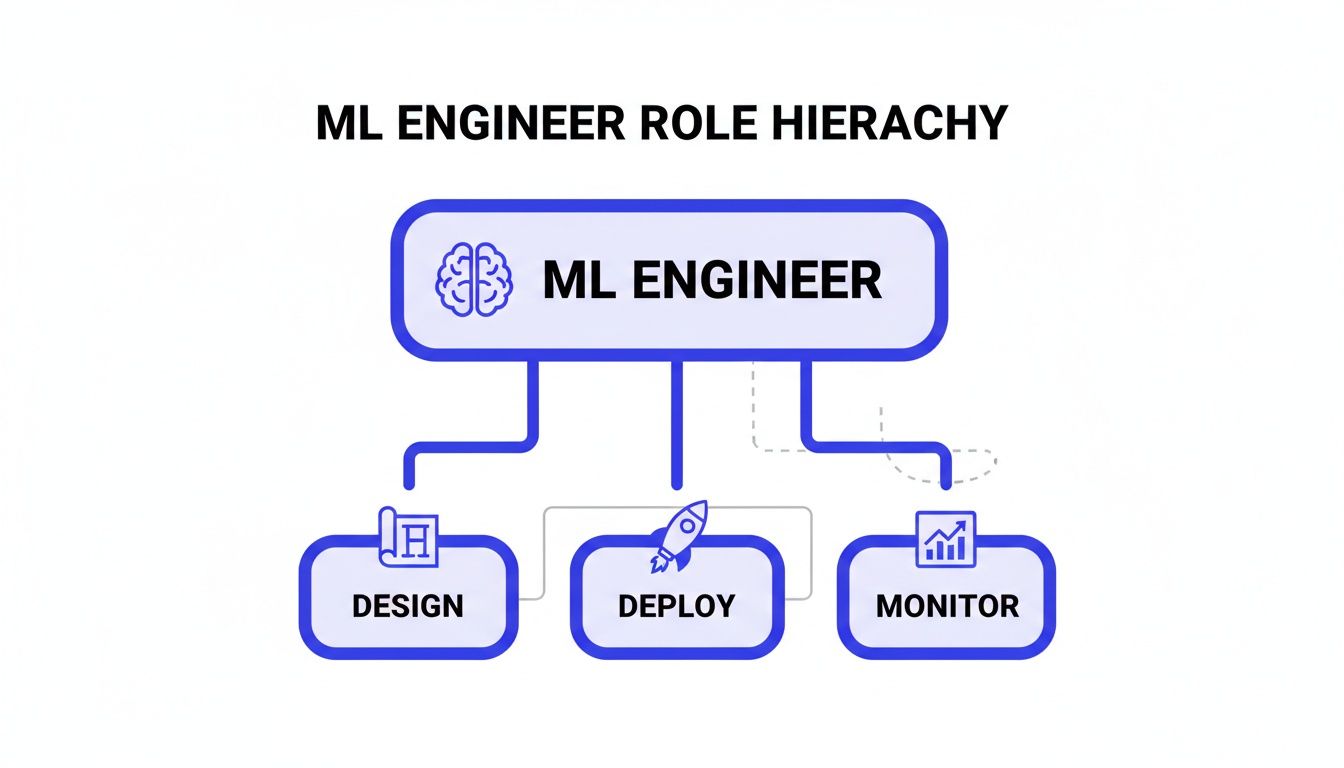
Alt text: Diagram showing the three core responsibilities of a Machine Learning Engineer: Design scalable systems, Deploy automated pipelines, and Monitor model performance.
Core Technical Competencies
A great ML Engineer is a great software engineer first. Their technical toolkit must reflect a focus on automation, cloud infrastructure, and production reliability.
- Programming & ML Frameworks: Expert-level Python is non-negotiable. They must have hands-on experience integrating models using frameworks like PyTorch or TensorFlow.
- Cloud & MLOps Platforms: Production ML runs in the cloud. Look for deep familiarity with a major platform like AWS SageMaker, Google Cloud Vertex AI, or Azure Machine Learning.
- Containerization & Orchestration: Proficiency with Docker for packaging services and Kubernetes for managing them at scale is a prerequisite for building reliable systems.
- Automation & Data Tools: Experience with tools like MLflow for experiment tracking, CI/CD tools (e.g., GitHub Actions) for automated deployment, and data processing techniques like scraping data for AI projects is crucial.
Key insight: An engineer who can talk about model accuracy is common. An engineer who can show you the Terraform script they wrote to deploy a resilient, auto-scaling inference endpoint is the one you hire.
Remote-Ready Skills
In a remote setting, communication and ownership are just as critical as technical skills.
- Asynchronous Communication: Can they explain a complex technical issue clearly in a Slack message or a pull request description? This is a remote superpower.
- Proactive Documentation: Great remote engineers write clean, well-commented code and maintain clear architectural diagrams. Their work unblocks the rest of the team.
- Problem Scoping & Ownership: They take a business goal, break it down into technical steps, ask clarifying questions upfront, and take full responsibility for the outcome.
Checklist: Your Remote ML Engineer Interview Kit
A standardized process removes bias and ensures you evaluate every candidate on the skills that matter. Use this four-stage framework to identify top talent.
[ ] Stage 1: Screening Call (30 mins)
- Goal: Validate core experience and remote-readiness.
- Interviewer: Hiring Manager or Senior Engineer.
- Key Question: "Describe the most complex ML system you've put into production. What was your specific role, and what was the biggest technical challenge you solved?"
- Red Flags: Vague answers about their contributions; inability to explain technical trade-offs clearly.
[ ] Stage 2: Technical Deep Dive (60 mins)
- Goal: Assess hands-on experience with production systems.
- Interviewer: 2-3 Senior/Staff Engineers.
- "A model's performance in production has degraded. Walk me through your debugging process. What metrics do you check first?"
- "Let's design a CI/CD pipeline for a model that needs to be retrained weekly. What are the key stages, and where are the most likely points of failure?"
- See our list of top machine learning engineer interview questions for more ideas.
- Goal: Evaluate real-world software engineering and deployment skills. This is the best predictor of on-the-job performance.
- Objective: Take a pre-trained
scikit-learnmodel and deploy it as a containerized REST API. - Task: Provide a serialized model file (
.pkl). The candidate must write a web server using Flask or FastAPI that exposes a/predictendpoint. The entire application must be containerized with Docker. - Evaluation Criteria: Code quality, clear
README.mddocumentation, and whether the Docker container builds and runs correctly on the first try. - Goal: Assess high-level architectural thinking and team alignment.
- Interviewer: CTO / Head of Engineering.
- Key Prompt: "We want to build a system that recommends related articles to users on our blog. Whiteboard the architecture, from data ingestion to the live API. Discuss the trade-offs you'd make for a V1 launch."
- What to Look For: Do they ask clarifying questions about business constraints (e.g., latency, cost)? Do they proactively discuss monitoring and scalability?
- Days 1-30 (Setup): Focus on immersion and a quick win. Provide access to all systems (AWS, GCP, codebase, Slack, Jira) on day one. Assign a small, low-risk task like fixing a bug in a data pipeline to build confidence.
- Days 31-60 (Ship): Assign ownership of a core component and a meaningful project, such as improving a model's inference latency. The goal is to ship their first significant feature to production.
- Days 61-90 (Improve): The engineer should now be proactive. Expect them to identify technical debt, suggest architectural improvements, and contribute to the team's knowledge base through documentation and code reviews. This is a core part of effective remote workforce management.
- Standardize your process: Use the 4-stage interview kit from this guide to ensure you're vetting for the right skills.
- Define your needs: Use our decision framework to confirm whether an ML Engineer is the right role for your current stage.
- Accelerate your search: If you need to hire in weeks, not months, consider a specialized talent partner.
- ML Engineer Salary Data, Wellfound (2024)
- Remote Machine Learning Jobs Market, BuiltIn (https://www.builtinla.com/jobs/remote/data-analytics/machine-learning?page=2)
- ThirstySprout's Guide to Remote Workforce Management
[ ] Stage 3: Practical Take-Home Assignment (3-4 hours)
[ ] Stage 4: System Design & Culture Fit (60 mins)
Budgeting & Onboarding Your New Hire
Salary Benchmarks & Total Cost
According to Wellfound data, the average expected salary for a remote ML engineer at a US startup is $145,000 per year, a 49% premium over other remote roles. Senior engineers in competitive markets can command over $300,000. Don't lowball your offer; the market is too competitive. For more on project-based costs, see our guide on understanding software development costs.

Alt text: Illustration showing a manager on a video call to hire a remote engineer, with icons representing budget and time considerations.
A 90-Day Onboarding Plan for Fast Impact
A structured onboarding plan is critical for getting a return on your investment. Break the first three months into clear phases.
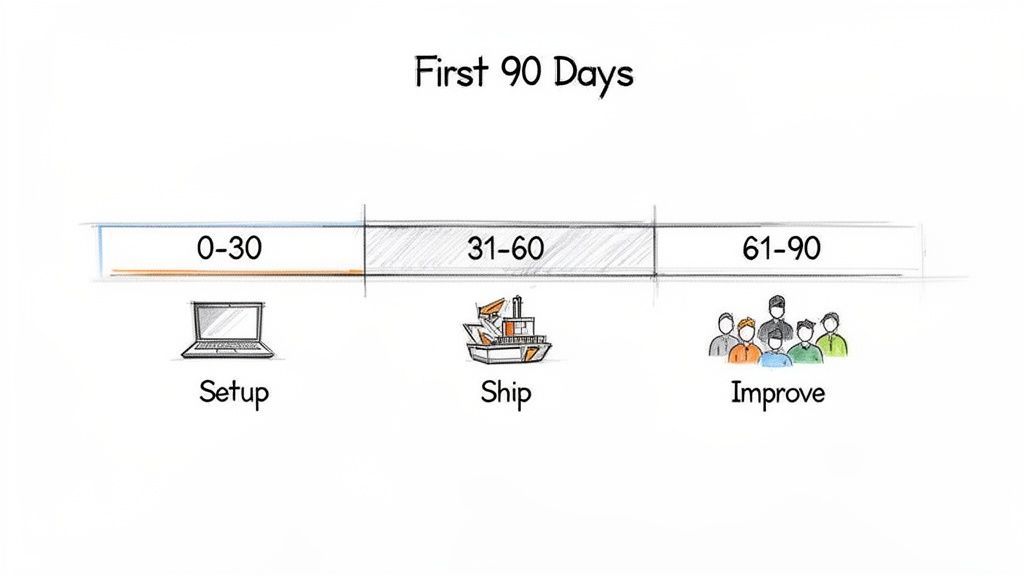
Alt text: A 90-day onboarding plan timeline for a remote ML engineer, showing three phases: Setup (Days 0-30), Ship (Days 31-60), and Improve (Days 61-90).
What to Do Next
The traditional hiring process for a remote ML engineer can take 2-4 months, delaying your product roadmap. To move faster:
At ThirstySprout, we connect you with pre-vetted senior AI engineers from our global network. You can start a pilot project in as little as two weeks, skipping the lengthy search process and getting straight to building.
References
Hire from the Top 1% Talent Network
Ready to accelerate your hiring or scale your company with our top-tier technical talent? Let's chat.