

TL;DR
- Rethink Management: Successful remote management isn't about replicating the office online. It's about building an intentional system based on asynchronous communication, clear documentation, and outcome-driven performance metrics.
- Hire for Remote: Vet candidates for both deep technical expertise and exceptional asynchronous communication. Use a multi-stage process with a practical take-home task that mimics real-world work.
- Build an Async OS: Define which tools to use for which conversations (Slack vs. Notion). Create a single source of truth for every project to protect deep work time and eliminate repetitive status meetings.
- Measure Impact, Not Hours: Shift from tracking online presence to measuring outcomes. Define specific KPIs tied to business goals, such as model precision, deployment frequency, or cycle time.
- Secure by Design: Implement a Zero Trust security model. Grant granular, role-based access to systems instead of relying on a slow, clunky VPN.
Who This Is For
- CTO / Head of Engineering: You need to hire specialized AI talent, scale your team globally, and implement processes that drive velocity without sacrificing quality.
- Founder / Product Lead: You are scoping new AI features and need to build a high-performing, cost-effective team to deliver on your product roadmap.
- Talent Ops / Hiring Manager: You are responsible for vetting, hiring, and onboarding remote engineers and need a repeatable framework for success.
This guide provides an actionable framework for building and managing a high-impact remote AI team, focusing on the systems and culture needed to ship complex projects faster.
Quick Framework: The Remote Team Operating System
Managing a remote team effectively isn't about a single tool or policy. It's about implementing a complete operating system built on three core pillars:
- Intentional Hiring & Onboarding: The process starts before the first interview. You must define success outcomes for the role, vet for async communication skills, and run a structured 90-day onboarding plan to ensure new hires can contribute quickly and confidently.
- Asynchronous Communication by Default: The central nervous system of a remote team. This involves creating a written guide on which channels to use for different types of communication, mandating a single source of truth for all project documentation, and using tools like Loom to replace unnecessary meetings.
- Outcome-Driven Performance: Accountability is built on clarity, not surveillance. This pillar requires defining specific, measurable KPIs that connect engineering work directly to business impact. Performance is measured by results, not by activity metrics like hours logged or lines of code.
alt text: An illustration showing three ascending blocks labeled with icons for communication, tools, and goals, representing the foundational pillars of remote workforce management. People figures are placed on each block, symbolizing team success at each stage.
Practical Examples of Remote Management in Action
Example 1: A 90-Day Remote Onboarding Plan That Works
A scattershot onboarding process is a primary cause of new hire failure in remote teams. A structured plan systematically connects them to the right people, processes, and culture.
A solid 90-day plan progresses from learning to full autonomy:
- Days 1–30 (Laying the Foundation): Focus on setup, immersion, and understanding the "why." This includes getting access to all systems, meeting key stakeholders, and reviewing core project documentation.
- Days 31–60 (Getting the First Win): Assign a small, well-defined project that the new hire can own end-to-end with guidance from an onboarding buddy. A successful first project is a massive confidence booster.
- Days 61–90 (Building Autonomy): The new hire should now be taking on larger tasks, finding answers independently in the knowledge base, and contributing proactively in team rituals.
Example 2: Implementing a Zero Trust Security Rollout
A health-tech startup with a fully remote engineering team struggled with a slow, unreliable VPN that hampered access to their AWS development environments. They switched to a Zero Trust architecture using a service like Cloudflare Access.
Here’s the step-by-step rollout:
- Consolidate Identity: They integrated their identity provider (Okta) to create a single, secure source of credentials for every employee.
- Grant Granular Access: They configured specific access policies. For example, a data science engineer could access the JupyterHub environment but was blocked from the production finance database.
- Check Device Health: They added rules requiring devices to have endpoint protection (like CrowdStrike) installed and updated before granting access.
The result was a 10% boost in developer productivity due to faster connections and a significantly stronger security posture. This is the foundational thinking behind securing big data environments.
Deep Dive: Trade-offs, Alternatives, and Pitfalls
Building a Foundation for Remote Success
To build a high-performing distributed team, you must move past the "temporary" mindset. A solid remote foundation aligns your operational strategy with core business goals. Remote work is no longer a trend; an estimated 32.6 million Americans will be working remotely by 2025. This shift directly impacts your ability to find and retain top talent, especially in specialized fields like AI. When you adopt a remote-first culture, the entire world becomes your talent pool.
A well-designed remote management system delivers tangible business value:
- Faster Time-to-Value: Hiring specialized experts globally, like an MLOps engineer, shortens project timelines.
- Increased Innovation: Diverse teams with different backgrounds lead to more creative problem-solving.
- Improved Resilience: A distributed workforce is less vulnerable to local disruptions.
The key trade-off is moving from spontaneous, in-person collaboration to deliberate, documented communication. This requires an initial investment in process and training but pays dividends in clarity and scalability. Exploring resources like a leader's ultimate guide to managing remote teams can provide structure for defining roles and responsibilities.
Bringing Global AI Talent on Board
Finding and hiring top-tier remote AI talent requires a playbook built for a global, asynchronous world. The process vets for two critical traits: deep technical expertise and exceptional asynchronous communication skills. One without the other is a recipe for failure.
A multi-stage vetting process works best:
- Screening Call (30 mins): Assess alignment with your company's mission and their ability to connect past experience to your problems.
- Technical Deep Dive (60 mins): Have them whiteboard a real-world problem, such as designing a CI/CD pipeline for a new ML model.
- Take-Home Task (3–4 hours): This is the ultimate async test. Provide a small, defined problem and evaluate the clarity of their code, solution structure, and documentation.
- Collaboration Chat (45 mins): Ask behavioral questions like, "Tell me about a time you resolved a technical disagreement without a live call."
Hiring internationally introduces compliance complexity. Research from Remote's comprehensive report shows 74% of companies face major roadblocks with overseas compliance. As you build your benefits package, offerings like travel health insurance for remote workers and freelancers can be a significant competitive advantage. For more detail, see our guide on how to hire remote AI developers.
This decision tree helps visualize the initial considerations when expanding your team globally, a key part of modern remote workforce management.
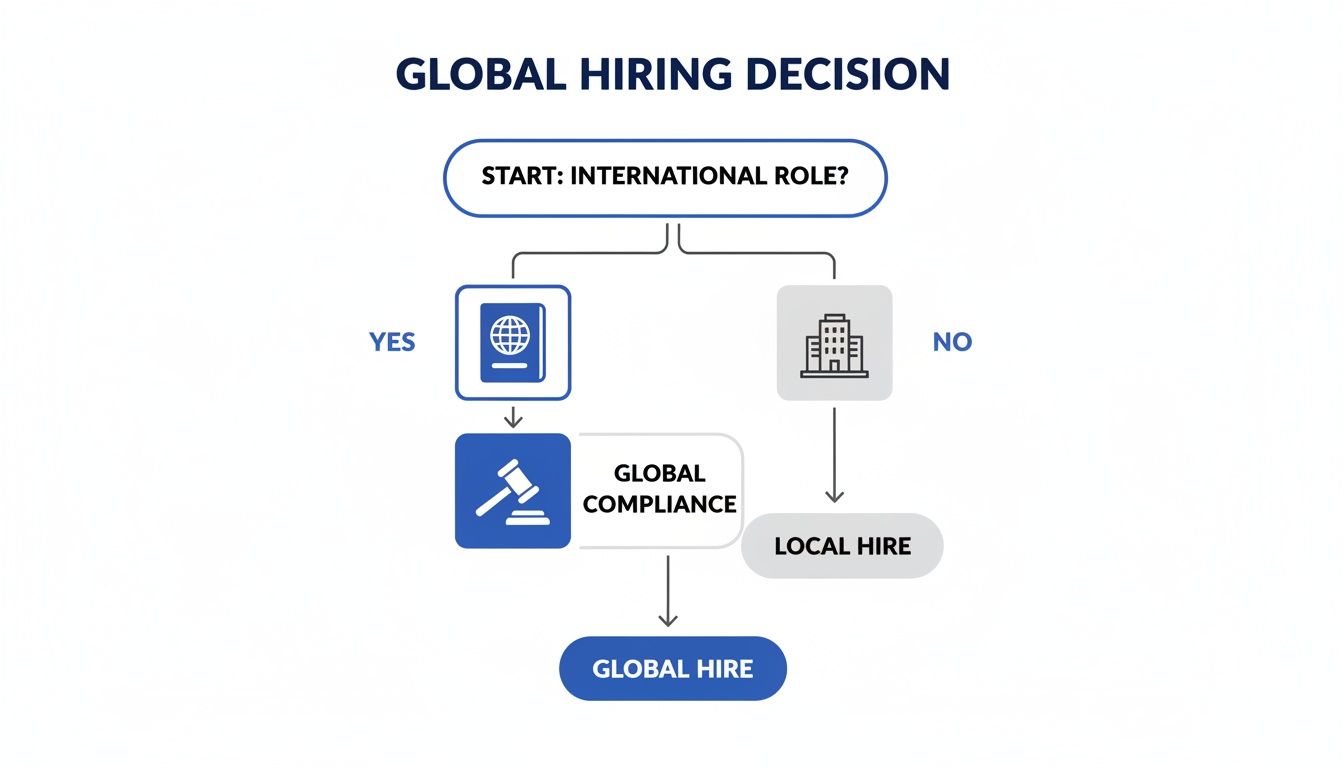 alt text: A decision flowchart for global hiring in remote workforce management. It starts with "New Hire?" and branches to "International?" or "Local?". The international path leads to "Global Compliance (EOR)" while the local path leads to "Local Payroll & Benefits".
Designing Your Asynchronous Communication System
The best remote teams thrive on a well-oiled asynchronous communication system. The goal is to shift the culture from valuing presence (who's online) to valuing documented outcomes (what got done). This is critical for engineers who need uninterrupted time for deep work.
The core principle is using the right tool for the right conversation:
- Low Urgency, Low Complexity (FYIs): A dedicated Slack channel (
#announcements) or a weekly email. - Low Urgency, High Complexity (Technical specs, process docs): A permanent home in Notion, Confluence, or a detailed Jira ticket.
- High Urgency, Low Complexity (Quick blockers): A direct message or targeted
@mentionin a project-specific Slack channel. - High Urgency, High Complexity (System outage): An immediate synchronous call.
The biggest pitfall is attempting complex conversations in Slack. If a thread goes back and forth more than three times without resolution, move it to a Loom video or a structured document.
Measuring Performance and Fostering Accountability
In a remote environment, measuring presence is useless. The focus must shift to measuring outcomes. Accountability is not about surveillance; it's about a shared understanding of success.
Define specific, outcome-driven Key Performance Indicators (KPIs):
- Model Performance Precision: "Increase
precision@10by 15% for returning users within Q3." - Deployment Frequency: "Reduce the average 'code commit to production' time to under 48 hours."
- Infrastructure Cost Reduction: "Decrease model inference costs on AWS by 20% through instance optimization."
While quantitative KPIs are essential, they don't capture the full picture. Crucial skills like proactive communication and collaboration are the glue of a high-performing remote team. For a deeper dive into these concepts, check out our guide on how to effectively manage a remote team.
Crafting a Secure and Efficient Remote Tech Stack
Your tech stack is the central nervous system of your remote team. For AI and engineering teams, tools must support iterative workflows and handle large datasets.
Project Management: Tools like Jira and Asana are excellent for technical teams. Jira excels with deep integrations into the developer ecosystem (GitHub, Bitbucket), allowing you to trace code commits back to feature requests. Asana is better for high-level roadmap planning and communicating with non-technical stakeholders. A common best practice is using Asana for the "what and why" (product roadmap) and Jira for the "how" (engineering execution).
Security: A Zero Trust model is the modern standard for remote security. It operates on the principle of "never trust, always verify," authenticating every access request regardless of its origin. This eliminates the need for clunky VPNs and provides a more secure and efficient experience for developers.
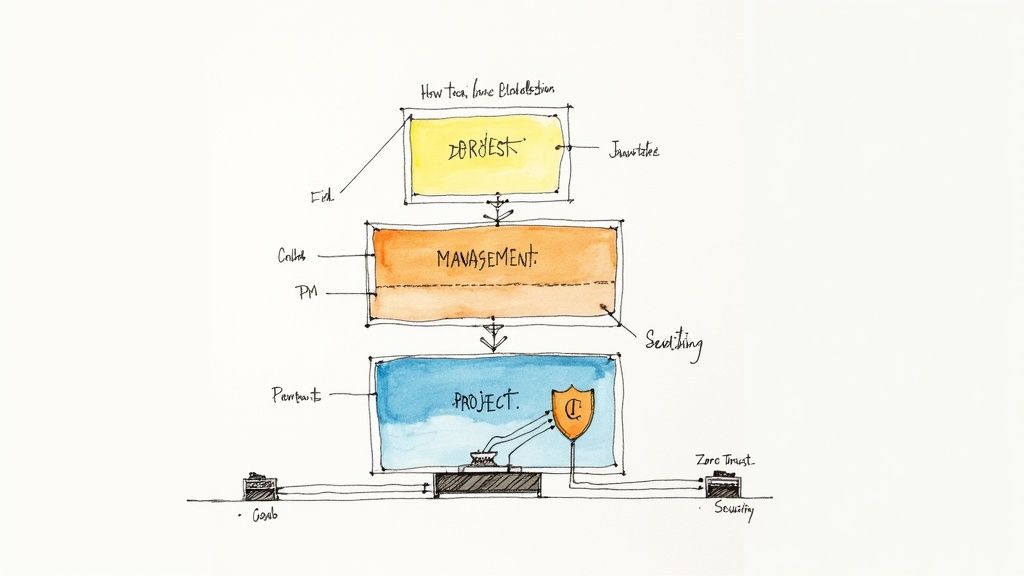 alt text: A diagram illustrating the key components of a remote tech stack. A central circle is labeled "Project Management (Jira, Asana)". It connects to "Source of Truth (Notion)", "Security (Zero Trust)", and "Communication (Slack, Loom)".
Checklist: Remote Workforce Management Template
Use this checklist to audit and refine how your remote team operates.
Hiring & Onboarding
- Define a role-specific scorecard focusing on expected outcomes before writing the job description.
- Create a take-home task that is a direct reflection of the candidate's day-to-day work.
- Implement a structured 90-day onboarding plan with a dedicated buddy and a clear "first win" project.
- Verify global compliance and payroll requirements before making an international offer.
Communication & Workflows
- Establish a written Communication OS that defines which tool is used for which conversation (Slack vs. Notion).
- Mandate a single source of truth document for every new project, including a Directly Responsible Individual (DRI) and clear goals.
- Institute a "Loom before meeting" policy for project updates and code walkthroughs to protect deep work time.
Performance & Accountability
- Set objective, measurable KPIs for every engineer that connect directly to business goals (e.g., cycle time, feature adoption).
- Use a balanced scorecard for performance check-ins that evaluates both quantitative results and qualitative contributions.
- Publicly celebrate outcome-based wins to reinforce a results-oriented culture.
Tools & Security
- Audit your tech stack for redundancy and ensure core platforms like Jira or Asana are configured for async work.
- Embrace Zero Trust security principles, granting granular, role-based access instead of using a traditional VPN.
What to Do Next
- Audit Your Current System: Use the checklist above to identify the biggest gaps in your current remote management process. Start with the one that will have the most immediate impact.
- Define Your Communication OS: In a shared document, clearly define your team's rules for communication. This single action can reclaim hours of productive time each week.
- Scope Your Next Hire: Ready to add a specialist to your AI team? Let us help you define the role and find the right expert without the friction of traditional recruiting.
Ready to build your high-performing remote AI team the right way? ThirstySprout provides pre-vetted, senior AI and engineering talent that integrates seamlessly with your remote workflows. Start a Pilot and hire experts in days, not months.
References
- How to Manage Remote Teams: A Leader's Ultimate Guide, LeaveWizard
- Global State of Remote Work, Remote.com
- Travel Health Insurance for Remote Workers and Freelancers, USA Travel Health Insurance
- ThirstySprout, How to Hire Remote AI Developers
- ThirstySprout, How to Effectively Manage a Remote Team
- ThirstySprout, A Guide to Securing Big Data Environments
Hire from the Top 1% Talent Network
Ready to accelerate your hiring or scale your company with our top-tier technical talent? Let's chat.