

TL;DR
- Define the Role First: Don't hire a generic "AI developer." Decide if you need an ML Engineer (to build), a Research Scientist (to invent), or an MLOps Engineer (to scale). This is the most critical decision.
- Use a Take-Home Test: The best way to vet skills is with a short, practical take-home assignment (3–4 hours max) that mirrors a real-world task, like containerizing a pre-trained model into a REST API.
- Source Beyond LinkedIn: Find top talent where they are active: niche communities like Kaggle and Hugging Face, academic conferences, and open-source projects on GitHub.
- Plan a 90-Day Onboarding: A structured onboarding process is non-negotiable for remote hires. Focus on a small, early win in the first 30 days to build momentum and integrate them into your workflow.
Who this is for
This guide is for technical leaders who need to hire and integrate remote AI talent effectively within the next 2–4 weeks.
- CTO / Head of Engineering: You need to build a high-performing AI team without derailing your roadmap.
- Founder / Product Lead: You're scoping a new AI feature and need to define the right role and budget.
- Talent Ops / Hiring Manager: You're responsible for sourcing, vetting, and onboarding specialized technical talent.
If you can't afford a mis-hire that costs you 3–6 months and burns through your budget, this playbook is for you.
Your Framework for Hiring Remote AI Talent
Hiring top-tier AI talent from anywhere in the world isn't about luck. It's about running a disciplined, repeatable process. The global talent pool is huge, but so is the competition. Posting a generic job description and waiting for applications is a losing strategy.
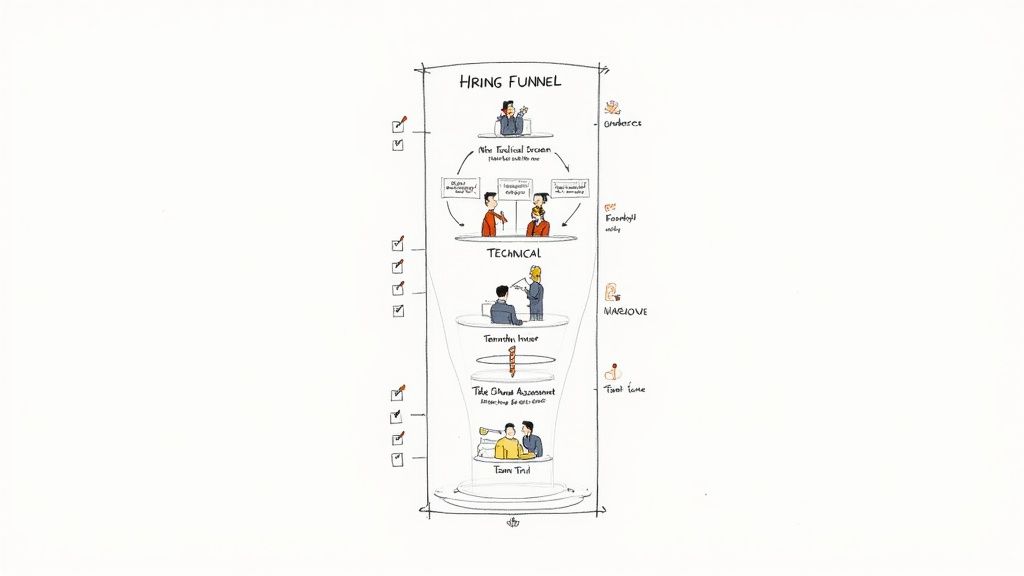
Success requires a structured framework that starts by defining the exact business problem you're solving, vets candidates for practical skills, and integrates them into your team so they can be productive from day one. This process minimizes bias and provides a clear signal on a candidate's true abilities.
The goal isn't just to fill a headcount; it's to hire an engineer who can ship production-ready AI features that create business value.

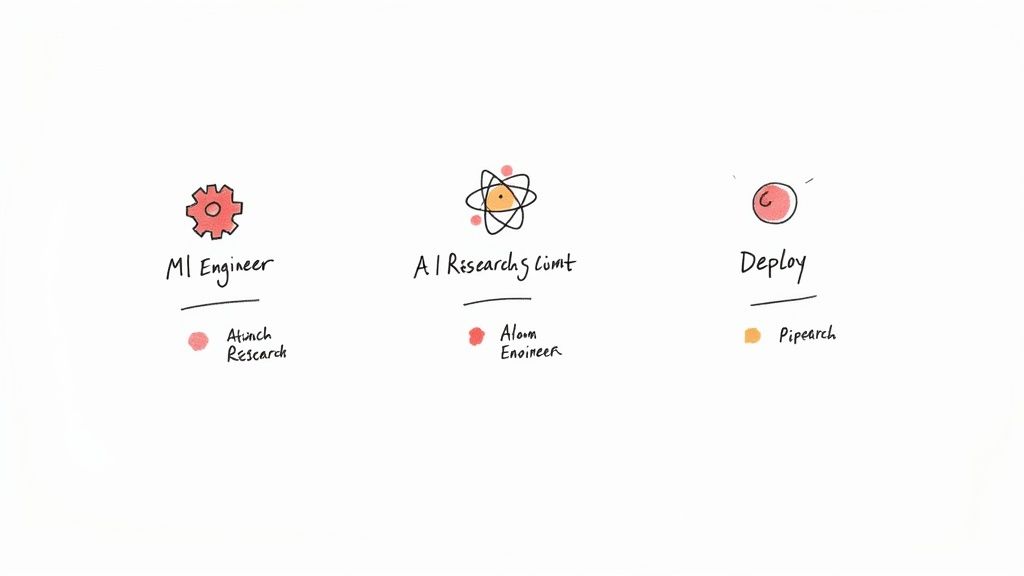
Caption: The three core phases of our hiring framework: Define the role, Vet the skills, and Onboard for impact.
Remote AI Hiring Framework at a Glance
This table summarizes the entire process, mapping out key actions, realistic timelines, and who on your team should own each stage.
Practical Examples: Which AI Developer Do You Need?
Before you write a job description, you must get clear on the business problem you're trying to solve. The skills needed to build a production Retrieval-Augmented Generation (RAG) system are completely different from those required to research a novel computer vision algorithm. Getting this wrong is a classic, costly mistake.
For most businesses, it boils down to three distinct roles.
- Machine Learning (ML) Engineer: The versatile builder. ML Engineers turn proven models into production-ready software. They build data pipelines, train models, and deploy scalable APIs. Hire them to build and ship a specific AI feature.
- AI Research Scientist: The innovator. They push boundaries by working on new model architectures or experimental techniques. Hire them when you face a problem with no off-the-shelf solution.
- MLOps Engineer: The systems architect. MLOps Engineers build and automate the infrastructure for reliable model deployment, monitoring, and retraining. Hire them when you need to manage the complexity of multiple models in production.
Example 1: B2B SaaS Startup Building a RAG System
A Series A startup needs to build a scalable, multi-tenant AI document analysis feature for its contract management platform. They have a rough proof-of-concept.
Business Goal: Ship a production-ready RAG system for document Q&A in the next 90 days.The Hire: A Machine Learning Engineer. They need a hands-on engineer to build robust data ingestion pipelines, fine-tune an embedding model on legal text, and deploy a low-latency inference endpoint on AWS. Success is measured in API uptime and accuracy, not research papers.
Example 2: Mid-Sized E-commerce Company with Model Sprawl
An e-commerce business has several ML models in production (recommendations, forecasting, fraud detection). The data science team struggles with slow, unreliable deployments.
Business Goal: Standardize and automate model deployment, monitoring, and retraining to improve reliability and velocity.The Hire: An MLOps Engineer. The problem is infrastructure, not the models themselves. They need an expert to implement a solid CI/CD pipeline using a platform like Kubeflow or MLflow. This hire will set up model drift monitoring with a tool like Evidently AI and automate the entire retraining workflow, freeing up data scientists to build better models.
Deep Dive: Sourcing, Vetting, and Onboarding
Caption: Tapping into global talent requires moving beyond traditional job boards to where top engineers are actively contributing.
Where to Find and Attract Top Remote AI Developers
The best remote AI developers are not scrolling through job boards. A "post and pray" strategy will fail. You have to go where they are.
- Niche Tech Communities: Places like Kaggle for data scientists and Hugging Face for NLP experts are goldmines. Look for people who consistently provide insightful answers or share impressive projects.
- Open-Source Contributions: GitHub is a living resume. Search for contributors to core AI libraries like PyTorch or LangChain. Someone actively contributing to these projects has proven, real-world skills.
- Specialized Talent Networks: Platforms that pre-vet AI talent can dramatically reduce your time-to-hire by giving you access to a curated pool of engineers who have already passed rigorous technical assessments.
When you're hiring remotely, geography is a strategic decision. Nearshore (Latin America) offers strong time zone overlap with the U.S., while offshore (Eastern Europe) provides a deep pool of talent with exceptional math and computer science fundamentals. To successfully tap into these global talent pools, you need effective candidate sourcing strategies guiding your approach.
How to Vet and Identify Top-Tier AI Talent
A bad AI hire can derail a critical project for months. Your vetting process must be deliberate and focused on real-world problem-solving. A great vetting system weeds out unqualified candidates and convinces experts your engineering culture is the real deal.
Our process at ThirstySprout is built on our candidate vetting engine, which prioritizes practical, role-specific assessments.
A practical take-home assignment is the single best predictor of on-the-job performance. Keep it short (3–4 hours) and directly relevant to the role.
Take-Home Example: Brief for a Senior ML Engineer
- Objective: Build a simple REST API using FastAPI that returns a sentiment analysis for a given text.
- Use a pre-trained model from Hugging Face.
- Containerize the application with Docker.
- Include a
README.mdexplaining how to run it. - Write basic unit tests for the API endpoint.
- What We Look For: Clean code, correctness, production readiness (Docker), and clear documentation.
- Ensure all accounts are active before login (code repos, cloud services, Slack).
- Schedule short, informal 1:1s with key team members, including product managers.
- Provide a clear overview of the current AI stack, model architecture, and data pipelines.
- Assign an onboarding buddy to help them navigate the tech environment.
- First task: Get the development environment running and push a non-critical change.
- Assign a well-defined, low-risk starter project (e.g., improve an existing model's accuracy by 1-2%, refactor a data script, add a monitoring dashboard).
- Schedule a weekly check-in with the hiring manager to discuss progress and blockers.
- Define the Role: Use the examples above to decide if you need an ML Engineer, MLOps Engineer, or AI Research Scientist.
- Prepare Your Vetting Kit: Create a short take-home assignment and an interview scorecard based on our templates.
- Start Your Search: Begin sourcing candidates from the niche communities and platforms where top AI talent is active.
- Kubeflow - The Machine Learning Toolkit for Kubernetes.
- MLflow - An open source platform to manage the ML lifecycle.
- Evidently AI - Open-source ML monitoring and observability.
- ThirstySprout Candidate Vetting Engine - Our process for assessing technical talent.
This small task reveals if a candidate understands modern ML libraries, containerization, and basic software engineering best practices like testing.
Onboarding and Managing Your Remote AI Team
A clumsy onboarding experience can turn a star hire into a disengaged team member. For remote AI roles, a structured plan is the only way to generate business impact.
Caption: A well-structured remote setup with the right tools is essential for a new AI developer's productivity.
A great onboarding process gives your new hire the context, tools, and support they need to contribute quickly. Our outsourced development and staff augmentation services focus on making sure every remote developer feels like a true extension of your team.
Checklist: Your 30-Day Remote AI Developer Onboarding Plan
The first month sets the tone. Your goal is to remove friction, build connections, and provide a clear path to an early win.
[ ] Day 1: Access & Introductions
[ ] Week 1: Context & Setup
[ ] Weeks 2-4: The First Small Win
The goal of the first 30 days is successful integration, not massive output. A developer who understands the "why" and feels connected to the team will deliver far more value long-term.

Caption: Ironclad contracts are non-negotiable for protecting your intellectual property when hiring globally.
Legal Contracts and Compensation for Global Talent
When hiring globally, you can engage talent as an independent contractor or through an Employer of Record (EOR). For your first few remote hires, a direct contractor model is often fastest. As you build a permanent team, an EOR handles local payroll, taxes, and compliance, reducing your risk.
When crafting an offer, you must understand what defines a competitive salary in that region. Here are some realistic annual salary bands for senior AI/ML engineers with 5+ years of experience:
Your contract is your most important legal protection. Ensure it includes non-negotiable clauses for Intellectual Property (IP) Ownership, Confidentiality (NDA), Scope of Work, and Payment Terms.
What to do next
Ready to build your remote AI team with confidence? ThirstySprout connects you with pre-vetted AI experts who have already cleared our rigorous technical assessments.
Find your next AI developer with ThirstySprout.
References
Article created using Outrank
Hire from the Top 1% Talent Network
Ready to accelerate your hiring or scale your company with our top-tier technical talent? Let's chat.