

Trying to pin down a software development budget can feel like chasing a moving target. Costs swing from $50,000 for a simple app to over $250,000 for a complex system. It all boils down to three factors: project scope, team location, and tech stack.
Getting a handle on these drivers is the first step to building a budget you can actually stick to.
TL;DR: Your Software Budget Essentials
- Quick Cost Brackets: A Minimum Viable Product (MVP) typically costs $50,000–$120,000. A full-featured application for a single platform lands in the $120,000–$250,000 range. Complex systems with AI/ML features often exceed $250,000.
- Primary Cost Drivers: Your final cost is driven by Scope Complexity (number and difficulty of features), Team Composition (mix of senior, mid-level, and junior talent), and Team Location (North American rates can be 3-4x higher than in Latin America or Eastern Europe).
- Actionable Framework: To get a defensible estimate, (1) define a tight feature scope, (2) determine your required team composition, and (3) calculate the cost using regional hourly rates plus a 15-25% contingency buffer.
- Recommended Action: For most new products, start with a tightly scoped MVP built by a managed remote team to balance cost, speed, and quality.
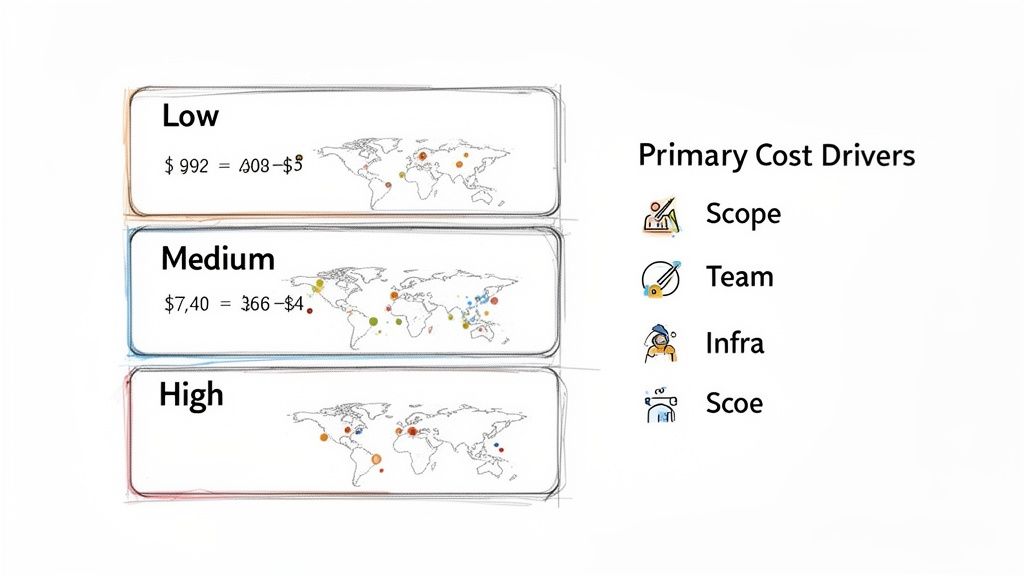 alt text: Infographic showing how software development cost is broken down into low, medium, and high categories based on regional hourly rates and key drivers like scope and team composition.
Who This Guide Is For
This guide is for operators who need to make budget and hiring decisions in weeks, not months. We wrote this for leaders responsible for shipping software on time and on budget.
- CTO / Head of Engineering: You need to scope a new product, scale your team, or integrate an AI feature with a budget that passes board scrutiny.
- Founder / Product Lead: You are defining the initial product roadmap and need to allocate venture funding for the technical build.
- Talent Ops / Procurement: You are evaluating the total cost of ownership (TCO) of different talent models, from full-time hires to managed remote teams.
By the end, you'll have a clear framework for estimating project costs, spotting hidden expenses, and choosing the right hiring model to balance cost, quality, and speed.
A Practical 3-Step Budgeting Framework
Moving beyond guesswork requires a structured process to determine your software development cost. We use a straightforward, three-phase framework to turn a high-level idea into a defensible budget. The goal is to connect your technical needs to clear business outcomes.
This process requires collaboration between product (PMs), engineering (CTOs), and leadership (founders).
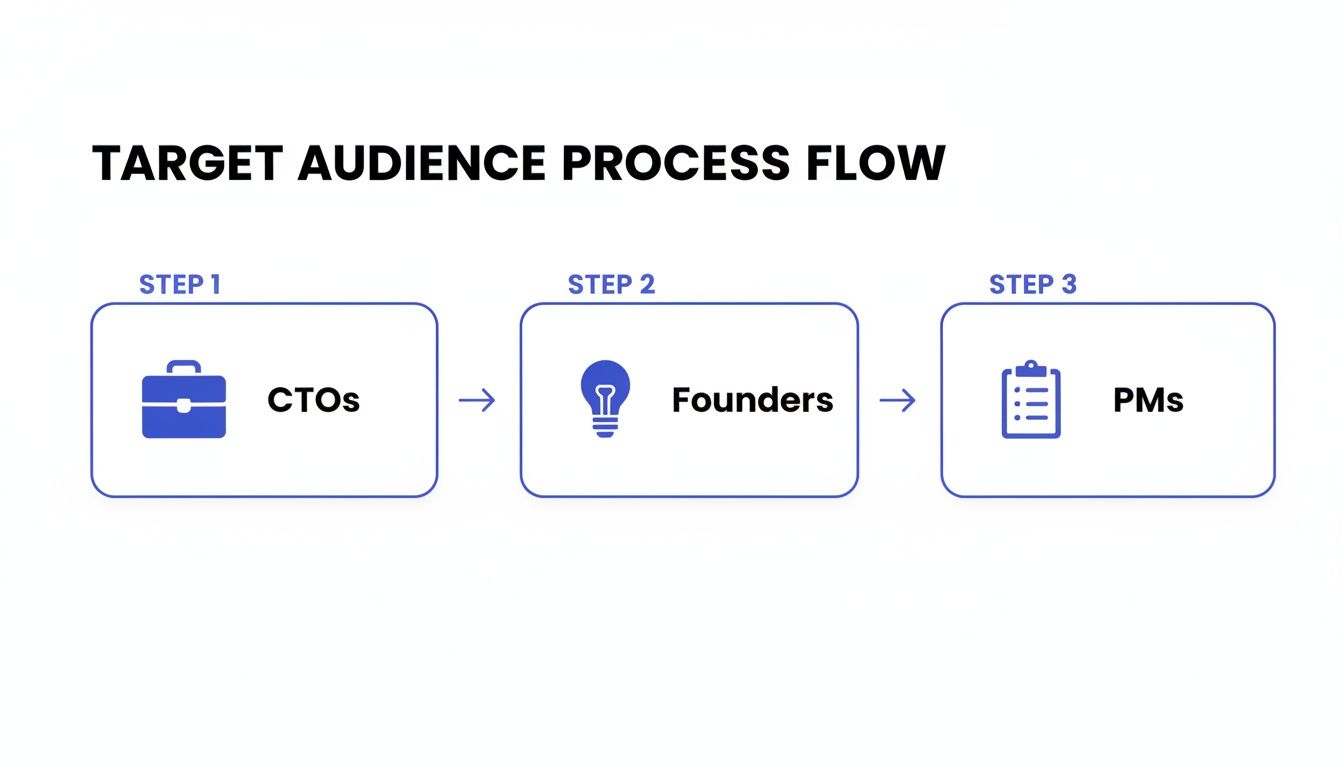 alt text: A process flow diagram showing how CTOs, Founders, and Product Managers collaborate on software budgeting, from strategic goals to feature scoping and technical oversight.
Step 1: Define Scope with a Work Breakdown Structure (WBS)
You must translate your business idea into a concrete list of features. Vague goals like "build a user dashboard" are useless for estimation.
Create a detailed Work Breakdown Structure (WBS) by listing every user story and the technical tasks required. For example, "user dashboard" breaks down into:
- User Story 1: As a user, I want to see my key performance indicators (KPIs) on a single screen.
- Technical Task 1.1: Build an API endpoint to fetch user-specific KPI data.
- Technical Task 1.2: Design and code a responsive UI component to display the KPI charts.
A well-defined scope is your best defense against budget creep. If a feature isn't in the WBS, it's not in the initial budget.
Step 2: Determine Team Composition
With a clear scope, you can define the team you need. This is a balance of cost, speed, and quality.
Use this rubric to guide your team structure:
- High Complexity / High Risk (e.g., AI features, core platform): Weight your team toward senior talent (60-70%). Include specialists like an MLOps engineer for AI projects.
- Medium Complexity (e.g., standard SaaS features): A balanced team works best. Aim for 30% senior, 50% mid-level, and 20% junior engineers.
- Low Complexity (e.g., internal tools): Rely on mid-level and junior talent guided by a single senior lead.
Your team mix directly impacts your blended hourly rate, making this a critical cost-control lever.
Step 3: Calculate the Cost Range
Now, you combine the outputs from the first two steps to calculate your budget.
The formula is simple:
(Total Estimated Hours from WBS) x (Blended Hourly Team Rate) = Base Development Cost
For example, if your WBS totals 1,200 hours and your blended team rate is $75/hour, your base development cost is $90,000.
Always present your budget as a range. Add a 15-25% contingency buffer to cover scope adjustments or technical challenges. This turns your $90,000 estimate into a more realistic $103,500 – $112,500 budget.
2 Practical Examples of Software Budgets
Theory is useful, but real-world numbers make budgeting tangible. Let's break down the software development costs for two common projects.
Example 1: B2B SaaS MVP
Scenario: A founder needs to build a Minimum Viable Product (MVP) for a simple B2B project management tool to validate the core idea with early customers. The goal is speed to market, not feature parity with established players.
The scope is minimal: user authentication, a project dashboard, and basic task creation. The architecture must be simple and rely on managed cloud services to reduce operational overhead.
Architecture and Team
- Frontend: React.js
- Backend: Node.js with a PostgreSQL database
- Hosting: AWS Elastic Beanstalk for easy deployment
- Team: 1 Senior Engineer (Lead), 2 Mid-Level Engineers, 1 UX/UI Designer (Part-Time)
This lean team is built for rapid execution of a well-defined scope.
Budget Breakdown
This budget is based on a 3-month timeline using a blended hourly rate for a remote team in Latin America. Understanding how offshore software development costs vary is key to this model.
This $95,160 budget is within the typical $75k - $120k range for a solid MVP ready for user feedback and investor demos.
Example 2: RAG AI Chatbot Integration
Scenario: An enterprise company wants to add an AI chatbot to its platform. The chatbot will use Retrieval-Augmented Generation (RAG) to answer user questions based on a large internal knowledge base.
This project requires specialized AI/ML skills, complex data pipelines, and rigorous model evaluation, which significantly increases the software development cost. Integrating AI involves more than an API call; it requires robust data infrastructure and MLOps talent.
Architecture and Team
- Data Ingestion: Python scripts for document parsing and chunking.
- Vector Database: Managed service like Pinecone.
- Retrieval/Generation: LangChain orchestrating calls to embedding (e.g., OpenAI Ada-002) and LLM (e.g., GPT-4) models.
- Backend API: FastAPI endpoint to serve chat responses.
- Team: 1 Staff AI Engineer, 1 MLOps Engineer, 1 Senior Backend Engineer, 1 Product Manager.
This is a team of specialists with deep expertise in AI, cloud infrastructure, and backend engineering.
Budget Breakdown
This project is budgeted for a 4-month timeline with higher hourly rates reflecting the demand for specialized AI talent.
The total cost is in the $150k - $250k range, driven by project complexity and the need for high-demand, specialized engineers.
Deep Dive: Hidden Costs That Inflate Your Budget
Your first development quote is just the tip of the iceberg. The bulk of your software development cost lies beneath the surface.
Identifying these hidden expenses is critical to avoiding budget overruns. These costs are part of your Total Cost of Ownership (TCO) and can add 20-50% to your initial build estimate.
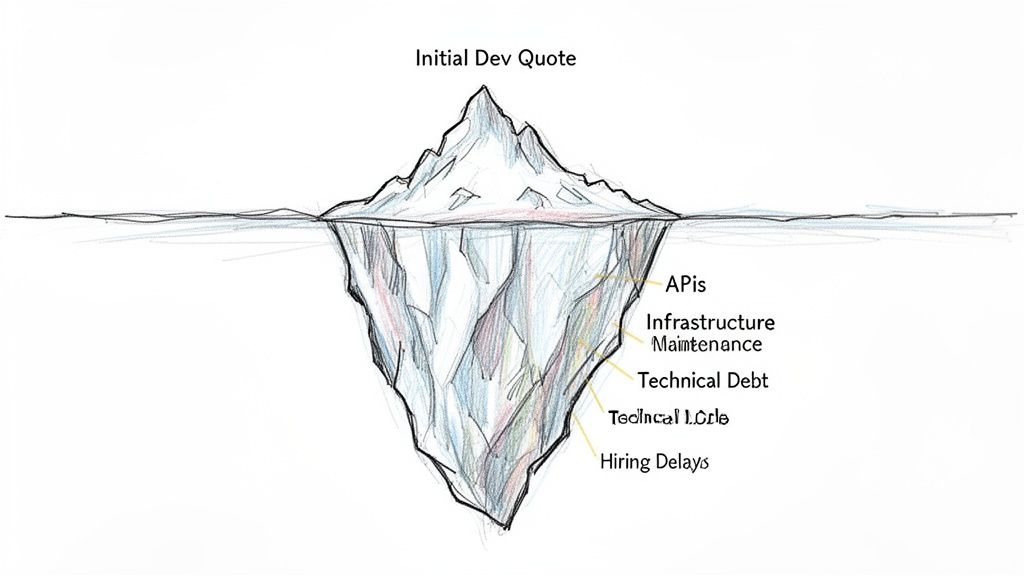 alt text: An iceberg diagram showing the visible 'Initial Dev Quote' above water, and larger, hidden software development costs like maintenance, infrastructure, and tech debt below the surface.
Operational and Technical Overheads
Software needs infrastructure, tools, and third-party services to run. These recurring operational costs scale with usage.
- Infrastructure Costs: Servers, databases, and storage on platforms like AWS, Google Cloud, or Azure are ongoing expenses. A simple app might start at $500/month but can grow to $5,000+ as traffic increases.
- Third-Party APIs: Services for payments (Stripe), messaging (Twilio), or mapping have usage-based fees that add up quickly at scale.
- Tooling and Licenses: Costs for project management software (Jira), code repositories (GitHub), and other development tools accumulate as your team grows.
Maintenance and Technical Debt
Your financial commitment doesn't end at launch.
Technical debt is the long-term cost of short-term compromises. Rushing an MVP with messy code results in slow feature development and costly refactoring later.
Ongoing maintenance is non-negotiable. Budget 15-20% of your initial development cost annually for bug fixes, security patches, and minor updates. A $100,000 MVP requires $15,000–$20,000 per year to maintain.
People and Process Inefficiencies
People are the most expensive part of software development. Inefficiencies directly impact your budget.
- Slow Hiring: Every week a key role remains unfilled, you burn cash without making progress. The opportunity cost of a delayed launch is immense.
- Employee Turnover: Replacing a key developer can halt progress for months. The total replacement cost, including recruiting and lost productivity, can exceed 1.5x their annual salary.
- Poor Project Management: A vague scope and shifting priorities lead to wasted time and expensive rework.
The global IT outsourcing market is projected to reach $806.53 billion by 2029, driven by the search for efficiency. While outsourcing can help, choosing the right partner is critical to avoid new inefficiencies. You can review more software development outsourcing statistics to see these trends.
Checklist: Action Plan for Controlling Software Costs
Use this checklist to maintain control over your budget from start to finish.
Phase 1: Pre-Development Scoping
- Define a tight MVP scope using clear user stories to create a firm project boundary.
- Get quotes from 2+ talent models (e.g., in-house vs. managed remote) to compare all-in costs.
- Build a 15–25% contingency buffer into your budget to handle unexpected issues.
Phase 2: Development Monitoring
- Conduct weekly budget vs. actual reviews to track hours logged against the plan.
- Prioritize ruthlessly each sprint to focus on features that deliver maximum value.
- Document all scope changes and formally assess their impact on budget and timeline. For more, see our guide on how to reduce software development costs.
Phase 3: Post-Launch Optimization
- Allocate an annual maintenance budget of 15–20% of the initial development cost.
- Establish a user feedback loop to guide future development investments.
- Schedule quarterly technical debt reviews with your engineering lead to prioritize refactoring. Knowing the key web design considerations for effective cost management can also help prevent future debt.
What to Do Next
- Scope Your MVP: Use our framework to define the core features for your initial product.
- Estimate Your Budget: Apply the cost calculation formula with our regional rate estimates and a contingency buffer.
- Explore Talent Models: Compare the total cost of in-house, contractor, and managed remote teams for your project.
Ready to get a precise cost for your next AI or software project? At ThirstySprout, we help you build a vetted, managed remote team in weeks, not months. Start a Pilot.
References
We believe in accuracy and transparency. Here are the sources and related reading used in this guide.
Hire from the Top 1% Talent Network
Ready to accelerate your hiring or scale your company with our top-tier technical talent? Let's chat.