

A remote-first company is an organization intentionally designed to operate with a distributed team as the default. This model rethinks core processes—from communication and hiring to performance management—for a workforce not tied to a specific location or time zone. It is a strategic decision to access global talent and increase operational speed.
TL;DR: How to Build a Remote-First Company
- Adopt Asynchronous Communication: Default to written, documented communication in tools like Notion or Linear. Use meetings for high-stakes problem-solving, not status updates.
- Build a Single Source of Truth (SSoT): Centralize all processes, project specs, and decisions in a knowledge base like Confluence or Notion. If it isn't written down, it doesn't exist.
- Hire for Remote-Native Skills: Your hiring process must vet for autonomy, written communication, and a bias for action. Use practical take-home assignments that simulate real work.
- Measure Performance by Outcomes: Ditch input-based metrics like hours online. Focus entirely on outputs, such as code quality, project velocity, and business impact.
- Use an Employer of Record (EOR): To hire globally without establishing local legal entities, use an EOR to manage payroll, compliance, and benefits.
Who This Guide Is For
- CTOs & Engineering Leaders: You need to hire specialized AI/ML talent faster and build a high-performance, scalable engineering culture.
- Founders & Product Leads: You're designing your company's operating model and want to build a foundation that supports rapid growth and access to a global talent pool.
- Talent & Operations Leaders: You are responsible for creating the systems for global hiring, onboarding, and compliance.
What Does Remote-First Actually Mean?
There’s a critical difference between "remote-friendly" and "remote-first." Remote-friendly companies bolt on remote work to an office-centric culture, where the office remains the center of gravity. This often creates a two-tiered system where in-office employees have better access to information and opportunities—a classic case of proximity bias.
A remote-first company builds its entire operating system on the assumption that no one is in the same physical room. This shift changes everything—from the software you use to how you document decisions. A genuine remote-first model levels the playing field, ensuring everyone has the same access and opportunity, regardless of location.
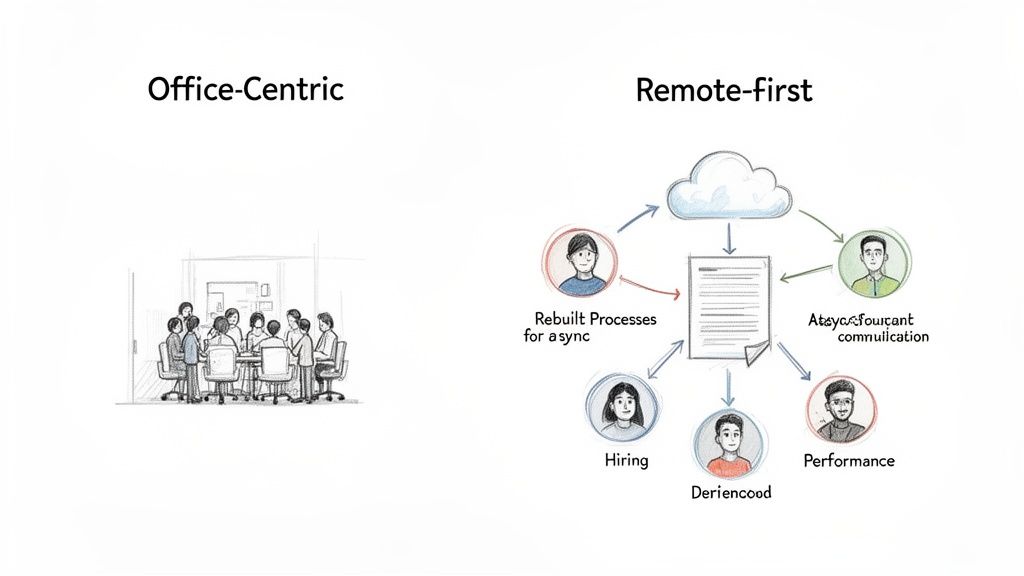
alt text: A diagram comparing office-centric (in-person meeting) to remote-first work models with async processes and distributed communication.
Core Principles of a Remote-First Model
A successful remote-first setup requires a deliberate focus on a few key principles that differ fundamentally from a traditional office.
- Asynchronous Communication by Default: The primary mode of communication is written, not real-time. This reduces meetings and accommodates different time zones, giving engineers space for deep work.
- Documentation is the Single Source of Truth: Every important decision, process, and update is documented in a central, accessible place. This replaces "hallway conversations" and ensures alignment.
- Performance is Measured by Outcomes: Success is defined by results and deliverables, not hours spent online. This builds a culture of autonomy and trust.
- Culture is Built Intentionally: Culture is actively cultivated through virtual events, clear communication norms, and shared values, not office perks.
The Spectrum of Work Models: A Comparison
To understand the model, it helps to see where remote-first lands on the spectrum. The table below breaks down how each model functions across key operational areas.
Remote First vs Remote Friendly vs Office Centric
Companies like Shopify and Coinbase have fully embraced remote-first, giving them a massive advantage in hiring the best talent from anywhere. Contrast this with hybrid models, like those at Google, where processes often remain tethered to a physical headquarters.
The litmus test is this: every process must be designed to work flawlessly for an employee who will never set foot in an office.
The Strategic Business Case for Going Remote-First
For a CTO or founder, remote-first is a strategic weapon. The goal is to gain a competitive edge in building world-class AI and engineering teams. The business case boils down to three advantages: accessing a global talent pool, hiring faster, and operating more efficiently.
When you drop geographic restrictions, you stop fighting over the same local engineers and start sourcing from a global talent ocean. This transforms your hiring funnel. According to a 2023 report, remote-first roles already attract 2.6 times more applicants than office-based ones. You can find more data on how remote work is reshaping the talent landscape.
Slash Your Time-to-Hire for Niche Experts
In specialized fields like MLOps or AI engineering, every day a role sits empty, your product roadmap slips. A traditional, location-bound search can drag on for months.
A remote-first company treats the world as its recruiting ground. This not only increases the number of qualified candidates but also speeds up the entire process. By hiring globally, you can shrink time-to-hire from months to just a few weeks—a critical advantage when you need to spin up a new AI team.
Cut Overhead and Reinvest in Your Team
While talent is the primary driver, the financial benefits are significant. Eliminating or reducing commercial real estate costs frees up capital that can be reinvested where it matters most:
- Offer top-of-market salaries to attract 1% global talent.
- Invest in a best-in-class tech stack that boosts productivity.
- Host impactful in-person offsites that build team cohesion.
This is about smart capital allocation—shifting funds from overhead to the people and tools that build your product.
The Trade-Offs You Can't Ignore
Going remote-first has real challenges. It requires a significant upfront investment in re-architecting your company's operating system. You will need to invest heavily in documentation platforms, async-friendly project management tools like Linear or Jira, and robust security.
It also means retraining managers to lead distributed teams by focusing on outcomes, not activity. Skimp on this intentional investment, and you risk communication breakdowns, productivity slumps, and a disconnected culture.
Designing Your Remote-First Operating System
Going remote-first requires building a new operating system (OS) for your company, one designed for a distributed team. This OS is founded on four practical pillars that replace old office-centric habits with intentional, scalable processes.
1. Default to Asynchronous Communication
The most important change is shifting from synchronous (real-time) to asynchronous (on your own time) communication. The default moves from a shoulder tap to a written message. This protects deep, focused work—a non-negotiable for hiring top-tier AI talent. Meetings become the exception, reserved for high-stakes problem-solving or team-building.
Practical Example: Async Sprint Planning
A fast-growing AI startup replaced its weekly 90-minute sprint planning meeting with an async process in Linear.
- Monday AM: The Product Manager starts a thread outlining sprint goals and a prioritized ticket list.
- Monday PM: Engineers review, ask clarifying questions in comments, and add estimates.
- Tuesday AM: The PM and Engineering Lead finalize the sprint based on the written discussion.
This change saved over 60 engineering hours per month and led to better-planned sprints because engineers had time to think through requirements.
2. Build a Single Source of Truth
In a remote company, if it isn't written down, it didn't happen. Documentation becomes the central nervous system of your company. This single source of truth (SSoT)—typically a tool like Notion or Confluence—is where processes, decisions, and project statuses live.
A deep commitment to documentation creates a level playing field and makes onboarding dramatically faster. As you build your OS, you'll need to remake company culture to attract global talent.
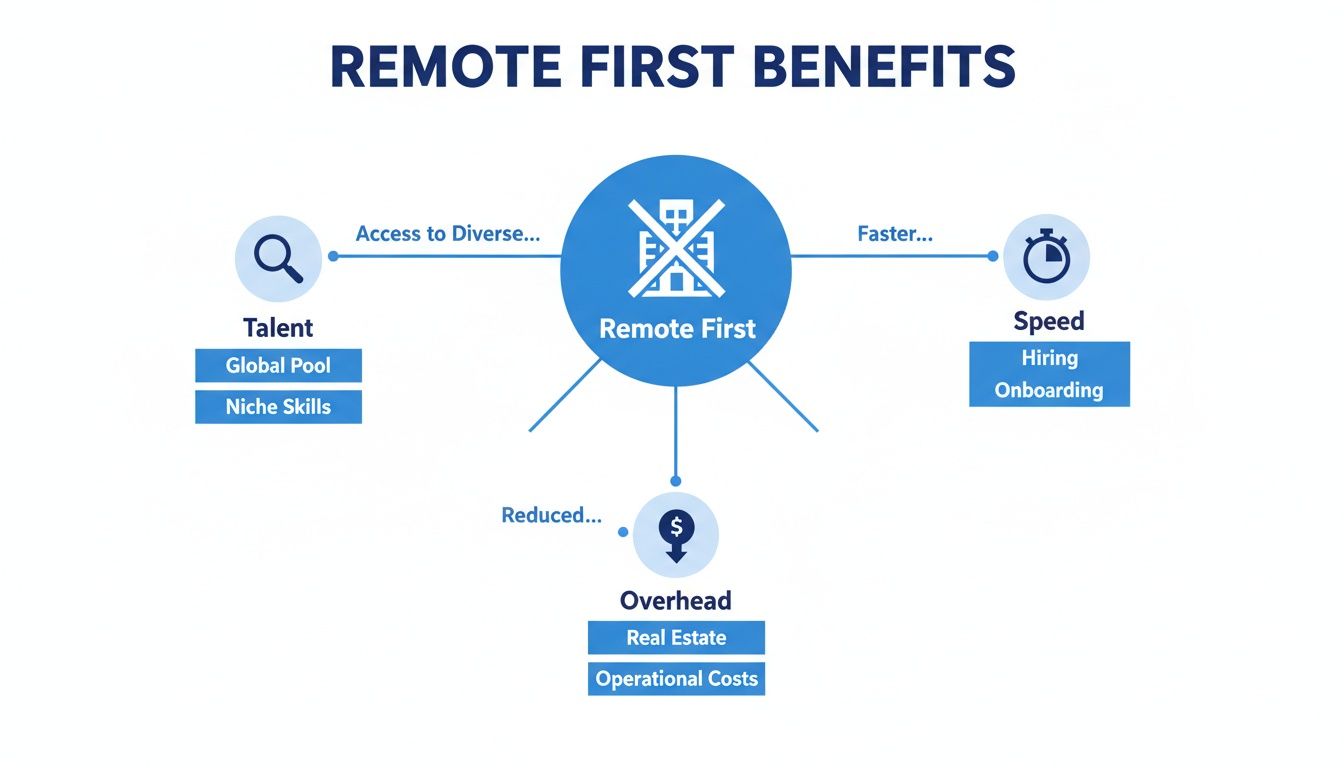
alt text: Infographic showing the benefits of a remote-first company model, including access to diverse talent, faster speed, and reduced overhead.
3. Create Intentional Culture Rituals
Company culture must be built with the same intention as your product roadmap. This means creating structured rituals that build connection and trust.
These rituals can look like:
- Structured Onboarding: A detailed 30-day plan that pairs every new hire with a "buddy" and walks them through key processes.
- Virtual Social Events: Optional, fun activities like virtual escape rooms or online gaming sessions.
- Regular All-Hands: Transparent, async-friendly company meetings where leaders share updates and answer pre-submitted questions.
4. Measure Performance Based on Outcomes
The final pillar is shifting performance measurement from tracking inputs (hours worked) to focusing entirely on outputs (results delivered). This is the bedrock of a high-trust, high-autonomy culture.
For your AI and engineering teams, this means focusing on concrete metrics:
- Code Quality: Assessed through peer reviews and bug rates.
- Project Velocity: Measured by sprint points completed or cycle time.
- Business Impact: Tied directly to the success of the features or models they ship.
In this model, managers become coaches whose job is to remove roadblocks and provide context.
Hiring and Onboarding Your Distributed AI Team
Old hiring methods are broken for remote-first companies. Your process must be designed to identify key traits of successful remote contributors: autonomy, excellent written communication, and a natural bias for action. The goal is to find experts who can manage themselves.
The talent pool is enormous. A recent study found that over 52% of remote-first companies use contract talent to scale quickly, compared to just 31% of office-based businesses. This agility allows you to onboard senior AI engineers in days, not months. The Virtual Vocations database recently tracked 424,778 vetted, fully remote job postings, a 49% increase from the previous year. You can discover more insights about the remote job market trends on VirtualVocations.com.
Vetting for Remote Readiness
Your hiring process should be an audition, not just a series of interviews. You must actively test for remote skills in a real-world context.
Practical Example: Vetting a Remote AI Engineer
We helped a client hire a senior ML engineer by replacing the standard coding challenge with a take-home assignment simulating a real task.
- The Task: We provided a poorly documented Jupyter notebook and a vague objective: "Improve the model's precision for this customer segment."
- The Process: The candidate had 48 hours and a private Slack channel with two engineers to ask questions.
- Clarity of Questions: Were questions sharp and specific?
- Documentation: Did they document their process, assumptions, and results clearly?
- Proactive Communication: Did they provide status updates without prompting?
The successful candidate delivered a fantastic write-up in Notion explaining their trade-offs. They proved they could think independently and communicate with total clarity—the two most powerful signals of a great remote hire. For more strategies, check out our guide on how to hire remote AI developers.
A Structured Remote-First Onboarding Plan
The first 90 days are critical. A great remote onboarding experience is a structured program designed to connect a new hire to your company's tools, people, and culture.
alt text: List of top 100 remote companies
An exceptional onboarding process is a competitive advantage for retaining the talent you worked hard to find.
The 30-60-90 Day Onboarding Template
Use this template as a starting point to empower new hires from day one.
First 30 Days: Focus on Integration
- Week 1: Complete logistics (systems setup, HR). Schedule 1:1s with key team members and assign an "onboarding buddy."
- Weeks 2-4: Assign a small, well-defined project. Task them with contributing to the knowledge base to learn your documentation culture.
Days 31-60: Focus on Contribution
- Give them full ownership of a more substantial feature.
- Involve them in core team rituals, like on-call rotations.
- Ask for feedback on the onboarding process.
Days 61-90: Focus on Autonomy
- Challenge them to propose a new project or process improvement.
- Encourage them to mentor a junior team member.
- They should be on their way to becoming a go-to expert in a specific area.
This phased approach ensures new hires feel connected and productive. For more hands-on advice, see these 7 tips for onboarding remote employees.
Building Your Essential Remote-First Tech Stack
Your tech stack is the foundation of your remote-first operation. It should be designed to replace casual, in-office interactions with structured, scalable systems. Every tool must have a clear purpose.
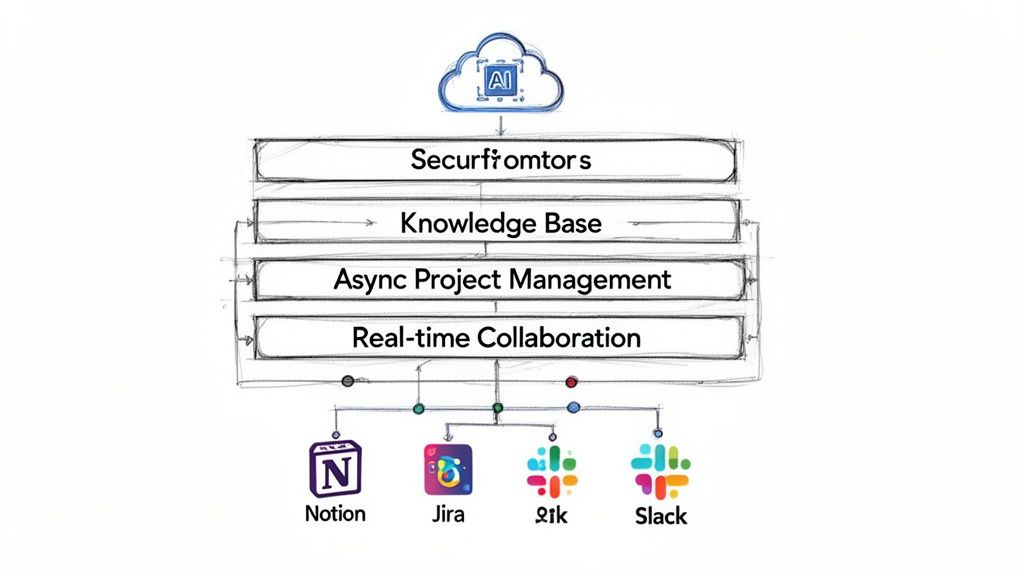
alt text: Diagram illustrates an AI-powered cloud platform, integrating knowledge base, project management, and real-time collaboration tools like Notion, Jira, and Slack.
Core Pillars of a Remote Tech Stack
Think about your stack in four distinct layers, each mapping to a core behavior.
- Central Knowledge Base: Your digital HQ and single source of truth. Examples: Notion, Confluence, GitLab Handbook.
- Asynchronous Project Management: Tools that keep projects moving without real-time meetings. Examples: Linear, Jira, Asana.
- Real-Time Collaboration Hub: Your space for urgent issues and team bonding. Use sparingly to protect focus. Examples: Slack, Microsoft Teams, Discord.
- Robust Security Controls: Essential for a distributed team. Includes Identity and Access Management (IAM) from providers like Okta, plus VPNs and Mobile Device Management (MDM).
Tool Selection Checklist
Use this simple rubric to choose the right tools for each pillar.
- Does it integrate seamlessly? Tools must work together to avoid information silos.
- Does it scale with us? Consider future needs for user management, performance, and API access.
- Does it meet our security and compliance needs? Look for features like audit logs, role-based access control, and certifications like SOC 2.
- Does it support async work? The best remote tools make it natural to review and approve work on your own schedule.
Sample Remote-First Tech Stack for an AI Team
A stack like this creates a cohesive ecosystem. For a closer look at the cloud platforms that enable this, see our guide on developing in the cloud.
Navigating Global Compensation and Compliance
Hiring globally presents complexities around pay and legal employment. Getting this right is a core strategic decision that impacts your budget, culture, and ability to attract top talent.
Choosing Your Compensation Model
There are three common models, each with trade-offs.
- Global Benchmark: Everyone in the same role gets the same pay, typically pegged to a high-cost market like San Francisco. This is simple and fair but also the most expensive.
- Local Market Rate: Pay is based on the going rate for a role in a specific region. This is budget-friendly but can create large pay gaps for the same work.
- Blended Approach: A single salary band for a role is adjusted by a location-based multiplier. This balances fairness with local market realities.
Managing International Employment Compliance
Once you decide how to pay someone, you must figure out how to employ them legally. Every country has unique labor laws and tax codes.
Guessing your way through international regulations can lead to fines, back-taxes, and "permanent establishment risk," where your company becomes a taxable entity in a foreign country.
Here are the main ways to legally hire talent abroad:
For most startups, an Employer of Record (EOR) is the smartest, most risk-averse way to start hiring globally. It allows you to test new talent markets without the immense cost of establishing a legal subsidiary. As you scale, you can compare strategies like nearshore vs offshore software development.
A 3-Step Action Plan for Going Remote-First
This three-step plan will help you turn principles into concrete actions for your engineering and AI teams.
Step 1: Audit Your Current State
Before moving forward, you need to understand your starting point. Use this scorecard to honestly assess your current ways of working against remote-first pillars.
This audit provides a data-driven foundation to identify your biggest gaps.
Step 2: Implement One High-Impact Change
Don't try to fix everything at once. Pick the area with the lowest score from your audit and focus on improving just that one thing for the next 30 days.
For example: If critical conversations are lost in Slack, introduce a new rule: "Any decision affecting more than two people must be documented in Notion." This simple habit forces clarity and builds the async muscle.
Focusing on one tangible change creates a visible win and builds momentum for future improvements.
Step 3: Start Building Your Remote AI Team
Once you have a solid remote-first foundation, you can confidently scale your team with top-tier AI and ML engineers. Your investment in your operating model pays off in your ability to hire faster, retain longer, and ship better products.
What To Do Next
- Complete the Remote-First Audit: Use the scorecard above to identify your team's biggest operational gap.
- Implement One Process Change: For the next 30 days, focus on improving that single area (e.g., documenting all technical decisions).
- Hire Your First Remote AI Expert: Bring on a senior AI engineer who can thrive in your new operating model and help champion remote-first practices.
Ready to build your world-class distributed AI team? ThirstySprout connects you with senior AI engineers and ML experts ready to integrate with your remote-first workflow.
Hire from the Top 1% Talent Network
Ready to accelerate your hiring or scale your company with our top-tier technical talent? Let's chat.