

A remote-first company builds its entire operating system—culture, communication, and processes—assuming no one is in the same physical room. This is a ground-up design choice, unlike a remote-friendly company where the office remains the center of gravity and remote workers are often an afterthought.
TL;DR: Your Remote-First Blueprint
- Default to Asynchronous: Shift communication from real-time meetings to documented, asynchronous collaboration. This respects time zones and enables deep work.
- Create a Single Source of Truth: Your documentation (Notion or Confluence) must be the primary hub for all decisions, plans, and processes.
- Measure Outcomes, Not Hours: Manage performance based on tangible results (e.g., model deployment frequency) using frameworks like OKRs (Objectives and Key Results), not on face time.
- Hire for Remote Skills: Actively screen for strong written communication and autonomy. Use a structured hiring process with a practical take-home assessment.
- Next Step: Use our checklist to audit your current remote practices. Book a scope call to define your next critical AI role and start a pilot in 2–4 weeks.
Who This Guide is For
- CTO / Head of Engineering: You need to hire elite AI/ML talent globally and build a high-velocity distributed team.
- Founder / Product Lead: You're scaling your team for new AI features and need an operating model that supports speed and quality without a central office.
- Talent Ops / Hiring Manager: You're tasked with building a scalable, compliant, and efficient pipeline for sourcing and onboarding remote engineers.
A Framework for Remote-First Operations
Making the leap to remote-first isn't just about changing a line in the employee handbook; it's a complete rethink of how work gets done. You must consciously replace office-centric habits—like hallway decisions and verbal agreements—with intentional, documented processes.
The goal is to level the playing field. In a remote-friendly setup, distributed team members miss out on impromptu "water cooler" conversations that turn into major decisions. A remote-first blueprint eliminates this by making distributed work the standard, not the exception.
Core Principles of a Remote-First Model
A successful remote-first company stands on three pillars that directly impact hiring speed, operational efficiency, and retention.
- Asynchronous Communication by Default: Instead of constant pings on Slack or a calendar packed with Zoom calls, communication happens in a way that doesn't demand an instant reply. This respects different time zones and protects focus time for deep work.
- A Documentation-Driven Culture: When you can't tap someone on the shoulder, your documentation becomes the single source of truth. Every decision, project plan, and process is written down, making information equally accessible to everyone.
- Outcome-Based Performance Management: With no one looking over your shoulder, the focus shifts to what you produce, not the hours you work. You set clear goals and measure success based on tangible results—like an MLOps team’s deployment frequency or a model’s accuracy improvements.
Practical Example 1: Remote-First vs. Remote-Friendly Operations
This table highlights the fundamental operational and cultural differences. Understanding these distinctions is critical for committing to a true remote-first model.
Practical Example 2: GitLab's Communication Charter
GitLab, one of the largest all-remote companies, provides a clear, public example of a Communication Charter. They explicitly state which tools to use for different levels of urgency, from "low context" (like a GitLab issue) to "high context" (a Zoom call).
- For a non-urgent technical question: Create a GitLab issue, allowing anyone to contribute asynchronously.
- For an urgent production outage: Use a dedicated Slack channel (
#production) with clear escalation paths. - For team bonding: Schedule optional "social calls" on Zoom.
This documented approach removes ambiguity and prevents notification fatigue, directly improving productivity and reducing burnout.
The Business Impact of Going Remote-First
This isn't just a startup trend; it's a strategic advantage. Companies like GitLab and Automattic (the company behind WordPress.com) have proven you can build industry-leading products with fully distributed teams.
The data backs this up. 47% of tech workers are fully remote, with another 45% in a hybrid model. This leaves a tiny fraction fully on-site. You can explore more data on the rise of remote work in tech.
Adopting a remote-first mindset makes your organization more inclusive, efficient, and resilient. It lets you hire the best AI and MLOps talent on the planet, not just the best people within a 30-mile radius of an office.
Deep Dive: Org Design and Tech Stack
Building a remote-first company is an act of deliberate design. A remote-friendly company might just swap conference rooms for Zoom calls, but a remote-first organization rethinks its operating system to succeed without a physical headquarters.
The challenge is replacing informal office communication with intentional, reliable processes. The aim is to create a culture where people can work autonomously but stay perfectly aligned.
Crafting a Communication Charter
A Communication Charter is a simple document that outlines the rules of engagement. It tells everyone what tool to use for what purpose and sets clear response time expectations.
Here’s a simple template for an AI team:
The Tech Stack: Your Remote Team's Central Nervous System
The right tech stack is the central nervous system of your distributed team, ensuring code, data, and insights flow frictionlessly across time zones. For remote-first companies, a well-designed stack is built around asynchronous workflows, clear versioning, and reproducible results.
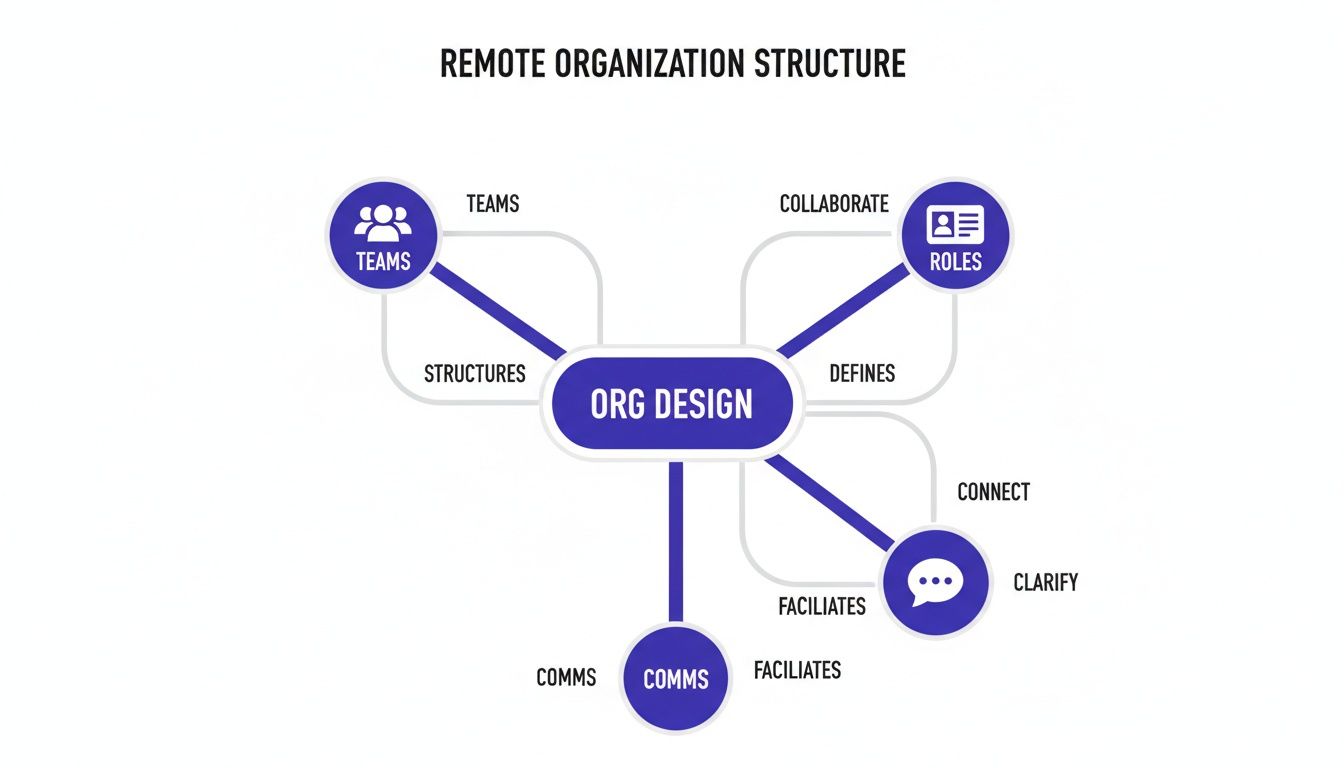
Alt text: A diagram showing how Org Design connects to Teams, Roles, and Comms in a remote organization structure.
A deliberate org design dictates team structures, which in turn shapes communication—all powered by the right tools.
- Code & Data Version Control: This is your foundation. Use GitLab or GitHub for code and a tool like DVC (Data Version Control) for data and models to ensure reproducible experiments.
- CI/CD & Automation: Your CI/CD pipeline is your most dependable employee. It automates testing and deployments, eliminating manual handoffs. Tools like CircleCI, GitLab CI, or GitHub Actions are essential.
- Experiment Tracking & Model Registry: A shared digital lab notebook like MLflow or Weights & Biases logs metrics, parameters, and artifacts so anyone can review and build upon previous work.
- Asynchronous Collaboration Hub: A tool like Notion or Confluence serves as the single source of truth for project specs, architectural decisions, and meeting summaries.
For a closer look at specific MLOps solutions, check out our deep dive into the top machine learning model deployment tools.
Checklist: A Remote-First Hiring Process
Finding and integrating top AI talent is a major roadblock for any company. In a remote-first setting, your hiring process must be a well-oiled machine designed to tap a global talent pool and screen for traits that predict success in a distributed team: exceptional written communication, a bias for action, and autonomy.
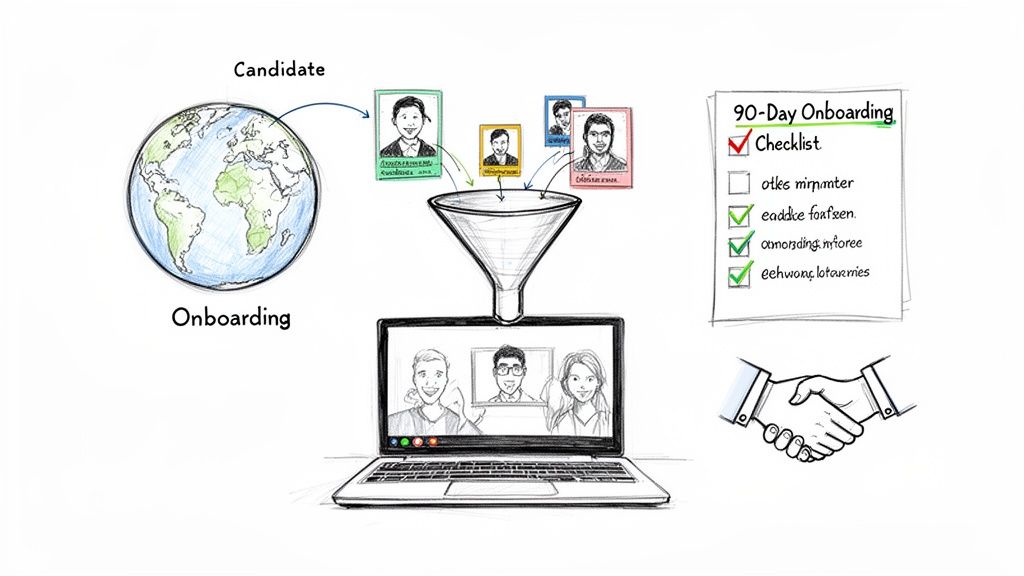
Alt text: Illustration showing global candidates funneling into a remote onboarding process with video calls, a checklist, and a handshake.
Remote Hiring & Onboarding Checklist
[ ] 1. Craft a Location-Agnostic Job Description: Forget office perks. Focus on the problems the new hire will solve in their first 90 days and the core technical skills required (e.g., experience with production-grade RAG systems). Make it clear the role is fully remote.
[ ] 2. Conduct Structured, Asynchronous Screens: Start with a short async questionnaire or a small take-home challenge. This respects the candidate's time while quickly filtering for written communication skills and genuine interest.
[ ] 3. Run Competency-Based Video Interviews: Use a consistent scorecard for every candidate. Focus interviews on specific goals, such as a technical deep-dive on a past project or a systems design session on a virtual whiteboard.
[ ] 4. Assign a Practical Take-Home Assessment: A well-designed, 3–4 hour assessment should mirror a real-world task, like containerizing a simple model or drafting a brief technical design document. This reveals practical skills better than theoretical questions.
[ ] 5. Execute a 90-Day Onboarding Plan: A great hire can fail without a structured onboarding process.
* Week 1 (Setup & Context): Provide tool access, security protocols, and key documentation. Schedule 1:1s with every team member.
* Weeks 2-4 (First Contribution): Assign a small, well-defined starter project, like improving logging on an existing model.
* Weeks 5-12 (Ownership & Impact): Transition the new hire to owning a small feature. Set clear 30, 60, and 90-day goals tied to team OKRs.
This structured approach improves the quality of hires and shrinks your time-to-hire. For companies building an elite remote team, dedicated AI Staffing Solutions can accelerate finding the right people. Data shows fully remote job postings are rising; you can see the latest data on fully remote jobs.
Our guide on how to hire remote AI developers dives deeper into building a world-class distributed team.
Pitfalls: Measuring Success and Staying Compliant
When you go remote-first, you stop managing by presence and start managing by performance. This requires a deliberate strategy for measuring what matters, staying compliant with global laws, and securing your data.
From Face Time to Real-Time Results
For remote AI and ML teams, success is measured by engineering momentum and business value.
- Cycle Time: How long does it take an idea to go from code to production? A short cycle time indicates a well-oiled machine.
- Deployment Frequency: High-frequency deployments show your team is agile and your CI/CD pipeline is solid.
- Change Failure Rate: What percentage of deployments cause a failure? A low rate is a testament to quality.
- Mean Time to Recovery (MTTR): How fast can you fix things when they break? A low MTTR shows you have excellent monitoring and a clear emergency plan.
Tackling Global Compliance and Security
Hiring talent globally creates legal, financial, and security challenges. Platforms like Deel or Remote.com are indispensable for managing global payroll, benefits, and local compliance, allowing you to access a global talent pool without needing a law degree in every country.
A simple checklist can prevent major headaches.
Global Hiring Compliance Checklist
- Worker Classification: Is your contractor agreement legally sound for the person's country?
- Intellectual Property: Does the contract clearly state your company owns all work, and is it enforceable locally?
- Payment & Invoicing: Is your payment process documented and compliant with local currency rules?
- Data Security: Do you have strong security measures like device management, mandatory VPNs, and data encryption?
- Termination Clauses: Are termination rules clear and aligned with local labor laws?
Running a distributed team requires a rock-solid approach to AI governance and best practices. This ensures your remote operations are efficient, secure, and compliant.
What to Do Next
Making the leap to a remote-first organization is a conscious act of operational design. It requires a full commitment to asynchronous communication, documentation as the source of truth, and outcome-based management.
The biggest engine for growth will always be your people. At ThirstySprout, we cut through the noise of sourcing, vetting, and onboarding senior AI and MLOps engineers, connecting you with production-ready experts from our network in days, not months.
Your Next Three Steps
- Audit Your Practices: Use our downloadable checklist to identify gaps in your current communication, documentation, and tooling.
- Scope Your Next Critical Role: Book a no-obligation call with our team. We’ll help you define the exact skills needed for your next senior AI, ML, or MLOps hire.
- Start a Pilot in Two Weeks: Engage one of our pre-vetted engineers on a flexible pilot project to see their impact firsthand before you scale.
References
FAQs on Remote AI Teams
- How do you prevent burnout? The best defense is creating strong company-wide systems. Successful remote-first companies often adopt a four-day workweek or enforce mandatory paid time off. Making asynchronous communication the default also relieves the "always-on" pressure.
- Is it more expensive to hire remotely? No, it is almost always more cost-effective. You save on office rent and utilities, and you avoid paying inflated salaries for high-cost-of-living areas. The biggest saving is the reduction in opportunity cost; accessing a global talent pool lets you fill a critical role in weeks instead of months, accelerating your roadmap.
- What's the biggest mistake when shifting to remote? Being "remote-friendly" instead of "remote-first." A remote-friendly setup creates a two-class system where those at HQ have an unfair advantage ("proximity bias"). A remote-first culture flattens this by making documentation the source of truth and async communication the standard for everyone.
Internal ThirstySprout Resources
Building a world-class remote AI team requires a partner who understands the nuances of distributed work. ThirstySprout connects you with pre-vetted, senior AI and MLOps engineers ready to contribute from day one. Start a pilot in just two weeks and see the difference.
Hire from the Top 1% Talent Network
Ready to accelerate your hiring or scale your company with our top-tier technical talent? Let's chat.