

A product team has a dashboard that refreshes too slowly, analysts are rebuilding the same datasets, and an AI feature is waiting on dependable training data. The CTO needs someone who can fix the underlying pipelines, but the hiring question is no longer, “Can this person write SQL?” It's whether a remote data engineer can work across time zones, manage reliability, control cloud costs, and prepare data for increasingly AI-oriented systems.
Introduction Who This Guide Helps and What You Will Decide
This guide is for CTOs, heads of engineering, founders, product leads, talent teams, and platform leaders who need to decide whether to hire a remote data engineer, what level of ownership to assign, and how to evaluate candidates without reducing the role to a list of warehouse tools.
The short answer is practical. A remote data engineer develops and operates the systems that move data from source applications into reliable, usable products. Remote work changes the communication model and operating rhythm, but it doesn't change the engineering responsibility. The role works best when the team has clear data ownership, documented interfaces, measurable service expectations, and enough technical independence to make progress without constant real-time supervision.
A hiring decision usually falls into one of four paths:
- Hire full-time when pipeline debt, data reliability, or platform strategy has become a sustained business constraint.
- Use a contract or project engagement when you need a defined pipeline repair, migration, or architecture decision.
- Use fractional support when recurring technical judgment matters, but the workload doesn't yet justify a full-time role.
- Wait or upskill internally when requirements remain unclear and simple scripts can still support the product.
Practical rule: Don't hire for “data engineering” in the abstract. Hire for a defined business outcome, such as trustworthy revenue reporting, faster event availability, or production-ready data for machine learning.
The guide moves from role definition to skills, timing, compensation, interviews, onboarding, and management. You can read it end to end, or use the decision matrix and scorecard as working documents during your next hiring cycle.
By the end, you should be able to write a sharper job description, choose an engagement model, test real engineering judgment, and establish a remote operating cadence that makes pipeline health visible.
What a Remote Data Engineer Actually Does
The UK Government Digital and Data Profession Capability Framework defines a data engineer as someone who “develops and constructs data products and services, and integrates them into systems and business processes.” That vendor-neutral definition is useful because it focuses on outcomes rather than a particular cloud provider or transformation framework.
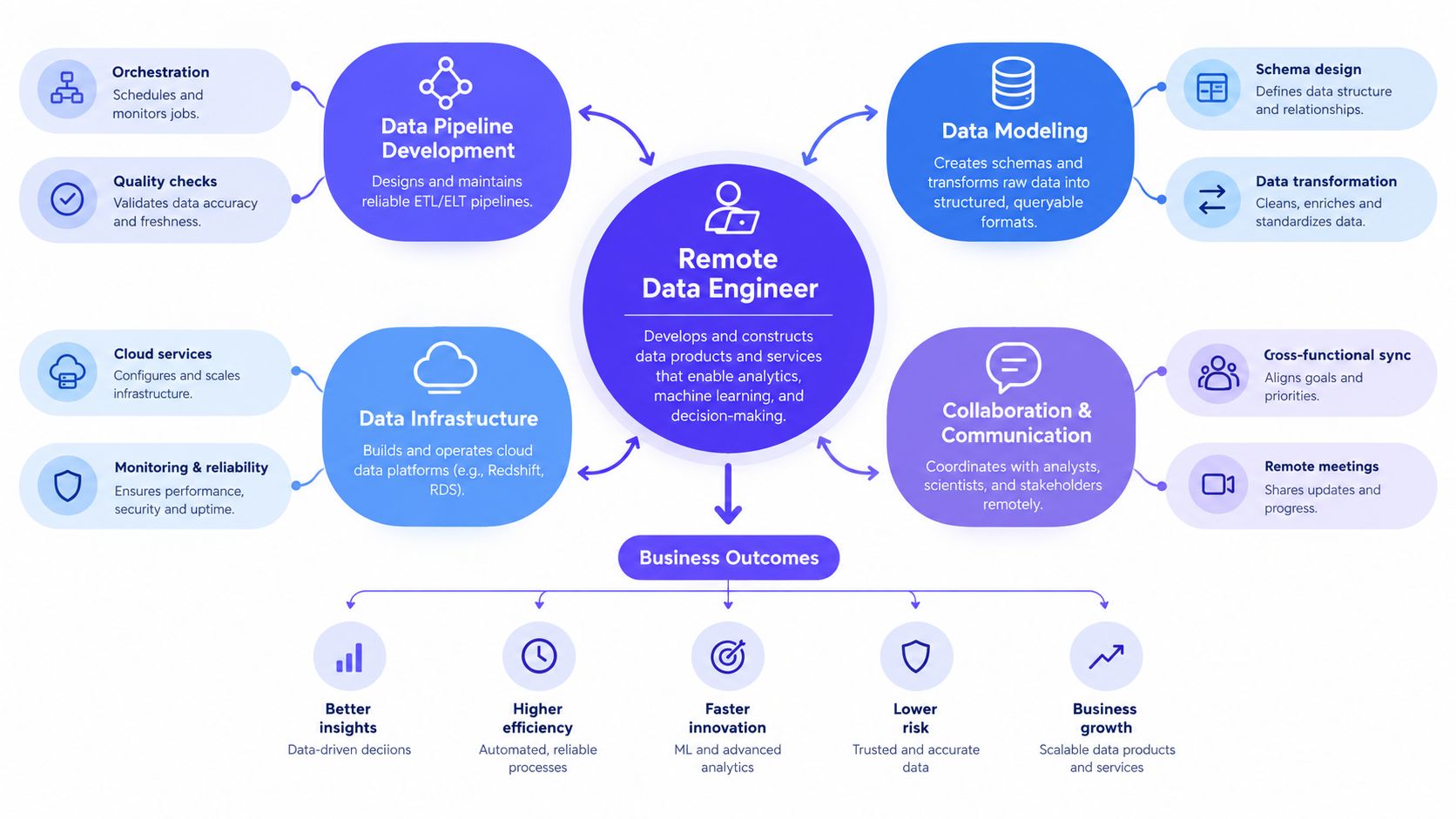
A remote data engineer builds the data supply chain for your company. Source systems produce orders, events, customer records, application logs, or model inputs. The engineer captures that material, transports it, cleans and reshapes it, checks its quality, and delivers it to a warehouse, operational service, dashboard, or machine learning workflow.
The work behind the pipeline
The job typically includes several connected responsibilities:
- Ingestion: Capturing data from databases, applications, application programming interfaces, files, and event streams.
- Transformation: Converting inconsistent source data into models that analysts, products, and machine learning systems can use.
- Orchestration: Scheduling dependencies, retrying failed jobs, and making pipeline state visible.
- Quality control: Checking freshness, completeness, uniqueness, schema changes, and business rules.
- Serving: Making data available through warehouses, tables, APIs, feature stores, or operational systems.
- Platform ownership: Managing permissions, reliability, observability, and cloud infrastructure.
Remote collaboration adds a second layer of responsibility. The engineer must document assumptions, record decisions, define data contracts, and communicate incidents clearly enough that teammates in another time zone can act without waiting for a meeting.
A data analyst consumes data to answer business questions and create reporting. A data scientist develops statistical or machine learning models. An MLOps engineer focuses on deploying, monitoring, and operating those models. A data engineer may support all three, but owns the connective infrastructure that makes their work dependable.
For candidates who want broader context on the profession and career paths, this guide to data engineer careers LATAM offers a useful regional perspective.
Core Skills and Modern Tech Stack Explained
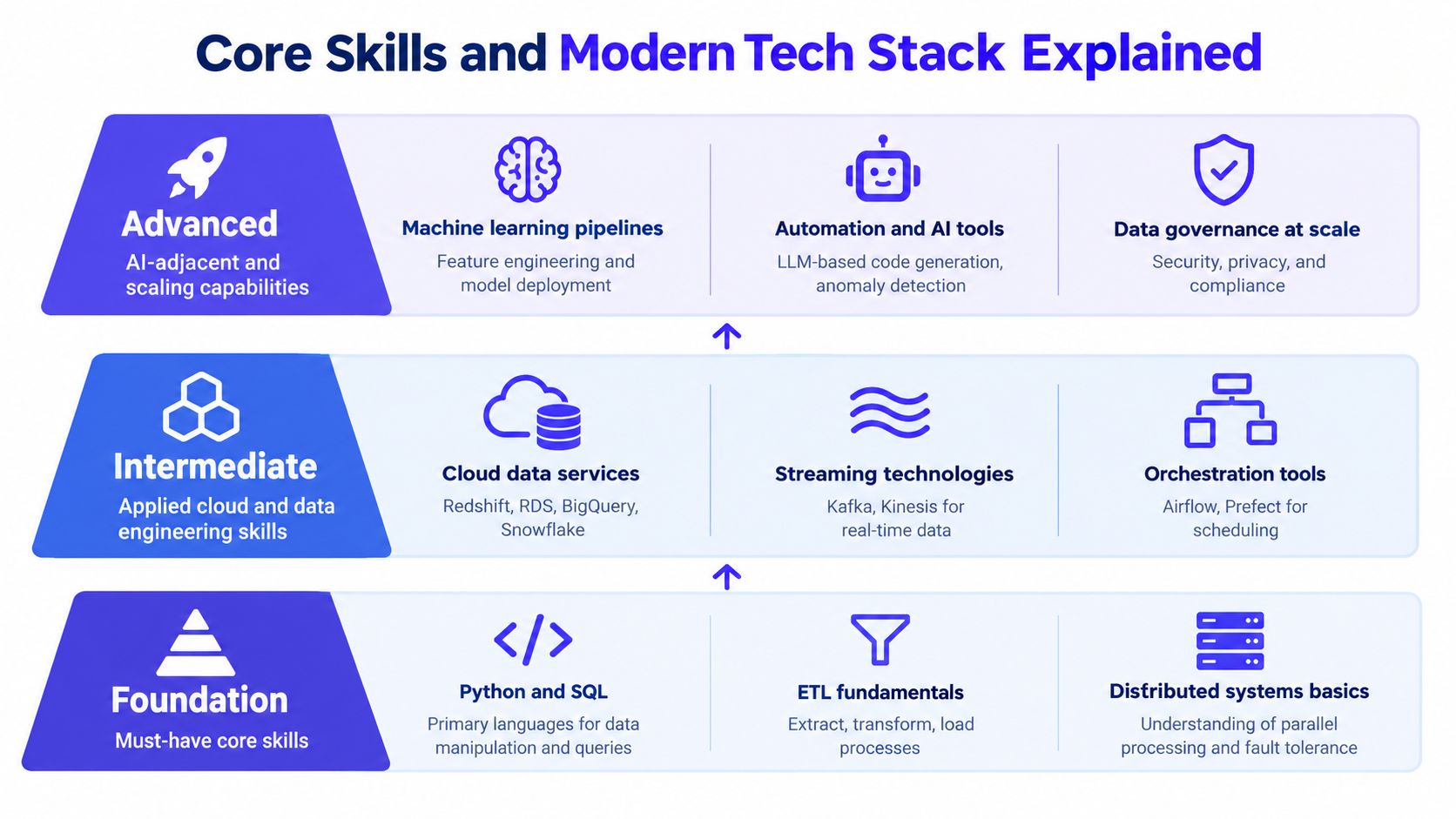
A credible remote data engineer should be evaluated in layers. Start with the fundamentals, then test applied platform skills, and finally assess whether advanced capabilities match your roadmap.
Foundation skills
Python and Structured Query Language (SQL) remain the core working languages. Python supports ingestion, transformation, testing, automation, and service integration. SQL reveals whether a candidate understands joins, window functions, aggregation, query performance, and the shape of the data they're producing.
The foundation also includes:
- Extract, transform, load fundamentals, including idempotency, incremental processing, retries, and backfills.
- Data modeling, so raw records become stable, queryable entities.
- Distributed systems basics, including parallel processing, failure handling, partitioning, and consistency.
- Testing and observability, so a successful job isn't confused with trustworthy output.
A current LinkedIn hiring guide describes a practical baseline that includes three or more years of Python and SQL experience, familiarity with AWS data services such as Redshift and RDS, and experience building or maintaining ETL processes. Treat that as a starting point, not a universal seniority rule. Your scorecard should reflect the systems the person will own.
Applied platform skills
The next layer includes cloud data services, orchestration, infrastructure as code, and streaming. Historical milestones help explain this progression. Barry Devlin and Paul Murphy formalized business data warehouse thinking in 1988, the term data lake emerged in 2011, Apache Spark arrived in 2010 as a faster alternative to MapReduce, and Airbnb built Apache Airflow in 2014 for pipeline orchestration. These milestones are summarized in this data engineer salary and role guide.
The engineer doesn't need every tool. They do need to explain why a batch process, stream, warehouse, lake, or operational store fits the workload.
For real-time systems, measure freshness as a chain of stages. Source capture, transport, transformation, and serving each consume part of the latency budget. One benchmarked study identifies sub-100 millisecond query response times as a practical target for real-time data systems, and connects architecture choices such as ingestion mode, indexing, streaming, and warehouse refresh cadence to user experience and business outcomes. See these data engineering best practices when turning those principles into platform standards.
Advanced and AI-adjacent capabilities
Modern hiring increasingly rewards engineers who can prepare unstructured data for large language model and machine learning systems, manage governance, optimize cloud spend, and support real-time products. These capabilities matter when your roadmap includes retrieval systems, model training, feature generation, event-driven decisions, or sensitive customer data.
Don't make advanced AI experience a default requirement for every role. Add it when the business problem needs it, and test the candidate's ability to make sound trade-offs rather than name tools.
When to Hire a Remote Data Engineer and When to Wait
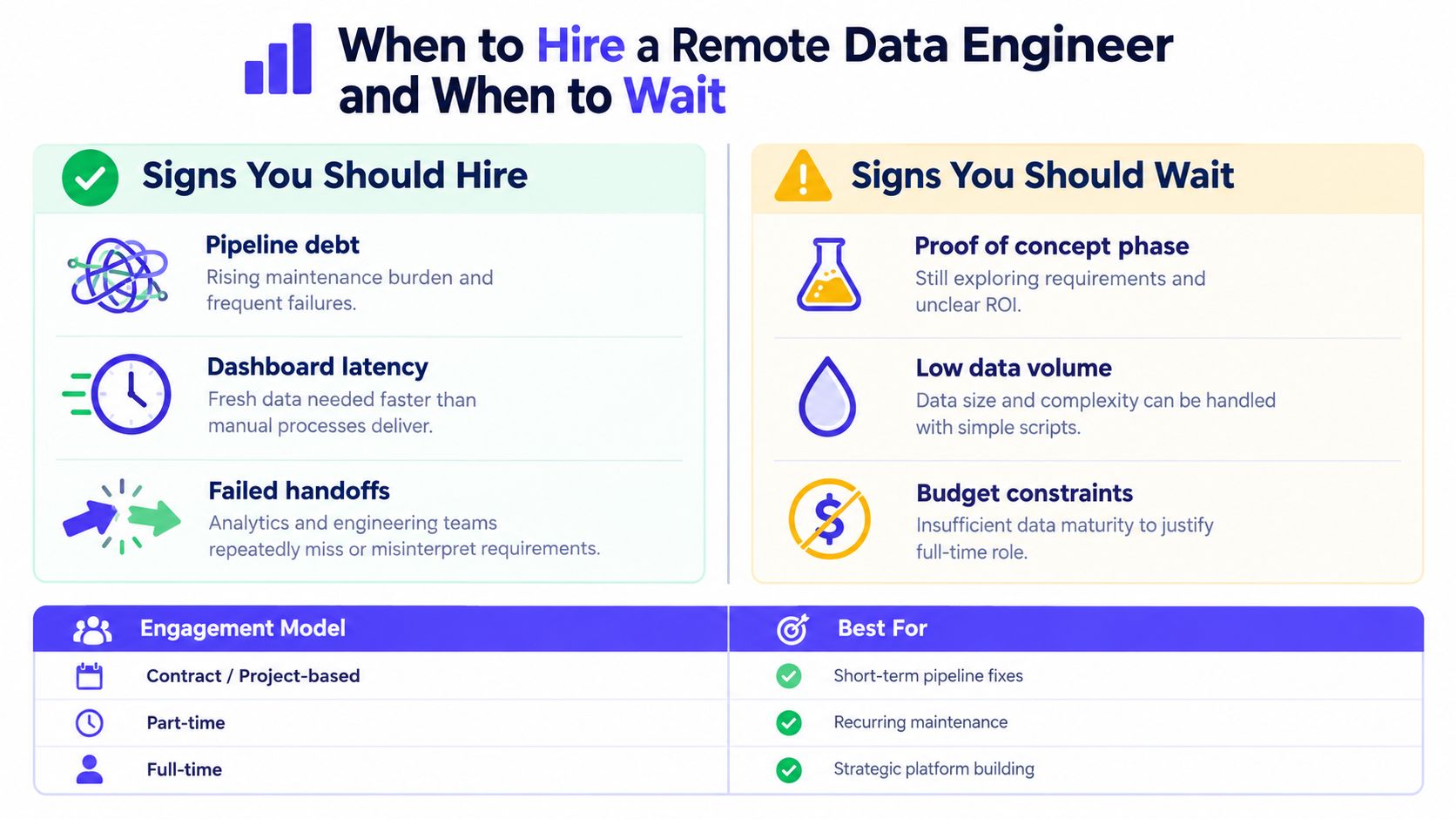
The right trigger isn't data volume alone. A modest dataset can still justify an engineer if unreliable data is blocking revenue reporting, product decisions, or an AI launch. Conversely, a large dataset may not need a full-time specialist if the requirements remain exploratory and the current team can operate safely.
Use these signals
Hire sooner when pipeline maintenance consumes engineering attention, dashboards arrive too late to support decisions, analytics and product teams repeatedly misunderstand handoffs, or an upcoming AI feature needs governed and reproducible data.
Wait when the product is still a proof of concept, requirements change weekly, simple scripts are sufficient, or nobody can name the data product the hire will own. Waiting isn't passive if you use the time to define sources, consumers, quality expectations, and access boundaries.
| Hiring Signal | Best Engagement Model | Risk If You Wait |
|---|---|---|
| Repeated pipeline failures | Contract or project-based | More manual recovery and weaker trust |
| Ongoing data maintenance | Part-time or fractional | Ownership remains unclear |
| Platform or AI data strategy | Full-time | Architectural decisions become harder to reverse |
| Unclear product requirements | Wait or upskill | You may optimize the wrong system |
| Immediate migration or repair | Contract, then reassess | Existing technical debt continues to slow delivery |
Choose the engagement model
A contractor fits a bounded migration, warehouse redesign, or pipeline stabilization effort. Define the handoff before work begins, including documentation, tests, ownership, and operating procedures.
A part-time engineer fits recurring maintenance or architecture support when the workload is real but uneven. This model needs a named internal owner, otherwise important decisions can remain stranded between engagements.
A full-time remote data engineer fits strategic platform building. Choose this path when the role must understand product context, influence upstream teams, and make a sequence of connected decisions over time.
Remote-only hiring has become a narrower market than many job descriptions imply. Independent job data cited in 2026 puts remote-only data engineer postings at about 2%, with another analysis describing a decline from roughly 10% to less than 2%, while broader posting data places fully remote roles at 4% of new roles in Q1 2026. These figures are summarized in this analysis of remote data engineer jobs. Candidates and employers should discuss time-zone overlap, travel expectations, and hybrid alternatives before treating “remote” as a simple location label.
Salary Benchmarks and Market Reality for Remote Roles
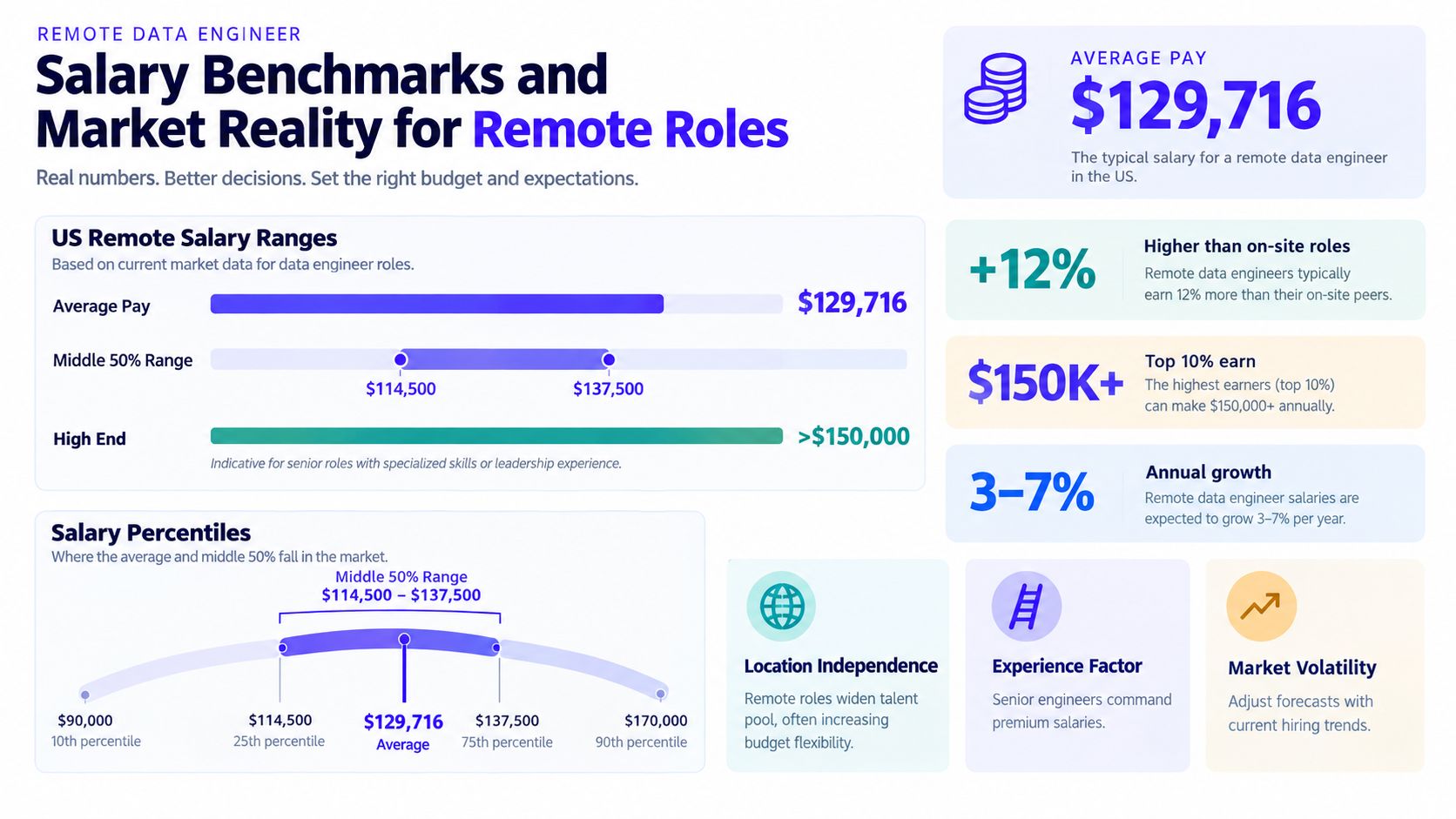
Budgeting gets easier when you separate a market reference from an offer formula. A salary snapshot for United States remote data engineers listed average annual pay at $129,716 as of May 28, 2026, with the middle 50% ranging from $114,500 to $137,500 and the 90th percentile reaching $162,000. The figures are reported in the remote data engineer salary snapshot.
Startup context adds another useful comparison. A separate 2026 market survey reported an average remote data engineer salary of $124,306 in startups, compared with $92,208 for the average remote startup salary, a difference of 34.8%. These values help establish a budget conversation, but they don't determine an individual offer.
What the numbers mean for employers
Remote flexibility can expand the candidate pool, but it doesn't automatically reduce compensation. Specialists who can design streaming systems, govern sensitive data, optimize cloud spend, or support AI pipelines may command materially higher total compensation. Independent coverage describes some senior specialist packages reaching $200,000 to $300,000 or more, so define whether your role needs general pipeline execution or cross-functional platform ownership before setting a range. The distinction is discussed in this remote data engineering market coverage.
Compensation also interacts with location policy. If you restrict hiring to a narrow time-zone band, you may reduce the practical benefit of a global search. If you allow broad location flexibility, document expected collaboration windows and how you handle local employment, compliance, and compensation practices.
A lower-cost offer can become expensive if the engineer inherits unclear ownership, unstable data contracts, and an unrealistic on-call burden.
For candidates, the trade-off works in both directions. A remote role may offer location independence and access to distributed teams, but it can also require stronger written communication, more deliberate documentation, and independent incident response. Evaluate the operating model, not just the salary figure.
Interview Kit Job Description and Practical Examples
A strong hiring process tests the work the engineer will perform. It shouldn't reward memorized tool names while missing failure handling, data contracts, or cost judgment.
A useful job description starts with an outcome:
Build and operate reliable Python and SQL data pipelines across AWS data services, including Redshift and RDS. Own ingestion, transformation, orchestration, quality checks, documentation, and incident response for analytics and machine learning consumers.
For a reusable structure, adapt this data engineering job description to your architecture and level.
Example one with a 90-day rollout
A SaaS company moving from batch reporting toward event-driven product analytics could set the following sequence:
- First phase: Map source events, consumers, ownership, and current failure points.
- Second phase: Establish an ingestion path, replay strategy, schema checks, and observability.
- Third phase: Move one decision-critical workflow to the new path, compare outputs, document operations, and define the next migration.
The candidate should explain what they wouldn't migrate first. Good judgment includes protecting the team from a broad rewrite when a narrower path can validate the architecture.
Example two with a take-home brief
Ask the candidate to build a representative ETL pipeline that:
- Reads source records from a simple input.
- Produces a modeled output for analytics.
- Includes checks for freshness, nulls, uniqueness, and schema changes.
- Uses Airflow or a comparable orchestration approach.
- Handles retries and explains idempotency.
- Includes a short README describing trade-offs and failure recovery.
Keep the data and requirements small enough that evaluation focuses on reasoning. Don't grade polish as a substitute for production judgment.
Scorecard and interview prompts
| Competency | Strong evidence | Warning sign |
|---|---|---|
| Python and SQL | Clear, tested transformations and efficient queries | Tool familiarity without reasoning |
| Pipeline design | Explicit dependencies, retries, replay, and ownership | Treats successful execution as reliability |
| Data quality | Defines checks tied to consumer needs | Adds generic tests without action paths |
| Streaming judgment | Connects latency, throughput, and delivery guarantees to the workload | Picks a framework by popularity |
| Remote execution | Documents decisions and communicates incidents clearly | Depends on meetings for basic progress |
Ask questions such as:
- How would you make an incremental load safe to rerun?
- What changes when a source schema evolves without notice?
- How would you divide a latency budget across capture, transport, transformation, and serving?
- When would you choose batch instead of streaming?
- How would you investigate a dashboard that suddenly shows fewer records?
- What would you document before handing a pipeline to another time zone?
- How do you control warehouse or streaming costs?
- What makes a data quality alert actionable?
- How would you design a replay path after an outage?
- Which assumptions would you validate before selecting a platform?
A benchmarked comparison found Storm had the lowest measured latency at 180 milliseconds, while Flink delivered the highest throughput and reliability among the evaluated stream processing systems. The stream processing benchmark supports a useful interview principle. Ask candidates to match the platform to the service-level agreement, not to crown one framework as universally superior.
For additional structured preparation, AI-powered interview guides for engineers can help interviewers organize prompts and evaluation areas.
Managing and Onboarding Remote Data Engineers for Impact
Hiring creates potential. The first operating cycle turns that potential into dependable output.
Give the engineer a clear owner, a named product problem, repository access, sample data, environment documentation, and a list of known constraints before the first working session. Security review should cover least-privilege access, secrets handling, production boundaries, and the difference between development and live data.
A practical 30-60-90 day plan
First 30 days: Map the data supply chain, meet consumers, inspect failure history, document assumptions, and establish baseline checks. The engineer should produce an annotated system map and a prioritized risk list.
By 60 days: Stabilize one important workflow. Add tests, monitoring, runbooks, ownership labels, and a recovery path. Review whether the original architecture still fits the actual workload.
By 90 days: Demonstrate a measurable operating improvement through reliability, freshness, cost visibility, or delivery confidence. Set the next platform priorities with product and engineering leadership.
For real-time systems, manage a latency budget at each hop, source capture, transport, transformation, and serving. A pipeline can look “real-time” at ingestion while still delivering stale data because transformation or serving consumes the available budget.
Use a weekly written update with four prompts:
- Delivered: What changed and which consumer benefits?
- Observed: What do freshness, failures, quality, and latency show?
- Blocked: Which decision or dependency needs leadership?
- Next: What will be completed before the next review?
A clear managing remote teams playbook can complement these rituals, especially when the team spans several time zones. For broader hiring context, review this guide to hiring remote developers.
Download or copy this onboarding checklist into your project workspace:
- Ownership: Name the business owner, technical owner, and incident contact.
- Access: Provision only the data and environments required for the first milestone.
- Architecture: Record sources, transformations, consumers, dependencies, and recovery paths.
- Quality: Define freshness, completeness, schema, and reconciliation checks.
- Communication: Set overlap hours, asynchronous update rules, and escalation paths.
- Review: Inspect progress at 30, 60, and 90 days against the original outcome.
ThirstySprout matches companies with remote data engineers for full-time, contract, and fractional engagements, including senior Python specialists who build production pipelines and cloud-native data systems. Visit ThirstySprout to discuss your data platform needs, define a focused pilot, and start with the right specialist in 2–4 weeks.
Hire from the Top 1% Talent Network
Ready to accelerate your hiring or scale your company with our top-tier technical talent? Let's chat.